
The Undivided Office and the Untended Garden
The LCMS Synod President cannot serve two masters. After sixteen years of Matthew Harrison, who ran against executive primacy to win in 2010, the record shows which one wins.

Rev. Dr. Matthew C. Harrison’s convention report for the 2026 LCMS National Convention in Phoenix reflects his unique political skills and rhetorical gifts.1 It is his typical blend of sophisticated theological engagement and recitation of concrete metrics that institutional stewards can sometimes be reluctant to volunteer. Harrison has, over sixteen years, managed an LCMS that is financially stronger, confessionally better-oriented at the seminary level, and more internationally engaged than the one he inherited in 2010. That record deserves acknowledgment, but the Synod President cannot escape closer scrutiny.
The LCMS Synod President’s office, as currently constituted, requires a single man to function simultaneously as the church body’s chief theological officer and its chief executive officer. Those two roles are inevitably in persistent, but largely unacknowledged, competition for his attention. The tension is asymmetric, as his report shows: administrative crises are immediate, bounded, and responsive to personal intervention. Doctrinal crises are diffuse, slow-moving, and resistant to the kind of decisive action that produces a satisfying resolution in a triennium report.
Consequently, over a long enough tenure, the administrative role crowds out the theological one. That is not due to any failure of conviction, but to the reality of perpetual Synodical triage when the corporation is a sunsetting global empire. The garden goes untended because the building is always on fire.
Harrison’s own convention report supplies the evidence for this thesis, perhaps with a thoroughness he almost certainly did not intend.
Constitutional Requirements
Before examining the record, it is necessary to establish the standard against which it is to be judged, because Harrison’s convention report implicitly assumes a standard that the LCMS Constitution does not share. The report presents a president who is busy, engaged, and consequential across a broad range of institutional domains. The Constitution requires a president whose primary function is something considerably more specific and limited.
Article XI.B.1 of the LCMS Constitution assigns the President supervision over “the doctrine and the administration” of Synod officers, Synod employees, the individual districts, and all district presidents.2 Article XI.B.2 establishes the duty that flows from that supervision: “It is the President’s duty to see to it that all the aforementioned act in accordance with the Synod’s Constitution, to admonish all who in any way depart from it, and, if such admonition is not heeded, to report such cases to the Synod.” Article XI.B.3 is the most sweeping formulation: “The President has and always shall have the power to advise, admonish, and reprove. He shall conscientiously use all means at his command to promote and maintain unity of doctrine and practice in all the districts of the Synod.”
These provisions do not describe an executive manager with a hobbyist theological portfolio. They describe a theological officer with an institutional remit, and the ordering is very deliberate. The LCMS First Constitution, the founding document produced under C.F.W. Walther, stated the synodical purpose as follows: “To stand guard over the purity and unity of doctrine within the synodical circle, and to oppose false doctrine.”3 Walther himself was characteristically unambiguous about the priority:
“Whether our Synod gains friends or makes enemies, wins honor or invites disgrace, grows or declines in numbers, brings peace or incites enmity, all this must be unimportant to us — just so our Synod may keep the jewel of purity of doctrine and knowledge.”
The office the Constitution created was built to serve that purpose, and no subsequent accumulation of institutional complexity has altered the black-and-white intent of the text.
Against that measure, the content breakdown of Harrison’s 2026 convention report is revealing. Analyzing the report’s substantive content yields about 35–38 percent theological and doctrinal material, versus 62–65 percent administrative and operational narration. The theological portion, moreover, is not uniformly substantive: several sections that open with doctrinal framing, the ecclesiastical supervision passage chief among them, quickly resolve into procedural self-defense rather than doctrinal reckoning. Strip those out, and the genuine theological proportion declines further.
The senior Synod Officer, who is constitutionally required to use “all means at his command to promote and maintain unity of doctrine and practice,” devoted roughly a third of his triennium report to that mandate, and a great deal of the remaining two-thirds to managerial problems.
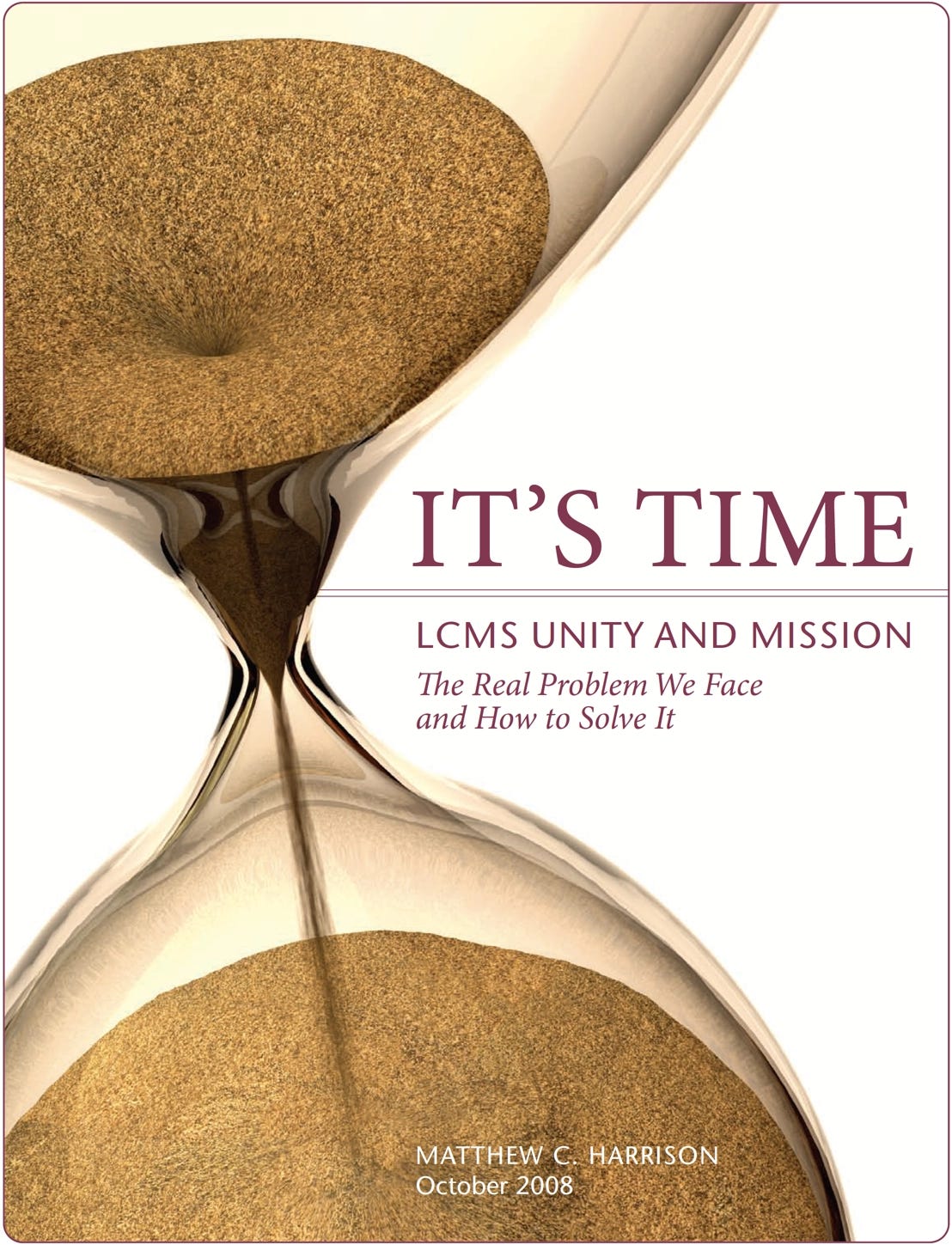
That inverse ratio is not an accidental stylistic choice. It is a governance signal that the President’s office, as currently structured, does not reliably prioritize what the Constitution does. The convention report is the official record of where presidential attention actually went, and it shows which master won. Readers who wish to understand how clearly the current Synod President once understood this dynamic are encouraged to consult his own pre-candidacy document, It’s Time: LCMS Unity and Mission (2008), in which he wrote that dollars, bylaws, structure, and administrative concerns “all inevitably, like centrifugal force, drive the heart of the church (Christ and the Gospel — theology!) to the periphery, despite all our best intentions. I know whereof I speak. I’ve seen it. I’ve lived it. I’ve suffered it. I’ve been guilty of it.”† What follows is the record of what happened next, despite his foresight.
The Man Who Saw It Coming
The structural critique advanced in this article is not original. Its most perceptive author is Matthew Harrison himself, writing in October 2008, two years before his first election as Synod President. In a document titled It’s Time: LCMS Unity and Mission, submitted to the Southern Illinois District’s Board of Spiritual Care and Supervision during the Blue Ribbon Task Force period, Harrison diagnosed the LCMS’s institutional pathology with a precision that makes his 2026 convention report extraordinarily difficult to read without irony.4On the centrifugal force of administration: “Dollars, bylaws, structure, legal matters, day to day nuts and bolts concerns about keeping the lights on, controversies, and political divisions, the constant need to raise funds — all inevitably, like centrifugal force, drive the heart of the church (Christ and the Gospel — theology!) to the periphery, despite all our best intentions. I know whereof I speak. I’ve seen it. I’ve lived it. I’ve suffered it. I’ve been guilty of it.” He then proposed the remedy: “The structure of Synod should defuse [sic] power away from the International Center to congregations and districts, with strong partnerships with the seminaries.” The man who wrote those sentences spent the next sixteen years personally convening ad hoc financial review panels for Concordia universities, negotiating inter-district real estate arrangements, launching a property and casualty insurance entity, and personally brokering university absorption deals. He did not diffuse power away from the International Center. He came to personify the International Center.
On the corporation problem: “The more the central offices become like a corporation, think like a corporation, act like a corporation, are governed like a corporation, dominated by constitution and bylaws instead of the pulsing heart of theology (Christ), the less funding will come to the national offices.” Harrison’s 2026 convention report is, in its dominant register, a conventional corporate annual letter. It presents $80 million in expenditures, 78 percent program efficiency, 44 RSO terminations processed, 28 new applications handled, and the launch of an insurance entity. It is precisely the document Harrison warned against in 2008, produced by precisely the institutional dynamic he named.
On honesty about real problems: “Let’s be honest. There are enduring divisions in the Synod… These divisions are publicly minimized or maximized depending upon one’s particular theo-political persuasion. They are artfully capitalized upon by various factions for political ends.” Compare the convention report’s treatment of the Our Savior Lutheran Church & School (Arlington, VA) case — a public doctrinal crisis in which Harrison had been formally appealed to in writing, had endorsed a district president’s closure of the investigation, and had seen the orthodox complainants illegally stripped of membership rights — which does not appear in the report at all, replaced by the anodyne assurance that “about 90 percent of the issues of ecclesiastical supervision that I discuss with district presidents are addressed calmly and corrected before they ever reach the public.” We have to be frank; this is not honesty about real problems. It is, in Peck’s terminology, which Harrison himself deployed in 2008, “pseudo-community”: the institutional presentation of a smoothly functioning supervisory architecture in place of a reckoning with its documented failure.
On speaking in generalities: Harrison explicitly identified “speaking in generalities” as the characteristic failure of Jacob Andreae’s first, unsuccessful attempt at Lutheran concord, and the very marker of pseudo-community. “One of the characteristics of pseudo-community is that people tend to speak in generalities.” The ecclesiastical supervision section of his 2026 convention report is, from first sentence to last, a study in generalities. Not one case is named. Not one offense is specified. Not one outcome is described. The section that should be the theological heart of a presidential convention report, the accounting of where doctrine was defended, where it was compromised, and what was done, is an exercise in the precise rhetorical mode Harrison identified in 2008 as the failure mode of institutional self-deception.
On the Formula of Concord model: Harrison argued in 2008 that real doctrinal unity requires stating controversies not only in positive terms but in negative terms, “the clear rejection of errors”, and that Andreae’s failure was his refusal to name errors and the men who taught them. Chemnitz succeeded, Harrison wrote approvingly, because he “never dictated” but “discussed until the disputed points were so clear that either his opponents could agree with him or they at least had to respect his judgment.” Sixteen years later, Harrison’s convention report declines to name the congregation whose pastor publicly endorsed transgender symbolism, declines to name the pastor, and declines to name the district president who closed the investigation without interviewing the complainants. The positive assertion that the supervisory system is working stands without the antithesis — without the acknowledgment of where it failed, and why, and at whose hands.
To rub salt in the wound, Harrison blames the internet for making his life harder than J.A.O. Preus’s:
“President Preus never had the internet to deal with. Instant communication. Instant judgment. Dealing with problems of doctrine and practice requires some deliberation and conversation. The online world does not grant that. And it demands all information and all justification now. Some matters are black and white. Many are nuanced. Some are thoroughly confused. But by the nature of the beast, dealing with individuals or a congregation is not something that is done in front of the public.”
— Harrison, Convention Report, R1 ↗
The OSLCS case was older than Parmigiano-Reggiano and more rancid than a block of Stilton before the internet ever noticed it. Nobody was asking for or expecting instant gratification, just some example of safekeeping the jewels of our theology. The United List and Steadfast Lutherans did not promote Harrison because they wanted a more well-oiled synodical machine, but because Harrison was supposed to arrest and reverse former President Kieschnick’s liberal theological drift.
Harrison wrote in 2008 that the LCMS’s cycle of pseudo-community and chaos was becoming “intolerably boring and unhealthy” and that “it’s never going to unite” through political means. He was right. What he did not anticipate, or perhaps did not wish to examine, was that the office he sought would subject him to precisely the centrifugal forces he described, and that sixteen years of institutional management would produce a convention report that embodies, with remarkable fidelity, every pathology he diagnosed in 2008. The man who saw it coming became, in the end, its most distinguished example.
The CUAA Benchmark
The convention report devotes approximately 450 words to the closure of the Concordia University Ann Arbor South Campus, and every one of them is worth reading carefully, because they establish what Rev. Dr. Matthew Harrison can do when he classifies a crisis as important enough for his personal attention.5
He personally requested the CUAA financials. He personally convened an ad hoc review panel, drawing chief financial officers from the other Concordia institutions to assess the situation independently. When the panel’s conclusion was “stark: a critical situation,” he personally contacted Concordia University, St. Paul, to explore whether absorption was possible. He personally urged the regents to retain as many programs as possible at the Ann Arbor campus. He personally requested a meeting between Michigan District leadership and CUWAA leadership, tracked the resulting negotiations, and noted when the tentative agreement fell apart. He told the delegates what he had done at each stage, what had succeeded and what had failed, and why the final decision rested constitutionally with the regents rather than with him.
The report’s CUAA account is candid about the limits of presidential authority, and that candor is itself revealing. Harrison understands the distinction between personal intervention and formal constitutional power. He intervened at every point where he could, documented the interventions, and explained their outcomes. He did not save the Ann Arbor campus, but not for want of attention, energy, or personal engagement across multiple stages of a fast-moving financial crisis.
The CUAA episode is not, moreover, the most compressed example of Harrison’s capacity for swift personal action. That distinction belongs to the January 2023 controversy over Luther’s Large Catechism with Annotations and Contemporary Applications, published by Concordia Publishing House. On January 22, 2023, the Gottesdienst blog published a critical review alleging that the volume’s contemporary application essays exhibit wokeism and political leftism. The next day, within approximately twenty-four hours of the online criticism appearing, Harrison ordered CPH to cease distribution of the book, unilaterally and via a public Facebook post, notwithstanding that the volume had completed the Synod’s formal doctrinal review process and that Harrison himself had contributed the foreword.6 He then reversed the halt eleven days later, on February 2, having concluded upon reflection that the controverted sentences contained nothing at odds with biblical and confessional Lutheranism. The CTCR subsequently issued a unanimous statement on February 17 affirming the volume’s doctrinal soundness, vindicating the original review.7 Whatever one concludes about the merits of the initial decision, the speed of Harrison’s personal intervention in response to right-flank blog criticism is not in dispute: twenty-four hours from online objection to executive action halting a Synod publication.
The record of presidential alacrity, then, runs as follows: one day to halt a book in response to blog criticism; vigorous multi-stage personal intervention to save a university campus; and six months of deferred inaction on a formal written appeal documenting a pastor’s public endorsement of transgender symbolism in the chancel and homosexual affinity in his congregation and church school, the exclusion of the catechism from school instruction, and the banning of orthodox members from worship. The comparison is not just unflattering but also serves as an index of which crisis category reliably commands the president’s attention, involvement, and energy.
That benchmark establishes what the Synod President is capable of when he judges a matter urgent. It makes what unfolded at Our Savior Lutheran Church and School in Arlington, Virginia, very difficult to explain.
The OSLCS Standard
The Ad Crucem News investigation of Our Savior Lutheran Church and School, published in three installments between November 11 and December 1, 2025, documents the following sequence of events with primary source correspondence.8
On May 4, 2025, four members of the congregation submitted a formal request for an investigation to Southeastern District President Rev. Harmon. The request documented three substantive areas of concern: doctrinal compromise including the pastor’s public support for homosexual and transvestite imagery and symbolism; the exclusion of Luther’s Small Catechism from school instruction, with the pastor’s own stated rationale being that it might be “a stumbling block to non-Lutherans”;9 and systematic retaliation against the members who had raised objections through proper Matthew 18 channels, including bans from worship, exclusion from the Lord’s Supper, and the accusation that a Board of Education member who raised the presence of Islamic library materials was a “white nationalist.”10
DP Harmon received that request, held conversations with the pastor and the principal, and, by June 2025, declared the matter closed, affirming that the pastor had “remained faithful to his ordination and installation vows.” The members who filed the complaint were neither interviewed nor provided with the investigative findings.11
On June 20, 2025, two members appealed directly to the Regional Vice-President and the Synod President, attaching detailed evidence and arguing that the district’s review had lacked due process and transparency. They asked Harrison to “take the reins of investigation” and confront what they described as “a blind spot in the system.” The regional VP subsequently informed the complainants that the President was satisfied the DP had handled the issue correctly and considered the matter settled.12
In this sequence, Harrison was not merely copied on correspondence in passing. He received a formal appeal, with evidence attached, from members of an LCMS congregation alleging that their pastor had publicly endorsed transgender symbolism in the chancel, that their school was operating outside Synod resolution on catechetical instruction, that Islamic materials affirming Allah and Muhammad were shelved in the school library, and that orthodox members had been banned from worship for raising these concerns. He reviewed the appeal. He endorsed the district president’s closure of the investigation. He considered the matter settled.
What followed is now well documented. On October 19, 2025, the OSLCS Voters’ Assembly stripped the three original complainants of their voting rights in a proceeding that created a membership class the congregation’s own constitution does not authorize, denied the affected parties any notice or opportunity to defend themselves, and was decided by voice vote.13 The faithful members whose formal appeal Harrison had closed in June were, by October, formally stripped of the membership rights they had exercised in filing it. By contrast, Harmon was awarded a prominent role at the recent Concordia Theological Seminary Call Day.14 The laity sees this double standard and resents it intensely.
Ad Crucem News published its initial investigative report on November 11, 2025.15 On that same day, Harrison issued a public letter stating “the matter was being handled.” The letter named no congregation, no pastor, no offense, and no timeline.
A form of resolution arrived on December 1, 2025, when Rev. Wayne Fredericksen resigned from the LCMS roster under threat of investigation.16 The proximate cause was not the transgender stole Fredericksen’s own resignation letter acknowledged as a “five-year-old” issue, not the suppressed catechesis, and not the Islamic library materials. As Ad Crucem News reported: “No mention was made of his accountability for first graders attending a queer musical and Islamic supremacist books in the school library.” DP Harmon, who had spent the summer actively blocking a meaningful investigation, received no public discipline. The congregation declared itself in full compliance with LCMS teaching and bylaws within days of the resignation it had not sought and the process it had actively obstructed.
The OSLCS case was not simply a congregational scandal that the supervisory machinery eventually resolved. It was, as Ad Crucem News argued in a series of three analytical pieces in the weeks following Fredericksen’s resignation, a diagnostic event that exposed, with unusual documentary precision, every structural weakness in the LCMS’s governance architecture simultaneously.17 A truncated investigation conducted without complainant interviews, a district president whose assurances were accepted as dispositive, a regional VP who was structurally bound to defer to the same assurances when a formal appeal landed on his desk, a Synod President who endorsed the closure and considered the matter settled.
Each failure corresponded to a specific and nameable gap in the accountability architecture: the absence of mandatory interviewing procedures, the absence of written investigative findings, the absence of meaningful whistleblower protection, and the substitution of therapeutic “reconciliation” for adjudicative fact-finding.
“The central problem shown by the Arlington, VA, scandal is that the LCMS governance model is built around assumptions that are no longer viable. We assume that doctrinal fidelity will be maintained by ordination vows, Christian character, personal goodwill, and fraternal admonition. This high-trust assumption has ceased to exist and is entirely unrealistic and unwise to maintain.”
— Ad Crucem News, December 2, 2025 ↗
Our proposed remedy, drawn from modern secular governance models, was precisely the bifurcation this article argues for: a theological officer relieved of administrative entanglement, and dedicated administrative and governance officers accountable for the procedural architecture that doctrinal oversight requires to function.18 The OSLCS case did not merely illustrate a problem that had always existed, but rather supplied the most granular public record the LCMS has produced in decades of what happens when a “duty to prevent” architecture is absent.19
The contrast with CUAA is not incidental. It is the whole case, and it has been repeated in the same district with the governance crisis at Immanuel Lutheran Church in Easton, MD.
A Problem of Governance Geometry
Harrison is not, on all the evidence, a negligent or incompetent man. The CUAA record and improved Synod finances prove it. Nor is he without theological conviction and teaching gifts. The problem is geometric rather than moral: the office he holds has a center of gravity that pulls administrative matters to the front of the queue, and, by its nature, doctrinal supervision perpetually surrenders to administrative and managerial immediacy driven by legal pressures.
Consider the pressures on the Synod President. When a university campus faces financial implosion, the relevant parties are identifiable, the question is bounded, the failure mode is visible and permanent, and the timeline is compressed. Personal presidential intervention, therefore, has direct, legible, attributable effects. Without intervention, consequences will be reported in every Christian press outlet within the week.
When a congregation is dissolving, theologically and literally, the relevant parties are dispersed and resistant, the questions are diffuse, the failure mode is invisible to the casual observer, and the timeline becomes infinitely elastic. Doctrinal drift accumulates over the years before it becomes publicly undeniable. Personal intervention by the President is accordingly diffuse, productive of messy arguments about Matthew 18 and Bylaw 1.10, and attributable only with difficulty to any specific outcome. The absence of intervention, meanwhile, is costless in the short run, because the failure is invisible until it might reach public ears.
An administrative officer who rationally allocates his time will, under these conditions, attend to the university crisis and defer the doctrinal one. Harrison is not irrational for having done so. He is, however, primarily the chief theological officer of the Synod, and the rational administrative response is the constitutionally wrong one. The OSLCS complainants understood this clearly enough to write, in their June 2025 appeal, that there was “a blind spot in the system.” They were more accurate than they perhaps knew. The blind spot is structural, and it is not Harrison’s alone. Harrison diagnosed it himself in 2008, predicted it would continue unless the structural conditions that produced it were changed. But then he assumed the office and left that machinery in place. The geometry he described has continued to operate precisely as he warned it would.
Controlling the Narrative
Harrison is a gifted communicator and synodical politician. His convention report demonstrates a sophisticated command of what to include, what to abstract, and what to omit entirely. The CUAA narrative is candid, specific, and self-exculpatory in a smart way: it documents Harrison’s every intervention while attributing the ultimate failure to the regents’ constitutional prerogative, which is both accurate and conveniently exonerating.
By contrast, the ecclesiastical supervision section is abstract, procedural, and anodyne, offering the assurance that “about 90 percent of the issues of ecclesiastical supervision that I discuss with district presidents are addressed calmly and corrected before they ever reach the public”20 without naming a single case, offense, timeline, or outcome. In It’s Time, Harrison identified “speaking in generalities” as the defining characteristic of institutional pseudo-community — specifically the failure mode of Jacob Andreae’s first, unsuccessful attempt at Lutheran concord, the one that “beat around the bush and left most of the basic problems unresolved.”† The ecclesiastical supervision section of his 2026 convention report is the exact specimen of the genre he named in 2008.
Unfortunately, his claim does not survive the OSLCS record. The case reached the public precisely because six months of non-public process had produced a closed investigation, an endorsed DP non-finding, and the punitive disenfranchisement of the orthodox complainants, still without justice. The resolution that followed was forced by public reporting, not by supervision. And the correction, such as it was, addressed only the most personally indefensible element of a doctrinal pattern that the Synod President had reviewed in June and waved off as settled.
The RSO section of the convention report supplies a third exhibit in the same pattern, though one that operates through understatement rather than omission. Harrison notes, with apparent satisfaction, that “over the past three years, some 50 agencies have ceased to be LCMS RSOs,” many of them “organizations whose practice aligned with the ELCA’s position on sexuality.”21 What the report does not volunteer is the timeline against which that figure should be read. Harrison himself states in the same paragraph that when he “became head of LCMS World Relief and Human Care in 2001,” there was already a “tremendous push by LCMS and ELCA staff to get as many organizations recognized by the LCMS and affiliated with the ELCA as possible.” He has therefore known that deviant RSOs were a structural problem for a full quarter-century, and has held the means to address them as Synod President for sixteen of those twenty-five years. Fifty terminations in three years, after decades of accretion, is not a program of reform.
It is a rate of attrition that, as Ad Crucem News observed in its analysis of the RSO disciplinary framework, reflects an informal system “based on overlapping levels of trust and goodwill” with no formal radical expulsion process and a preference for handling withdrawals “administratively to avoid public attention and negative press.”22 The report’s characterization of the RSO situation as improving is not incorrect. But it does not disclose that organizations whose practice the report describes as aligned with ELCA sexuality positions, some of which, as Ad Crucem News has documented, have been aligned with the advocacy of the Church of Satan, remained credentialed LCMS RSOs while Harrison exercised the full authority of the Synod Presidency for sixteen years. “It takes time… but we’re getting there” is the convention report’s closing note on the subject. The delegates should examine what, precisely, it has taken sixteen years to begin getting to.
The same selective lens applies to Harrison’s account of international church relations, which the convention report presents as a sustained success narrative. The LCMS is described as the most heavily resourced Book of Concord church in the world; the ILC is portrayed as a body of faithful partner churches seeking LCMS theological guidance and responding to the corrupting influence of the LWF; new fellowships with the Lutheran Church of Bolivia and Lutheran Mission Australia are celebrated as doctrinal fruit. What the report does not mention is the Independent Evangelical Lutheran Church of Germany (SELK), an ILC member body in altar-and-pulpit fellowship with the LCMS, whose 15th General Pastoral Convention in Hofgeismar in June 2025 declined to confessionally foreclose women’s ordination.23
The convention voted against a structural mechanism for parallel women’s ordination by 53 to 28, but qualified both its principal resolutions with the word “currently,” making the rejection explicitly time-bound and contingent on present delegate composition rather than rooted in Scripture and the Confessions! More telling still, 47 percent of SELK delegates voted that women’s ordination is “theologically possible,” and seven-eighths voted to promote women to roles that 1 Timothy 2:12 expressly forbids. A church body where nearly half the pastors have no theological objection to female ordination is not a church body that can be described, without qualification, as seeking LCMS theological guidance and holding fast to the Book of Concord. Harrison’s convention report describes the LCMS’s global theological leadership in uniformly triumphalist terms. SELK does not appear in it.
The convention report’s omission of Rev. Michael Mohr is in the same category, though its gravity is incomparably greater. Mohr, the former Central Illinois District president, was arrested on January 28, 2026, on federal charges of producing child sexual abuse material involving multiple juvenile victims,24 and was subsequently indicted by a federal grand jury.25 Harrison personally visited Mohr in prison on February 9, issued a pastoral letter through the LCMS Reporter, and eventually suspended Mohr from the roster, pending his immediate resignation.26 The removal was swift once it came.
Harrison’s letter did not announce formal suspension, removal from office, or initiation of disciplinary proceedings under Synod bylaws. There was only an oblique reference to discipline: “Our church body has an ecclesiastical process for conduct unbecoming a minister of the Gospel. These processes will be followed.”
— Ad Crucem News, January 30, 2026 ↗
The letter did not disclose whether Mohr remained in good standing on the Synod roster, whether formal proceedings under Bylaw 2.17 had commenced, whether suspended status under Bylaw 2.13.4 had been imposed, or what procedural timeline was in effect.27 Under Bylaw 2.15, district presidents are authorized to take immediate disciplinary action in cases of immoral or scandalous conduct; whether that authority had been invoked was not disclosed. None of this appears in the convention report, including any accounting of what the Mohr case reveals about the oversight architecture and how it needs to be modernized.
Harrison does not shade the facts through invention, and his convention report is far from dishonest in any conventional sense. The shading operates through political selection: what is narrated with granular specificity, what is narrated abstractly, and what is not narrated at all. The pattern is consistent — administrative competence is documented and attributed, but doctrinal failure is managed through abstraction, procedural references, and the quiet confidence that most delegates will be blind to the gaps.
The Reform the Office Requires
The necessary structural reform is plain and simple: the LCMS Synod President’s role should be formally split into a Chief Theological Officer and a Chief Executive Officer, because the consolidation of those two roles in a single person, in a lavish transnational corporation that C.F.W. Walther would surely be shocked by, has consistently produced an officer drawn toward the executive function at the expense of the theological one, and because the theological function is constitutionally the primary one. Harrison himself warned in 2008 that “the more the central offices become like a corporation, think like a corporation, act like a corporation, are governed like a corporation, dominated by constitution and bylaws instead of the pulsing heart of theology (Christ), the less funding will come to the national offices” and proposed that “the structure of Synod should defuse [sic] power away from the International Center to congregations and districts.”† He did not diffuse it. The reform this article proposes, and which Ad Crucem News has been advocating for months, would create meaningful obstacles to executive overweighting.
The Chief Theological Officer, the constitutional heir to the Synod Presidency as the framers conceived it, would hold doctrinal accountability over the districts and their presidents, the seminaries, the congregations, the RSOs, and the Synod offices. That officer’s primary output would be theological: formal doctrinal investigations and findings, COP engagement, church relations, international fellowship, and the confessional leadership that requires sustained attention. That officer would not be personally negotiating with university regents or convening ad hoc financial review panels. The constitution would not require it, and the job description would not permit it. His urgency would be directed to preventing the devouring of the sheep by tyrannical shepherds and incompetent leaders marinating in dysfunctional structures that reward seniority over merit.
The Chief Executive Officer would hold administrative accountability: the Board of Directors relationship, the budget, the Concordia institutions, the mission boards, the conventions, and all of the operational complexity that currently competes with doctrinal supervision for the Synod President’s calendar. That role would derive its authority from the BOD rather than from the theological office’s constitutional prerogatives.
The objection that the LCMS’s congregationalist polity makes such a bifurcation theologically problematic is answerable. The Synod President’s theological authority already operates through persuasion, visitation, and the COP rather than through direct juridical power over congregations. Harrison himself has acknowledged, in the convention report’s overture supporting expanded authority for the mission boards, that a reduction in the Synod President’s administrative scope “is a good move.”28 However, he does not appear to have connected that acknowledgment to its logical conclusion.
The objection that Harrison is a gifted man who has managed both functions capably is both true and precisely the point. The LCMS should not design its governance around the assumption of extraordinary individuals. It should design governance that produces adequate theological oversight even when the Synod President is ordinary or lacks capacity in both roles. The current structure does not reliably produce that outcome. The sixteen-year Harrison tenure is the best-case version of the consolidated office, and even the best-case version produced a convention report in which the arrest of a district president on federal child exploitation charges does not appear, in which the most fully documented case of congregational doctrinal dissolution in the triennium is treated as evidence that the system works, and in which the president’s most vigorous and specific documented interventions are uniformly administrative.
The garden was left untended because the building was always on fire. The convention can hire a better gardener and expect a different result, or it can recognize that the building and the garden require different offices and officers, and build accordingly.
What will the United List do? It’s time.

Harrison, Matthew C. “President’s Report to the 2026 LCMS National Convention.” LCMS 2026 Convention Workbook, R1, p. 1. lcms2026.adcrucem.news/reports/2026/1
LCMS Constitution, Article XI.B.1–3. LCMS Handbook (2019 ed.), pp. 111–112. files.lcms.org (2019 Handbook PDF). For a detailed analytical treatment, see “Ecclesiastical Supervision According to the 2019 LCMS Handbook.” saunders--ecclesiastical_supervision_per_handbook.pdf
LCMS First Constitution (1847), quoted in ACELC, “Teaching Outline on Pure Doctrine.” The Walther quotation on the “jewel of purity of doctrine” follows in the same document. s3.amazonaws.com/…/outline_-_pure_doctrine.pdf
Harrison, Matthew C. It’s Time: LCMS Unity and Mission — The Real Problem We Face and How to Solve It. October 2008. Submitted to the Board of Spiritual Care and Supervision of the Southern Illinois District during the Blue Ribbon Task Force on Synod Structure and Governance period. Distributed freely; the document states “This document may be reproduced and distributed freely.” Held at the Concordia Historical Institute, St. Louis. All quotations from Harrison’s 2008 document in this article — including those marked with † — are drawn from this source.
All CUAA narrative details, including the direct quotation “stark: a critical situation,” are drawn from Harrison, R1 (see note 1). lcms2026.adcrucem.news/reports/2026/1
Gottesdienst. “The Large CRTechism.” January 22, 2023. Harrison’s Facebook announcement halting CPH distribution was made on January 23, 2023. gottesdienst.org/gottesblog/2023/1/22/the-large-crtachism. For Harrison’s halt announcement and subsequent reversal, see LCMS Reporter, “Update from President Harrison on Large Catechism,” February 23, 2023: reporter.lcms.org/2023/update-from-president-harrison-on-large-catechism. For broader context, see Christianity Today, “A Mighty Controversy Is This Lutheran Catechism,” February 7, 2023: christianitytoday.com/2023/02/lutheran-catechism…
LCMS Commission on Theology and Church Relations. “CTCR Statement on Luther’s Large Catechism with Annotations and Contemporary Applications.” February 17, 2023. “The CTCR forthrightly asserts that this volume does not change, question or supplant any doctrinal position of the LCMS, including any Synod teaching on contemporary cultural issues such as race or sexuality. The CTCR furthermore categorically rejects any assertions to the contrary.” resources.lcms.org/reading-study/ctcr-statement-on-luthers-large-catechism…
Ad Crucem News. “Doctrine, Governance, and Due Process Dispute at LCMS Congregation.” November 11, 2025. adcrucem.news/p/doctrine-governance-and-process-dispute
The pastor’s rationale — that the Small Catechism might be “a stumbling block to non-Lutherans” — is documented in Exhibit 3.a.ii of the complainants’ May 4, 2025, formal investigation request, as reported in note 7 above. adcrucem.news/p/doctrine-governance-and-process-dispute
The “white nationalist” characterization is drawn from Exhibit 3.a.i of the complainants’ investigation request, as reported in note 7 above. adcrucem.news/p/doctrine-governance-and-process-disput
DP Harmon’s June closure, the “remained faithful to his ordination and installation vows” quotation, and the complainants’ exclusion from the process are all documented in note 7 above. adcrucem.news/p/doctrine-governance-and-process-dispute
The June 20 appeal, the “take the reins of investigation” and “blind spot in the system” language, and the regional VP’s communication are all documented in note 7 above. adcrucem.news/p/doctrine-governance-and-process-dispute
Ad Crucem News. “LCMS Southeastern District Chaos Intensifies.” December 1, 2025. adcrucem.news/p/lcms-southeastern-district-chaos
Concordia Theological Seminary. 2026 Candidate Placement Service. April 29, 2026. https://portal.ctsfw.edu/s/candidate-placement-service
Ad Crucem News. “205 Days To Reconcile an LCMS Pastor Modeling a Transgender Stole in the Chancel?” November 25, 2025. adcrucem.news/p/205-days-to-reconcile-an-lcms-pastor
Fredericksen’s resignation, the “five-year-old” self-reference in his resignation letter, and the “no mention” finding regarding the queer musical and library materials are all from note 12 above. adcrucem.news/p/lcms-southeastern-district-chaos
Ad Crucem News. “Takeaways from the LCMS Southeastern District Scandal.” November 26, 2025. The piece identified eleven discrete systemic failures exposed by the OSLCS case, including the collapse of the Council of Presidents as a unifying theological authority, the effective independence of districts as “micro-Synods,” and the subordination of adjudication to therapeutic reconciliation. adcrucem.news/p/takeaways-from-the-lcms-southeastern
Ad Crucem News. “How Institutional Governance Has Evolved: What the LCMS Can Learn.” December 2, 2025. The direct quotation is from the article’s section on the central problem with LCMS governance assumptions. The piece proposed a “Failure to Prevent Doctrinal Dissolution” framework modelled on UK corporate governance law, with dedicated offices of Synod Chief Executive Officer and Synod Chief Governance Officer specifically to relieve the theological office of administrative entanglement. adcrucem.news/p/how-institutional-governance-has
Ad Crucem News. “Killing a Synod With Kindness.” February 16, 2026. The article, published the day after the Mohr arrest, identified the LCMS’s chronic failure to enforce discipline against sexual deviancy as a pattern continuous with the OSLCS case, arguing that the Synod “does not lack teaching on human sexuality, but it does get jelly legs about enforcing what the Bible states is required to be believed, taught, and confessed.” It called for the end of the “era of gentle words, lenient handling, and lengthy deliberation.” adcrucem.news/p/killing-a-synod-with-kindness
Harrison, R1. Direct quotation from the Ecclesiastical Supervision section of the presidential report (see note 1). lcms2026.adcrucem.news/reports/2026/1
Harrison, R1. RSO statistics and quotations from the Recognized Service Organizations section of the presidential report (see note 1). lcms2026.adcrucem.news/reports/2026/1
Ad Crucem News. “Simple Reasons for the LCMS to Immediately and Permanently Terminate an RSO.” July 3, 2025. Documents Lutheran Family Services Rocky Mountains’ participation in the June 2025 Greeley Pride festival and consecutive material-weakness audit findings by RubinBrown LLP for fiscal years 2023 and 2024, including disbursement of federal funds to “ineligible” vendors. As of publication, LFS RM remained an LCMS RSO in good standing. adcrucem.news/p/simple-reasons-for-the-lcms-to-immediately
Ad Crucem News. “Time for the LCMS to Cut Germany’s SELK Loose.” August 16, 2025. The 15th General Pastoral Convention of SELK (June 23–27, 2025, Hofgeismar) voted 53–28 against a parallel women’s ordination structure, but qualified both principal resolutions with the word “currently,” explicitly tying the rejection to present delegate composition. 47 percent of delegates voted women’s ordination “theologically possible.” Separately, 67 of 83 delegates (seven-eighths) voted to expand women’s roles to include pastoral assistants, lectors, deacons, catechists, and lecturers — roles foreclosed by 1 Timothy 2:12. ILC reporting on the convention: ilcouncil.org/2025/08/14/selk-pastoral-convention-offers-clarity-on-ordination/. Full analysis: adcrucem.news/p/time-for-the-lcms-to-cut-germanys
Ad Crucem News. LCMS District President Arrested on Federal Charges
LCMS Reporter. “Mohr Indicted by Federal Grand Jury.” February 13, 2026. reporter.lcms.org/2026/mohr-indicted-federal-grand-jury/
LCMS Reporter. “Update on Mohr Roster Status.” February 10, 2026. reporter.lcms.org/2026/update-on-mohr-roster-status/
Ad Crucem News. “LCMS Announces Interim Measures in District President Child Porn Case, but Disciplinary Clarity is Absent.” January 30, 2026. adcrucem.news/p/lcms-announces-interim-measures-in
Harrison, R1. The “good move” quotation appears in the section on expanded authority for the mission boards (see note 1). lcms2026.adcrucem.news/reports/2026/1
Anchoring this in 2008 is illuminating.
This is great work. Thank you for your research and commentary.