
How Institutional Governance Has Evolved: What the LCMS Can Learn
Building systems that ringfence the faith we claim to hold: from trust-based oversight to evidence-based accountability

In the business world, governance is evolving from not just an expectation that you will uphold your fiduciary duties, but that you have taken active measures to detect and prevent others from failing in their duties and compliance. This is evident in commitments such as anti-slavery declarations, supply chain ethics compliance, bribery and corruption mandates, and so on.
Consequently, the UK’s recently enacted “Failure to Prevent Fraud” regime1 may offer a helpful governance model idea for the LCMS to pursue, repurposed as a “Failure to Prevent Doctrinal Dissolution”. The UK law recognizes something the LCMS governance system has not yet internalized: by the time you discover the fraud (doctrinal drift), heavy reputational and institutional damage has already been inflicted.
These “duty to prevent” systems operate on a simple but profound governance maxim explicit in the UK reforms:
Debasement is prevented through structure, not sentiment.
In a church body context, there would be a recognition that it is virtually impossible to:
repair catechesis after children are catechized in heterodoxy,
restore doctrinal identity after a church and school culture has shifted radically,
rebuild trust when due process is weaponized against people with doctrinal concerns,
reconstruct pastoral credibility when secrecy and impenitence are the norm.
The central problem shown by the Arlington, VA, scandal is that the LCMS governance model is built around assumptions that are no longer viable. We assume that doctrinal fidelity will be maintained by ordination vows, Christian character, personal goodwill, and fraternal admonition. This high-trust assumption has ceased to exist and is entirely unrealistic and unwise to maintain.
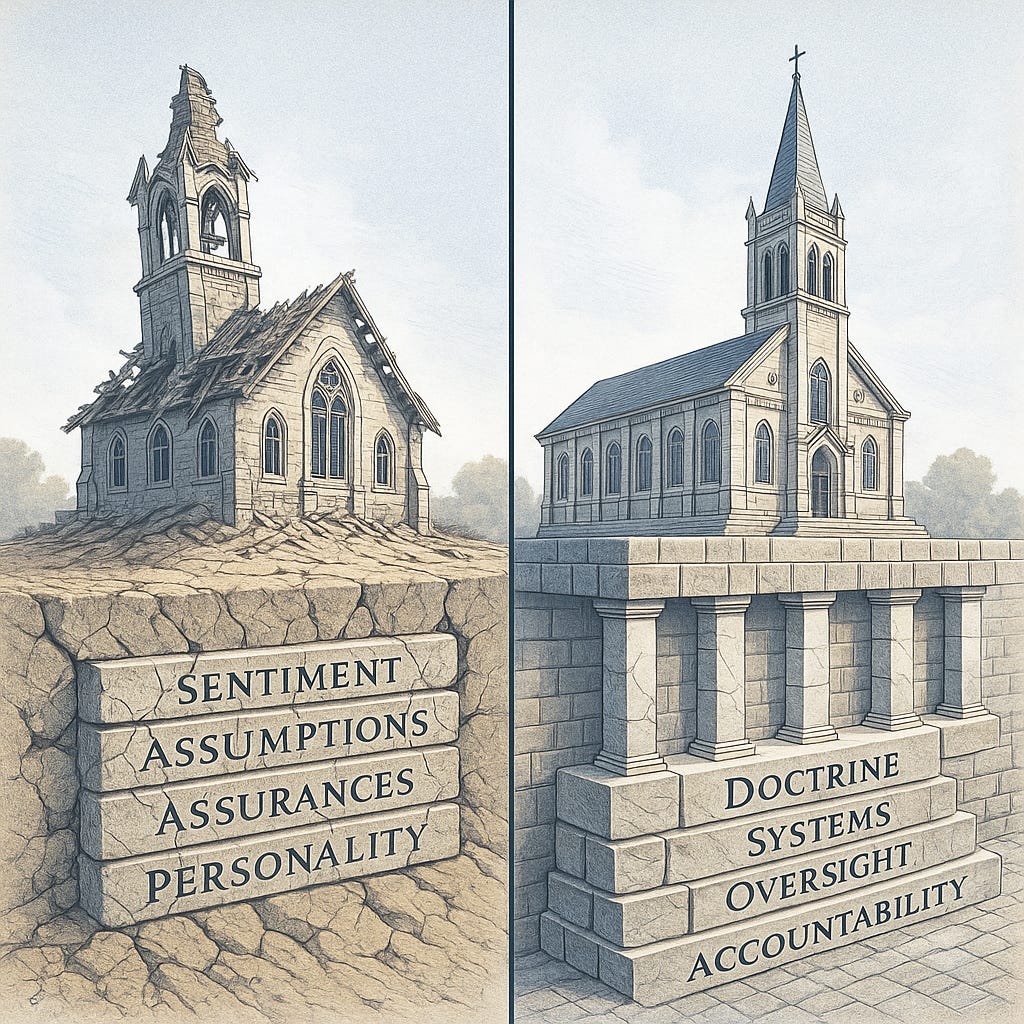
The UK legislative model is realistic about the nature of humans and institutions, requiring business systems and processes to be engineered to assume crime is inevitable and to prevent wrongdoing regardless of the virtue or goodwill of the individuals embedded in the system.
A system of Christian fraternal trust is always preferable, but the size and nature of the Synod, plus examples like OSLCS’s foundering because of its lack of evidence-based supervision and absence of uniform procedures, mean we have to replace a collegial and culturally-bound 19th-century polity with a 21st-century governance system. If we are going to be and behave like a mega corporation, then we need mega corporation governance.2
Strengths of LCMS Governance
Decentralized congregational autonomy (Constitution Article VII) allows local ministries to flourish.
Confessional commitments (Articles II and VI) ground the Synod in an unambiguous doctrinal identity.
Ecclesiastical supervision (Bylaws 1.2.1, 2.14–2.17) provides a framework for admonition and correction.
Advisory relationships between congregations and Synod leadership minimize coercion.
Historical culture of trust among clergy and laity encourages fraternal relationships.
However, these strengths only function properly within a shared confessional culture, which the Synod no longer possesses in equal measure from its core to its furthest reaches.
Weaknesses of LCMS Governance
Reactive governance: intervention usually occurs only after complaints, scandals, or doctrinal collapse once it has been made public.
Assurance-based supervision: leaders rely on verbal assurances rather than adjudicating evidence.
Absence of uniform procedures: districts differ dramatically in visitation, oversight, conflict resolution, and theological discipline.
No system of doctrinal risk assessment: pastors, schools, and universities operate without a structured evaluation of ‘doctrinal drift’ factors.
Deficient chain of evidence: investigations, interviews, doctrinal reviews, and corrective actions often leave no paper trail, and outcomes are usually secret.
Diffuse accountability: supervisory responsibility is unhelpfully vague across Pastors, CVs, DPs, RVPs, SP, and Boards.
Whistleblower vulnerability: complainants have little protection and are often marginalized, excluded, or retaliated against.
Lack of transparency: decisions are made privately, often without written findings or publicly reviewable reasoning.
The cumulative drag of these deficiencies points to a problem with the Synod’s governance architecture.
Looking Across the Pond
The UK model is secular, but its logic maps quite well to any church body that has an interest in doctrinal fidelity:
Doctrine is not maintained by sentiment, but by structure.
Oversight is not an afterthought but an office.
Accountability is not optional but intrinsic to operations.
The Church exists in the real world. Therefore, systems must anticipate real-world failure and the threat of unbiblical compromise.
Pastoral care and good order are not opposed or deposed by improved governance. The point is to address the worldly things we have tacked on to the Office of Holy Ministry, not the content of the preaching office.
Truth and consequences must precede reconciliation (read 1 Cor 5).
A preventive governance architecture is not an alien import or corporate invention imposed on the church; it is deeply rooted in historic Lutheran polity. In the earliest decades after the Reformation, church order was not left to chance. Under Martin Luther and his colleagues, the first church visitations began in the 1520s on behalf of the Elector of Saxony, precisely to survey whether congregations truly taught pure doctrine, administered the sacraments rightly, and maintained catechetical discipline.
Within decades, the church order impetus produced documents like the Saxon Visitation Articles of 1592, which recount a systematic, statewide “audit” of doctrine and sacramental practice that every pastor and teacher was required to confess. External order, liturgy, discipline, doctrine, and education were never incidental. They were essential to preserving pure doctrines and the sacraments amid threats of doctrinal error or indifference. It doesn’t have to preclude some salutary variation in forms.
The preventive model proposed here simply revives and updates our heritage for a Synod far larger, more complex, and culturally plural than sixteenth-century Saxony. The goal is unchanged: guard the Gospel.
In other words, the LCMS needs a reformed governance architecture that takes its own theology seriously for a change.
Component 1: Create a Clear, Enforceable, Auditable Duty
UK analogue: Failure to prevent fraud = organization accountable, which results in:
criminal liability,
litigious processes, and/or
magisterial enforcement.
LCMS analogue: Failure to prevent doctrinal dissolution = ecclesiastical supervisory negligence, which results in.
A SP, RVP, DP, CV, or Pastor cannot close a theological or relational dispute based solely on leadership assurances.
An institution cannot claim “we didn’t know” when doctrinal drift is visible for months or years.
A leader cannot justify heterodox practice under “contextualization.”
This “duty of doctrine” reframes doctrinal oversight: Not ‘did we intervene?’ but ‘did we design and maintain systems that prevent impure doctrine taking root?’
Component 2: Define Reasonable Procedures
UK analogue: Requires “reasonable fraud-prevention procedures.”
LCMS analogue: “Reasonable Confessional Procedures”, such as:
Catechetical reviews and audits (sermons, curriculum, chapel content, library holdings, etc.).
Transparent dispute-resolution timelines.
Mandatory interviews with all complainants (whistleblowers).
Written investigative findings.
Uniform standards for schools (LIMOS for K–12 and CUS).
Mandatory reporting when deviations are found that may trigger a mandatory investigation and resolution process.
Documented accountability pathways for SP, RVPs, DPs, CVs, Pastors, and Congregational Leaders.
Component 3: Governance Liability Rises to Those Who Control the System
UK analogue: Leadership is accountable if they fail to implement systems that prevent wrongdoing.
LCMS analogue:
Pastors are accountable for parish doctrine and praxis, including church schools.
Principals are accountable for curricula and teachers.
School Boards are accountable for the Principal and school decisions.
Circuit Visitors are accountable for failed pastor supervision (regular theological “welfare checks”).
District Presidents are accountable for failed circuit visitor supervision.
Regional Vice Presidents are accountable for failed District President supervision.
The Synod President is accountable for failed Regional Vice President supervision.
A new office of Synod Chief Executive Officer is accountable for administrative and operational failures.
A new office of Synod Chief Governance Officer is accountable for governance and due process failures.
The proposed offices of Synod Chief Executive Officer and Synod Chief Governance Officer are administrative, not theological, roles. Their purpose is not to intrude upon the OHM, nor to reinterpret doctrine, nor to create a parallel magisterium. Instead, these positions would exist precisely to prevent contamination of doctrine and pastoral oversight from administrative failures, procedural gaps, governance inconsistencies, and complex business decisions that have repeatedly undermined ecclesial integrity.
By separating theological roles from the administrative architecture, the Synod protects the preaching office from becoming entangled in secular compliance burdens, procedural disputes, institutional crises, and business compromises. The CEO and CGO handle the worldly things we have layered onto the church’s life: organizational risk, documentation, timelines, reporting structures, conflict procedures, so that bishops, pastors, circuit visitors, and ecclesiastical supervisors can attend to the cure of souls without being blindsided by needless governance failures.
In other words, these roles do not threaten the church's theology; they safeguard it by ensuring that administrative negligence never metastasizes into doctrinal corruption. Consequently, it is not about creating a punitive structure and process, but about restoring architectural clarity because, at this time, LCMS accountability is:
diffuse,
inconsistent,
personality-dependent, and
highly variable across districts.
A “duty to prevent doctrinal dissolution” eliminates ambiguity: Who is responsible for what, before a scandal breaks? Who is going to take the fall for failing to prevent doctrinal dissolution?
Component 4: Evidence Rather Than Assurance-Based Governance
The UK legislation ended the practice of believing organizations simply because they said: “We did a review,” “Everything is fine”, “We have a policy”, “We are in compliance”, and so on.
This maps onto the OSCLS scandal:
DP closed the investigation without interviewing the complainants and addressing manifest false doctrine.
Assurances from church and district leadership were treated as dispositive.
No written findings.
No cross-checking of claims.
No meaningful review of the church and school doctrinal environment.
No admonition and consequences for doctrinal and governance failures by the pastors, school, and congregational leadership.
No protection for the whistle-blowers.
A dissolution-prevention model would require:
evidence of fidelity,
documented oversight,
documented interviewing of all parties,
transparent records, and
consequences.
It would move the LCMS back to a model of adjudication in which assurances are treated as data points requiring verification to confirm Scriptural and Confessional fidelity before attempting any resolution and reconciliation.
What Does it Look Like in Practice?
1. Quinquennial Doctrinal Integrity Review (QDIR)
Every LCMS parish, school, university, institution, RSO, and Partner.
All rostered personnel who are not ordained.
2. Mandatory Confessional Risk Assessment
Each district maintains an annually updated risk matrix mapped to a risk assessment for:
high-risk doctrine drift factors,
high-risk curricular imports,
high-risk cultural pressures,
high-risk school and parish governance issues, and
high-risk pastoral concerns.
The point of reviews and risk assessments is not micro-management, but the duty to ensure that policies are evidenced in practice. To quote the UK legislation, “Organizations must demonstrate operation of procedures, not merely existence.”
3. Documented “Reasonable Confessional Procedures” Binder
Every parish must maintain:
catechetical curriculum documentation,
chapel content policies,
doctrinal review checkpoints,
library acquisitions policies,
personnel training records,
continuing education standards and requirements,
local dispute adjudication procedures, and
local dispute appeal procedures.
4. Procedural Due Process as a Governance Standard
Any dispute requires:
protecting complainants/whistleblowers,
interviewing all complainants,
interviewing all accused parties,
establishing an evidentiary record with an appropriate chain of custody, and
issuing written findings.
5. Timeline Discipline
No Synod authority figure should be able to “pause” a matter indefinitely.
A 30-60-90 day framework, borrowed from commercial compliance frameworks, should apply.
6. Synodical Uniformity
The “duty to prevent doctrinal dissolution” removes the ability for:
saltwater districts to functionally operate as ELCA-aspirant entities,
a tiny minority of confessional districts maintaining the expected standards,
the COP and Synod BOD avoiding hard accountability conversations and decisions.
Conclusion
The UK’s “Failure to Prevent Fraud” governance logic is helpfully relevant to the Synod. It assumes that harm is not prevented by vows, trust, character, or goodwill, but by systems, oversight, and verifiable procedures. The LCMS has the footprint of a major corporation, but it’s governance is a 19th-century hang-over and designed for a smaller, culturally, and confessionally coherent church body.
The scandal at OSCLS demonstrates the consequences of relying on assurances rather than evidence, on personality rather than procedure, on reconciliation rather than adjudication, and on relational trust rather than architectural clarity. Doctrinal drift is never an unexpected event; it is the predictable result of a system that has not been designed to prevent it.
Suppose the LCMS desires a Scripturally-informed and bound shared confession in the coming decades. In that case, it should consider adopting an explicit Duty to Prevent Doctrinal Dissolution, as a modern governance architecture. The reforms don’t need to be punitive or bureaucratic. They are the unavoidable consequence of needing to take our theology and praxis seriously in a period of decline and drift. Doctrine is not preserved by sentiment. It is preserved by structure, accountability, and systems that anticipate human weakness, as evidenced by demonstrable failures in the Southeastern District and OSLCS.
Next year’s Synod National Convention should commence the process for decisive and deliberate reforms centered around:
Adopt a Synod-wide Duty to Prevent Doctrinal Dissolution.
Mandate biennial doctrinal integrity reviews.
Implement uniform, evidence-based procedures for conflict/dispute resolution, oversight, and corrective action.
Hold every level of supervision accountable for demonstrable, documented doctrinal oversight.
Replace opacity with transparency, so that trust is rooted not in personalities but in transparent adjudicative processes.
In the absence of intentional reform of the Synod’s governance architecture, ongoing doctrinal dismemberment remains the inevitable outcome. The LCMS has to choose between the predictable consequences of structural negligence and building a governance system appropriate to the prime directive to preserve our confession, in a manner that works with the scale of our responsibilities and the depth of our assets.
If we truly believe what we say about Scripture, the Confessions, and the Office of the Ministry, then we must govern as though these truths do matter.
Although this article draws extensively on the UK’s “Failure to Prevent Fraud” model, it is essential to note that the underlying logic is already well-established in American regulatory practice, so it is not an alien imposition. U.S. law does not have a single, unified “failure to prevent” offence, but there are multiple statutory and regulatory regimes that collectively impose front-loaded duties and incentives to prevent misconduct, backed by enforcement consequences when prevention systems are weak, untested, or undocumented.
1. Bank Secrecy Act (BSA) / Anti-Money Laundering (AML) Regime
Under the BSA, financial institutions are legally obligated to maintain a formal AML Program.
2. Foreign Corrupt Practices Act (FCPA)
The FCPA’s “books and records” and “internal controls” provisions impose an ongoing duty on companies, especially public companies and those with international operations, to design, implement, and operate anti-bribery controls.
3. Sarbanes–Oxley Act (SOX)
SOX requires public companies to maintain, test, and document internal controls over financial reporting (ICFR), with executive certification and external audit attestation. The law ended the era in which leadership assurances were accepted at face value; evidence of adequate controls is now required. The shift from “trust us” to “prove it” mirrors the transition advocated here for ecclesial governance.
4. Federal Sentencing Guidelines for Organizations (FSGO)
The FSGO does not create a direct “failure to prevent” offense, but it shifts the locus of responsibility upward: leadership is expected to ensure the design, operation, and evaluation of preventive systems.
Church bodies are very vulnerable to a paraphrase of Robert Conquest’s Second Law of politics: “Any entity not explicitly Biblical will eventually become its surrounding culture.”
Excellent article. In the wake of the bizarre happenings at OSLCS, I am most saddened that the congregation was so easily bamboozled by those in whom they put their trust... their pastor and faculty. I'm saddened that one of the few LCMS congregations in the Washington DC metro area with a longstanding and viable K-8 school could now be lost completely to the confessional fold of the synod. We are warned to beware of wolves in sheep's clothing, but we just don't expect it to happen within our own church body. Pray that this church and school may be restored to orthodoxy. Pray that our synod will be renewed with vigilance to prevent sheep-skinned wolves from preying on our lambs.
Interesting that Neuhaus’ Law isn’t brought up much in these conversations about doctrinal compliance and enforcement.