
Can a Church Remain Silent Even After Caesar is Corrected by His Magistrates?
Pastors, state emergency powers, and the manufacture of “Christian Nationalism” as an ecclesial crime.

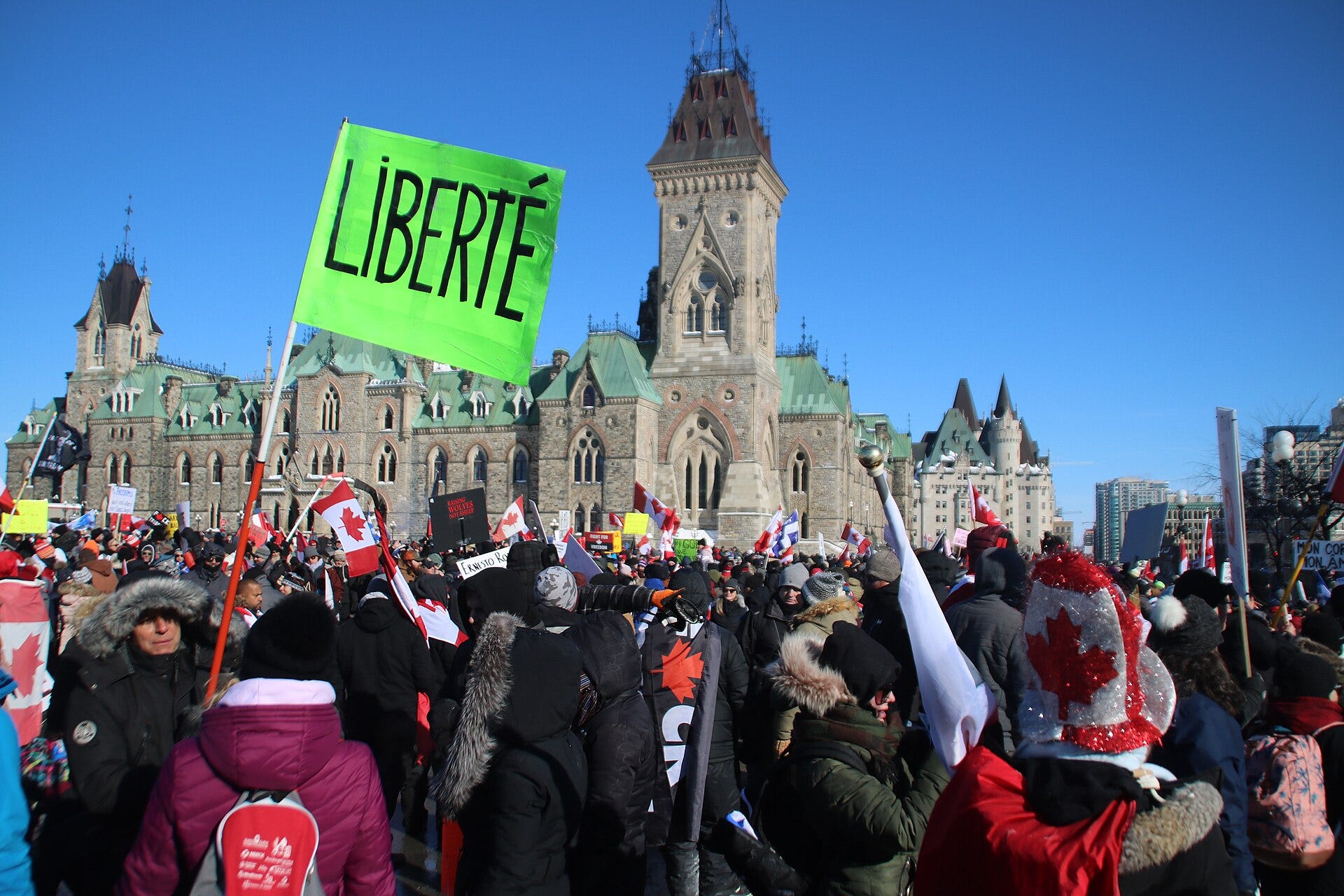
In 2022, the Government of Canada invoked the Emergencies Act, thereby escalating a crackdown on peaceful protesters in the capital, Ottawa. The protestors had driven to Ottawa in the “Freedom Convoy” to demand an end to draconian COVID-19 measures. Four years later, all individuals targeted for protesting have been vindicated by the Federal Court of Appeal of Canada, which admonished the Trudeau regime. The senior court ruled that existing laws were sufficient to address the protests, while the extraordinary police powers were unjustified and illegal. The government of Canada retains the right to appeal the ruling.
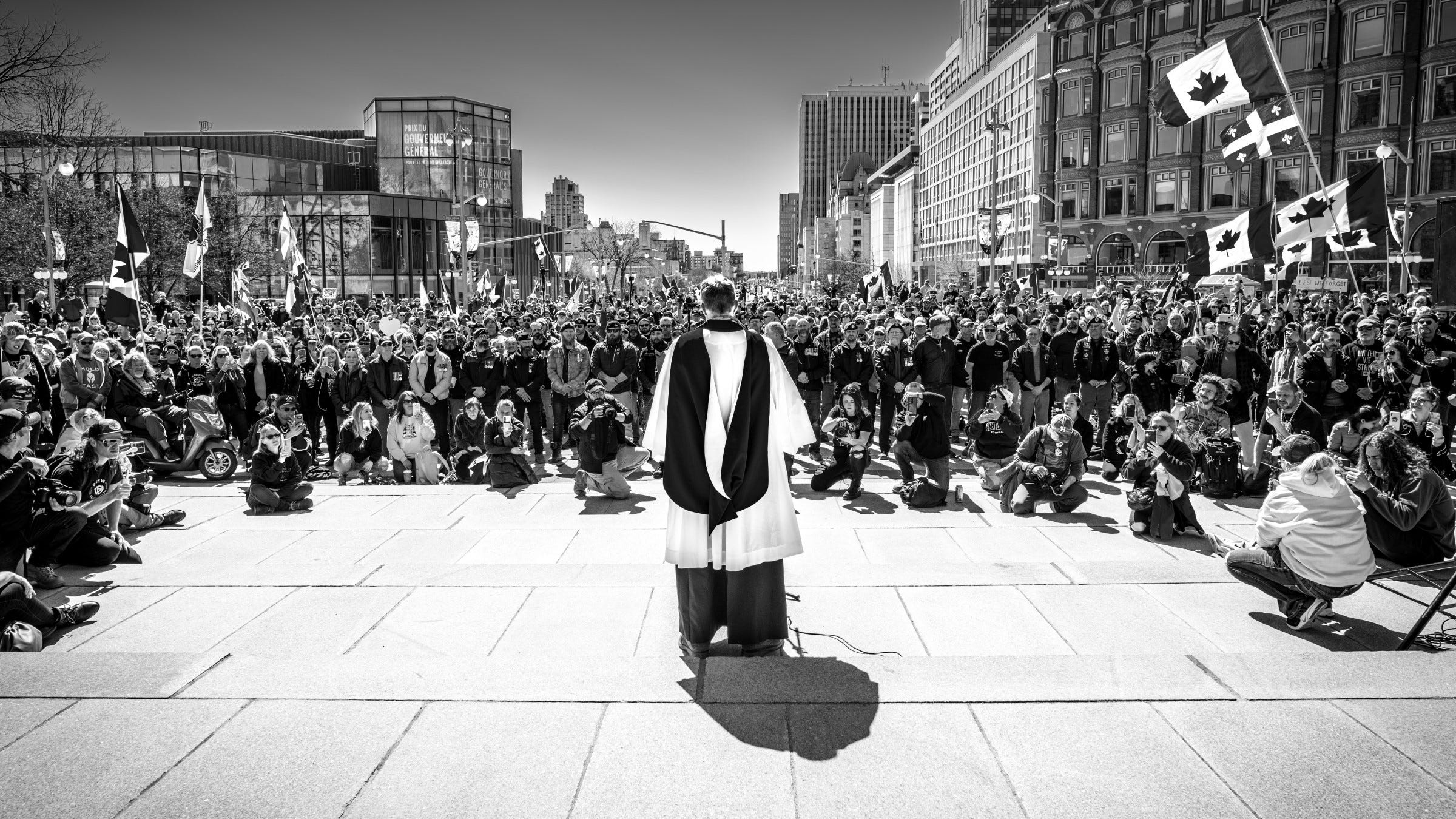
Among the vindicated in the case was Rev. Harold Ristau, a Canadian Lutheran pastor and retired chaplain in the country’s armed forces. His involvement was limited and public. He attended a Saturday demonstration with his family and three seminary students, and none of them had a leadership or organizing role in the Freedom Convoy. When former soldiers recognized him as a pastor, he accepted their request to lead a brief devotion at the War Memorial. Months later, at a lawful gathering, he vested and conducted a short service. None of these acts violated Canadian law or his ordination vows. Ristau’s appearance was historic - never before has Lutheranism been so visible and influential in the public square in Canada or the USA.
Ristau’s initial presence in Ottawa was in opposition to COVID restrictions, not to the later invocation of the Emergencies Act. The Court’s ruling addressed the latter. The church’s response, however, treated both as equally discrediting and failed to substantively engage either on their merits.
Vindication from the bench; indictment from the institution
Some will object that this is an “internal Canadian” matter on which outside voices should remain silent. But injustice in the Church is never merely local. Confessional accountability does not recognize national borders, especially when our Synods are in altar, and pulpit fellowship, and a portion of the LCMS even straddles the border. Indeed, many LCMS pastors were trained at St. Catherine’s, and there is an ebb and flow of parishioners across the border in both directions. The issue is simple: when a pastor is wronged, the question is not which passports critics hold, but whether he was treated justly and faithfully.
Caesar has been rebuked by his own courts, but the Lutheran Church–Canada (LCC) has yet to acknowledge, let alone repent of, its ostracism of Rev. Ristau and its general weakness in responding to COVID-19. Within days, seminary leadership reversed its own earlier assessment of Ristau’s conduct in a sudden and public retreat. What had initially been treated as a lawful and appropriate pastoral presence was reclassified as a reputational risk. The shift was not the result of new evidence, but of institutional anxiety and characteristic Lutheran quietism.
To be clear, not every LCC board member or institutional leader supported this course of action. A number spoke privately and publicly in Ristau’s defense. But internal dissent was overridden by formal decisions that prioritized institutional risk and reputation management over pastoral solidarity, confessional fidelity, and an opportunity for national and international Christian witness.
At the same time, none of this denies God’s providential rule over nations and rulers. But divine sovereignty does not suspend human accountability, especially within the Church, which is called to judge its own conduct first.
In April 2025, The Canadian Lutheran, the official publication of the Lutheran Church–Canada, published an essay by Rev. Dr. Thomas Korcok entitled “A Lutheran Response to Christian Nationalism.” The article was presented as a considered theological “think piece” by a St. Catherine’s Seminary faculty member and received commendations after being shared among the LCMS Council of Presidents. In reality, it functioned as a not-so-subtle disciplinary document that dispensed with due process in favor of pot shots. For Korcok and his fellow travelers, the greatest sin is refusing to baptize the repressive Canadian state’s actions and attitudes.

The article never names Ristau, but it didn't need to, because the inferences were black-and-white.
Korcok’s essay constructs a Potemkin village of “Christian Nationalism” to fit his desire to diagnose a psychological and moral personality type: anxious about tyranny, preoccupied with civil liberties, resistant to global technocratic moral regimes, suspicious of state power, and unwilling to accept ecclesial quietism as a Christian virtue. As Andrew Cusack has noted, the term “Christian Nationalism” was largely devised as a political label to alarm progressive constituencies and has since become a convenient designation for anyone whose Christianity extends beyond private sentiment.

The article is not an argument or a refutation of one, but rather regulates and suppresses concern about civil liberties and Christian rights. This is a serious and consequential error on Korcok’s part. Ristau has never advocated for theocracy. He did not suggest canonizing Canadian law. He did not confuse the Kingdom of Christ with the Dominion of Canada. The only thing he actually did was refuse to pretend that unjustified and, ultimately, unlawful state coercion is irrelevant to the witness and conduct of Christ’s Church.
For this, Ristau was treated not as a brother to be defended, but as a risk to be managed, an individual to be ostracized, and a man to keep out of the pulpit, as if he had already been found guilty of violence, sedition, or criminal conspiracy: crimes he was never even charged with.
Quietism as a weapon
The theological evasion at the core of Korcok’s thinking is as deceptively simple as it is theologically naive: because the Church has an unshakable heavenly kingdom, Christians should not worry about a functioning and just civil society. It’s an eccentric clerical Stoicism that belies the true meaning of trust in Christ under conditions of political coercion and civil injustice.
Indeed, it reads very piously; however, it’s the Platonic “Dualism” category error, not a well-formed Christian or Lutheran doctrine. For Plato, the body belongs to the realm of shadows and decay, while the true, pristinate self is the immaterial soul, untouched by what happens in the “lower” world. What the LCC implicitly embraced in its response to Rev. Ristau is a baptized version of this same dualism: the heavenly kingdom is inviolable, and what happens to bodies, bank accounts, vocations, and civil standing is supposedly theologically insignificant.
Christianity does not allow for the idea of an immortal soul detached from human history; it affirms the resurrection of the body, the incarnation of Christ, and the authentic suffering of real people facing real injustice. To dismiss unlawful coercion against a pastor as spiritually trivial because “our true kingdom cannot be shaken” is not Two-Kingdoms theology; it's a retreat into a bunker of abstraction, where tangible wrongs are ignored while the Church congratulates itself on preserving the purity of an invisible realm.
The issue was never whether the Church’s kingdom could be shaken. The issue was whether pastors may name injustice without being accused of betraying Christ or country. Canada’s Federal Court of Appeal has now confirmed that the state acted unlawfully. Korcok’s theology required the Church to behave as though legality were spiritually beside the point.
Romans 13 affirms the necessity of civil authority, but it does not baptize every exercise of power, nor forbid lawful protest or judicial appeal. Ristau’s actions operated entirely within a traditional Lutheran understanding of Romans 13.
This is not how the Evangelical Lutheran Church should act when one of its pastors is seriously wronged. It reflects how bureaucracies behave when protecting their reputation and making nice with the state takes priority over pastoral obligation. In doing so, the church also forfeited an unusual opportunity for public witness. A pastor’s visible, lawful presence amid national controversy could have been treated as an occasion for careful teaching and pastoral explanation. Instead, it was treated as probable contamination.

The orphaned pastor
Korcok accuses “Christian Nationalists” of believing in a distant Christ who has abandoned His Church. The irony is difficult to miss.
Rev. Ristau understands what abandonment looks like. It appears as a church body that refuses to defend you while the government subjects you to coercive measures. It looks like theological essays are published about you without ever speaking with you. It takes the form of being dismissed as a troubler of Israel, even though the law clearly vindicates you.
The civil courts have done their work, but ecclesial work remains undone. Cultural decline and moral confusion are real and not to be diminished in this circumstance. However, the Church bears much of the responsibility for the nature and pace of that decline. Consequently, generalized calls for repentance cannot substitute for addressing concrete injustice when it occurs. Even recent acknowledgments that “more should have been said” during the COVID-19 pandemic have stopped short of institutional repentance. Partial admissions have substituted for full accountability.
Will the Lutheran Church–Canada ever admit that it mistreated lawful conscientious objection as a form of theological deviation? Will it acknowledge that it attempted to discipline indirectly because it lacked the courage to accuse openly? Will it recognize that it sanctified the Canadian state's illegality as a form of faithful Christian witness and obedience?1
When the Church condemns what the civil law vindicates, or races to sentencing before the verdict of magistrates, we are dealing with a profound theological failure that hints at why Lutheran church bodies in the West are collapsing at an unprecedented rate. We should not be insensitive to the providential judgement of God in all of this.
This is an appropriate time to be reminded of the false accusations against Werner Elert and Paul Althaus for being Nazis.
One more: “anxious about tyranny, preoccupied with civil liberties, resistant to global technocratic moral regimes, suspicious of state power, and unwilling to accept ecclesial quietism as a Christian virtue” describes a Christian nationalist in the article. The label sure describes this Lutheran and this American.
In the small catechism, Fr. Luther begins with the 10 Commandments and their meanings…in this world, in nations, cultures and societies. It is all quite spiritual. How can we not stand up to tyranny for the sake of the elect?