
The Atlantic District's Strange Marginal Self Pity
An overture to the 2026 Synod convention rests on a geographic and historical premise that does not survive mild scrutiny.

The Atlantic District has submitted to the 2026 LCMS Convention Overture 1-31, “To Give Thanks for and Offer Renewed Commitment to Work of Atlantic District.” It fits the fluff-filler genre at conventions, maintaining the cadence of Doxology singing and an overall feel-good vibe.
However, this Overture caught my eye because it makes false claims in asking the Conventioneers to thank God for nearly 120 years of service and committing the District, on the model of the Lord Jesus Christ, to renewed missionary work “for the cultural, geographical, and societal margins of the U.S.” Not only does the Atlantic District claim to be on all margins, but declares it’s just like Jesus since his “own life and ministry placed Him at the cultural, geographical, and societal margins of the Roman Empire.”
Alas, both premises are demonstrably false. The LCMS Atlantic District covers the eastern half of New York State, including the five boroughs of New York City, Long Island, the Hudson Valley, and the Capital Region: roughly 18 million people inside about 20,000 square miles, by the District’s own published account.
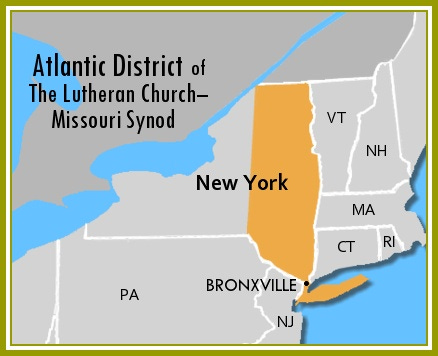
This is hardly the margin of the United States. It is, by every meaningful demographic, economic, and cultural measure available, the absolute center of it. The New York-Newark-Jersey City metropolitan statistical area is the most populous, wealthiest, and most ethnically diverse in the country. In other words, this is a perfect fit for the District’s missional self-promotion. The analogy to the Roman Empire completely fails under basic examination, because the seat of Roman provincial administration in Judea was a purpose-built deepwater port, Caesarea Maritima, designed to integrate the eastern Mediterranean into imperial trade.
To say that Jesus ministered at the margins of Rome is to mistake distance from the capital and provincial designation for cultural irrelevance, and to overlook the vast archaeological and textual evidence of how thoroughly Galilee and Judea were woven into the empire’s economic, military, and administrative life. Indeed, that is why it was so heavily garrisoned. There, Jesus was at the very center of his people and culture, attracting the attention of the lowliest and the highest because he was fulfilling prophecy in their sight.
It’s a consequential factual error, because the entire missional self-understanding the resolution proposes for the District, and which it asks the delegates in Phoenix to ratify, depends on the premise that the Atlantic District is geographically and culturally peripheral. It is not. The pastoral implication of this misdescription is that the District has been telling itself a bit of a sob story about its position, possibly to soften the blow of its decline.
By every available metric, the Atlantic District ministers in the most economically consequential urban concentration on the planet. The “geographical margins of the United States” are, in any normal use of the English language, places like rural Wyoming, the Mississippi Delta, the Aleutian Islands, Appalachia, or the colonias of the Texas borderlands.
Jesus Did Not Minister at the Margins of Rome
The third WHEREAS asserts that “the Lord Jesus’ own life and ministry placed Him at the cultural, geographical, and societal margins of the Roman Empire.” This is a sentimental construction that is not found in any history book.
The Roman province of Judea was governed not from Jerusalem but from Caesarea, the deepwater port city built by Herod the Great between 22 and 10 BC and dedicated to Caesar Augustus. Caesarea was the seat of the Roman prefects and procurators of Judea from 6 AD onward, including Pontius Pilate, who agreed to crucify Christ Jesus to appease the baying mob. The port of Sebastos at Caesarea, which Josephus compared favorably to the harbor of Athens at Piraeus, was one of the great technological achievements of the ancient world: an artificial deepwater harbor in open sea, enclosing roughly 100,000 square meters, built using hydraulic concrete that set under water. Caesarea was a major port for trade between the Roman Empire and Asia, equipped with a forum, a theater, public baths, paved streets, an aqueduct system bringing water from Mount Carmel, and a temple to Augustus as its focal point. It also served as a base for the Herodian navy, which supported Roman expeditions as far as the Black Sea.
After the destruction of Jerusalem in 70 AD, Caesarea became the provincial capital and an intellectual hub of the eastern Mediterranean for some 650 years. It is mentioned by name in the Acts of the Apostles in connection with Peter’s reception of Cornelius the centurion, with Philip the Evangelist, and with Paul, who was imprisoned there before his appeal to Caesar took him to Rome itself.
Galilee likewise was not the rural backwater of pious Sunday-school imagination. The Via Maris, the principal trade route linking Africa with Europe and Asia, ran through the region. Sepphoris, four miles from Nazareth and rebuilt by Herod Antipas during Jesus’ lifetime, was a sophisticated Roman city with colonnaded paved streets, markets, public buildings, bathhouses, a theater, and a population estimated at 8,000 to 12,000. Antipas called it “the ornament of all Galilee.” Tiberias, founded by the same Antipas as a new lakeside capital around 19 AD, was built precisely to divert the international pilgrim and merchant traffic flowing between Caesarea and Jerusalem through Galilee. Greek was widely spoken throughout the region. The roads were probably heavily and continually used by merchant convoys and Roman military units. Jewish villagers traded their products in urban markets that connected them, through Caesarea and Tyre, to the wider Mediterranean economy.
The geography of Christ’s ministry was, in fact, not at all marginal. It was at a juncture of major trade routes, under direct imperial administration through a purpose-built port city, where Jewish, Greek, Phoenician, Arab, and Roman populations encountered one another constantly. If anything, this is the Roman analog to the New York metropolitan area: a coastal node of imperial commerce, ethnic mixture, and administrative consequence, situated at one of the great mercantile crossroads of the ancient world. The parallel between Caesarea Maritima and the Port of New York and New Jersey is much closer than the parallel the resolution proposes between New York and the Sunday School version of Galilee.
The District’s territory is the most demographically central, economically powerful, and culturally consequential urban concentration in the country, if not the world. The only sense in which the District is “marginal” is the sense in which confessional Lutheranism itself is sociologically marginal within the New York metropolitan area, which is true but a different claim altogether. To say “we are a shrinking LCMS subsidiary in a large secular city” is accurate, modest, and could even be missionally productive. To say “we minister at the margins of the United States, after the model of Christ at the margins of Rome” is simply false.
Self-Flattering Marginality
The rhetoric of marginality obviously has ecclesial appeal. The District identifies with the “model of Christ on the margins”, which confers sympathy with respectability while apparently framing decline as faithfulness. Out of this, the District says it can “offer great gifts to the Synod”.
Unfortunately, the self-description is inaccurate, and that creates a problem for the District’s actual ministry. If the District is in fact ministering in the demographic, economic, and cultural epicenter of New America, then the missional question facing it is not how to faithfully shrink at the margins but how to faithfully witness in a place where the entire world is currently being assembled as the prototype New America, and where the Gospel encounters every language, every religion, and every culture imaginable. Those are very different missional questions, requiring different institutional postures, different resourcing strategies, different expectations, and maybe even different leadership.
According to its website, the District has a different self-perception, identifying its situation as “one of the most densely populated, ethnically diverse areas of the country” and its work as proclaiming the Gospel in twelve languages to people of “Islam, Buddhism, Hinduism, and others.”
Consequently, the Atlantic District is at the center, not at the margins. The 18 million people within its 20,000 square miles include some of the most religiously, ethnically, linguistically, and economically consequential populations in the world. Its ministry, properly understood, is not a witness from the periphery but a witness at the geographic node where the United States is presently being remade and where filthy lucre gushes out with the force of ten thousand Yellowstone geysers.
It’s hard to see this overture making it out of committee later this month, given the serious errors.
This is a weird overture. Why would a district seek the affirmation of the Synod in the first place? And why not the other 34 districts of the Synod, all of whom have unique challenges and opportunities? This one goes on the Omnibus.
Pride disguised as humility