
On the Doctrine of the Church - C.F.W. Walther Smacks Down the Buffalo Synod
From Der Lutheraner, Volume XIII, 1856–57 — Complete Text Translated to English

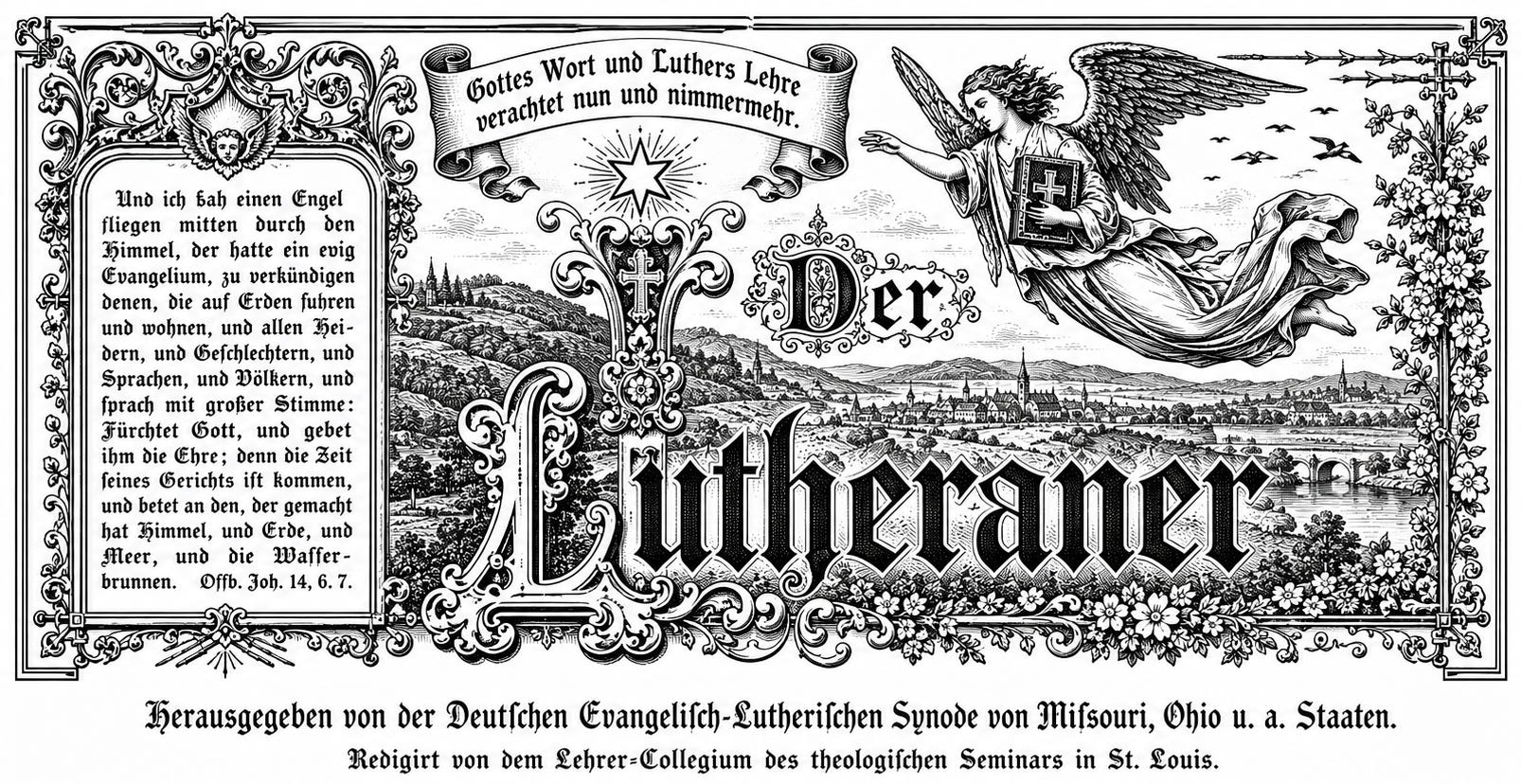
Translator’s Note: This machine translation (Anthropic Opus 4.8) renders the complete seven-part series “Ueber die Lehre von der Kirche” as published in Der Lutheraner, Volume XIII (1856–57). The author is C. F. W. Walther, editor of the Lutheraner and first president of the German Evangelical Lutheran Synod of Missouri, Ohio, and Other States. The series was published as a sustained theological counteroffensive against the Buffalo Synod’s doctrine of the Church, which Walther identified as a re-importation of Roman ecclesiology under Lutheran nomenclature. The translation preserves Walther’s doctrinal precision and forensic structure while rendering his German periodic constructions in cultivated American ecclesiastical English based on the register of W.H.T Dau. Footnotes in the original have been incorporated inline or lightly abridged. Scripture citations have been standardized. Quotations from Luther follow the Weimar and Walch editions as cited by Walther. The Grabauists are the followers of Johann Andreas August Grabau, superintendent of the Buffalo Synod, whose hierarchical doctrine of church and ministry Walther opposed throughout his career.

You are free to:
Share — copy and redistribute the material in any medium or format
Adapt — remix, transform, and build upon the material
Under the following terms:
Attribution — You must give appropriate credit to Ad Crucem News and the translation method, provide a link to the license, and indicate if changes were made. You may do so in any reasonable manner, but not in any way that suggests the licensor endorses you or your use.
NonCommercial — You may not use the material for commercial purposes.
ShareAlike — If you remix, transform, or build upon the material, you must distribute your contributions under the same license as the original.
No additional restrictions — You may not apply legal terms or technological measures that legally restrict others from doing anything the license permits.
AD CRUCEM NEWS EDITORIAL PREFACE TO THE TRANSLATION
Context For The Controversy
In the thirteenth volume of Der Lutheraner, published across 1856 and 1857, C. F. W. Walther — editor of the paper and first president of the Missouri Synod — set down the most sustained and systematic argument he ever made for the Missouri doctrine of the Church. The occasion was a direct conflict with the Buffalo Synod, led by Johann Andreas August Grabau, which had been pressing the claim that the visible, confessionally orthodox Lutheran Church is the One Holy Christian Church: the Body and Bride of Christ, outside of which there is no salvation. Walther regarded this position not as a rigorous form of Lutheranism but as its precise inversion, a reintroduction of Roman ecclesiology with Wittenberg substituted for Rome and Lutheran pastors substituted for the pope.
The essay advances eight distinct arguments against the Buffalo position, each more far-reaching than the last. Walther opens with the doctrinal stakes:
The claim that membership in the visible Lutheran Church is necessary for salvation adds a condition beside faith and thereby makes the Church a co-savior beside Christ, overturning the article of justification by grace alone upon which, in Luther’s own words, everything else stands or falls.
From there, he moves outward. The false doctrine, he argues, hands Lutherans disarmed to the papacy, since it cannot answer the Jesuit challenge — “where was your church before Luther?” — without either admitting the Roman Church was the true one or conceding that the promises of Christ to his Church went unfulfilled for a thousand years.
It corrupts the pastoral office by redirecting ministry away from genuine conversion and toward the maintenance of external churchly conformity, making hypocrites secure in their nominal membership.
It creates the conditions for the worst kind of soul tyranny, as any institution that claims to be the visible Body of Christ can use that claim to make even unjust censures feel like the judgment of God.
And it repels precisely the true Christians in other communions whom it ostensibly means to attract, since no man who has tasted the grace of Christ will consent to be told he stands outside the saving Church.
Against this Walther sets Luther’s own ecclesiology, drawn at length from the Commentary on John 14–16: the true Church is that scattered communion of all who genuinely believe and trust in Christ, known to God alone, present within every community that retains the essential articles of the Gospel, not coterminous with any visible institution however orthodox. The marks of the Church named in Article VII of the Augsburg Confession — pure preaching and right administration of the Sacraments — describe the Church in its flourishing state, not a boundary fence that determines who belongs to Christ.
The essay closes by distinguishing Missouri’s position sharply from unionism: the obligation to join the orthodox Church is real and urgent, but it rests on the duty of the conscience, not on the metaphysical claim that salvation is impossible outside it. The sentence extra ecclesiam nulla salus remains true — but the Church it names is the invisible communion of all believers, and no visible body may appropriate it as a proprietary warrant.
“For this reason I have put forth this sermon, that everyone might henceforth see and learn what the holy Christian Church is, and where it is to be found. Where this is well understood, one has a great and comforting defense against all false teaching.”
Luther, Weimar Ed. XIV, 290
I. The Controversy Defined — and Why It Cannot Be Set Aside
A longer absence from St. Louis, together with the need to make room in the Lutheraner for other pressing matter, has prevented us from continuing and completing our Preface to this thirteenth volume without interruption. Since our treatment of the announced topics has also grown considerably beyond what we initially intended, it now seems awkward to pursue the subject further in the form of a preface. The reader will therefore forgive us if we leave the preface as a fragment and take up the matter announced in it — and already partly treated — as a single extended essay.
We have already declared that we reject the doctrine of the Church as it is held and defended by the Buffalo Synod and others: the doctrine, namely, that the actual Church — the Church apart from which there is no salvation, the Church which the Holy Scriptures call the spiritual body of Jesus Christ (Eph. 5:23; 1:22–23; Col. 1:24) — is a visible one, and indeed, among visible churches, specifically the Lutheran one. We have at the same time testified that we, for our part, adhere to the doctrine set forth in the confessional writings of our Church, above all in the Apology, that “the Church, in the proper sense of the word, apart from which no one can be saved, is the invisible Church — that wonderful, hidden communion of truly believing, born-again children of God, scattered over the face of the whole earth, which, because the Lord alone knows those who are his (2 Tim. 2:19) and no human eye can look into another man’s heart, remains hidden not only from the world but from every human gaze, until the Lord shall at last separate the sheep from the goats, the good fish from the bad, the wheat and the children of the Kingdom from the chaff and the tares and the children of wickedness” — and she, the desolate and weather-beaten one (Isa. 54:11), shall at last be revealed as the Bride of Christ with him in glory (Col. 3:3–4).
A man can know with absolute certainty only of himself whether he is a true believer and a pardoned Christian — not of another. One may, in love, assume as much of everyone who confesses faith in Christ with his mouth and lives outwardly as a Christian. In many cases, however, one can know with equal certainty that a person is not a true Christian — if he repudiates faith or leads a godless life while speaking of faith. An ungodly person may feign piety; a genuinely pious person cannot feign ungodliness.
Now: is this a distinction of such importance that one has reason to contend over it? Would it not be better to overlook this difference, in order to spare the Church unnecessary disturbance? We answer: it is true that there are many questions among theologians which bear no relation to the essence of the Christian faith, which one man answers one way and another answers differently, and about which it is irresponsible to quarrel — questions that have no connection with the order of salvation, that are settled neither by the confessions nor by Scripture, and according to which it would be wrong to judge the orthodoxy of a Christian. But the doctrine of the Church is altogether different in kind. This doctrine is not only clearly revealed in God’s Word and set forth in the Church’s confessions; it is also inseparably bound up with the whole doctrine of salvation, so that one cannot alter the doctrine of the Church without simultaneously breaking the chain of the order of salvation and shaking the entire edifice of the Christian religion. The doctrine of the Church is not some technical subtlety that exists merely to give speculative minds their material for disputation; it is a doctrine that deeply affects the whole thinking, willing, and living of Christians.
It may seem almost incredible to some that, if this were so, so many who are all in earnest about pure doctrine could disagree on this very point. But the matter stands as follows. In recent times, many people arrived at the conclusion that the Christian religion could not survive if one clung only to a vague, general Christianity, and a longing therefore arose everywhere to emerge from that wavering uncertainty and find something firm and conscientious to stand upon. Men began to recognize, more and more, that strict Lutheranism was finally the only firm and reliable foundation on which to build. A Lutheran wind arose, and almost everything that claims to be orthodox now wants to sail by it. Not a few, however, have misunderstood it. Not a few have come to think that to be strictly Lutheran or strictly churchly means precisely to hold, strictly and inexorably, to everything external that has ever been the custom in the orthodox Lutheran Church.
Moreover, whereas in the earlier period of revival everything rested upon feeling and inner experience, and the power of God’s means of grace — working independently of human effort, worthiness, and will — was neither believed in nor taken into account, now the papal teaching is being approached again: the teaching that the means of grace work ex opere operato, that their mere use already works grace, makes one a member of the Body of Christ, and secures blessedness. And whereas previously no one asked about a church that had the truth and to which one must adhere — everyone simply regarded the conventicle he attended as the true Church — now it is thought that only he who confesses not merely that one is obligated to adhere to the visible orthodox Church, but that this visible Church is itself the Church apart from which there is no salvation, is rightly cured of the old individualism. In short, it is thought that one cannot move far enough from the errors of the previous generation, and that the closer one comes to the doctrine and spirit of the Roman Church, the more strictly Lutheran and churchly one becomes. No deviation on the other side is feared at all. Thus it has come about that no one has deviated further from true Lutheranism than those who most urgently want to be Lutheran and churchly.
No teacher of our Church is more unwelcome to the so-called “strictly churchly” Lutherans — and stands more in their way — than Luther himself; no writings are less studied by them than Luther’s, for they know quite well that there is no greater enemy of such Lutheranism than Luther.
It has not been considered that the path of genuinely pure doctrine is itself an exceedingly narrow path, upon which only he remains who with equal holy earnestness is intent upon slipping neither to the right nor to the left. Men have thought that the laurel of orthodoxy is cheaply bought: it requires no serious study, no research, no reflection, no prayer, no fighting, no overcoming of temptation. Any carnal, unconverted person need only adopt a sufficiently ill-tempered posture against all alleged heretics and against everything that has the appearance of ecclesiastical laxity, and insist loudly on everything that has the appearance of churchliness — and then the matter is done, the prize of orthodoxy is won, the Grand Inquisitor has taken his seat, and everything must now fear citation before his strict tribunal. Thus it has come about that no teacher of our Church is more unwelcome to the so-called “strictly churchly” Lutherans — and stands more in their way — than Luther himself; no writings are less studied by them than Luther’s, for they know quite well that there is no greater enemy of such Lutheranism than Luther.
But we hasten to our subject. Luther gives excellent counsel on how one may readily determine whether any doctrine is sound or not: one must look above all at whether the article of justification before God — by grace, through faith alone, in Christ — is intact. Among other passages, he writes: “One can see in all the histories that all heresy and error arose precisely where this article fell, since men were certain they could manage quite well on their own, and so fell away from it to other things. . . . Everything hangs and stands upon this one article, and it supports all the others along with itself, so that whoever errs in the others certainly does not have this one right either; and even if he holds the others and does not have this one, all is in vain. This article, moreover, has this grace: if one holds to it diligently and earnestly, it prevents heresy and keeps men from running against Christ and his Christianity. For it certainly brings the Holy Spirit with it, who thereby enlightens the heart and maintains it in a right and certain mind, so that it may remain pure and clear.” (Commentary on John 14–16, on chap. 16:3.)
Let us therefore examine the doctrine of the Church — the doctrine now being exchanged for another — according to this chief article of the Christian faith. For if one now teaches that the visible orthodox Church is the One Holy Christian Catholic Church, of which the Third Article of the Apostles’ Creed says, “I believe in one holy Christian Church, the communion of saints”; the Church which Luther in his exposition of the Small Catechism calls “all Christendom on earth” and which the Augsburg Confession calls “the assembly of all believers”; the Church which in Scripture is called the Body of Christ and his Bride; and of which the ancient dictum holds: Extra ecclesiam nulla salus — “outside the Church no salvation” — there is no doubt that this doctrine overturns the fundamental doctrine of justification by faith alone, upon which the Church stands or falls. For it sets up an additional condition of salvation beside faith: one must also be in the visible orthodox Church if one is to be saved, and thereby makes the Church a co-savior beside Christ.
Here some will say: Do you not yourselves admit that the sentence is true — “Outside the Church there is no salvation”? If you make belonging to the invisible Church necessary for blessedness, do you not yourselves overthrow the doctrine of justification just as much as we do when we teach that the visible Church is the Church apart from which there is no salvation? We answer: both doctrines seem to argue in the same way against justification by faith alone — but it is only an illusion. Note the following.
As certainly as faith alone makes one blessed, one may nevertheless say of many other things that they are necessary for salvation, without in any way contradicting this teaching — because without these things true faith is not possible, and therefore they necessarily include faith. Thus, for example, one can say that no one can be saved without Christ, without in any way offending the doctrine of justification by faith alone. Why? Because that is nothing other than to say that no one can be saved without faith; for without Christ, grasped by faith, there is no saving faith. One can likewise say — without the slightest violation of justification by faith alone — that without the Word of God, without the Gospel, without repentance, without the new birth (John 3:3), without sanctification (Heb. 12:14), no one can be saved; for without the Word and the Gospel no faith is possible, and where there is true saving faith, the new birth and sanctification have also taken place. Something may rightly be called necessary for salvation only when it ultimately amounts to nothing more than saying: apart from faith there is no salvation. But if one declares necessary for salvation something without which true faith is nevertheless possible, then the fundamental doctrine of justification by faith alone is indeed overthrown.
Now let us apply this to the doctrine of the Church. If by the sentence “Outside the Church there is no salvation” one understands the invisible Church, this does not overthrow the doctrine of justification — it confirms it. For to say “Outside the invisible Church there is no salvation” is no different than to say: outside of Christ, or without faith in Christ, there is no salvation. For he who does not belong to the invisible Church must be without Christ and without faith, since the invisible Church is precisely the spiritual Body of Jesus Christ, the communion of all true believers and saints in the Spirit; and again, he who stands in faith is precisely a true member of the spiritual Body of Jesus Christ and belongs to the invisible Church. The statement “Outside the invisible Church no salvation” means nothing other than: outside of Christianity, in which alone Christ and his means of grace are to be found, there is no salvation — “for there is no other name under heaven given among men by which we must be saved” (Acts 4:12).
But the matter is altogether different when one maintains that the Church, outside of which there is no salvation, is the visible orthodox Church. In this way, the fundamental doctrine of justification by faith in Christ alone is utterly overthrown. Since a man may have true faith in Christ outside the visible orthodox Church, this doctrine declares that faith in Christ is not sufficient for salvation; the visible orthodox Church is placed beside Christ and made a co-savior; and the whole foundation of Christian blessedness is shaken to its core.
Therefore, when we reject the new doctrine that the visible Evangelical Lutheran Church is the One Holy Christian Catholic Church, outside of which there is no salvation — the Bride and the Body of Jesus Christ — we are not following some eccentric “Missouri direction”; we are remaining on the old path of our faithful orthodox fathers in the faith. We are securing for ourselves — against this new doctrine, which presents itself under the attractive appearance of strict churchliness and serious opposition to unionism and indifferentism — the highest and most glorious jewel, the true Palladium, the unconquerable fortress of Lutheran Zion: the pure and unclouded doctrine of justification by grace alone, without works, through faith alone in Jesus Christ alone. As our fathers wrote in the Smalcald Articles, and as we, their least sons, echo and confess: “Of this article nothing can be yielded or surrendered, though heaven and earth and all things temporal should be destroyed. For there is none other name given among men whereby we must be saved, saith Peter, Acts 4. Upon this article everything depends which we teach and practice against the pope, the devil, and all the world. Therefore we must be absolutely certain of this doctrine and not doubt it at all, or all is lost.”
The Latin text reads even more sharply: “De hoc articulo cedere aut aliquid contra illum largiri aut permittere nemo piorum potest” — “No godly person can depart from this article, or admit or concede anything contrary to it.” It is not enough, then, simply to present justification correctly when one treats it directly; one must also refuse to accept any other doctrine that stands contrary to this article.
II. The Papal Trap — and the Only Defense Against It
A second reason why we should not allow the pure Lutheran doctrine of the Church to be taken from us at any price is this: the pure doctrine is the most powerful bulwark against the papacy, and an insurmountable wall that separates us forever from the empire of the Roman Antichrist — whereas the false doctrine, on the contrary, plays directly into his hands.
Consider the following. If the visible orthodox Church were, as is now being claimed again, the One Holy Christian Church — outside of which there is no salvation, no blessedness, the very Body and Bride of Jesus Christ — then this visible orthodox Church would have to have existed always, without interruption. For of his holy Christian Church the Lord says plainly: “The gates of hell shall not prevail against it” (Matt. 16:18), and the Seventh Article of the Augsburg Confession states expressly: “It is also taught that there must always be and remain one holy Christian church.”
Now it is beyond dispute that before the Reformation, throughout the entire heyday of the papacy, there existed no such visible orthodox Church as the visible orthodox Lutheran Church. What then follows? It follows that the visible orthodox Church cannot be the One Holy Christian Church — or else those who insist upon it must concede that Christ did not keep the promise made to his Church and that the true Church, in the proper sense of the word, had almost entirely vanished from the earth for a thousand years. Since no one who still wants to be a Christian can believe or admit this, those who regard the visible orthodox Church as the general Christian Church are left with only one recourse: they must admit that the One Holy Christian Church is the visible Roman one. For it is the Roman Church that has persisted through all the centuries of the Christian era, and although other ecclesiastical communities have arisen from time to time alongside and in opposition to Rome, none of them maintained an uninterrupted existence or was free from grave errors.
The papists know this very well. They have raised the question countless times: “Do you not yourselves admit that the Church can never perish? Then where was the Church before your Luther, if it was not the Roman Church?” Lutherans who possessed the pure doctrine of the Church were never at a loss to answer this. They replied: The true Church of Christ, to which all those glorious promises belong, has never perished — but this Church is not any visible church; it is the invisible Church, the congregation of the true believers and saints hidden from the world and from the eyes of men. Friedrich Balduin, for example, in his polemic against the Jesuit and later Cardinal Pázmány, provides the following answer to Pázmány’s charge of inconsistency:
“We do not deny these promises, since we consider them absolutely true. But we say that the particular and visible church, which God gathers in various places through the preaching of the Word and the use of the Sacraments, can and does perish — when the purity of the Word is driven out by heretics and persecutors, and the confessors of the truth are scattered. For by this means the church loses its outward splendor; while in the meantime there always remain some who keep the true faith unadulterated — yes, while God, even through the corrupt visible preaching ministry, begets for himself sons and daughters who belong to the catholic invisible church.”
Balduin, Phosphorus veri catholicismi, p. 745–46
Johann Gerhard defends himself against the papists in the same fashion: “We do not deny that the promises of the uninterrupted duration of the Church are of certain and irrevocable permanence; but we add that they will not be fulfilled in the way the papists imagine, as if the outward splendor of the Church would be uninterrupted and the preaching of the Word would never be corrupted. These promises are fulfilled — if not in the visible church — in the invisible church, that is, in the hidden sheepfold of the elect. . . . We also say that not only this or that particular church, but absolutely all particular churches can be so darkened by the clouds of corruptions, errors, heresies, and persecutions that their outward splendor ceases and no known visible multitude remains that enjoys a pure public preaching ministry; and yet there are always some left who retain the foundation of faith, and God gives birth even through the corrupt preaching ministry to sons and daughters who belong to the catholic invisible church.” (Loci, Art. of the Church, § 86.)
In this way our fathers overcame the papists by means of the pure doctrine of the Church. But what are those to say who believe and teach that the visible orthodox Church is the Catholic Church, which can never perish and never has perished? What are they to say when the Jesuits call out to them: “Where was the true visible Church before the Reformation, if it was not the Roman one?” They must cast down their eyes in shame — or else, with evil consciences, they invent sophistries and falsify history. And, alas, not a few have been led into the arms of the Babylonian Harlot by nothing other than this false doctrine of the Church in which they had allowed themselves to be entangled. For once a man has been brought so far as to admit that some visible Church is the One Holy Christian Church to which those glorious promises belong — that it cannot fall, that it is guided into all truth — he is already caught, and will thereafter easily accept even the greatest errors of that Church, reasoning correctly enough: if this visible Church truly is the One Holy Christian Church, then what it teaches must be true, what it does must be right, and what it commands must be binding.
III. A False Goal for the Ministry
A third reason to regard the false doctrine of the Church as anything but innocent and harmless is this: it necessarily corrupts the goal of the pastoral ministry. Consider the following. If a preacher holds the right doctrine concerning the Church — if he is convinced that the Church in the true sense of the word, outside of which there is no salvation, is the invisible communion of all true believers, saints, and those who have been born again and renewed by the Spirit of God, and that not only no openly godless person but also no hypocrite belongs to it, no matter how correct his knowledge of right doctrine and how earnest his zeal for orthodoxy — then the goal of such a preacher will be, above all, to awaken his hearers from the sleep of sin, to bring them to genuine repentance and living faith; in a word, he will aim to build up the invisible Church, to make all those entrusted to him into living stones built upon the spiritual house. And just because such a preacher teaches the doctrine of the Church as a double-edged sword, it will pierce soul and spirit, marrow and bone, and judge the thoughts and intentions of the heart. No carnal, unregenerate, unconverted, impenitent man will find in it a resting place for his confidence; he will rather see with horror that he belongs to the Church no more than the tares belong to the wheat, though they are always mixed together.
The goal of the ministry of a preacher who holds the false doctrine, however — who is under the delusion that a particular visible Church is the Church outside of which there is no salvation — must necessarily be quite different. Such a preacher must hold that even the hypocrites who outwardly profess the pure doctrine belong to the true Church and are real, if dead and moribund, members of it. Such teachers insist that even hypocrites who hold to pure doctrine are at least dead members of the Church, outside of which there is no salvation. It is truly remarkable to observe how they fight for the proposition that even hypocrites belong to the Church — as though it were a precious jewel. They know only too well that if they can no longer count hypocrites as part of the true Church, their visible Church is gone, and they have nothing left.
A preacher captive to this error will seek above all to establish a well-ordered external church system in his congregation, and will think he has accomplished a great deal if he persuades those entrusted to him to accept all the confessional symbols as the legal standard of faith and doctrine, and to introduce all manner of old external customs in the divine service. He will be concerned above all not to make his people Christians, but to make them “churchy” in his sense. The church discipline he exercises will be directed chiefly against those who seem unreliable in their “churchly” attitude, while overlooking much in the case of those who display great zeal for external churchliness, even when their heart-Christianity and daily life are otherwise very bad. The result, which cannot be otherwise, is that hypocrites become secure, comforting themselves with membership in the only true Church despite their unconversion — insisting on the pure doctrine and crying as the Jews once cried: “The temple of the Lord, the temple of the Lord, the temple of the Lord!” (Jer. 7:4.)
IV. The Tyranny of the Soul
A fourth reason why the false doctrine of the Church is not a small matter is that it encourages the most frightening tyranny of the soul. The Lord says of his one holy Church that it has the keys of the Kingdom of Heaven, that it must be heard, that he who does not hear it is to be counted as a heathen and a publican, and that what it binds on earth is bound in heaven (Matt. 16:19; 18:17). If any visible Church were to be considered the One Holy Christian Church, and if that Church placed some innocent person under the ban, this innocent person would be compelled to believe that he stands likewise under God’s ban — that he is bound in heaven also — and would have to respect even a false ban as a genuine Church ban. Those at the helm of such a visible Church, if they are men of domineering spirit, can therefore use this false doctrine to frighten poor souls as their purposes demand, to hold them in subjection despite every tyranny, and to do with them precisely what they will — for he who holds a man’s conscience holds also his will, his body, his powers, and his purse.
Woe to poor Luther had he not already possessed the pure doctrine of the Church when the pope cast him out! Either he would have been driven to humiliation before the papal Church — or to despair.
Woe to poor Luther had he not already possessed the pure doctrine of the Church when the pope cast him out! Either he would have been driven to humiliation before the papal Church — or to despair. But since he knew, even then, that the Church to which God had given the power of the keys and such glorious promises was in reality that invisible congregation of the saints, which does not coincide with the visible Church but is only to be found within it, he laughed at the impotent papal and episcopal thunderbolts. He knew that the true Church in the true sense of the word — “the congregation of the saints,” which actually possesses the right to bind and loose — had certainly not banned him, nor would it ever ban him, since Christ had not said of his Church that it would banish his own. He knew that every unjust ban of a visible Church was not a ban of the Church but a ban against the Church, and that a visible Church must prove that its ban is a genuine binding act — that it acts in the sense of the Bride of Jesus Christ and therefore does not use the keys of the Kingdom against Christ’s order but according to it.
We are speaking from experience at this point as well. Stephan — whom we once followed as our leader and as the most resolute witness of the truth of the Lutheran Church — also held this false doctrine of the Church, and it bore all the aforementioned bitter fruits in the lives of many of his followers. Yes, this doctrine lay like a spell upon the whole community, until at last the merciful God forcibly opened our eyes.
V. Luther Against the “Strictly Churchly” Lutherans
A further reason why the doctrine that the visible Church is the One Holy Christian Church must not be regarded as innocent and harmless is that it stands in flat contradiction to Luther himself — the very Luther whom its advocates invoke. In his interpretation of John 14–16, commenting on John 16:1–2, Luther writes:
“What should one do here? It is indeed difficult to stand here and preach against such a ban. . . . But what is the defense and the ground on which we may stand against such an outrage? Nothing else but the masterpiece St. Paul uses in Romans 9:7 when he says: ‘Not all who are descended from Israel belong to Israel.’ They are not all the Church who boast of and bear the name of the Church. . . . I believe and am certain that even under the papacy the Christian Church remains. But on the other hand I know that the great number among them, who have the prestige above all, are not the Church — as our popes, cardinals, and bishops are not God’s apostles and bishops but the devil’s, and their people are not God’s people but the devil’s people; and yet some true Christians have remained among them, even if led astray in error, preserved by God’s grace and help in a miraculous manner. Therefore it remains invalid when they boast and insist with great splendor: ‘We, pope, bishops, and all who are among us, are the Christian Church.’ . . . Let us therefore recognize and honor as the true Bride of Christ those who abide in the pure word of Christ and have no other comfort of heart than this Savior, whom they received in Baptism and confessed, and whose Sacrament they have received. These are the true Church — not only in one place, as under the pope, but wherever they are, as far as the world extends. In outward form they may be scattered to and fro; but in this article they come together, which is called: ‘I believe in God the Father Almighty, and in Jesus Christ our Lord, born for us, suffered, died upon the cross.’ Behold, this is the true Catholica, the common Christian Church.”
Luther, Commentary on John 14–16 (on John 16:1–2)
It is nothing short of remarkable that those who want to be most strictly Lutheran and churchly are precisely those who can least afford to open Luther’s writings. For there is no greater enemy of their system than Luther himself. When he was banned by the pope, it was not by appealing to the invisibility of the true Church but by applying it that he kept his footing. He did not say: “The Roman Church has banned me, but it is an invisible Church and therefore its bans are nothing.” He said: “The Roman Church has banned me, but it is not the Church in the proper sense — the true Church has not banned me and will not ban me, for the true Church is that congregation of saints and true believers in which Christ rules by his Word.” The doctrine of the invisible Church was for Luther not an escape from accountability but a precise instrument of accountability: it measured every visible church’s claims against the only standard that matters, the living faith of those who know and trust Christ.
VI. An Obstacle to the Church’s Own Growth
Those who declare the visible Lutheran Church to be the Church outside of which there is no salvation undoubtedly do so in order to elevate the Lutheran Church and to persuade those who do not belong to it to join. But this very doctrine is a real blot upon our Church and one of the greatest obstacles to its spread.
All true Christians and children of God in the unbelieving communities are certain, through the Holy Spirit, that they are already in God’s grace for Christ’s sake, and that in their present state they will accordingly be blessed — as certain as the Word of God and the living testimony of the Holy Spirit within them. If they hear or read that those who claim to be strictly Lutheran assert that there is no salvation outside the visible Lutheran Church, they do not consider it true at all. They see quite plainly that if they accepted this doctrine and therefore joined the Lutheran Church, they would have to deny Christ and his grace, which they have already experienced in their own souls. The saddest part of this is that when such Lutherans publicly propound this false doctrine, the great majority of those in the unbelieving communities assume that these Lutherans in particular are the strictest — the ones who most faithfully represent the teaching of our Church. Those Lutherans, on the other hand, who will not endorse this false doctrine are assumed to have fortunately deviated somewhat from strict Lutheranism, and thereby to have come a little closer to the sects. Eternity will one day reveal how many souls were held back from the Lutheran Church by precisely this.
It is therefore truly not contentiousness when we confront those Lutherans who declare the visible Lutheran Church to be the One Holy Christian Church outside of which there is no salvation. Far less is it malice or contempt for our dear Lutheran Zion that guides us. On the contrary: it is precisely our insight into the glory of this Church, and our longing that all people should enjoy the unspeakable grace that is given to our Church in the pure Word and the unadulterated Sacrament before any other community, that does not allow us to remain silent.
VII. Answering the Objections — Augsburg Confession, Article VII
We come at last to the objections raised against our doctrine of the Church, and to the dismissal of the distortions often offered in argument against it.
The first and principal objection is this: Since the Augsburg Confession says, “It is also taught that there must always be and remain one holy Christian church, which is the assembly of all believers, in which the gospel is preached purely and the holy sacraments are administered according to the gospel” — is it not obvious that, according to this foundational confession of our Church, the Church in which God’s Word is purely preached and the Sacraments rightly administered is the One Holy Christian Church outside of which there is no salvation? And since the visible Lutheran Church alone exhibits these marks, must it not therefore be that One Holy Christian Church?
To this we answer simply: if the Augsburg Confession is a confession of true truth — as we do not doubt — then this cannot be the correct interpretation; first, because it is an historical fact that there have been times when no such thoroughly orthodox visible church existed, while the One Holy Christian Church cannot be interrupted or perish; and second, because it is absolutely undeniable that there are true Christians also outside the visible Lutheran Church, who accordingly are saved — which makes it beyond all dispute that the visible Church, insofar as it is visible, cannot be the Church outside of which there is no blessedness. One must therefore either admit that the visible Lutheran Church is not the One Holy Christian Church — or else assert, maintain, and (which is impossible) prove that apart from the visible Lutheran Church no one has been saved and no one will be saved.
But what does the Seventh Article actually mean, if not this? It means that the Confession is giving a definition of the Church — describing it not as it often tends to be, but as it should be in its ideal and normal state. When one defines a man, one does not say he is a one-eyed being simply because some men lack an eye; one says he has two eyes, because that is what belongs to his nature. So too with the Church. Pure public preaching of the Word and lawful administration of the Sacraments are the marks of the Church as it should be. If some communities lack one or the other in various respects, this reveals that such communities are not pure, orthodox churches — but it does not mean they are no church at all.
This is not a new interpretation of our own devising. It is the understanding always held and declared in the Lutheran Church. Dr. Johann Benedikt Carpzov writes: “The Church is defined here — that is, described — not as it often tends to be, but as it should be in its natural state, when it is not oppressed by persecutors or destroyed by heretics. It may therefore happen, and often does, that it lies secretly hidden under a tyrannical regime or lives under a corrupt preaching ministry; nevertheless it does not cease to be the Church, as the Apology of the Augsburg Confession has explained quite splendidly.” (Isag., p. 306.) Johann Gerhard is equally explicit: “It is to be noted that there are certain degrees of that ‘purity’ of the preaching of the Gospel, because the Word of God is preached in the church sometimes more purely, sometimes less purely, and it does not immediately cease to be a church, even if it should not teach purely even in some principal articles of religion. But it does not cease to be a church by any corruption, because even when the public ministry of the visible church is corrupt, God begets and maintains for himself a holy seed and spiritual sons.” (Loci, Art. of the Church, § 126.)
The Apology itself adds, by way of further explanation: “About this, the true doctrine and church is often so completely suppressed and lost, as happened under the papacy, as if there were no church — and it can often be seen as if it had even perished. So, as impossible as it is for the true church to perish, it can and has happened that it loses the visible adornment of pure public preaching.” From this it is as clear as the noonday sun that when the Augsburg Confession says “in which the gospel is preached purely and the holy sacraments are administered according to the gospel,” it does not mean to say how the church always is, but how it should be; the church is described not in its ordinary state, but in its flourishing state. Since the Augsburg Confession gives a definition of the church, it naturally describes it not according to its accidental temporary infirmities and defects, but according to its perfection — just as when one defines a man, one speaks of a being with two eyes, although there are indeed men who lack one.
VIII. The Visible Catholic Church — Against the Charge of Unionism
The principal charge pressed against us by our opponents — that we are essentially friends of unionism — rests on the accusation that we teach the visible general Church to be nothing more than a collection of all the sects as such. But we have never taught this, and we have repeatedly and publicly denied it.
Our ancient teachers, following the Holy Scriptures, distinguished clearly between the general church in the proper sense and in the improper sense. The general invisible Church includes all orthodox believers and the elect who have lived from the beginning of the world — some already in heaven, some still on earth. The general visible Church is the whole body of called and baptized Christians. Gerhard expresses it thus: “The Church is called catholic primarily and originally with respect to the elect and saints, insofar as it includes all true believers in Christ, that entire mystical spiritual body whose head is Christ. But because the elect and true believers are not apart from the multitude of the called but exist within the visible Church, in which there are also hypocrites mixed with them, the visible Church of the called is also, in a subordinate sense, rightly called catholic.” (Loci, Art. of the Church, § 151.)
When, therefore, we speak of a Roman Church or a Reformed Church as belonging in some sense to the visible general Church, we do not mean the sect as such — we do not mean those who wholeheartedly adhere to the fundamental errors of Rome or of Zwingli and Calvin, who blaspheme and fight the truth. We mean the true Christians who are bound among the followers of the Pope, Zwingli, and Calvin and held captive — those who out of weakness do not recognize the true doctrine and therefore do not outwardly join the orthodox Church, but who also do not blaspheme the truth, and who are preserved in grace and saving faith by certain chief truths of the Gospel which the sects still retain, in a way known to God alone. They are like those two hundred servants of David whom the rebel Absalom had carried along with himself, of whom it is said: “But they went in their simplicity and knew nothing of the matter” (2 Sam. 15:11; cf. Rev. 2:20–24).
Far be it from us to declare it a matter of indifference to which visible church a person belongs, or to suggest that membership in the orthodox Church is superfluous. Whoever recognizes error and retains it, whoever recognizes the error of the church in which he finds himself and yet professes it, whoever knows which is the only orthodox Church and yet does not profess it — such a one is indeed in the Church as a baptized person, but he is not of the Church; he is a willful sinner, in a damned state both in his confession of error and in his denial of the truth, just as he who lives openly in sins and vices.
The Grabauists have made a new attempt to escape this either-or by claiming that although they teach the visible Lutheran Church is the holy Christian Church outside of which no one can be saved, they do not thereby deny that true Christians among the sects are also saved — since these, they say, belong to the visible Lutheran Church in that they confess the right doctrine in the midst of the sect and adhere to the right Sacrament, and thereby make themselves visible as members of the true visible Church. But whoever thinks this is Lutheran doctrine knows the Lutheran doctrine as little as these gentlemen claim to know it. The question is not whether those who, in the midst of the papacy, confess and use Word and Sacrament unadulterated are Lutherans — that is self-evident. The question is whether also such souls in the sects will be saved who do not have the pure Lutheran doctrine and the unadulterated Sacrament of the Altar, who do not confess or use them, but are preserved in grace and saving faith by certain chief truths of the Gospel which the sects still retain, in a way known to God alone. If the Grabauists do not admit this, their doctrine remains a more than papist church-riding, in which the Church is placed in the stead of the Savior — for even the papists count many outside their Church at least to the soul of the Church, and allow them to be saved. If, however, our opponents do admit this, then their doctrine of the visible orthodox Church outside of which there is no salvation is over; for whoever says that no one can be saved outside the visible Lutheran Church and at the same time admits that God also converts souls through the corrupt preaching ministry of the unbelievers, cannot be helped by argument — only by medicine.
We therefore conclude by pointing to the Eighth Thesis of our book The Voice of Our Church, which represents the faith to which our entire Synod has publicly and solemnly committed itself: “Although, where God’s Word is not preached in full purity and the holy Sacraments are not administered completely in accordance with the institution of Jesus Christ, God nevertheless gathers for himself a holy Church of the elect, provided God’s Word and Sacrament are not denied but both remain essential — nevertheless, each one is bound in his blessedness to flee all false teachers and to avoid all unbelieving congregations or sects, and on the other hand to profess the right-believing congregations and their right-believing preachers and to keep to them, where he finds such.”
Extra ecclesiam nulla salus! — Outside the Church there is no salvation. The sentence is true. But the Church it speaks of is the communion of all who truly believe in Christ, scattered over the face of the whole earth, known fully to God alone — and it is precisely for that reason that no visible institution, however orthodox its confessions, may seize that sentence for its own self-justification.
✦ ✦ ✦
Is that really a 100% AI translation? That's impressive and even more so if it really maintains the technical language correctly. Was it as simple as asking AI to translate the file?