
No Room in the LCMS for Charlie Kirk as DEI Assault on Our Young Men is Brushed Aside
In September the Synod's President named Charlie Kirk plainly. In July his convention refused the name, and refused to let its theologians look where he looked.

Ten months before the 2026 convention met, the President of the Missouri Synod wrote a pastoral word to its young men. Charlie Kirk had just been assassinated for his free speech and Christian Witness, and Matthew Harrison, in a message dated September 17, 2025, named the man and the moment without flinching. Kirk, he wrote, was “a devout Christian, murdered for his conservative religious and political views,” and “not a racist, and certainly no hater.” To the Synod’s young men, Harrison was blunter still, telling them that the world is fixated on “everybody else’s perceived injustices but yours,” and that “DEI has cost you academic advancement and employment.” It was a president’s clear naming of a murdered Christian and of the discrimination his young men carry. On Monday afternoon his convention declined to repeat either.
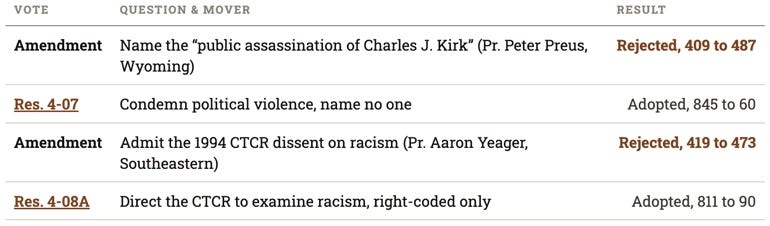
The two most revealing votes of Monday’s morning session of the Convention were both amendments, and the convention rejected them both. In the space of an hour, Floor Committee 4 brought the Missouri Synod two resolutions on politics, one condemning political violence and one condemning racial hatred, and the floor adopted each by the comfortable margin it keeps for propositions no delegate in the hall was against, 845 to 60 on the first and 811 to 90 on the second. The votes that revealed the mind of the assembly were the two amendments it declined, because in each the floor was offered the concrete in place of the abstract, a murdered man’s name or a careful old dissent, and in each it said no.
Refusing to name the victim
Resolution 4-07, “To Condemn Political Violence and Encourage Participation in Public Life,” reached the floor already emptied of its occasion. Six overtures on political violence had gone to Floor Committee 4, and three of them, overtures 4-53, 4-54, and 4-55, had asked the Synod to reckon with the assassination of Charlie Kirk. The committee consolidated all six and returned a resolution that condemns “political violence in any form,” lays it to public figures “of various political persuasions,” commends a 1995 study document, and names no one. This publication traced that erasure before the floor convened, in “Where Martyrdom Resolutions Go to Bleed Out”: the resolution quotes the Large Catechism at length on the devil who sows “contention, murder, sedition, and war,” and then strikes from its own resolves the one recent, concrete murder its overtures had set before it.
Pastor Peter Preus of the Wyoming District was willing to put Charlie Kirk back into the text, and moved to amend the final whereas so that “various political persuasions” would be followed by “in particular, the public assassination of Charles J. Kirk.” His case for it was modest and confessionally careful. He conceded the theological distance at the outset, granting that the Synod would have “many disagreements” with Kirk, and rested the amendment on narrower ground, that Kirk had encouraged respectful dialogue among those who disagree and had, in Preus’s words, “encouraged young men in particular to not be bitter, which we all know is an issue in my generation.” A member of the floor committee, speaking only for himself, added that President Harrison had already addressed the question and had “pleaded with the assembly to come to a good resolution” of it.
The assembly’s resolution of it was to end the discussion and strike the name. A motion to cut off debate on the amendment carried with sixty-nine percent; the amendment then failed 409 to 487, and the convention adopted the nameless resolution 845 to 60. The margin against the name was not overwhelming; roughly forty-six percent had wanted it, but it was decisive, and it was cast with the President’s own plain naming already ten months on the record.
The confessional objection to naming Kirk is a serious one, and it deserves to be stated at its strongest. A synod may in good conscience decline to enshrine a man it did not catechize, since the Augsburg Confession honors the martyrs as examples of God sustaining His people rather than as intercessors to be invoked, and Kirk was a non-Lutheran evangelical or “Catholic Curious,” depending on your view. Yet the amendment Preus actually offered asked for none of that. It did not name Kirk a martyr, nor set a day of remembrance, nor place him on any calendar. It asked only that a resolution condemning political assassination acknowledge, by name, the year’s most prominent political assassination, of a man killed in the open while confessing Christ in the open, whom the President of the Synod had already called a devout Christian murdered for his views. The floor declined even that, which leaves the gentler explanation: an unwillingness to be seen speaking a conservative’s name in a season that has made his murder a partisan flashpoint.
A dissent shunted
Resolution 4-08A, “To Direct the Commission on Theology and Church Relations to Examine Current Political and Social Issues,” performs a similar maneuver. It opens in the universal, condemning “all forms of racial hatred as sinful” and grounding the condemnation in the image of God and the oneness of believers in Christ. Then it narrows, and the narrowing is a giveaway. When the resolution stops describing and starts directing, when it hands the Commission on Theology and Church Relations a concrete assignment to define, to document, and to prepare new materials by the end of the triennium, the ideologies it lists for examination are these: “racism (White supremacy and Kinism), antisemitism, and Christian Nationalism.” Every movement named there is coded to the right. Kinism, a fringe racial heresy, is named. White supremacy is named. Christian Nationalism, a contested label the resolution treats as a self-evident danger, is named. Black nationalism is not named. Ethnically bound groups within the Synod are not named. La Raza is not named. Communists and Antifa are not named. And the racial preference the President himself had told the Synod’s young men “has cost you academic advancement and employment” is not named.
When a delegate rose to widen the commission’s field of view, he did not reach for the left at all. He reached for the Synod’s own past. Pastor Aaron Yeager of the Southeastern District moved to direct the CTCR’s new examination to include a document the Commission itself had produced, the 1994 “Racism and the Church: A Dissenting Opinion,” the first minority report in the Commission’s history, signed on April 9, 1994, by four respected confessional scholars, the historian Rev. Dr. Cameron MacKenzie, the dogmatician Rev. Dr. Norman Nagel, the New Testament scholar Rev. Dr. James Voelz, and Rev. Dr. Ken Schurb, and printed in the 1995 convention workbook.
The dissent is no apology for racism, and it says so in its opening lines, affirming that the majority report’s biblical sections “contain powerful and eloquent reminders that God is no respecter of persons.” Its quarrel was with method, that “by adopting a sociological analysis of contemporary society, the majority of the CTCR has stepped outside of its own area of expertise and into one where it does not really belong,” and its remedy was a theological definition of racism, “pride in one’s group (family, nation, race, etc.), on the basis of which one demeans those who belong to other groups,” a definition that indicts the sin in every direction at once, in whatever color or party it appears. A delegate who spoke for the amendment called the dissent “very carefully written and very well balanced,” a treatment of race “that’s not ham-fisted, like sometimes we’re inclined to do.” The Commission’s own staffer (Rev. Dr. Rick Serina) rose not to oppose the amendment but to enlarge it, observing that the 1994 exchange ran to three documents, the report, the dissent, and an executive response, all in the 1995 workbook, and urging the delegates to read every CTCR document they could. And there is an irony the floor cannot have intended: the dissent’s parting counsel commended “the wisdom of the CTCR’s usual practice of sticking to theology,” and the resolution the convention adopted sends the Commission back into the examination of political and social issues, the very terrain the dissent had warned it away from, while declining to pack the warning.
The floor refused to heed the warning. The amendment to admit the Synod’s own confessional dissent on race into the study “barely,” in the chairman’s word, failed, 419 to 473, and the convention then adopted the resolution 811 to 90, with a committee insertion directing the Commission to prepare its new documents “as it deems appropriate.” The committee’s stated reason for having left the dissent out was procedural: the resolution’s supporting whereas cited a litany of past convention resolutions, and a Commission document was not a convention resolution and so would not fit the frame. It is a thin reason, since the amendment proposed to add the dissent in exactly the place such a reference belongs, in its own whereas and its own resolve, and the point of order that might have killed it on that ground was overruled under the convention’s own Rule 23. What survived was a commission instructed to define racism for the whole Synod, declining to weigh the most careful words its own fathers ever wrote on the subject, and left free to deem what it likes appropriate.
One habit of mind
Set the two votes beside each other, and beside the pastoral word that preceded them, and a single habit appears. Last September the President named a murdered Christian, named the discrimination his young men bear, and named the ideology that inflicts it. In July his convention condemned political violence and racial hatred at a level of generality impossible to refuse, and then, offered the concrete twice, a name to record and a dissent to weigh, declined both. A church that will condemn violence but not name the man murdered for his confession, and will commission a study of racism but not admit into it the careful dissent its own fathers wrote, has not risen above the partisanship it fears but has merely chosen the safer half of the debate.
The votes below are the record of that hour. The Commission will spend the triennium documenting the racism of the right, on the Synod’s instruction and at the Synod’s expense, unbound by the dissent of Nagel and MacKenzie and free to deem what it likes appropriate, and the man shot in the open for a confession made in the open will appear neither on the church’s calendar nor in its resolution. Their President had said the harder thing already, and in plainer words. The floor heard it, and chose to record only the half that was safe to record.
Method and source. The tallies and the debate are from the convention floor of Monday afternoon, July 20, 2026, transcribed from the convention livestream and provisional until the Monday minutes and Today’s Business, Issue 4, are published. President Harrison’s quoted words are from “A Pastoral Word from President Harrison,” LCMS Reporter, September 17, 2025. Resolution 4-07, “To Condemn Political Violence and Encourage Participation in Public Life,” consolidates six overtures of Floor Committee 4, among them the three Charlie Kirk overtures (4-53, 4-54, 4-55); its erasure of the specific request is traced in this publication’s pre-floor analysis, “Where Martyrdom Resolutions Go to Bleed Out” (Ad Crucem News, July 2, 2026). Resolution 4-08A, “To Direct the Commission on Theology and Church Relations to Examine Current Political and Social Issues,” consolidates overtures 4-13 through 4-22; the quoted assignment (“racism [White supremacy and Kinism], antisemitism, and Christian Nationalism”) is the resolution’s own text as printed in Today’s Business, Issue 2B. The amendments, their movers, and the quoted floor remarks (Pr. Peter Price of Wyoming; Pr. Aaron Yeager of the Southeastern District; the supporting delegate; and the CTCR’s associate executive director) are from the floor debate. The 1994 dissent is “Racism and the Church: A Dissenting Opinion,” dated April 9, 1994, and signed by Cameron A. MacKenzie, Ken Schurb, James W. Voelz, and Norman Nagel; it is printed with the CTCR report and the executive-committee response in the 1995 convention workbook (pages 62-64, Appendix R3-01A), and its quoted words here are from that text. Compiled by Ad Crucem News; editorial analysis, no Synod imprimatur.
Cover illustration: ChatGPT
The CTCR will certainly look at its prior documents including the "Dissent" documents in its new assignment. I don't think the convention needs to micromanage its bibliography (especially considering that few of the delegates voting have likely read any of these documents.
As for the naming of Charlie Kirk in a synodical resolution on political violence, Charlie Kirk was an outspoken political conservative and the mere mention of his name has considerable political connotations. In a sermon preached a few weeks after Charlie Kirk's murder on the topic of evil, the devil, and spiritual warfare, I took note of and named not only Charlie Kirk but also Melissa and Mark Hortmann of Minnesota, as victims of politically motivated violence, balancing the political spin. A general resolution descrying political violence (do we really need such a resolution in the first place?) needs to be non-specific in its political perspective. One cannot name a prominent victim without naming others otherwise a general resolution becomes specifically about that person, whether intended or not.
https://www.charliekirkstopinthenameofgod.com/