
Where Martyrdom Resolutions Go to Bleed Out
Three overtures asked the 2026 LCMS Convention to reckon with the public murder of a Christian and to remember the faithful witnesses of our time. The proposed resolution avoided all of it.

Six overtures on political violence reached Floor Committee 4, and three of them asked the Missouri Synod to reckon with the public assassination of Charlie Kirk. Overtures 4-53, 4-54, and 4-55 asked the Synod to acknowledge his witness, to weigh whether a man killed for confessing Christ had died a martyr, and to set a day within the church year for the remembrance of faithful witnesses in our time. The committee compressed all six into a single Proposed Resolution 4-07, and in the process, the specific request vanished. The resolution the committee returned condemns “political violence in any form,” lays it at the feet of public figures “of various political persuasions,” commends a 1995 study document, and mentions Charlie Kirk… not once.
The three overtures
Overture 4-53, “To Acknowledge the Witness of Charlie Kirk and Establish September 10 as a Day of Prayer for Faithful Witnesses in Our Time,” set his death at a Turning Point event on September 10, 2025, within “the context of cultural hostility toward the Gospel,” and asked for a remembrance in continuity with the Synod’s existing commemorations of apostles and confessors. Overtures 4-54 and 4-55 went further and asked the Synod to name him a Christian martyr, one killed for his confession, even as 4-55 included some hesitation, granting that the Synod stood “not in full doctrinal agreement with Charlie Kirk.”
One line in the overtures calls for a footnote, thanks to the development of new evidence in the ongoing criminal case that is advancing toward a trial with a possible death penalty on the docket. Overture 4-53 describes Kirk as killed by “sniper fire,” which is the tidy summation of the official government story. However, that narrative has not held up under sustained scrutiny of the facts.1
The overtures wanted:
To name Charlie Kirk and acknowledge his Christian witness.
To consider whether a man killed for his confession died a martyr.
To set September 10 as an annual day of prayer for faithful witnesses.
To understand his death in the context of “cultural hostility toward the Gospel.”
Resolution 4-07 shrank from the requests and offers only:
To condemn “political violence in any form.”
To lay it to figures “of various political persuasions.”
To encourage “peaceful engagement in the public square.”
To commend a 1995 CTCR study, and to name no one.
Committee Four looks away
The martyr question deserved a hard look because it is genuinely difficult, and a church might, in good conscience, have answered it in the negative. Charlie Kirk was not a Lutheran (it’s not clear what his specific confession was, but it seems to have been a hybrid of Dispensational Evangelicalism and “Catholic Curious”). The Augsburg Confession honors the saints and martyrs with care, not as intercessors to be prayed to, but as examples of God sustaining His people through suffering and of their steadfast witness to be admired and imitated. A man killed at a political rally, however Christian his open confession, raises the fair question of whether he died for the faith itself or in the explosive mix of our nation’s politics. To place a contemporary, frankly partisan figure on the calendar of a confessional church is a step a committee could soberly decline, and the drafters of 4-55 evidently recognized this, since they conceded the disagreement in the overture.
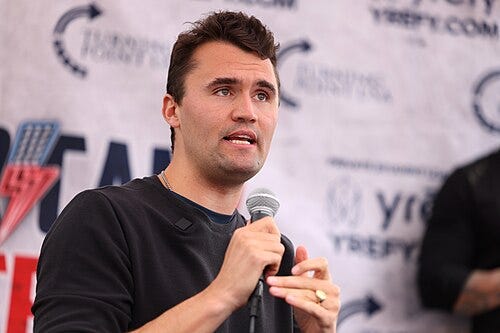
Resolution 4-07 has no trace of those original touchpoints. It does not decline the martyr designation on confessional grounds, nor engage with the idea of a day of remembrance, nor test the claim that a Christian was killed amid hostility to the Gospel. It simply removes the man, the death, and the question altogether, and sets in their place a condemnation of violence “in any form” by persons of “various political persuasions.” The hard question was not answered, but entirely avoided.
Blame them all
The formula that suffocates the resolution is “multiple assassination attempts of politicians and other public figures of various political persuasions.” The phrase is built to spread the blame for combustible kindling evenly across every corner, refusing to look for the culprits who supply the lighters and accelerants. Where the overtures had named a specific death and a specific hostility, the resolution meekly answers with a condemnation so general that it could have been drafted in any year of the republic, about any casualty of any faction or party. However, evasive generalities of that kind are hardly an example of neutrality; rather, they are an obvious decision about what the church is permitted to see and think.
What the overtures were clearly pointing at was a present danger attached to particularly toxic and deadly Christophobic ideologies.
Please don’t recognize the patterns
The very public assassination of a public Christian is something the church should not avert its eyes from, be it Charlie Kirk or Egyptian Copts having their throats slit by Islamists spun up via American meddling in the region. Charlie Kirk died in the open for a confession made in the open, and the killing was met in leftist and liberal quarters with justification and glee.
It was not a one-off glitch in the matrix. Left-wing violence has been steadily rising in murderous intent, ferocity, and frequency2. This January, a Sunday service at Cities Church in St. Paul was stormed by an anti-immigration-enforcement protest that singled the congregation out because one of its pastors works for immigration enforcement, and thirty-nine people, the former CNN anchor Don Lemon among them, now face federal charges of conspiracy against the free exercise of religion. Further north, arson against Canadian religious institutions more than doubled after ground-penetrating radar at former residential schools was announced to the world as the discovery of “mass graves of children” and evidence of hidden genocide. That children died at those schools is documented history, but the 2021 claim of secret mass graves was the separate and now-doubtful one, at worst a hoax and at best academic incompetence. The churches burned and were vandalized by the dozens, and the arsonists could not be bothered to wait for evidence, even as Prime Minister Trudeau, condemning the fires as unacceptable, pronounced the anger behind them “understandable”. According to the Macdonald-Laurier Institute’s analysis, fewer than four percent of the fires have resulted in so much as a charge. Whatever people think lies beneath the ground, the burning of a church is not an argument about graves or historical injustice, but targeted violence against Christians.
The organizations that profit from compiling lists of enemies have a stake in this. The Southern Poverty Law Center, whose “hate group” maps rely on broad brushing indiscriminate categorization, inspired a gunman to choose the Family Research Council for a 2012 attempted murder spree. Now, the SPLC was itself indicted in April 2026 by a federal grand jury in Montgomery, Alabama on eleven counts of wire fraud, false statements to a federally insured bank, and conspiracy to commit money laundering, the government alleging that between 2014 and 2023 it secretly routed more than three million dollars in donor money to individuals tied to the very extremist groups, the Klan among them, that it denounced in public and raised funds to fight. Therefore, it is a simple observation of evidence that our ruling establishment designates violence selectively and counts the victims unequally. Christians are conspicuously among the unequally counted.
That selectivity is the structure Resolution 4-07 forwards to the Convention floor. Shown a pattern that begs to be noticed, the committee reached for a blunt machete stamped with “various political persuasions” to amputate our five senses. A church should not become a partisan, but it has every obligation to see and grasp reality, for the sake of its children at least. So, a resolution that refuses to distinguish the arsonist from the fire he sets is not rising above secular quarreling to a high and admirable moral throne; it’s just pretending it does not have to notice, let alone be involved.
None of this is peculiar to Committee 4, which is all the more discouraging. The convention, across its whole workbook, met specific and often urgent demands in a uniformly hortatory mood. Wherever you read, the governing verbs are encourage, commend, and reaffirm. A decisive vocabulary is largely absent.
Conclusion
The proposed resolution quotes the Large Catechism at length, and the Luther passage it invokes says the devil “causes so much contention, murder, sedition, and war,” that he begrudges a man even a mouthful of bread eaten in peace. The committee has ended up quoting Luther on murder in the abstract while striking from its own resolution the one recent, concrete murder its overtures had set before it. A synod that condemns “all” political violence, at the very convention where it was asked to name the man killed while confessing Christ, and cannot bring itself to say his name, has not made peace with anyone or anything, but it may have branded itself a soft target.
Cover photo: “Video captured on Instagram shows Charlie Kirk being carried from event after he was shot by a gunman, Sept. 10, 2025” Screen grab from Instagram account of jeremyking_80 via https://www.cbsnews.com/news/timeline-charlie-kirk-fatal-shooting/
The default narrative of a Transtifa Super Soldier has drawn serious and technical dissent, even as the state has charged Tyler Robinson with murder. The most comprehensive open-source forensic challenge to the official version assembled to date is the independent analysis by John Bray at Follow the Epicenter. which posts its raw video and analysis code and asks to be checked rather than believed, marshals acoustic, optical, and ballistic evidence that it argues is inconsistent with the story of a single gunman firing a single shot, and that the reason and the method were darker than the official record is willing to allow. Ad Crucem News renders no verdict on the ballistics of that terrible day; we will wait for all the evidence. What is beyond dispute is that Charlie Kirk bore a bold Christian confession before tens of thousands and was killed in the course of making it.
Recent, specific incidents (2024–2025)
The assassination of Charlie Kirk — killed at a Turning Point USA event; described repeatedly as one of the most notable political assassinations in modern American history.
Two assassination attempts on Donald Trump — the first at Butler, Pennsylvania, in July 2024 (apparently by the mysterious Thomas Matthew Crooks), the second at the West Palm Beach golf course (by the Ukraine mercenary recruiter, Ryan Routh).
Shots fired at podcaster Tim Pool’s home — within the same time frame and political context.
Graphic, violent threats against Matt Walsh, his wife, and his children — Walsh confirmed the threats were specific and different in kind from ordinary online abuse.
An armed man going door to door at Benny Johnson’s home — where his wife and children live; the man ranted, was believed armed, and fled before police arrived.
The same man showing up at “Cat Turd’s” home.
The storming of the Sunday worship service at Cities Church in St. Paul, Minnesota.
The Dallas ICE facility shooting (Texas, 2025) — the gunman (“Joshua Jahn”) tried to shoot ICE agents and instead shot and killed detainees.
Antifa raids on ICE facilities — shooting at ICE agents and attempting to bomb ICE agents.
A National Guard soldier / Guardsman killed — Rahmanullah Lakanwal, a CIA trained Afghan paramilitary, killed 20-year-old Specialist Sarah Beckstrom of Summersville, West Virginia, and critically injured 24-year-old Staff Sergeant Andrew Wolfe of Martinsburg, West Virginia.
Categorical / mass-unrest
The 2020 BLM/Antifa riots — arson, assault, looting, and the months-long occupation of city blocks (the “summer of love”). Notably, this violence is excluded from standard terrorism datasets.
Ongoing Antifa street violence — treated as disconnected low-grade incivility instead of sustained terrorism.
Historical and analogical references
President William McKinley — assassinated by an anarchist, 1901.
1970s left-wing terror — “over 2,000 bombs planted in 1972 alone,” tied to the Weather Underground, specifically terrorists Bill Ayers and Bernardine Dohrn, who were rewarded with professorships and prominent roles in elevating Barack Obama from their Hyde Park hangout.
The Spanish Civil War of the 1930s — assassination of the Spanish prime minister and several party leaders, notable as a pattern of political-terror escalation.
This quote has kept coming to my mind over the last few years regarding the LCMS.
“We make men without chests and expect from them virtue and enterprise. We laugh at honor and are shocked to find traitors in our midst.”
― C.S. Lewis, The Abolition of Man
Pastors, be a man with a chest. Be strong and courageous. Be like the Martyrs. Be like Charlie Kirk. Not the cowards from floor committee 4.
Sad missed opportunity for the LCMS to take a definitive stance on the evil, anti Christian movements. I know personally individuals who started attending church or changed churches as a response to Charlie's death.