
LCANZ and Uniting Church Resume Fellowship Talks After Women’s Ordination Vote
LCANZ meets with Uniting Church in Australia, signaling that ultimate agreement on altar and pulpit fellowship cannot be far off.

Lutheran Church of Australia and New Zealand (LCANZ) Bishop Paul Smith met in Melbourne with Uniting Church in Australia (UCA) President Rev. Charissa Suli to continue theological dialogue between the two denominations. The stated goal of the dialogue is altar and pulpit fellowship, equivalent in Lutheran terms to full communion.
Smith told the dialogue group that the two churches should consider how to learn from each other about living with differing opinions, citing LCANZ’s 2024 decision to permit two views on female ordination (which, in practice, only permits one view).
Six Times a Charm
On October 5, 2024, the LCANZ Convention of the General Synod voted for the sixth time since 2000 to allow female ordination to the preaching office. The sixth vote finally crossed the required ⅔ majority threshold required to amend the Theses of Agreement. Within months, the LCANZ ordained its first women pastors in April 2025.
The International Lutheran Council (ILC) reduced the LCANZ from Associate Member to Observer following the vote, and by March 2025 its Board of Directors voted to remove the LCANZ from observer membership entirely after the church confirmed it would not reconsider the decision. Lutheran Church Canada (LCC) declared through President Timothy Teuscher that the vote had “severed the bond of fellowship” between the two bodies, ending an agreement in place since 1994.
Lutheran Mission Australia (LMA) was formed following the 2024 vote and was accepted into the ILC as a Recognized Organization in September 2024, with a launch service in November. LMA has argued that the ordination dispute reflects a broader shift in the LCANZ’s hermeneutical approach to Scripture.
A Forty-Seven-Year Dialogue
The LCA–UCA Dialogue was established in 1978 with the stated aim of establishing pulpit and altar fellowship. Through the 1980s, the dialogue produced agreed statements on Justification, Law and Gospel, Baptism, Ministry, and the Church, all received by both denominations as stages toward fellowship.
The process stalled in 1993 when the UCA declared that fellowship had essentially been achieved, a view the LCA did not share. A subcommittee reported that getting both bodies to conform to a shared understanding of the nature of the church “could prove an endless task.”
Dialogue resumed in 1997 with a shift toward practical cooperation. This phase produced guidelines for cooperating congregations, shared ministry arrangements, a Declaration of Mutual Recognition (2009–2010), and a 2022 joint statement on Holy Communion titled “At the Table”. The LCA’s website described the approach, known as Receptive Ecumenism, as yielding the “refreshing discovery that our two Churches’ positions on the Lord’s Supper complement one another far more than previously thought.”
The “At the Table” document stated that a Concordat toward full communion would require “study and agreement in regard to the ordering of ministry, including the matter of the ordination of women, not currently permitted in the LCA.” The October 2024 vote removed that barrier. In October 2025, the UCA dialogue group reported that the LCANZ’s recognition of women’s ordination had “given renewed energy to the Dialogue’s work on ministry.”
Comparative Denominational Trajectory
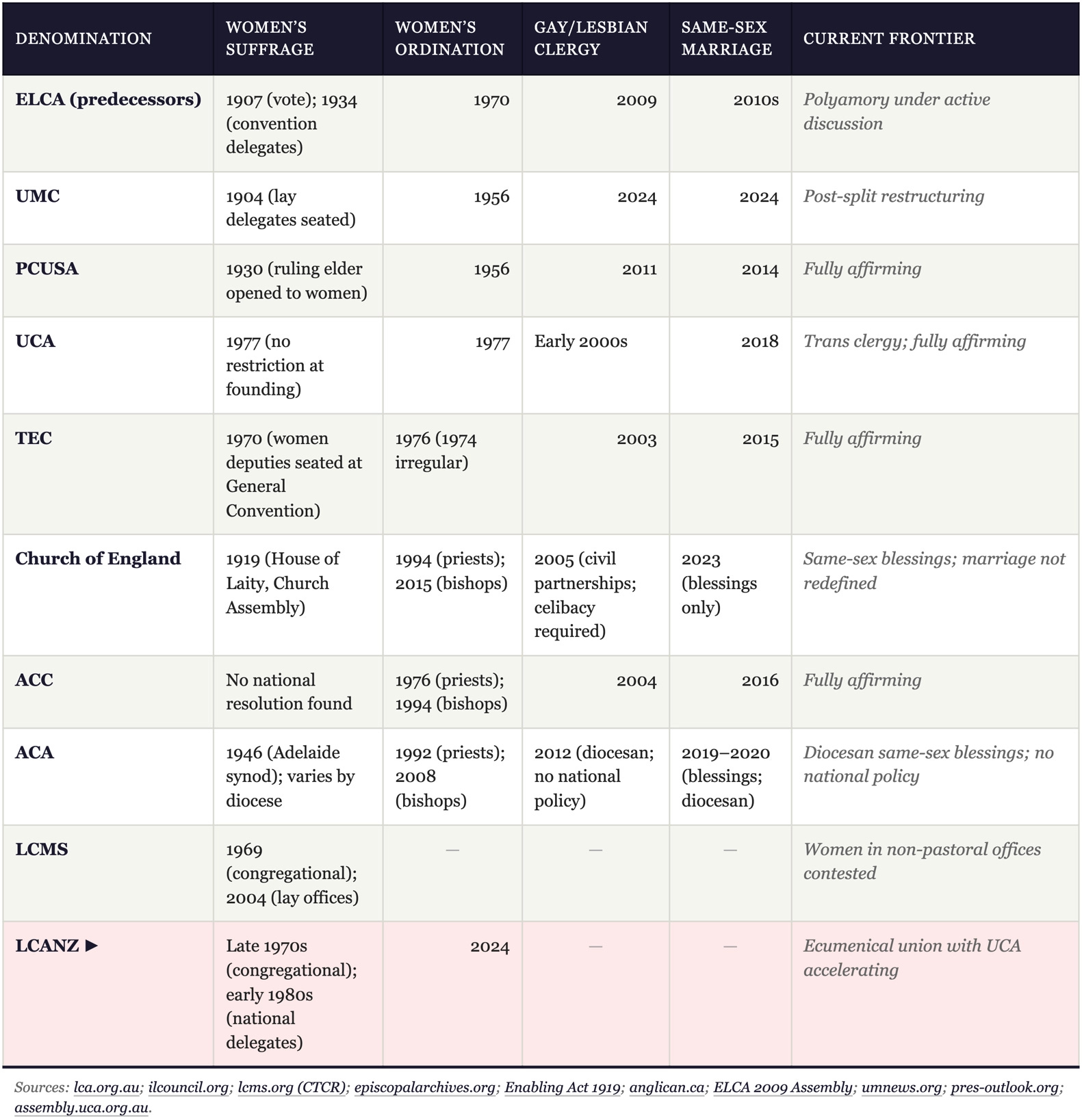
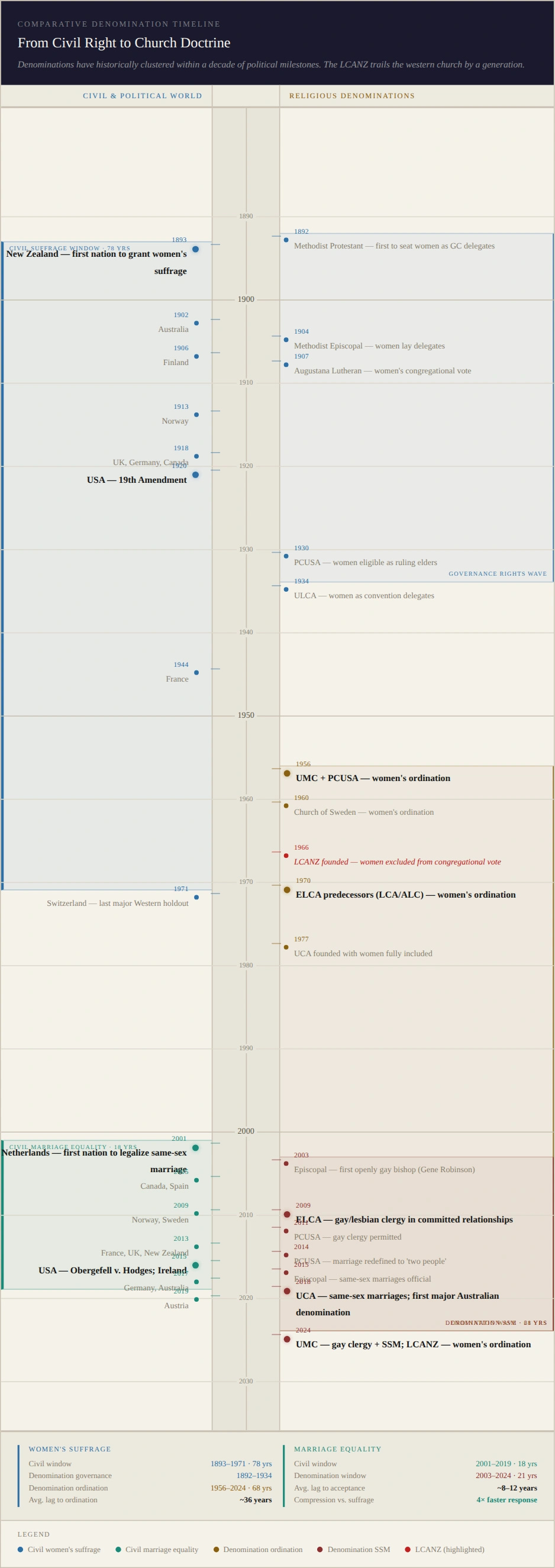
The LCANZ formally excluded women from congregational voting at its 1966 establishment, a full generation after comparable denominations had resolved the question. It moved through female suffrage, female lay leadership, and female ordination in roughly 58 years. For comparison, the UMC took 120 years from seating women delegates (1904) to adopting same-sex marriage (2024).
The UMC and PCUSA both granted full clergy rights to women in 1956. The ELCA’s predecessor bodies did so in 1970. The UCA did so at its founding in 1977. Each denomination subsequently addressed questions of gay and lesbian clergy and same-sex marriage, resolving them in the same direction. The ELCA moved from women’s ordination (1970) to openly partnered gay and lesbian clergy (2009) in 39 years. The UCA reached same-sex marriage in 41 years. The PCUSA changed its constitutional definition of marriage from “a man and a woman” to “two people” in 2014. That was just three years after eliminating barriers to ordaining clergy with same-sex partners. The UMC removed its “incompatible with Christian teaching” language regarding homosexuality and approved same-sex weddings in May 2024.
The UCA became the first major Australian denomination to endorse same-sex marriage in July 2018, nine months after federal legalization. It was also the first Australian denomination to allow openly gay ordination. As of 2024, the UCA has openly gay and lesbian clergy in four synods and at least one openly transgender ordained minister.
Extraordinary Lutheran Ministries, an ELCA-affiliated organization for LGBTQ rostered leaders, published a 2018 reflection from a polyamorous member noting that its board and community had “been engaging in conversation around the topic of polyamory.” When the ELCA subsequently proposed conduct guidelines making marriage the standard for clergy relationships, LGBTQIA advocacy groups objected that marriage should not be elevated as the sole valid framework for clergy sexual relationships.
The LCMS, which also traces its heritage to German Lutheran immigration, permitted women’s congregational suffrage in 1969 and opened non-pastoral lay offices to women in 2004. It continues to prohibit women’s ordination.
The Episcopal Church (TEC) seated women deputies at its General Convention in 1970 and ordained women to the priesthood in 1976, after a guerrilla action to proceed with irregular ordinations in 1974. Consequently, that produced the consecration of Gene Robinson as its first openly homosexual bishop in 2003. The Robinson case also demolished restrictions on divorce, since he was married (with two daughters), for 13 years before “coming out as gay” in 1986. Robinson was in a civil union with a man from 2008, converted it to a marriage in 2010, but divorced in 2014, a year after retiring. A year later, the TEC authorized and implemented same-sex marriage rites.
The Church of England admitted women to the House of Laity in 1919, ordained women priests in 1994, and authorized same-sex blessings in 2023 while ostensibly retaining its traditional definition of marriage. The Anglican Church of Canada ordained women in 1976. It approved same-sex marriage at General Synod in 2016. The Anglican Church of Australia ordained women priests in 1992, and individual dioceses have authorized same-sex blessings beginning in 2019.
Comparative Denomination Timeline
One thing is never surprising: the devil never gives up in his efforts to destroy the church. However, when the Lord Jesus returns in glory, the devil will have no choice but to surrender as he is thrown into the lake of fire along with all his demons and those who followed him!
This continues to show me we must reverse the allowance of female voting in our congregations and synod broadly.