
Harrison's Five-Vote Presidency
President Matthew Harrison is elected for a sixth term as LCMS President on the third ballot by just five votes, consistent with last week's forecast.

The third ballot of the Missouri Synod’s presidential election has returned the incumbent, Rev. Dr. Matthew Harrison, to office for a sixth and final term with a bare majority of 50.1 percent, the narrowest decision the contest could have produced and the one our forecast had marked as most likely, a crossing of the fifty-percent line on the third round rather than the fourth. Of the 5,038 valid ballots cast, at a convention-high 92.0 percent turnout, Harrison took 2,524 to the challenger Rev. Dr. Joel Biermann’s 2,414, with 100 remaining on the line of Rev. Benjamin Ball, who had asked his own supporters to spend their votes on the incumbent. The figure that will define the term is not Harrison’s 110-vote lead over Biermann but his margin over the majority line itself, because 2,524 is exactly five votes more than half the ballots cast, so the third round was decided, and a fourth averted, by five votes, a result that seats a president without seating a mandate at the close of a contest the incumbent led on every ballot yet could not finish until a rival pointed a bloc his way.
The narrowest of decisions
The seven-model statistical ensemble this site published before the round proved essentially correct, calling Harrison to cross fifty percent first, most likely on the third ballot, and naming the incumbent the favorite in better than nine of ten simulations. What the model could not promise, and did not, was room to spare. Its central projection carried Harrison to a bare 50.7 percent, and its own account of the race put the likeliest margin at the thin end of a wide band, so a five-vote majority does not contradict the projection. Harrison’s share climbed from 43.8 percent on the first ballot to 46.3 percent on the second and to 50.1 percent on the third, while Biermann climbed faster from behind, 39.0 to 46.0 to 47.9, the two drawing level at the second ballot before Harrison pulled just across the majority line on the third. That line, moreover, rose as he approached it, because turnout climbed to 92.0 percent on the third round, the highest of the three, so the incumbent reached his majority into the stiffening headwind the forecast had named rather than away from it.
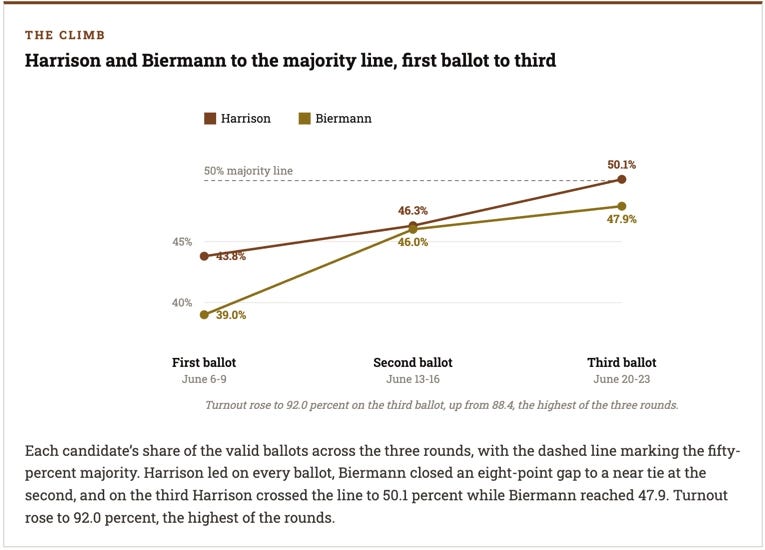
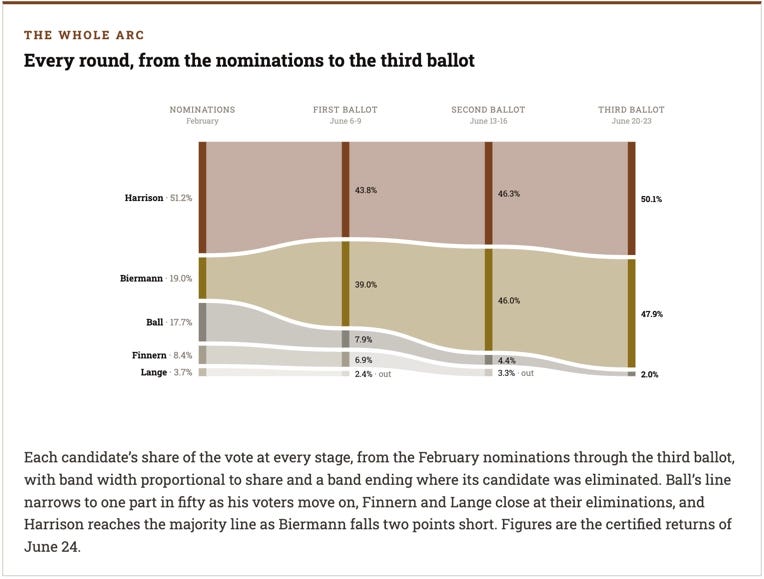
Read across every phase rather than at the finish alone, the contest is as much a story of transfer as of turnout, the smaller blocs emptying round by round while the two leaders drew level, and Ball’s support, once it had been pointed at the incumbent, fell to a residual of one vote in fifty.
A win without a mandate
Harrison’s lead over Biermann was 110 votes, a margin that would read as comfortable in some contests, yet the majority that actually elected him cleared the required halfway mark by only five votes, short of which the third ballot would have failed and a fourth begun, as slender a hold on the office as a majority can be. Harrison has led the church since 2010, and yet on the first ballot of 2026, he could not gather a majority, nor on the second, nor on the third by more than that handful, which is to say that a delegate body that had returned him before declined to return him easily now. The arithmetic that put him over is borrowed arithmetic. Before Ball directed his bloc toward the incumbent, the same released votes leaned to Biermann, and every defensible projection favored the challenger, so the margin records not a groundswell for Harrison but a transfer to him.
The consequence is a house divided almost exactly in two, 50.1 percent to 47.9, with nearly half the convention having preferred another man at the last. Such a result confers the gavel and constrains its use, because the resolutions still to be debated, the appointments still to be made, and the priorities the president set out for the term ahead all meet a floor that gave him its confidence by the narrowest measure it could while still giving it at all. A bare majority is a mandate to hold the existing settlement, not a commission to remake it, and the president who reads it as more than that will make trouble for himself. As predicted, President Harrison is the lamest of lame ducks for his final term.
Ball: benefactor’s bill
The man who supplied the margin may be the man it costs the most. Rev. Benjamin Ball did not withdraw from the presidential race so much as redirect it from within, asking the delegates who had chosen him to vote for Harrison while his own name stayed on the ballot, and the five votes that separate the incumbent from a fourth round are plausibly the gift of that request. Ball is no bystander to the Synod’s offices, but its Second Vice-President, the elected vice-president for the Central Region, and his nomination statement for 2026 had already named that vice-presidency the more prudent service, judging the duties of parsonage and school better paired with a regional office than with the presidency he was nominated to seek. He carried the Central Region’s nominations for his own seat with 185 of 265, the front-runner’s share by a wide hand.
Yet the man Harrison just defeated stands on that same Central Region ballot. Biermann, who pushed the incumbent to within five votes of a fourth ballot before falling short, was nominated for the regional vice-presidency as well, and where he is short by the nomination count, he is not short by name, having spent three rounds before the whole convention as the alternative who nearly flipped the contest. A floor that came within five votes of denying Harrison his majority is positioned to make Biermann a vice president, and to do so by unseating the very incumbent whose endorsement secured that majority. Should that aftershock arrive, and it would take the floor following the profile rather than the nomination sheet that still favors the incumbent vice-president, Ball will have settled the presidency on Harrison and surrendered his own seat to the claimant he turned aside, the kingmaker billed for the crown he bestowed. The regional contests are decided on the floor at the convention, where the standings on the election tracker can move further than any nomination sheet foretold.
The verdict
Harrison governs, then, but on the narrowest sufferance the office affords, returned by the margin the model had predicted as the likeliest shape of the race and owed to a bloc that was lent rather than won. The convention’s second act, the regional vice-presidencies settled on the floor, may yet answer its first, seating the president’s defeated rival among the officers and removing the ally who carried him across the line, so that the same week ends with Harrison in the chair he nearly lost and Ball out of the one he expected to keep.
Method and source. The third-round result is the certified return reported by the Office of the Secretary on June 24, 2026: of 5,038 valid ballots cast at 92.0 percent turnout, Matthew C. Harrison received 2,524 (50.1 percent), Joel D. Biermann 2,414 (47.9 percent), and Benjamin T. Ball 100 (2.0 percent), Harrison achieving the majority required by Bylaw 3.12.2.4. Half of the ballots cast is 2,519, so the majority stands five votes past the halfway line. The first- and second-ballot standings are the certified results from the same office (second ballot: Harrison 2,243, Biermann 2,229, Ball 212, Finnern 158; 4,842 cast, 88.4 percent turnout). The pre-round forecast referenced is Ad Crucem News, “LCMS Election Math Favors Harrison, Even if Turnout Rises,” which put Harrison’s eventual win near ninety-four percent and his third-ballot crossing near seventy. Ball’s endorsement is his congregational letter, “This Man Receives Sinners,” June 18, 2026; his office is recorded on the LCMS leadership roster; the Central Region vice-presidential nominations (Ball 185, Schuermann 27, Biermann 22, Cloeter 22, Brock 9, of 265) are from the published 2026 slate, the seat decided by convention-floor ballot. Compiled by Ad Crucem News; editorial analysis, no Synod imprimatur.
At least no Biermann, the guy who quotes Forde favourably and suggests that sometimes pastors should give their congregations a "surprise" with some fun variation of the usual Sunday service
I do find it ironic that so many confessionals were worried about a Biermann presidency because of his stance on self-defense in the Large Catechism and eagerly supported Harrison, the same guy who approved the Large Catechism, and thereby Biermann's essay.