
Another Congregational Governance Crisis Boils Over in the LCMS Southeastern District
A congregation has experienced an intensifying series of governance failures, including financial opacity, apparent constitutional noncompliance, and institutional self-dealing.

When a member of a Lutheran Church—Missouri Synod (LCMS) congregation discovers that something is amiss in his or her congregation, what is the faithful course of action? The answer should be straightforward, given our overlapping polities with constitutions, bylaws, and fiduciaries. The Synod has a President vested with supervisory authority over District Presidents, who, in turn, are charged with supervising the congregations in their care. Supposedly, the LCMS has processes that surface, examine, and correct problems without the whole thing devolving into a spectacle of hurt feelings, recriminations, and scandal.
That, at least, is the theory. The practice, as it turns out, is something else entirely.
A member of a Maryland (LCMS Southeastern District (SED)) congregation, referred to hereafter as “X”, recently approached Ad Crucem News with a detailed set of governance and financial concerns about the member’s church. They are the kind of questions that any fiduciary, any treasurer, any congregational president, any pastor, any district official should welcome and be able to answer without hesitation, if the books are in order.
The questions revolve around compensation transparency, whether the congregation’s constitutional processes are being followed, financial arrangements with a building-sharing congregation of a different confession, and whether the math of the annual budgets adds up at all. It is not even clear whether the LCMS congregation holds a clear title to the property it has paid for. These are not accusations developed from personal grievance or professional ignorance. They are specific, documented, and grounded in the congregation’s own records, bylaws, and the basic governance standards applicable to any organization, but especially to a religious non-profit.
X has done everything by the book, raising concerns privately through the congregation’s authority and leadership channels. X sought reasonable answers from the people who are supposed to provide them, but received silence, deflection, ostracism, and shaming in return. Fellow congregants, some of whom have independently reached similar conclusions and some of whom have already departed in frustration, are willing to corroborate the complaints.
The picture that emerges is not of a minor bookkeeping error or an inconsequential administrative oversight, but of a persistent pattern of failure and concealment. The congregation has experienced an intensifying series of governance failures, including financial opacity, apparent constitutional noncompliance, and institutional self-dealing, that have deepened over the years.
Our analysis has identified over twenty critical governance discrepancies at this congregation, spanning financial, constitutional, pastoral, and regulatory domains. What follows is a summary of the six broadest categories; the granular evidence will be published in subsequent installments.
The situation in Maryland corresponds closely to the institutional death spiral we have described for congregations entering the end stages of their organizational lives. In this case, the congregation no longer appears to function in a recognizably legitimate form. The questions raised are serious enough to warrant independent review.

Silence Is the Loudest Noise
Ad Crucem News has been asked by concerned members of the Maryland congregation to look into these matters. In the interest of fairness, accuracy, and the Christian duty to hear all sides before drawing conclusions, we prepared tailored sets of questions and transmitted them to six individuals with direct knowledge of and responsibility for the congregation’s affairs:
the District President of the Southeastern District;
the congregation’s Pastor;
the current Congregational President;
a former Congregational President with longstanding involvement;
the current Treasurer; and
a former Treasurer who has attempted financial reforms.
We gave each recipient a week to respond and assured them that this inquiry is not adversarial. Their responses would help ensure that any reporting reflects the full picture and gives a fair hearing to all parties. Each was offered the option of responding by telephone if preferred.
Five of the six recipients have remained silent. No acknowledgment. No rebuttal. No explanation. No request for more time. Not one word.
The sixth, District President Harmon, has responded. His reply, reproduced in its entirety below, deserves careful reading.
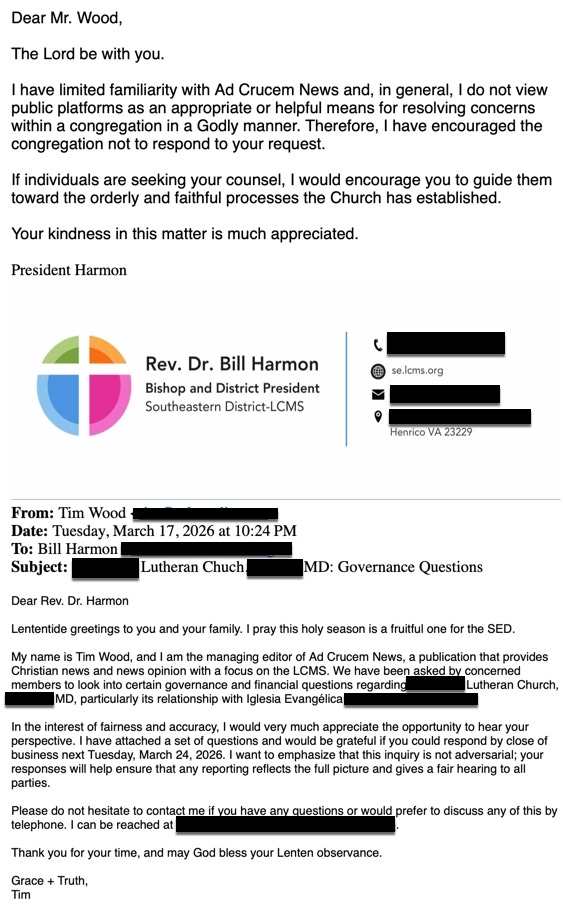
This is a surprising response for someone who is constitutionally charged with supervising the congregations in his district, ensuring doctrinal fidelity and good order, and being the shepherd of shepherds. He does not say, “These are serious questions, and I will look into them. Thank you for bringing this to my attention.” He does not deny that problems exist. Instead, he “encourages” the congregation not to answer the questions. He then invokes “the orderly and faithful processes the Church has established”, but those are the very processes that have already failed to produce satisfactory or meaningful answers when pursued privately and through the commended channels.
Having failed to receive a substantive response from DP Harmon, X also contacted Synod President Matthew Harrison, as did others in the congregation. To date, X’s correspondence has never been acknowledged, nor have those of other members. The entire chain of ecclesiastical authority, from the congregation to the District to Synod Inc., has declined to engage with the matter, which is what led X to seek help elsewhere.
Readers of Ad Crucem News will recognize SED District President Rev. Dr. Bill Harmon’s name from the dispute that developed at another church in his district, Our Savior Lutheran Church and School (OSLCS) in Arlington, Virginia. That case involved a pastor who modeled a transgender stole in the chancel, a school that took first graders to an LGBTQ+ musical at the Kennedy Center, Islamic proselytization books in the school library, and the exclusion and retaliation against members who raised doctrinal objections through proper Matthew 18 channels. When four members submitted a formal investigation request to Harmon in May 2025, he spoke with the pastor and congregational leadership, but, according to the complainants, did not interview them. He closed the investigation in June 2025, declaring the pastor had “remained faithful to his ordination and installation vows.” The complainants maintain that this conclusion was reached without examining the evidence they had compiled.
Now, barely four months later, the pattern of response at another SED congregation looks similar.
The broader pattern is familiar to anyone who monitors institutional dysfunction across the LCMS. When the processes fail, the institution’s reflex is not to fix them but to insist, with an air of theatrical pastoral gravity, that everyone must continue using them because they are long-established and on the books. The fact that they produce no or limited accountability is treated not as evidence of failure but as evidence that the questioner lacks patience, piety, or charity.
We must gently note that the Scriptures do not share this confidence in process for its own sake. “By their fruits you shall know them” (Matthew 7:16) is a results-oriented standard. It would be helpful if our doctrine of sin also had some purchase in our governance, which is why the foundations of the Synod’s governance approach need examination.

What the Questions Would Have Clarified
Since neither the congregation’s leadership nor the District President has chosen to address these matters privately, and since the “orderly and faithful processes” have thus far produced only silence, we will lay out, in broad terms, what our investigation has uncovered so far. The governance concerns at this congregation fall into several distinct but interlocking categories.
1. Financial Opacity
The congregation’s annual expenditures substantially exceed any plausible estimate of its members’ aggregate giving capacity. When one compares the total expense budget against the realistic ceiling of what a congregation of this size and demographic profile can generate through tithes and offerings, one is left with a large annual gap that must be financed from somewhere.
The balance sheets show no new debt. They show no significant drawdown of existing reserves. The money is coming from somewhere, and the most obvious source is the guest congregation that dominates use of the building. If that is the case, the scale of the contribution raises substantial questions about organizational independence and about whether the financial relationship has been properly disclosed and characterized.
2. Compensation Questions
Based on the congregation’s own budget documents, the pastor’s total compensation package accounts for over 50% of the congregation’s annual budget. According to the District’s published salary guidelines, his base salary appears to exceed the recommended range for a minister at his experience level, particularly given that he holds a Specific Ministry Pastor (SMP) certification. By comparison, a sister LCMS congregation of similar size in the same area compensates its pastor, a man with substantially more experience who holds a certification for general ministry, at a considerably lower figure.
Based on available records, additional paid staff positions appear to have been created without the congregational approval required by the constitution. At least one of these positions is filled by a family member of existing leadership, and another by a family member of the pastor. These arrangements present conflicts of interest that standard nonprofit governance requires to be disclosed and managed, if not avoided entirely.
In aggregate, these are not isolated irregularities. They describe a congregation whose governance appears to have been captured by a small circle of individuals who have systematically insulated themselves from the constitutional checks the Voters’ Assembly is supposed to provide.
3. Constitutional Non-Compliance
The congregation’s governing documents require that officers be elected by the Voters’ Assembly for defined terms. Available evidence suggests that at least one officer has remained in his position beyond the expiration of his term without a new election, constituting a de facto self-reappointment. The office of Congregational President has turned over repeatedly under pressure, with at least two presidents resigning under circumstances connected to disputes with entrenched leadership. One individual has resumed the presidency multiple times, thereby concentrating authority that the Constitution is designed to prevent.
New positions and titles appear to have been created and filled without the constitutionally required vote of the congregation. The Voters’ Assembly, the body that under LCMS polity holds ultimate temporal authority in a congregation, has been effectively circumvented.
4. Pastoral Credential Questions
The pastor’s ordination pathway (Specific Ministry Pastor) includes specific restrictions, among them a requirement for ongoing supervisory oversight by a pastor holding full certification. Available information raises questions about whether these supervisory requirements are currently being met. The pastor was certified for limited ministry in another state, and it is not clear from the available records whether he was subsequently certified for general ministry as a sole senior pastor.
5. Building-Sharing Arrangement
The congregation shares its facilities with an independent religious entity under a Memorandum of Understanding (MOU). The financial terms of this arrangement are opaque, and the visible terms heavily favor the guest congregation. Board of Trustees minutes confirm that a signed MOU has been returned, but the document itself has not been made available for inspection to the congregation at large. Moreover, the MOU does not appear to bear the signature of an authorized officer of the guest congregation, which raises questions about its legal validity.
If the guest organization’s financial contribution is as large as the funding gap analysis suggests, the arrangement may have crossed the line from a building-sharing agreement into something closer to a financial dependency. Such a relationship would raise questions under federal tax law, including whether revenues from the arrangement constitute unrelated business taxable income (UBTI) and whether the financial flows are being properly characterized and reported.
6. Syncretism and Unionism
LCMS Constitution Article VI prohibits member congregations from engaging in unionism and syncretism, that is, from sharing altar and pulpit fellowship, or participating in joint worship and ministry, with congregations or organizations that hold a different confession of faith.
The guest congregation is not an LCMS congregation. It is listed each week in the host congregation’s Sunday bulletin as “one of its missions.” However, it is conspicuously absent from the congregation’s website (which boasts many other missions). Alarmingly, the guest congregation lists the host church’s address as its legal domicile in state filings and other public documents. The guest congregation, by its own description, is an independent, non-denominational Pentecostal church committed to a different confession of faith.
When an LCMS congregation shares its facilities with a church of a different confession on a scale where the partner’s financial contribution and building occupancy dominate, the arrangement has moved well beyond a landlord-tenant or charitable “mission” relationship. At that level of interdependence, the question is no longer whether the two organizations are merely sharing a building, but whether they are functionally operating as a single ministry.
In that case, can the LCMS congregation’s confessional identity and operational independence be maintained in any meaningful sense?
What Comes Next
This is the first in a series of articles about this congregation, which, based on the evidence we have reviewed, appears to have been failed by its own leadership. We have documentation and corroborating witnesses. We have the congregation’s own financial records, board minutes, published bulletins, and constitutional documents. We have given every accountable party the opportunity to respond, and with the exception of the District President’s instruction not to engage, the uniform preference has been silence.
In subsequent articles, we will highlight where the congregation needs help to restore proper governance and control over its facilities. We do this not out of malice but out of the conviction that the Lutheran confessional tradition demands both grace and truth, and that truth does not become optional when it is inconvenient for the institution.
Our reporting on the OSLCS Arlington dispute ultimately brought a measure of justice and vindication for the whistleblowers, and some restoration of good order. Every institution that had the authority and the duty to act in that case failed to do so until the evidence was made public. The “orderly and faithful processes” did not work at OSLCS Arlington until the lights were turned on.
So, we are turning on the lights again. This time, the concerns are financial as well as doctrinal, and, in some respects, they may prove more serious: the arithmetic alone raises questions that, depending on what a closer examination reveals, could warrant forensic financial review.
The whistleblower, X, has done everything the church asks its members to do. X raised concerns. X went through channels. X sought a resolution privately. When that failed, X sought the counsel of the District President. When the DP declined to engage, X contacted the Synod President and then Ad Crucem News. Only Ad Crucem News responded and commenced a review of the evidence.
That is not good order. It is institutional indifference, and the members of this congregation deserve better.
If you are a member of an LCMS congregation experiencing similar governance concerns and similar institutional indifference, you are not alone. Ad Crucem News is easy to reach.
A point of clarification for readers regarding OSLCS: the only order that has taken place to date, as far as original complainants are aware, is fmr. P. Fredericksen's resignation (though he maintains(ed?) involvement with the church - this was brought to DP Harmon's attention). The Elders, Church Leadership, and School Staff have not retracted their public stances/actions re LGBTQ matters & Islamic proselytizing material (a few books have supposedly been removed from the school library but not all). Same teachers and principals maintain their respective roles. They've not rescinded their banishment orders for those of us who received letters. The congregation maintains that Synod's stances on LGBTQ matters are immoral (as expressed during a congregational meeting with DP Harmon and reported by Ad Crucem).
Thank you, Ad Crucem. Prayers for X's congregation.
Good reporting. The Southeastern District congregation member complainants caught in these disputes, not by their own fault, but out of their faithfulness to our Lord Jesus Christ, are particularly blessed to have Ad Crucem’s help.
A related, interesting stat I saw published by the ACELC (Association of Confessing Evangelical Lutheran Congregations) recently in their January 2026 minutes, comes to mind: “In researching Dispute Resolution, the Documents Committee found that it takes over 400 days, at a minimum, to address a public sin. This hinders Ecclesiastical Supervision. They are preparing a letter to the Council of Presidents on this topic.”