
Who Is Losing or Gaining the Church in America?
Mainline Protestantism is in freefall, and Confessional bodies are declining. Only the nondenominational and the unaffiliated are growing, and that may not be the good news it looks like.

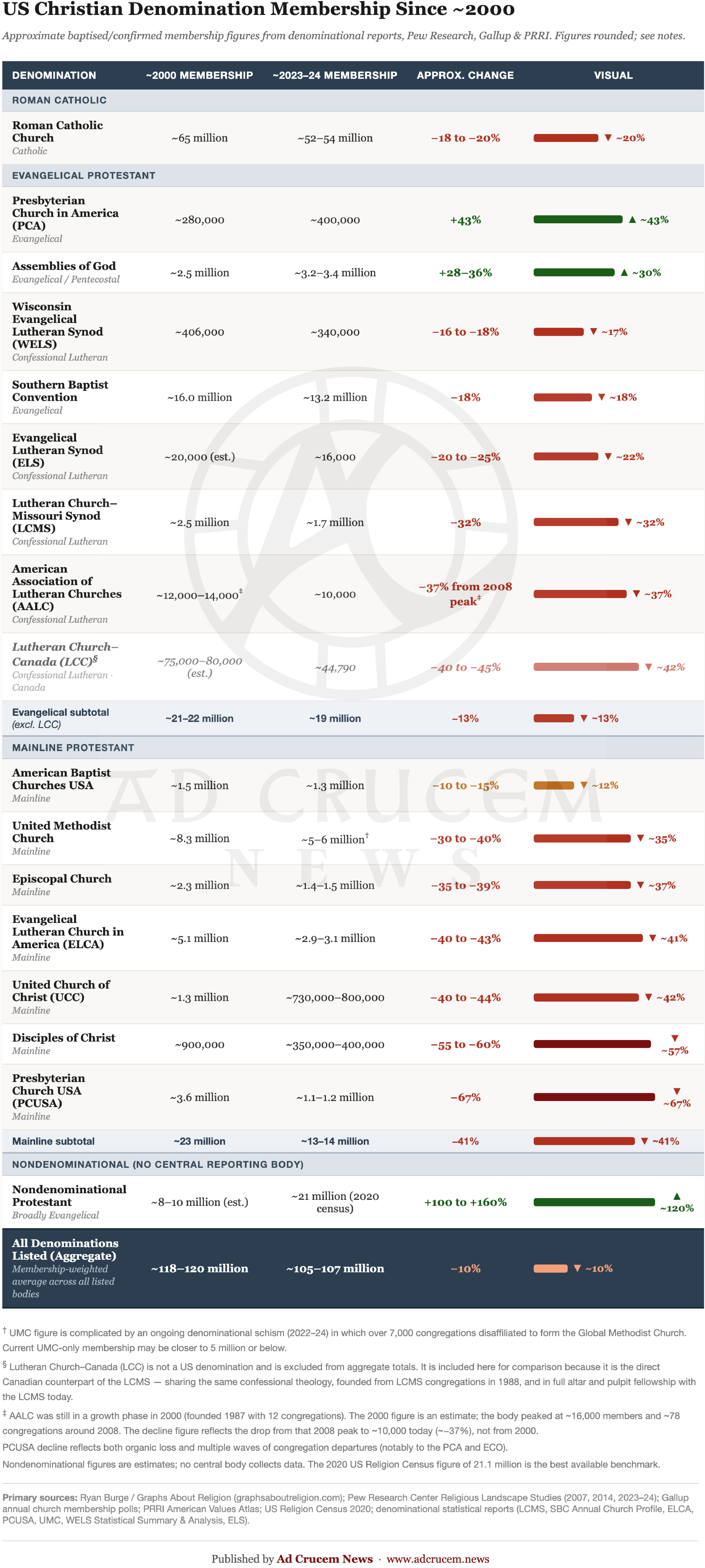
Across the church bodies surveyed (Roman Catholic, Evangelical Protestant, Mainline Protestant, and Non-Denominational), aggregate membership has declined dramatically for nearly everyone. It fell from approximately 118-120 million to 105-107 million, a net loss of roughly ten percent over two decades. The totals, however, obscure significant variance within the meta categories, suggesting a different story to be told for each “tribe.”
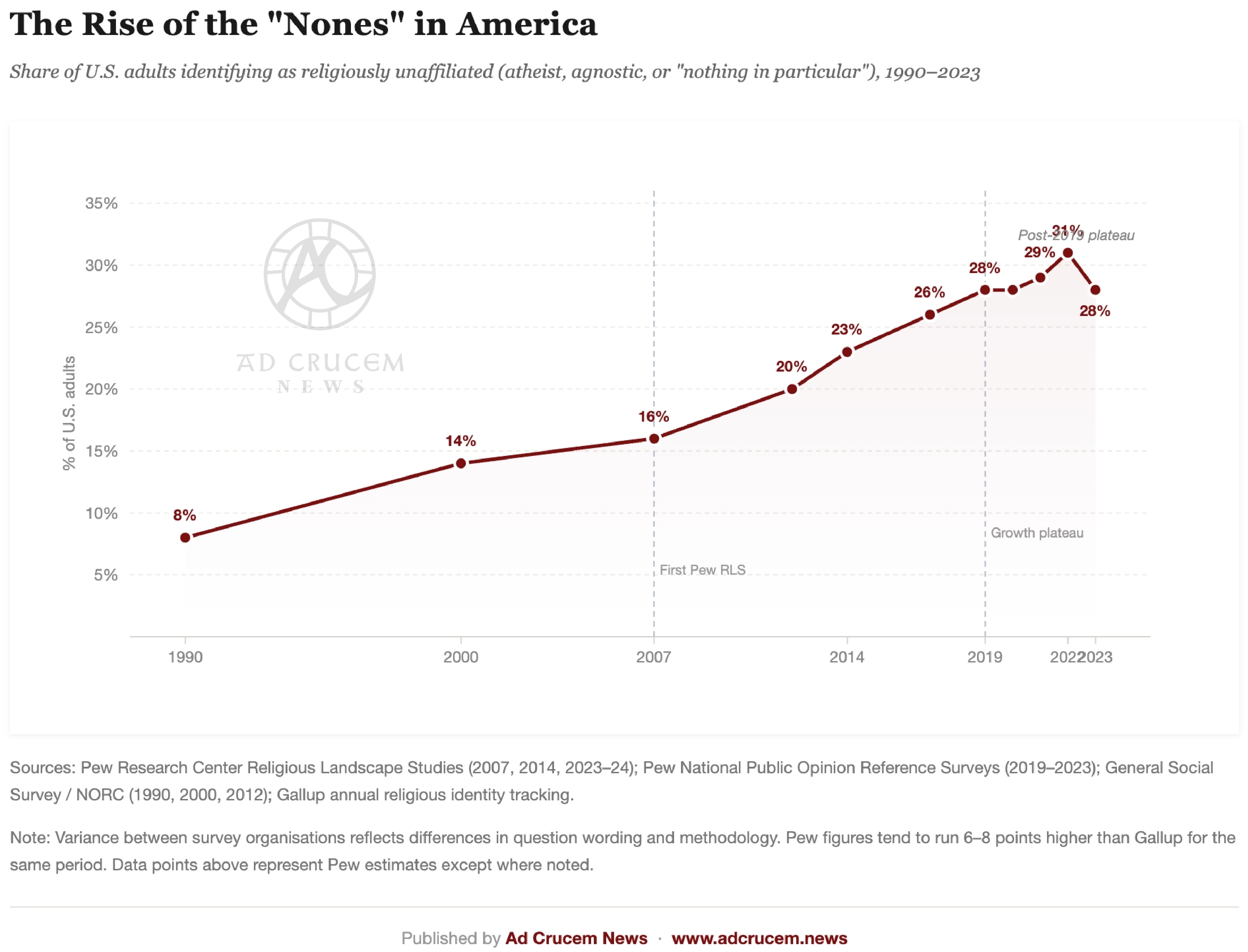
The biggest story is one not shown in the table below. In 2000, approximately 14 percent of U.S. adults identified as “religiously unaffiliated”. By 2023, that figure had reached 28–31 percent depending on the survey instrument, making the “nones” (atheists, agnostics, and those who describe their religion as “nothing in particular”) now the single largest cohort in American religious life. They outnumber even Catholics, and they outnumber evangelical Protestants, which includes the once mighty Southern Baptist Convention (SBC). Consequently, the denominational membership losses recorded in the table below do not simply represent inter-denominational redistribution. Rather, a substantial portion of the membership and worship attrition has not moved from one church to another, but has left the building entirely.
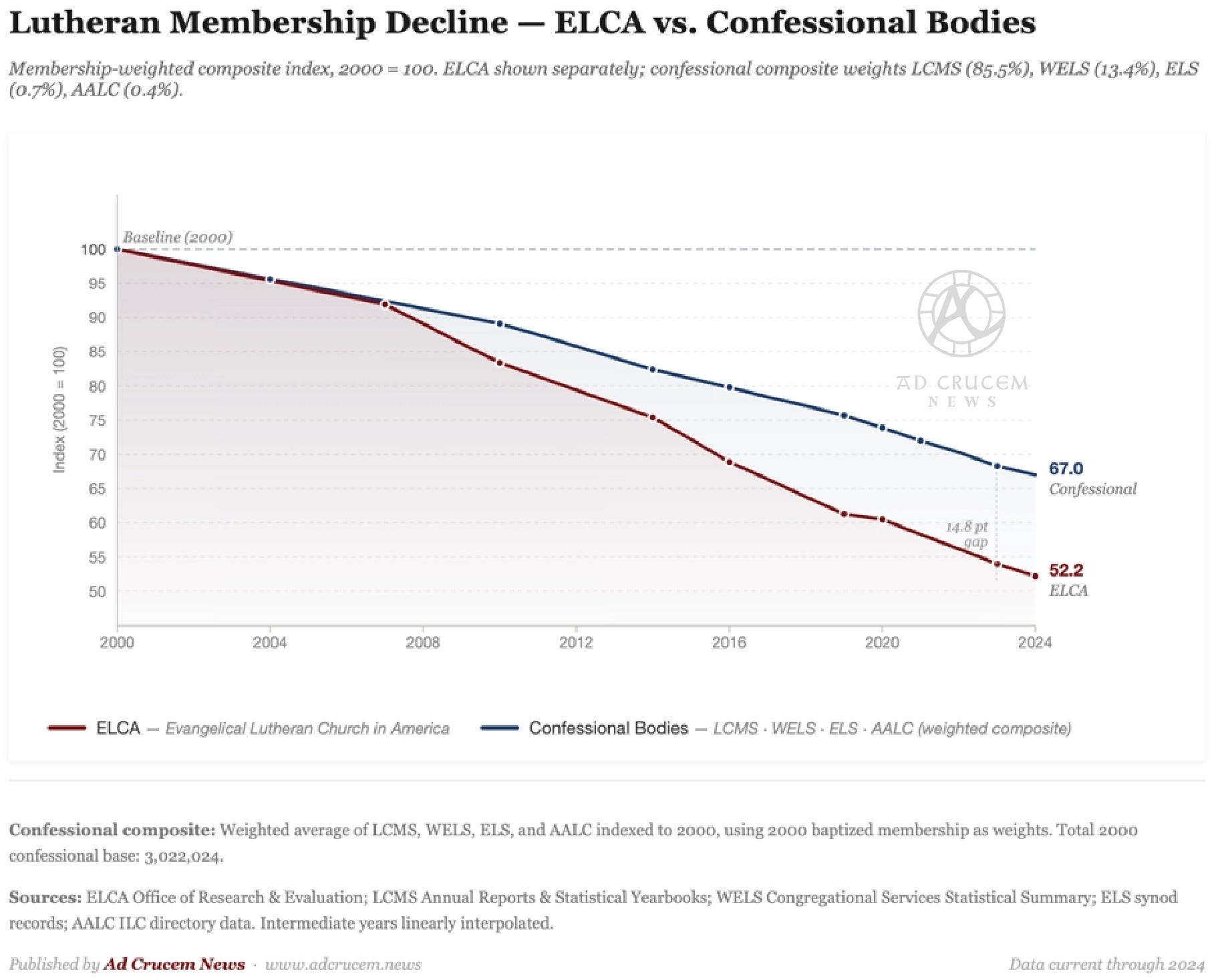
Mainline Protestantism shows a weighted-average decline of 41 percent across the seven denominations surveyed. The Presbyterian Church USA gave up approximately two-thirds of its 2000 membership. The ELCA lost nearly half. For all the mainline churches, there has been sustained, directionally consistent sloughing off for decades. Governance liberalization, theological pluralism, and the progressive substitution of cultural accommodation for confessional steadfastness have all compounded, creating an apparently insurmountable structural and theological crisis. This decline is not just an accident of demographics. It is a predictable product of deliberate institutional decisions and of accommodations like endorsing birth control and treating children like lifestyle ornaments that impinge on holidays to Hawaii.
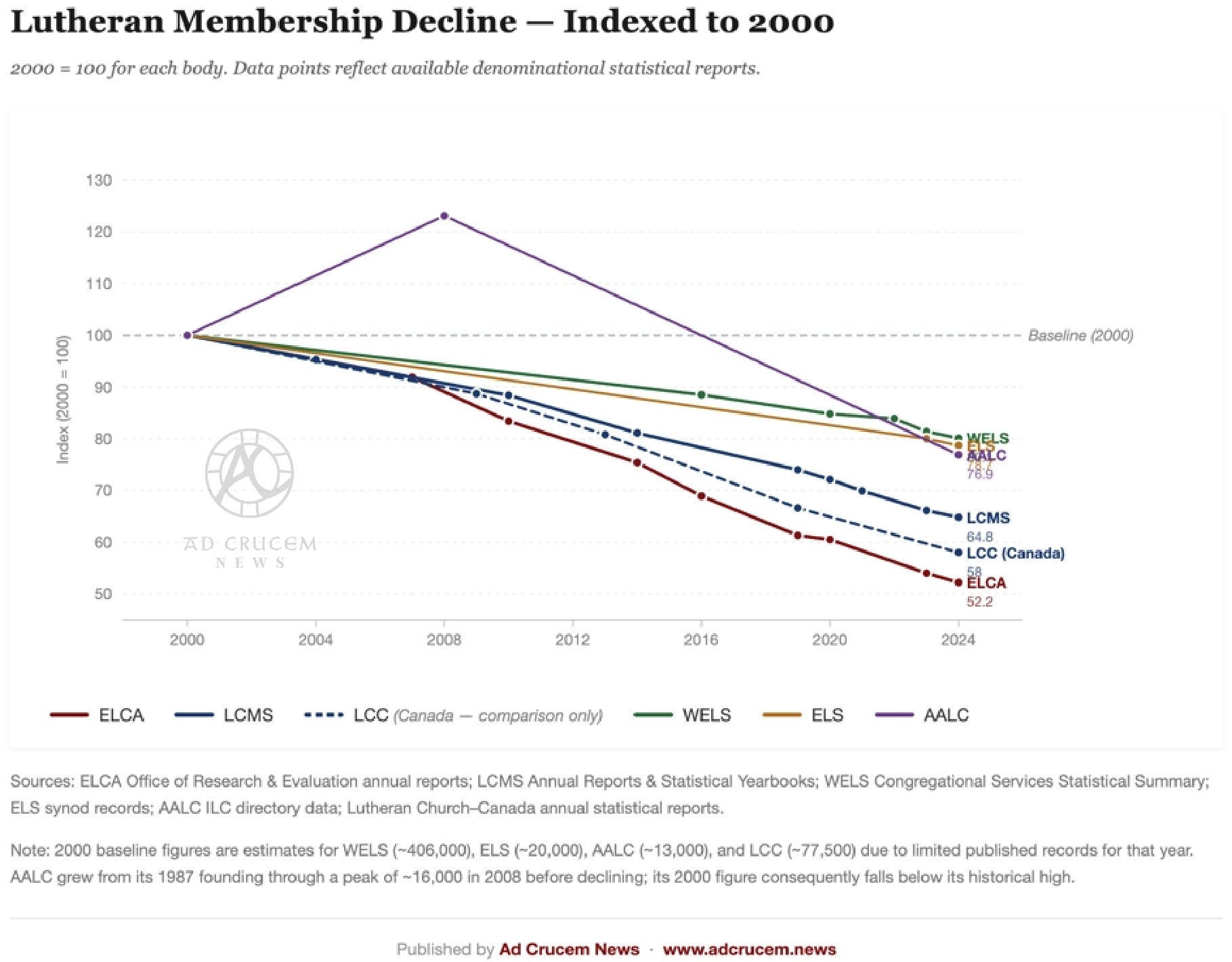
Evangelical and confessional bodies are not exempt from decline. The SBC reports an 18 percent drop. The Lutheran Church–Missouri Synod (LCMS) is down around 32 percent, but weekly worship attendance is about 50% lower. Fractional confessional Lutheran bodies (WELS, ELS, AALC) are moving along the same downward curve, though the decline is less pronounced and they are relatively tiny. The Presbyterian Church in America and the Assemblies of God are the exceptions.
The only “tradition” with a clear record of growth is non-denominational Protestantism. It rose from an estimated 8–10 million in 2000 to approximately 21 million by 2020. However, the absence of any clear confession, centralized governance structure, or reporting mechanism makes this the least reliable datapoint, so it should be treated lightly. Nevertheless, the anecdotal evidence from casual observation of the giga churches (weekly attendance +10,000) is hard to ignore.
Growth without doctrinal accountability is not self-evidently a positive indicator of institutional health or longevity. Consequently, what appears as the one bright spot in an otherwise bleak dataset may instead represent the redistribution of religious sentiment and activity into structures institutionally incapable of preserving a Christian confession. It seems those non-denom churches become staging posts on the road to the city of “nones,” just as contemporary worship Lutheran churches become staging posts for evangelical churches with better bands, better lighting effects, and a barista in the Narthex.
Overall, we can conclude that the institutions losing members are losing them consistently. It is true across decades, regions, and governance models. The exception is churches with only fuzzy doctrines.
The table below documents the record. Please note that the data is from publicly available sources, and some estimation is applied. The margin of error is large because the emphasis was on compiling the broadest available dataset rather than on pinpoint accuracy.
Even essentially conservative institutions have failed to pick up on, or have even resisted, what could be oversimplified as national politics in the US and the west. Ten years ago there were so many disappointing voices in the Missouri Synod condemning Mr. Trump for advocating only enforcing the law and upholding Christendom. Some holdouts will bring up this or that profane utterance as proof that they had to condemn him, but I continue to mock and ignore such dainty little guys peeing their pants. Trump didn't invent or create the sentiments he tapped into, but he's the easy totem to use for this. Church ignores realities of life day to day among the working (and out of work) folks, tending gnostic. Church where over 90 percent of the pastors are politically very conservative and vote R (sometimes holding the nose) muzzles the pastors and rejects a lifeline when Trump tries to cancel the "Johnson Amendment," fearing the walkout or, maybe worse, the angry phone calls from the congregants who vote for abortion, gender surgery on teens, lawless treatment of our borders, and other outrages. Indigenous (American) and less doctrinally anchored bodies picked up on the outcry of young men much sooner. At the core, the Missouri Synod is conservative, but accreted decades of mushy feminism dull and delay the ability of the synod to address what is happening to people. A lot of mushy weight has to be shed for the synod to get back to its virtuous core. The pattern for the "mainlines" is the same; they just are much further along the death march. It won't be a march to death, though. Just a smaller, purified church. Say this at beer or coffee or voters' or council and check the response: It is not always the will of God for attendance to grow in buildings styling themselves as "church" in a particular locale.
When we look at the decline of the Church in the west, we tend to play into the devil's hands, looking for someone, perhaps in administrative leadership, (pastors/synodical leaders/or even congregational leaders). That is, we want to find someone to blame. We look at things programmatically, and we are tempted to believe that, (and this is something that the Synod and church members have been doing since I was in the ministry), when we have found the person(s) to blame, we have solved the problem. We attack the church, its leaders, or even the sheep themselves. Missional, (in the broadest sense), perspectives seem to drive the Church, so that, instead of looking to the Lord, His Word, we look to technique(s), that will cause the Church to grow. That might work in the business world for a brief time, make the bottom line increase, but it is contrary to the way mission works in the Church. Analysis can be helpful, but the Church has to realize that she is called to be faithful, not necessarily to grow, (cf 1Kings 19:18 Yet I have reserved seven thousand in Israel, all whose knees have not bowed to Baal, and every mouth that has not kissed him.”) We cannot see the Church, and we have come to believe, and push, throughout my 30+ years in the ministry, that programs, will grow the Church. It is a temptation that will bear little fruit, even as it did for Fuller's Church Growth Movement. (Cf the book Stealing Sheep, written in 2001, Stealing Sheep: The Church's Hidden Problems of Transfer Growth Paperback – January 1, 2001, by William Chadwick (Author), and the note on the back by a prof from Fuller who said that their efforts of truly growing the Church over a 30 year period, produced ZERO growth, but just, as Dr Alvin Schmidt used to say, was just "sheep shifting.")
When we see Non-denoms growing, we look at it programmatically, and ask what are they doing, and seek to imitate them, use their methods, (sounding more like Finney than any Confessional Lutheran), indiscriminately. Non-denoms are, by definition, unchurchly organizations, not, as Paul exhorts the Ephesians, Ephesians 4:1 I, therefore, the prisoner of the Lord, beseech you to walk worthy of the calling with which you were called, 2 with all lowliness and gentleness, with longsuffering, bearing with one another in love, 3 endeavoring to keep the unity of the Spirit in the bond of peace). "Endeavoring" better translated "being zealous to keep (treasure, guard), the unity of the Spirit, that is, to remain ONE confessionally. But the non-denoms do what they have always done, act as lone wolves, who will not engage the Church, trying to be inclusive and rejecting the notion of correcting false teaching, but setting up idiosyncratic "confessions" usually constructed by one man, the pastor, and that with the goal of proving to some who will listen, that they are inclusive. This kind of behavior is an appeal to the latest fads of human thinking, cf Christian Smith's new book, (Why Religion Went Obsolete: The Demise of Traditional Faith in America by Christian Smith (Author) 2025), in which he notes that the thing that people expect the Church to do is "get along." "Religion is good when it fosters community, social cooperation, peace, and harmony." [Smith, Christian. Why Religion Went Obsolete: The Demise of Traditional Faith in America (p. 50). (Function). Kindle Edition.]
This is one thing that people think Church is good for, and any who argue about religion, doctrine, etc, will fail to be, for those who are culturally bound, someplace they would want to go. Instead they will be attracted to those places who define themselves as being outside/above the messy work of being zealous to keep, treasure, guard, the "unity of the Spirit in the bond of peace." They stand alone, and people join them, not because they care about the Church, (capital C), but because they do not want to be part of a church that understands this is a battle, not against flesh and blood, but against the devil. They are unchurchly organizations, built on human asperations and machinations. Hence they stand alone, or with a small group of people who do not fight against doctrine, but agree to disagree. Remember, the LCMS split in the 70s was not just about the bible, but about the doctrine of the Church and ecumenism/fellowship/cooperation. (Cf Kurt Marquart's Anatomy of an Explosion).
Secondly, the Church has been coopted by therapeutic ideology/methods, which is extremely legalistic, tending to cancel culture. The therapeutic culture that we live in becomes an authority that stands above Scripture, does not allow pastors/churches to speak the word clearly, but the pastor must become therapeutic in his preaching because, as Smith wrote last year, "A second good most Americans think religion can provide is emotional and psychological support." [Smith, Christian. Why Religion Went Obsolete: The Demise of Traditional Faith in America (p. 48). (Function). Kindle Edition.] When pastors do that, they are not able to speak to Christians, as Christians, who depend on the Word, the whole council of God, to create and sustain the Church. Even Tim Wood interview with Ahlman (Why the LCMS Is in Freefall — and What Must Change), ended with Tim Wood losing connection, and the hosts, running immediately to the old saw of meeting "felt needs" of people. In December, Ahlman spoke to a DCE about a book about leadership, written by a Fuller Psych prof, Rare Leadership, which was nothing but therapeutic posturing and in some ways, sadly lacking in biblical clarity. They are accommodating to this second good that the world defines as primary for the Church, emotional and psychological support. While this might work for a time, it does not create disciples, but clients in the therapeutic society.
The Church, using techniques learned from the world will gather hearers, but the therapeutic message that the world expects, (for to the world, the therapeutic is the new authority, that which defines good and evil, so to speak), and it will join for a time, but then, like any other human organization, will fail, even as the more liberal, culturally defined liberal churches in the stats prove, will decline. Crowds will come and go, read the bible, but there will be those who will stand, confess, and declare the Word, which will keep them to eternity. (Cf the temptation of Jesus, "man does not live by bread alone, but by every Word that proceeds from the mouth of God"). The churches that are declining look like businessmen looking for the latest hook to attract people, rather than faithfully standing on the Rock, who is Christ.