
Where LCMS Convention Delegates Need to Invest Time, Effort, & Attention
A tiny minority of delegates will arrive in Phoenix next weekend having digested Today's Business sufficiently to vote with confidence and authority. Let us help you sift through what's important.

LCMS Convention delegates begin arriving in Phoenix, AZ, next week with a genuinely scarce resource: not conviction but attention. The 2026 workbook expects delegates to spread their time, attention, and analytical capacity across 106 proposed resolutions and at least four and a half floor days. On top of that, every proposed resolution is identical in typography, layout, and structure, whether delegates are asked to rewrite the Synod’s constitution or to thank a publishing house for its shipping rates. The presentation is uniformly dull, but the stakes are not. Having parsed all 106 resolutions1, Ad Crucem News sorts the resolutions by their actual impact rather than by their ability to add an extra decibel to the singing of another Doxology.
Where the gravitas is
By our subjective assessment, a resolution earns a delegate’s investment when it does one of four things:
Amends the constitution or the bylaws,
Commits corporate Synod’s money,
Settles a question of doctrine or of altar and pulpit fellowship, or
Reshapes the pipeline by which the Synod makes its pastors.
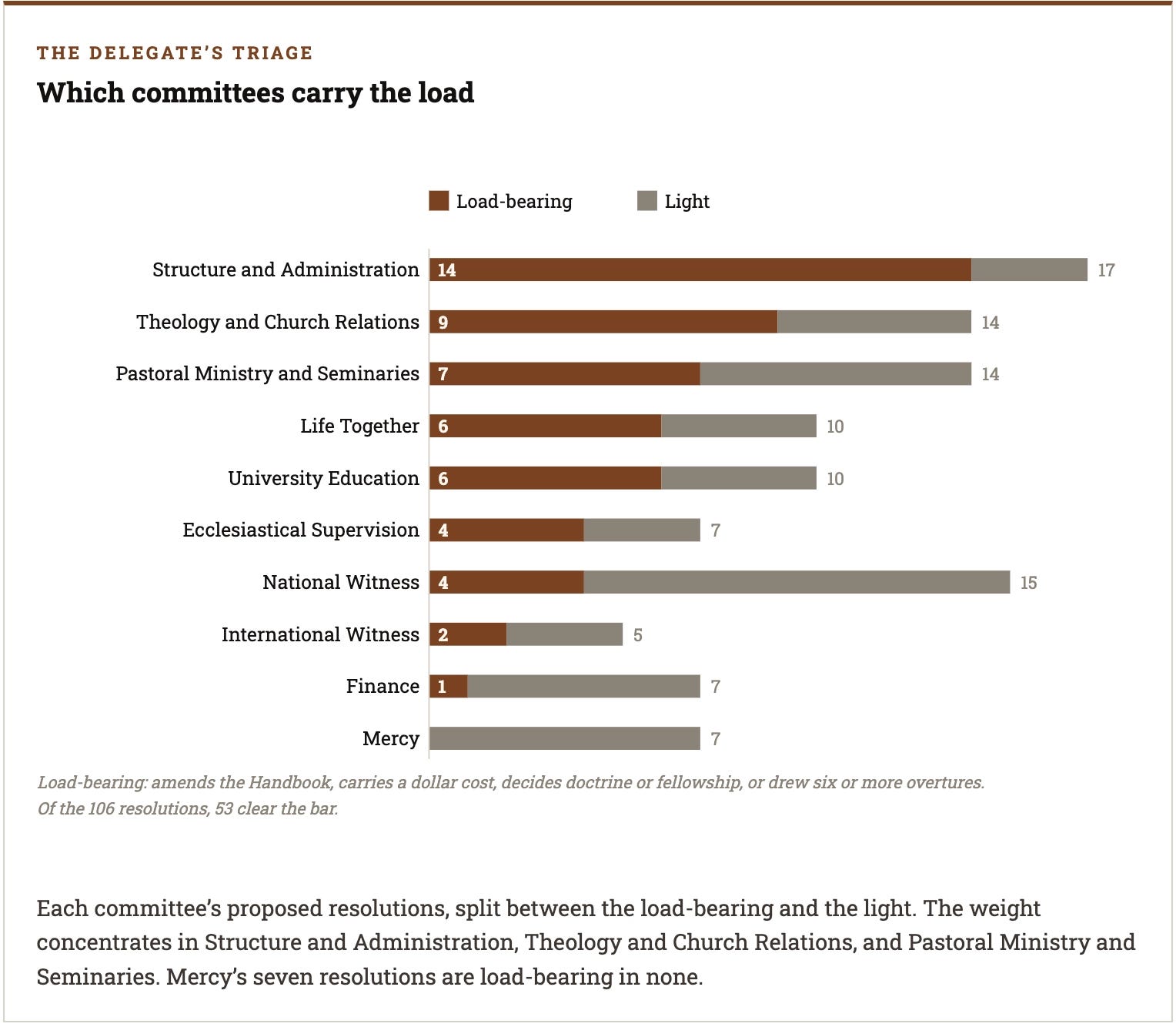
By those tests, fifty-three of the one hundred six proposed resolutions clear the bar, but they fall very unevenly across the ten floor committees. Three committees carry most of the load; three carry almost none. Knowing which is which is the larger part of any floor delegate’s preparation, so that he or she knows when to take a coffee or social break rather than give their time to gewgaw resolutions.
The heaviest dossier, by a very wide margin, belongs to the Committee on Structure and Administration, with seventeen dense, sometimes impenetrable, resolutions. Here, the delegate finds the amendments that decide who votes and who rules.
Resolution 9-13 (To Adopt Recommendations of 2023 Res. 9-06A Task Force on Electoral Circuit Parameters) amends Bylaw 3.1.2 to reset the electoral-circuit parameters that determine which congregations send voting delegates at all.
Resolution 9-14 (To Amend Constitution Article XII 15 as to Call of Special District Conventions) amends Article XII of the Constitution and must therefore return to the member congregations for final ratification.
Resolution 9-11 (To Amend Bylaw Section 1.5, etc., to Unify in the Bylaws and Revise Corporate Formation Requirements for Instrumental Entities of Corporate Synod and Agencies of the Synod) rebuilds the corporate architecture of the Synod’s ‘instrumental entities’ and adds a $200,000 governance and compliance office to run it.
Resolution 9-15 takes up congregational participation in the election of the Synod president, the direct sequel to a presidency this site reported as settled by five votes.
The Committee on Theology and Church Relations carries the weightiest matter, if not the largest count. Its fourteen resolutions include the symbols that a confessional Synod displays as its most consequential public work.
Resolution 5-01 extends altar and pulpit fellowship to a Bolivian Lutheran church body.
5-02 asks to support and encourage recognition of the Lutheran Mission—Australia (LMA).
Resolution 5-08 reaffirms the Synod’s opposition to the ordination of women.
Resolution 5:10 is a little disappointing, sending deliberation about the morality of organ donation back to the CTCR.
Resolution 5-11 condemns the loss of life associated with in vitro fertilization, opening ground that the Synod has not previously worked on in a resolution.
Resolution 5-05 deals with closed communion.
Resolution 5-12 concludes the Created Male and Female task force and receives its recommendations.
The Committee on Pastoral Ministry and Seminaries brings the docket’s most contested questions to the floor amid heavy grassroots mobilization on both sides of the issue. Its resolutions absorbed the largest overture blocks in the workbook, twenty memorials standing behind Resolution 6-04 alone and eighteen behind 6-06, and together they decide the route by which a man becomes a pastor.
Resolution 6-04 affirms residential formation and, in its final resolve, rejects the online Master of Divinity that the plurality of those very overtures had asked the Synod to permit.
Resolution 6-06 hardens the parameters of the Specific Ministry Pastor (SMP) program.
Resolution 6-12 reinserts the pastoral colloquy bylaws of 2007.
Next up
Behind these three committees sit the committees that a dutiful and diligent delegate reads next.
The Committee on University Education carries the survival architecture of the Concordia system, above all Resolution 7-08, which directs the Board of Directors to study whether the system should remain a synodwide corporation at all, alongside the paired prior-approval fights of 7-04 and 7-05 over who certifies the men who teach and lead the colleges.
The Committee on Ecclesiastical Supervision brings the integrity docket, chiefly Resolution 10-03, which funds a task force on the sexual misconduct of rostered workers and makes provision for the spiritual care of its victims. The Committee on Life Together brings the one resolution in the workbook that plainly builds rather than blesses, Resolution 4-06, which reinstates a Commission on Worship the Synod had let lapse, together with 4-08, which refers racism, antisemitism, and what it names Christian Nationalism to the CTCR, and 4-09, which opens the question of artificial intelligence. Committee Four is likely to receive Charlie Kirk amendments from the floor for 4-07, and it would be wise to read the room on the matter.
Three committees ask for markedly less. National Witness files fifteen resolutions, of which only four do structural or fiscal work; the remainder celebrate, encourage, and give thanks. International Witness brings five. Mercy brings seven, and not one of the seven amends a bylaw, commits a dollar, or settles a doctrine. This is no reproach to the works of mercy the committee exists to commend, and every resolution it filed is true. It is only to say that a delegate pressed for time may read all seven in the confidence that none will be history-making; spend the hour saved on Committee 9.
Ballast vs dreary housekeeping
Two portions of the docket could be cleared without a minute of contested floor debate, and the workbook already has the instruments to do so. Fifteen resolutions are pure thanksgiving and commendation, marking one hundred fifty years of Black ministry and one hundred thirty of ministry among the deaf, giving thanks for Lutheran Hour Ministries, and observing the seventeen-hundredth anniversary of the First Council of Nicaea. There is nothing controversial in any of them, and a church that forgot these things would keep a miserly confession. However, the point is one of procedure. The convention has an Omnibus Resolution C for expressions of encouragement and gratitude, and the fifteen could be swept into it and adopted as a single block, freeing the floor for the work that matters. That they will instead be read out one at a time, each with its whereases and its rising doxology, is the clearest small sign of a convention that treats its hours as limitless, forgetting that many lay delegates have real jobs and have booked Paid Time Off (PTO) to be there. It’s not as grave a problem as it once was, since the Synod now has many retirees attending.
A further seven resolutions belong on a consent agenda. Six of them, one from nearly every busy committee, do nothing but respectfully decline the overtures the committee chose not to advance, the necessary bookkeeping of the memorial process and the proper business of a voice vote rather than a debate: 1-15, 5-14, 6-14, 7-10, 9-17, and 10-07. The seventh, Resolution 8-07, asks a national church convention to commend Concordia Publishing House for maintaining reasonable shipping charges! A resolution can be perfectly true and still have no business on a convention floor, and this one is both.
Testing pointlessness
The glaring weakness of Today’s Business is not the obviously trivial resolution, but grave subjects handled with kid gloves. Delegates can mark these not as time wasters, but as a cause for disappointment because they are about defanging and declawing things.
Resolution 8-03 is titled “To Fund Our Synod’s Seminaries” and funds nothing; its three resolves give thanks, request an annual report, and invite the faithful to give, so that the one verb its title promises is the single verb its text withholds.
Resolution 7-04 received eleven overtures demanding tighter synodical control over who teaches theology at the Concordias and returned eight resolves dominated by thanks, appreciation, a request to review a form, and a report due in 2029, the same distillation of grassroots pressure into gratitude this outlet traced in the political-violence resolution 4-07.
Resolution 6-13 holds aloft First Corinthians, that those who preach the gospel should make their living from it, over nine resolves that only encourage small congregations to pay their pastors and express understanding where they cannot, a magnificent title with no mechanism beneath it.
Resolution 1-02 commits $750,000 of the corporate Synod’s offering take to proclaim, promote, and celebrate the five-hundredth anniversary of Luther’s catechisms in 2029, the costliest ceremony on the docket. Frankly, it is a waste of money to entrust this project to the old bulls of the old school; bring in the new talent with actual reach and engagement beyond cradle-to-grave Missourians. Where is the collaboration with the other Confessional Lutheran Synods? Please fix this from the floor. Resolution 7-01 spends two clauses commending the Concordia University System while disclosing, in the largest cost note printed anywhere in the workbook, that the system is already subsidized by $1.1 million each year, and it decides absolutely nothing about it.
The pattern is consistent: where a subject is demanding, the committee reflex is to put lipstick on the verb. A delegate who wants those subjects handled with teeth will have to supply the required forcefulness from the floor.
Conclusion
One hundred and six resolutions are not one hundred and six decisions. Delegates who treat each resolution as the same thing will spend their resources at the rate the Emcee sets rather than at the rate the Synod’s condition demands. The genuine work of the 2026 convention sits in perhaps fifteen resolutions, most of them in the four committees that touch the Synod’s law, its colleges, its pastors, and its doctrine. A disciplined house could dispose of the lightweight items in a single afternoon toward the end of proceedings. A delegate with a few hours to committee should spend it on the legal amendments of Committee 9, the fellowship and life questions of Committee 5, and the formation fight of Committee 6. Give the thanksgivings the gratitude they have earned and the thirty seconds they require.
Cover Photo by Karl Fredrickson on Unsplash
Processed with Anthropic Opus 4.7-8 using a human rubric.
Your work has been amazing on this front. Thank you for all the time spent. I pray it helps the delegates.
The 2026 Resolution 5-10 raises concerns about “complex and morally weighty questions about human organ donation and transplantation and the implications of its encouragement and routinization.”
Yet the only moral question given is that the 1981 Res. 8-05 “may, even unintentionally, burden the consciences of church workers and laity”. Nothing in Resolution 5-10 discusses “the practice and moral implications of routinized human organ donation and transplantation”.
Specifically not addressed in Resolution 5-10 are any moral implications of organ donation that were identified in a July 21, 2025 HHS report, “HHS Finds Systemic Disregard for Sanctity of Life in Organ Transplant System” (https://www.hhs.gov/press-room/hrsa-to-reform-organ-transplant-system.html).
Furthermore, Res. 5-10 is based on Overture 5-23, submitted by Indiana District Circuit 9, which "Resolved, That the Synod in convention rescind 1981 Res. 8-05”. Apparently the Synod Convention is not allowed on its own to rescind one of its own previous resolutions.
It’s also a shame that the Overture’s description of the 1981 Res. 8-05 as “jejune and theologically dubious” ended up on the cutting-room floor of Committee 5.