
What Lutherans for Racial Justice Would Rather You Not Remember As Another LCMS Pastor Defects to ELCA
A departing pastor’s apologia reopens a 2022 question that a raft of apology letters was meant to have closed.

On June 13 the Facebook page of Lutherans for Racial Justice reposted a Substack reflection by the Rev. Dr. T.J. Johnson, titled “When the Church Loses the Compassion of Christ,” and commended it with the assurance that the social justice activist group respects “pastors, other church workers, and laity who choose to shake the dust off their feet,” and that it celebrates “with them in their peace or new vocations when they find them.” The celebration is revealing because what LRJ wants as a plain testimony of conscience (snap, snap, snap, go the woke fingers!) for its readers reopens precisely the matter that LRJ and its sympathizers spent the autumn of 2022 persuading the Synod to forget.
Superficially, one might classify Johnson’s reflection as a moving testimony. Johnson recounts being assaulted in his own receiving line in September 2024 by a parishioner enraged at a sermon on the third chapter of James, describes congregants who in the spring of 2025 sought to bring charges against him for attending an interfaith immigration vigil, and accuses President Matthew Harrison of speaking with two voices, setting the January 2017 letter that pledged to love the immigrant “documented or not” against the February 2025 letter that called the LCMS “a law-abiding and patriotic church body.” He reads a pre-election warning about “the gay and trans agenda” as partisanship in clerical dress. What Johnson never mentions is how the author came to be a pastor whose exit Lutherans for Racial Justice celebrates.
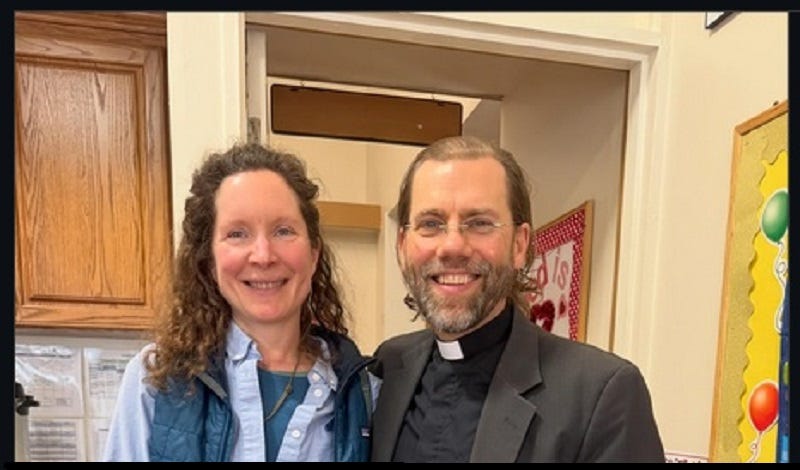
The Rev. Dr. Thomas Johnson, the same churchman, was installed in 2022 at St. Luke’s, Dix Hills, New York, in a rite at which a Methodist clergywoman, er person, appeared in clerical vestments. This was the same congregation where vested LCMS women had served at a previous pastor’s installation in 2014. Both scandalous spectacles were noted at the time in Gottesdienst. The 2014 incident was met with Synodical silence. The 2022 incident was resolved, to the satisfaction of those who wished it resolved, as a misunderstanding and an oversight, with apology letters duly issued. The correspondence that once filed the episode under inadvertence reads rather differently now that Johnson has published his convictions on his Substack1. After all, for a man does not, as a rule, stumble by accident into the very practice he will later leave in order to embrace.
Johson left St. Luke’s in January 2026, and within less than a month, he was serving at an ELCA congregation - Zion Lutheran in Redmond, Oregon. He was allegedly installed by a woman whom the Evangelical Lutheran Church in America counts as some version of a bishop. Notably, Zion is careful to avoid mentioning Johnson’s LCMS past, and videos of Zion’s services show women in prominent roles, including one serving as some sort of celebrant from behind the altar! Less than a month. The trajectory that Johnson’s note presents as the slow ripening of conscience moved, in the event, at the speed of a prearranged call.
Indeed, this is the method of Lutherans for Racial Justice, and the fundraiser it mounted for Wayne Frederickson, the Virginia pastor associated with a transgender-pride stole, was an earlier turn of the same wheel: elevate the sympathetic figure, recast the heterodox act as compassion, and keep at all times the deniability that lets the group profess the Synod’s confession while laboring hard against it. The “new vocations” it celebrates are, with conspicuous regularity, vocations exercised in a church body that ordains women and blesses what the Missouri Synod confesses against, and the dust these pastors shake from their feet always seems to fall on the same doorstep.
Controversial LCMS LGBTQIA+ YouTube Interview Canned

Unite Leadership Collective (ULC) recently interviewed Pastor Mark Schulz (retired) and Joshua Salzberg, a layman who founded Lutherans for Racial Justice, about homosexual and transsexual issues in the church. The video was removed from circulation on February 12, 2026, at the request of Schulz’s District President and Synod President Matthew Harrison.
The note’s own comment thread shows the machinery running. It is an affirmation chamber of the departing and the already-departed, in which one reader confesses that the LCMS no longer feels like her home and asks where she might go, and Johnson himself counsels her to “shop around widely.” As for the charge of hypocrisy laid against Harrison, it dissolves the moment one declines to collapse “love thy neighbor” into “no human is illegal.” The 2017 and the 2025 letters say in substance the same thing: that the church loves the immigrant, but will not bless the breaking of the law. Only a reader who has already made unlimited and unmoderated immigration the measure of Christian charity will be unable to discern the difference.
There is, nevertheless, reason for hope in the Atlantic District, where the formation pipeline that produced such vocations no longer runs unopposed, and where a growing share of the pastors have set themselves against women deacons and the rest of that rotten inheritance, even as LRJ’s Facebook post counted one “like” from one of the district’s own vice-presidents. The work of dismantling the Post War-era latitude that formed these men is, on the present evidence, unfinished, and Lutherans for Racial Justice will go on celebrating its fruits for precisely as long as it is permitted to.
Killing a Synod With Kindness

Lutherans have a hard time knowing when and how to deal with theological subversives. There is an understandable, but too reflexive, hesitation to move quickly and to be firm in discipline because we are so steeped in the Eighth Commandment (best construction),
The same convictions govern his pulpit. Across his five most recent recorded homilies (YouTube) the Law neither accuses nor instructs, sin figures not as guilt incurred before God but as division to be healed and woundedness to be soothed, and the Gospel is recast from the forgiveness purchased at the cross into an unconditional welcome extended in advance of repentance. The atonement, where it surfaces at all, comes across as solidarity rather than Christ’s perfect satisfaction. In his sermon quoting Hosea 6:6, in which he sets learning “what this means” against adding to “your list of correct doctrine and beliefs,” he casts the “rigid and judgmental” religious man as the villain, and announces that the altar is “not a Lutheran table” but one open to all “whatever their background, identity,” including “their past, their doubts.” That is the purest expression of gospel reductionism, where the mercy of God is preached at the expense of the Law that makes mercy necessary.
I served as Tom Johnson's vicarage supervisor (2003-2004) in his pursuit to be an LCMS pastor. In assigning him to me, the then director of vicarage at CTSFW shared that Tom had been ordained in the Presbyterian Church in America, that all indications showed that he was embracing confessional Lutheranism and that now the seminary would see how this all played out during his vicarage year. Let me say that among the fifteen vicars I had the joy of helping to form, there were two that I felt uneasy about, but in both cases, nothing which rose to the level of raising a red flag. Tom Johnson was one of them. Unfortunately, in the final evaluation form which vicarage supervisors filled out, there was not an "Option X" noting that this student seemed to "check all the boxes", but still there is a gut feeling and concern about his true allegiance to our doctrine and faith.
A number of years ago, I was contacted by my district president telling me that Tom had come to him upset with the way I had treated him on vicarage, that I did not respect the fact that he was ordained and act toward him accordingly. I simply shared with the DP that I treated Tom the same way I have treated all my vicars - with love and respect - but there was no getting around the fact that he was a vicar and there to learn, to be guided, mentored, supported and when needed, corrected.
Nothing that has transpired in Tom Johnson's personal and professional life surprises me. One thing I believe he is not, a victim. I pray for him.
The Rev. Mark H. Hein, pastor emeritus
I associate this kind of nonsense with older men who went to seminary pre walk out. Has this spread to younger pastors? If it's just the elderly pastors it will die out.