
What Does an LCMS Congregation Owe Citizens and Caesar?
When Immigration Law Meets Congregational Hospitality.

“Let every person be subject to the governing authorities. For there is no authority except from God, and those that exist have been instituted by God.” — Romans 13:1
This is the third in a series of articles examining governance failures at an LCMS congregation on Maryland’s Eastern Shore. The first article laid out the broad pattern of financial opacity, constitutional non-compliance, and institutional self-dealing. The second examined the tax implications of misclassifying rental income as charitable donations. This article addresses a different category of risk, one that the congregation’s own leadership has discussed internally, been warned about by its own members, and not fully responded to.

The issue is straightforward: What are the legal obligations of an LCMS congregation that shares its building with a guest organization whose membership may include individuals without lawful immigration status?
It is a question that no one at this congregation appears willing to answer definitively.
The Facts as They Stand
The LCMS congregation shares its facilities with an independent Pentecostal church under a Memorandum of Understanding (MOU). The guest congregation has approximately 300 attendees, roughly four to five times the host congregation’s regular attendance. It holds services, stores equipment, maintains a locked office inaccessible to the host’s own members, uses the host’s address as its legal domicile on all Maryland regulatory filings, and has 24/7 access to the building.
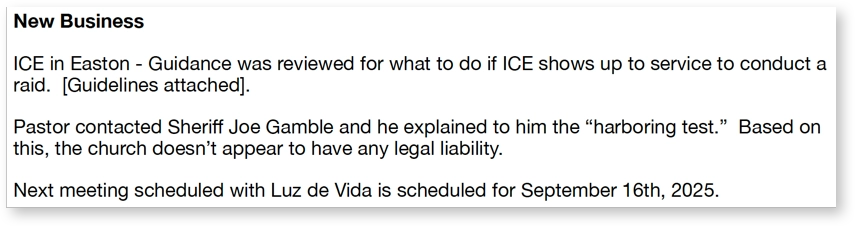
In the summer of 2025, the host congregation’s Board of Trustees (BOT) discussed U.S. Immigration and Customs Enforcement (ICE) activity in the area.1 The BOT minutes of August 19, 2025, record that “Guidance was reviewed for what to do if ICE shows up to service to conduct a raid,” and that the pastor “contacted Sheriff Joe Gamble and he explained to him the ‘harboring test.’ Based on this, the church doesn’t appear to have any legal liability.” The minutes also note a “Dinner with Luz de Vida Leadership” scheduled for the following evening, reflecting the close social relationship between the host and guest congregations’ leadership.
Two concerned members of the LCMS congregation, each with graduate education and professional backgrounds comprising decades of legal and compliance experience, recognized that the BOT’s response was inadequate. They raised their concerns through appropriate internal channels, beginning with private correspondence and culminating in a formal meeting with the Board of Trustees, Board of Elders, and the pastor on October 30, 2025. “The conversation of what occurred derives from the personal accounts of the two members as participants physically present at the meeting who made contemporaneous notes during and immediately following the meeting.
The substance of their warning was as follows: the congregation’s leadership has a closer relationship with the guest congregation’s leadership than any rank-and-file member does. The host congregation’s leaders attend joint meals, conduct joint meetings, and interact regularly with the guest congregation’s officers. The host congregation’s members, by contrast, have essentially no contact with the guest congregation; they do not attend the same services, do not speak the same language, and have no visibility into who comprises the guest congregation’s membership and how its leadership functions.
The concerned members did not demand an immigration audit. The pastor’s own October 22, 2025 email acknowledged as much, though it initially characterized their inquiry as seeking “names and contact information”, a characterization the members rejected in writing, clarifying that they were raising the matter “as exclusively an administrative/business one which the BOT specifically introduced to all congregation members in its ‘Meeting Minutes’ of 8/19/2025.” What they asked was far simpler: have a conversation with the guest congregation’s leadership to determine whether any members lack lawful immigration status, and if so, to offer compassionate guidance, including information about voluntary departure programs, in accordance with the LCMS’s own published position, which supports immigration but opposes illegal immigration and encourages congregations to help individuals come into legal compliance.
The leadership’s response, according to the two members, was to acknowledge the concern, validate the members’ expertise, express personal agreement that the situation posed risks, and then do nothing. Apparently, no such conversation with the guest congregation has occurred, and no legal counsel has been retained. No information has been shared with the LCMS congregation’s voting members since the matter was, in the words of a leadership communication, “dispositioned.”
The congregation’s inaction is all the more troubling in light of recent media reports about regional ICE activity wherein individuals, including a former president of the guest congregation, were apparently apprehended by ICE. Despite widespread local news coverage and direct knowledge among them that federal immigration enforcement had reached into the guest congregation’s own leadership, neither the pastor of the host LCMS congregation nor its leadership has taken action to reduce potential risks to the host congregation they serve.
Potentially Playing With Fire
The federal prohibition on harboring is codified at 8 U.S.C. § 1324(a)(1)(A)(iii). It provides that any person who, “knowing or in reckless disregard of the fact that an alien has come to, entered, or remains in the United States in violation of law, conceals, harbors, or shields from detection, or attempts to conceal, harbor, or shield from detection, such alien in any place” is subject to criminal penalties.
There are two elements:
knowledge (or reckless disregard), and
an affirmative act of concealing, harboring, or shielding from detection.
The whistleblower and Ad Crucem News are not asserting that this congregation has violated federal harboring law. We are observing that the congregation’s leadership has been formally warned by its own members, individuals with relevant professional expertise, that the factual circumstances create potential exposure under the statute, and that leadership has declined to take any action to determine whether the risk is real or to mitigate it if it is.
The distinction between knowledge and reckless disregard is important. You do not need to know for certain that someone lacks lawful status. You need only act with reckless disregard, meaning you are aware of a substantial risk and consciously choose not to inquire.
When a congregation’s own Board of Trustees has discussed ICE enforcement activity in the area, reviewed guidance on what to do if ICE conducts a raid, and when qualified members have formally warned in a documented meeting that the building-sharing arrangement creates potential harboring exposure, continued inaction cannot be plausibly explained away, in our opinion.
The Unincorporated Problem
The potential legal exposure is exacerbated by a structural fact that the whistleblower has been warning about for years: the LCMS congregation is not properly incorporated.
Most LCMS congregations are incorporated as nonprofit corporations under their state’s laws. Incorporation creates a legal entity that can own property, enter into contracts, and be sued — shielding individual members from personal liability for the organization’s obligations and legal exposure.
This congregation, despite years of urging by its own members and a constitutional requirement in its governing documents that it incorporate, has never done so. The property’s Deed of Trust [as opposed to the Deed itself] remains in the names of deceased former members. Every voting member of the congregation is, in the eyes of the law, potentially personally exposed to any liability the congregation incurs, including possible federal liability under immigration law.
As one of the concerned members stated in the October 2025 meeting: “Every member of this congregation, in the eyes of the IRS, is a landlord.” The same principle applies to federal immigration enforcement. Without a corporate shield, liability could flow through to individuals.
The Guest Congregation’s Corporate Filings
The guest congregation, by contrast, is incorporated. Its articles of incorporation were filed more than a decade ago with the Maryland Secretary of State’s office using the host LCMS congregation’s address as its legal domicile. The articles were subsequently amended, at the request of one of the same concerned members, to clarify that the building is not owned by the guest congregation. The amended articles now list one of the guest congregation’s officers’ home address in Cambridge, MD, as the resident agent.
However, that officer of the guest congregation does not have a publicly listed telephone number or email address, and the host congregation’s members cannot reach him directly. In fact, even if one searches for information about contacting the guest congregation, the results direct one to either visit the host LCMS congregation’s street address or ask members of the host congregation. Likewise, Moody’s online business listing directory lists the guest congregation’s contact information under the host LCMS congregation’s address.
Notably, all communication between the two congregations flows through a former LCMS host congregation's president, who serves as an apparent self-appointed, sole liaison and has received inquiries from the guest congregation about buying the LCMS host congregation’s building (reported comments made during BOT meetings). The host congregation also does not advertise the guest congregation as one of its missions.
When Every Authority Says “Not My Problem”
The sheriff’s response was only the beginning. What has followed is a cascade of non-response that extended through every level of ecclesiastical authority available to the congregation.
After consulting with the sheriff, the pastor sought guidance from his ecclesiastical superiors. He contacted the Delmarva Circuit Visitor and the Southeastern District President, Rev. Dr. Bill Harmon. Both responded, but neither, it appears, conducted an independent investigation of the facts on the ground.
On October 14, 2025, the Circuit Visitor emailed Harmon:
“Thank you for your quick and thorough response to [redacted] and for keeping me in the loop. I’m glad that you were able to connect directly and that you could confirm the LCMS guidance for him and his congregation in their situation. It also affirms my conversation with him.”
On October 28, 2025, District President Harmon sent a letter to the pastor, the identical letter that was subsequently forwarded to the concerned members as the official response to their warnings. Harmon wrote:
“As we discussed, both the Southeastern District and Synod have provided guidance for congregations should ICE approach a church. Nowhere in that guidance is it recommended or required that a congregation gather or provide names of individuals. Your conversation with Sheriff Gamble also reaffirmed that Immanuel’s circumstances do not meet the legal definition of ‘harboring.’”
There are several problems with this response. First, the District President is not a lawyer and does not indicate that he consulted counsel. Therefore, the conclusion that the congregation’s circumstances “do not meet the legal definition of harboring” is a legal determination that, in our opinion, he was unqualified to render. Second, according to the concerned members, key facts appear not to have been communicated to Harmon: that the guest congregation maintains a locked office inaccessible to host members, that the guest congregation’s corporate checks are reportedly processed as “offerings” through numbered giving envelopes alongside member contributions, that the guest congregation used the host’s address as its corporate domicile for years, and that (by leadership’s own admission at the October 30 meeting) no member of the host congregation’s leadership had ever attended a guest congregation service or had direct knowledge of its membership composition.
Third, and perhaps most significantly, Harmon’s letter reaffirmed the sheriff’s conclusion without independently investigating the underlying facts. Sheriff Gamble himself, as the pastor noted in his own October 22 email, was consulted because “he and I serve on the same [town] Prayer Breakfast Committee.” The sheriff is, by all accounts, well-intentioned, but he, too, is not a lawyer, and the legal analysis of federal harboring law was not, so far as we can determine, based on a comprehensive understanding of the building-sharing arrangement or direct knowledge of the status of officers and members of the guest congregation.
The pastor’s October 22, 2025, email to the concerned members reveals an avoidance approach: what the members had raised as an administrative and legal concern was reframed as a matter requiring spiritual “reconciliation.” The pastor wrote at length about the need to “reconcile our thoughts” and to come to a “table of Biblical reconciliation.” The concerned members responded on October 25 by reiterating that they had brought “the present matter to the table as exclusively an administrative/business one.” Their request was not honored. According to their own subsequent written account, the October 30 meeting “became a theological, ‘reconciliation’ issue despite that we were trying to present clear, simple reasons for our concern that Immanuel members faced potential liability regarding illegal harboring, and IRS non-conformance which would threaten Immanuel’s tax-exempt status.”
The result was that a legal and compliance concern was absorbed into a pastoral discipline process designed to produce emotional resolution rather than institutional action. As recognized by one of the concerned members, “Personal feelings aside…there exists no standard doctrinal or liturgical provision for a pastor to convene a small, private gathering of congregational officers plus two specific members in a private room at the church building for a session expressly called a ‘Corporate Confession & Absolution’ hearing.”
The District President’s Apparent Conflict
The adequacy of District President Harmon’s October 28, 2025, response must be evaluated in light of his own public activities during the same period.
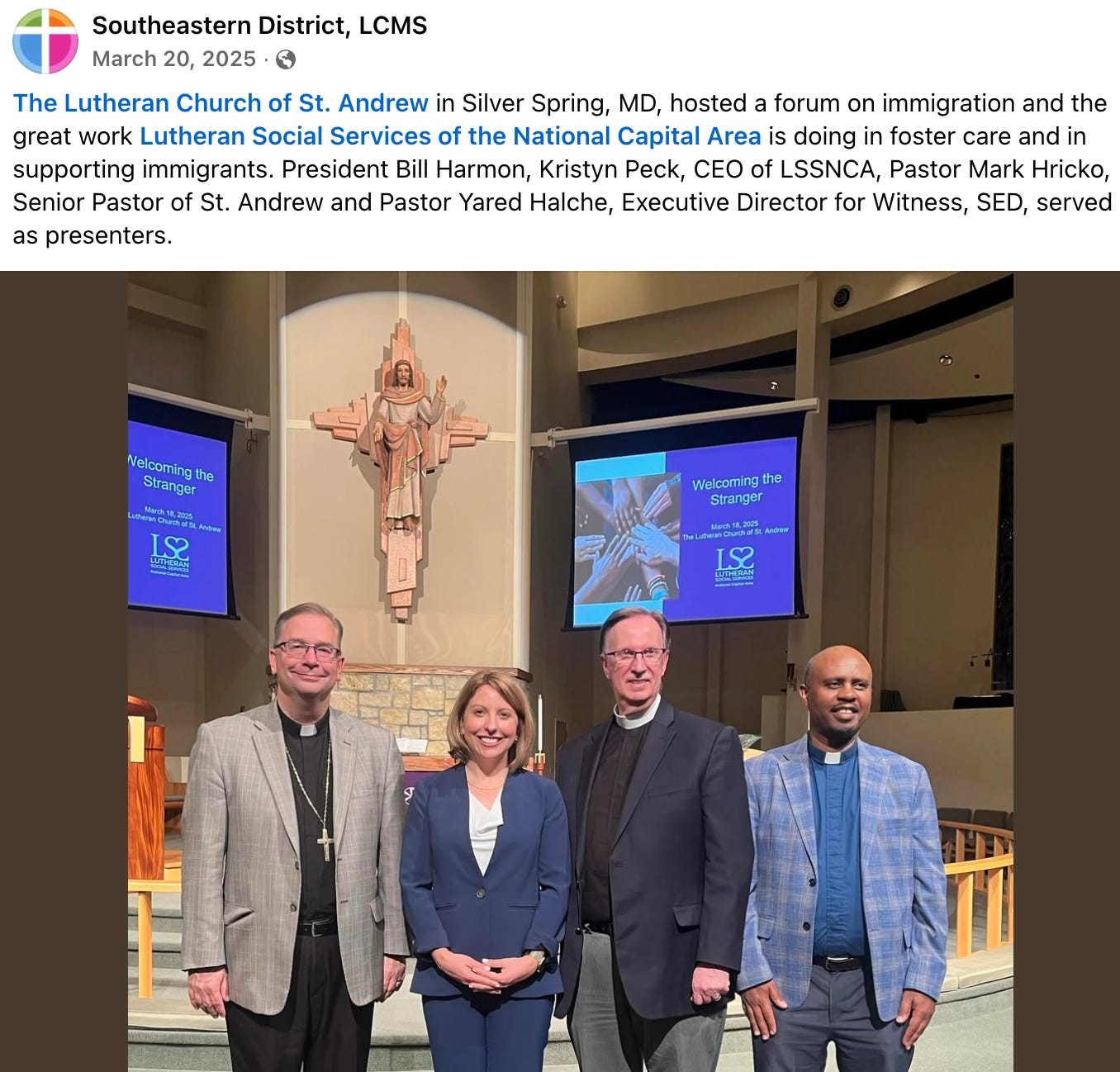
In March 2025, Harmon appeared on a panel at an “Immigration Forum” held at the Lutheran Church of St. Andrew in Silver Spring, Maryland. The event was co-billed with Kristyn Peck, CEO of Lutheran Social Services of the National Capital Area (LSSNCA). The forum’s stated topics included “The work of LSS in Immigration Services and Refugee Resettlement” and “What we can do to serve our new neighbors.”
LSSNCA’s own publications from the same period describe its legal team conducting “Know Your Rights” workshops “directly inside apartment buildings” in communities experiencing ICE enforcement activity, helping families “create emergency plans for what to do if there is an ICE raid,” and offering legal services ranging from “fighting deportation to petitioning for family members and applying for citizenship.”
Whatever one’s views on the merits of that work, LSSNCA represents an overt institutional hostility toward immigration enforcement, one that, in the opinion of some LCMS members, is difficult to reconcile with the Synod’s stated position.
LCMS President Matthew C. Harrison addressed the relationship between the Synod and such organizations directly in a February 6, 2025 letter to the church body. Harrison stated unequivocally: “The LCMS is a law-abiding and patriotic church body. We don’t invite or support illegal immigration.” He further noted: “There are indeed millions who have broken federal immigration law. That is wrong.” Harrison also wrote that the LCMS encourages congregations to welcome immigrants and “also always urge and often assist them in doing the right thing, that is, becoming legal residents.”
In the same year that President Harrison was publicly affirming the Synod’s position that illegal immigration is wrong and that congregations should help individuals come into legal compliance, District President Harmon appeared publicly alongside an organization whose own published materials described its legal team as “fighting deportation” on behalf of undocumented immigrants and conducting “Know Your Rights” workshops in communities experiencing ICE activity.
Moreover, in the LCMS’s official RSO (Recognized Service Organization) update covering August 2025 through January 2026, posted January 30, 2026, Lutheran Social Services of the National Capital Area appears under the heading “Dissolved/Withdrawn/Terminated.”
None of this proves that Harmon’s advice to the congregation was deliberately misleading or that he obstructed immigration enforcement. However, it raises a question, in our opinion, about whether a District President who had publicly aligned himself with an organization actively assisting undocumented immigrants was the right person to objectively evaluate whether a congregation’s building-sharing arrangement with a guest church potentially harboring undocumented members posed legal risk.
Unanswered Letters
The concerned members continued to follow up after the October 30, 2025 meeting.
On February 18, 2026, one of the members sent a detailed written communication to the Board of Trustees, Board of Elders, and the pastor, documenting the full history: the August 2025 BOT minutes, the reframing of their administrative concern as a reconciliation issue, leadership’s refusal to inquire into the guest congregation’s membership, the Harmon letter, the LSSNCA connection, and the Harrison letter. The communication included documentary evidence numbered for reference. It also noted that Immanuel had reportedly seen members resign in recent weeks “because of factors that we understand to involve the existing Luz de Vida arrangement.”
No substantive response was received.
On March 9, 2026, the same member forwarded the entire package directly to District President Harmon, noting that Harmon’s October 28, 2025, letter “offers no value in addressing the situation” and that Harmon appeared to have acted “in direct contradiction to LCMS President Harrison’s stated position.”
Harmon, too, did not respond.
On March 19, 2026, the same member forwarded the entire package, now containing the unanswered letter to Harmon, to LCMS President Rev. Dr. Matthew C. Harrison.
Harrison also did not respond.
The documentary record, as it now stands, shows that the concerned members raised the immigration issue through every channel available within the LCMS’s polity: private correspondence to the pastor, formal meeting with both boards, written communication to all leadership, and direct correspondence to both the District President and then to the LCMS President himself. At every level, the response was the same: no direct acknowledgment, no direct engagement, and habitual inaction.
A Transparency Problem
Perhaps the most troubling aspect of this situation is not the legal risk itself but the deliberate decision to keep the congregation’s voting members uninformed about it.
The Board of Trustees raised the subject of ICE activity in its August 2025 minutes, but then took no visible action beyond consulting the sheriff. Concerned members raised the issue formally, in writing and in person. Leadership acknowledged the concern and took no action. The District President was consulted, and he provided a letter that, in our opinion, was not informed by the material facts. The broader congregation, including those who may face personal legal exposure because the church is unincorporated, has not been informed that the issue exists, that it was raised, that members with professional expertise in law, compliance, and forensic accounting warned of specific risks, or that leadership chose not to act.
In a congregational polity, where the Voters’ Assembly holds ultimate temporal authority, the decision not to bring a material legal risk to the voters cannot be dismissed as a mere oversight. It is straightforwardly a governance failure. The voters cannot exercise their constitutional authority over matters they do not know exist.
This is consistent with the broader pattern we have documented at this congregation: financial opacity, suppressed audits, self-appointed officers, and a leadership circle that treats transparency as a threat rather than an obligation. The immigration question is the same problem.
Misdirected and Misapplied Compassion
This article is not an argument against immigration, against a ministry to immigrants, or against the presence of non-English-speaking congregations in LCMS buildings. The LCMS’s commitment to the Great Commission transcends language, ethnicity, and national origin. Lutheran churches should be places where all people hear the Gospel in their own tongue.
It is an argument that a congregation cannot claim to act in Christian love while simultaneously refusing to determine whether it is placing its own members in legal jeopardy, refusing to offer lawful pathways to the very people it claims to serve, and refusing to tell its own voting members that the question has even been raised.
Compassion that depends on ignorance is not empathy or sympathy, but convenience. It will stop being convenient the moment federal enforcement arrives at the door, which is precisely the scenario the congregation’s own Board of Trustees thought important enough to discuss, even though the ultimate result was to only partially address it.
Board of Trustee’s [sic] Meeting Minutes - 8/19/2025
"The sheriff is, by all accounts, well-intentioned, but he, too, is not a lawyer, and the legal analysis of federal harboring law was not, so far as we can determine, based on a comprehensive understanding of the building-sharing arrangement or direct knowledge of the status of officers and members of the guest congregation."
Not only is he not a lawyer, but he also (in his office) isn't the right law enforcement individual to speak on it. It's understandable that a congregation uses what resources it has available to make the best judgement it can, but it needs to properly consider the resource for what it is.
Thank you so much, I especially appreciate the link to official LCMS policy. I am a Trump supporter with all his known character faults.
I would have been one of those who left that congregation. I think law and emigration, and the biblical standards that can inform us, are woefully under taught.
I have found this book 📕 to be a great resource in the Biblical principles reading “Stranger” and immigrant.
Markus Zehnder
The Bible and Immigration: A Critical and Empirical Reassessment