
Time to Rethink Missouri’s Adversarial Convention Polity
Part One: The Diagnosis. A fourteen-vote presidential margin, an 88-overture floor fight, and the price of deciding everything at once.

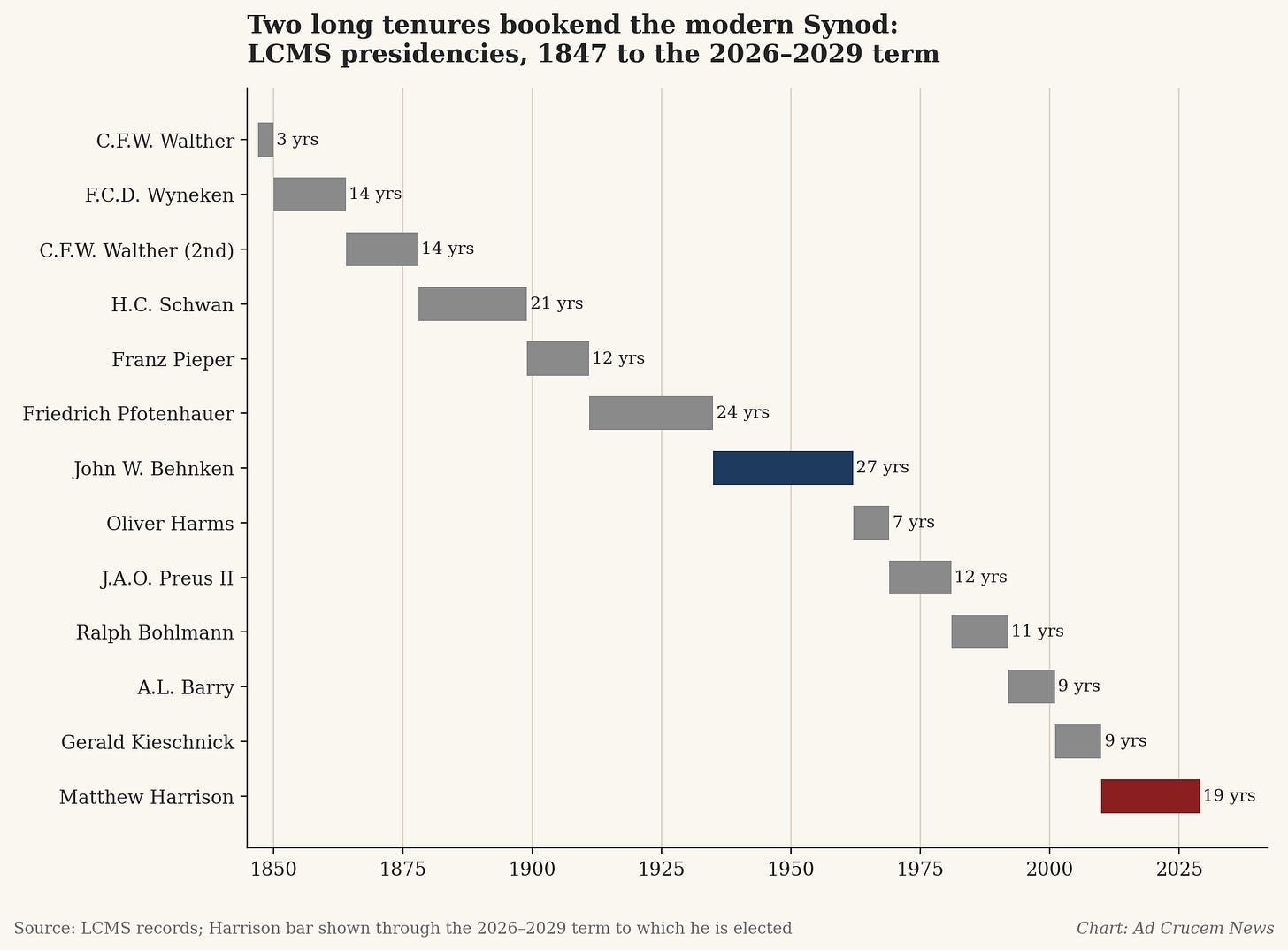
The 69th Regular Convention of The Lutheran Church—Missouri Synod opens with closed floor committees meeting today at the Phoenix Convention Center under the theme “Christ Is Risen Indeed,” and by the time the delegates take their seats, the most consequential decision of the triennium will already be more than three weeks old. The Rev. Dr. Matthew C. Harrison was declared president-elect on June 24, after a third round of internet balloting, for a sixth term that will carry his presidency past the nineteen-year mark and make it the longest since John W. Behnken’s. What remains for the floor is everything else, and everything else is considerable: 106 resolutions plus three omnibus resolutions, distilled from 374 unique overtures, to be dispatched in five days by an assembly that must also worship, hear essays, greet partner churches, and elect the remainder of its leadership. The contention of this article, and of the one to follow, is that this arrangement, a single arena resolving everything at once every three years, has become an emotional and financial extravagance the synod can no longer afford.
A Nine-Month Campaign
Consider the architecture of the Presidential election. The process began last fall with an online nominating window, administered by the vendor YesElections, that closed on February 18, five months before the convention. The five nominees receiving the most congregational votes were announced in early March. From the opening of nominations to the final result, the synod conducted a nine-month national election campaign, and three rounds were needed to settle the election by the narrowest and least compelling margin possible: Harrison 2,524 votes, or 50.1 percent, against Biermann’s 2,414 and Ball’s residual 100; just five votes past the halfway line, as Ad Crucem News reported the same day at its convention microsite under the headline “The Five-Vote Presidency.”
An election that ends 46.3 to 46.0 has no mandate and is, ultimately, just a census of a Synod divided over who gets the fancy office and perks. Moreover, contests this close are not fought by volunteers assembled for the occasion but by standing apparatus, and the LCMS has it in spades. None of the mobilization and election machinery demobilizes between triennia because, under the current calendar, there is no between; the next all-deciding convention is always thirty-six months away, and the nominating window for it opens sooner than that.
The ferocity and crossfire are aggravated by tenure. Harrison has held the office since 2010 (having campaigned aggressively from 2008), and each and every challenge mounted against a sixteen-year incumbency is understood by both camps as something close to a last chance, since a challenge deferred is, in practice, a challenge foreclosed. Consequently, each triennial contest arrives freighted with the accumulated weight of an era, and the campaigns spend accordingly.
The Office
The ferocity also has an object: the office itself. Since the 2010 restructuring, the Synod President holds ecclesiastical supervision over the district presidents and the officers of the Synod, sits atop the national and international mission offices that absorbed the old program boards, exercises authority over the doctrinal review of the Synod’s publications, the praesidium arrives partly as his retinue, he appoints the floor committees that decided which of this year’s 374 overtures would reach the floor and in what form, and he makes compromises about disciplinary issues to avoid disturbing the peace and the vote tallies. Dwell on that a little: an incumbent standing for re-election appointed the committees that determined how overtures affecting his own office would be presented to the delegates voting on them. It’s not a question of motive, because the arrangement indicts itself regardless of how honorably any particular man administers it.
Moreover, the changes of the last two decades made the president the only officer in the Synod elected directly by the whole body, by congregational electors rather than by convention delegates. Whatever efficiencies commended the change, its constitutional effect is that the president alone may claim a mandate from every congregation, a form of legitimacy that no board, no commission, and arguably no convention can match, and an office so elected acquires a standing above the deliberative organs rather than within them. The Synod built itself a plebiscitary presidency, and there is little evidence in the historical convention record that it deemed such a presidency necessary.
An office with supervision, appointment, agenda, and mandate powers, and which is renewable indefinitely, inevitably generates its own politics regardless of the occupant. Consequently, the power of the office only intensifies, and long tenure compounds the effect, because sixteen years of appointments and agenda management convert an office into a loyalty-and-patronage network, whether its occupant seeks one or not. The Synod’s own paperwork identifies the ineluctable teleology.
Set against what the office was instituted to be, the accumulation of power and influence is not only imprudent but something of a theological inversion. When the sons of Zebedee chased clout, the Lord named the Gentile pattern of rulers lording it over their subjects, and commanded a different way: Yet it shall not be so among you; but whoever desires to become great among you shall be your servant. (Mark 10:42–45). Augsburg Confession XXVIII defines the power of bishops as the power of the Word alone, preaching, absolution, and the judgment of doctrine, not executive functions. The Treatise on the Power and Primacy of the Pope sets any superiority of one minister over others in a civil setting only. A synodical presidency created by a constitution to serve an advisory synod is the last office in Christendom entitled to a lordship slippery slope.
The early Synod presidents assumed the office as a burden added to a parish call. Walther was President while pastoring and teaching. Wyneken, the second president, wore himself out in the congregational visitation the Constitution still names among the president’s duties. The office was modeled as itinerant, sacrificial, and additive. It was what a man carried alongside his real call, and the president’s constitutional identity was that of a visitor, not an executive. In the intervening century, the visitation office grabbed for itself an International Center, a communications apparatus, an appointments portfolio, a global empire, secret finances, and a nine-month re-election campaign. What was designed as a position of duty and sacrifice now carries the power, the institutional wealth, and the trappings of a transnational corporate empire. Meanwhile, the Convention Workbook contains overtures from congregations that can no longer afford a full-time pastor.
It’s an asymmetry that needs no further explanation, but it’s worth remembering that the danger of this accretion of power and prestige is not a novelty the founders failed to imagine. The LCMS exists on account of a strongman episode (Martin Stephan), while the Preus era of the 1970s demonstrated that the enlarged modern office serves whichever wing of the Synod captures it.
Speed Running Everything
Meanwhile, the decade’s doctrinal question was wrapped into the same ballot. Pastoral formation, the question of how the synod trains, certifies, and supervises the men it ordains, drew 88 overtures assigned to Floor Committee 6. By itself, that count approaches a quarter of the unique overtures submitted to the entire convention. The positions span the full breadth of the argument, from overtures demanding suspension of the Specific Ministry Pastor program and endorsement of residential seminary formation as the exclusive route to ordination, to overtures seeking expanded online degree pathways through the seminaries. The question for delegates became only whether the Synod’s two seminaries should remain the exclusive institutions for training LCMS pastors. However, the question could not be deliberated on its own terms, because the second-place presidential candidate is a professor of systematic theology at Concordia Seminary, St. Louis, and every argument about formation was therefore also, and unavoidably, an argument about the presidency. A congregation’s view of the SMP program became a proxy for its view of the incumbent, and a professor’s candidacy converted every classroom question at the seminaries into campaign material, so that the merits of both disputes were discounted accordingly.
This cycle produced 464 overture submissions amounting to 374 unique overtures, against 322 submissions and 279 unique overtures in 2023, an increase of one-third in a single triennium. The floor committees, meeting at the International Center from May 29 through June 1, compressed these into 106 resolutions plus three omnibus resolutions for a convention of five working days. Once worship, essays, elections, and ceremonial business consume hours of precious time, there are often only a handful of minutes of floor time per resolution, rather than anything resembling meaningful deliberation. Delegates will be asked to settle matters touching ecclesiastical supervision, eucharistic discipline, pastoral formation, and the governance of the Concordia University System at a pace that might embarrass a municipal zoning board. Moreover, the resolutions most likely to be contested are precisely the ones already superheated by the election.
All of this is being conducted by a church body of fewer than half a million weekly worshippers, and many fewer each year. All the activity and the thousand-odd delegates traveling to Phoenix are drawn from the same finite reserve of pastors, elders, teachers, and lay officers who are simultaneously being asked to arrest a membership decline, staff a worsening shortage of church workers, and keep parish schools open. Indeed, the tragedy is not that the contest was won by the wrong man or the right one, a question on which this publication takes no position, but that a body of this size spent this much of itself to arrive at a fourteen-vote census of its own division, and stands scheduled to do it all again in thirty-six months.
The Synod condenses the most visible expression of its existence into one week of decisions producing triumph or heartbreak, and then it marvels at the adversarialism that results. Nevertheless, the same 2026 cycle that exposed the problem also, almost inadvertently, demonstrated the beginning of its correction. The presidential election that consumed the synod was conducted without the convention, so the issue is architectural rather than personal. The synod has already conceded that its most fraught decision needs no convention floor. Part two will take that concession to its conclusion.
Agreed, and thank you. The Convention is meant to legislate and inspire. The inspire part is playing to a very small but overrepresented group of ultraconservative (not an overstatement) faction of pastors and laity that are not representative of the entirety of the Synod. Perhaps a virtual format for making decisions, especially in light of decreasing contributions to Synod Inc is the prudent thing to do.