
Three Years After the Concordia Texas War, Only Ann Arbor Still Draws Blood
The CUS docket returned to the LCMS Convention, but drew far less blood: the study of who should even own the system passed at 94 percent. Concordia Ann Arbor was the last open wound to be salted.

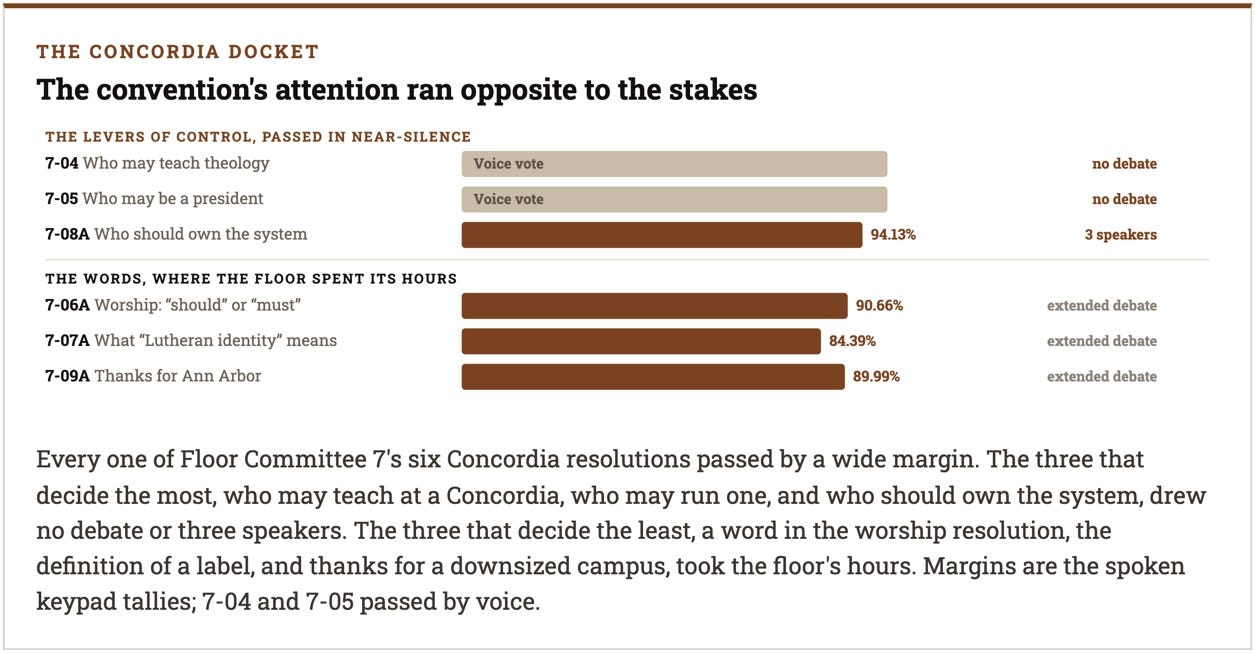
The Concordia University System, whose governance consumed the 2023 convention three years ago, in the bitter aftermath of Concordia University Texas moving to declare unilateral independence from the Lutheran Church—Missouri Synod, came to the floor again this week, with Floor Committee 7 bringing six resolutions for consideration. The two that decide who is allowed to teach theology at a Concordia and who is allowed to run one passed without a single delegate rising to speak. The resolution that asks whether the Synod should own its universities differently, the largest governance question on the docket, passed at better than ninety-four percent after three speakers and no amendment. What the floor fought over, at length and by name, was a single word in the worship resolution, the meaning of the phrase Lutheran identity, and whether a downsized Concordia in Ann Arbor still has leaders worth commending.
Easily passed
Resolution 7-04 and Resolution 7-05 are the quiet levers of the whole docket. The first directs a review of the prior-approval protocol for university theological faculty, the process by which the Synod signs off on who may teach religion at a Concordia; the second orders a parallel protocol written for university presidential candidates, so that the men who run the campuses are vetted for doctrine before they are hired. These are the resolutions that decide whether the identity language everywhere else on the docket has fangs. Each was read, moved, and adopted by voice without dissent, and not one delegate walked to a microphone.
Who should own the Concordias?
Resolution 7-08A carries the structural question the system has circled for a decade, whether the Concordia University System should remain a separate corporation or be folded into the Synod as a commission, and it directs the LCMS Board of Directors and the CUS board to weigh the two models and bring the better one to 2029. The Day Four preview had marked this as the day’s governance fight, and named the amendment expected to carry it: a filed motion from Rev. Steven Mueller of the Pacific Southwest District, the chief mission officer at Concordia Irvine, to strike the Institution Advisory Council from the study and hand it to the Concordia presidents instead. The amendment never came. When Rev. Timothy Barber of the Florida-Georgia District asked from the floor who actually sits on the Institution Advisory Council, the platform answered that it is the five Concordia university presidents, together with the system’s president Jamison Hardy, which is to say the study of whether to restructure the Concordias had already been handed, in part, to the men who run them, and Mueller’s amendment would have changed almost nothing. Rev. Charles Lehmann of the Southern District, the same delegate who would press the AALC admonition to its hardest form later the same day, told the floor he had spoken with one of the drafters the night before and urged the floor to leave the resolution alone: “Let’s let them do what they want to do.” A third delegate called the question, and the study of who should own the universities passed 94.13 percent to 5.19 percent, the highest margin of the afternoon, on the least examined question of the day.
Should, or must
The energy the corporate question did not draw went to Resolution 7-06A , which asks that worship on Concordia campuses form students to be faithful to Scripture and the Confessions and names Lutheran Service Book as the benchmark. Brian Dahl of the New England District moved to strike the word “should” from the conformity resolve and put “must” in its place, and the one-word amendment opened the longest debate of the committee’s day. A student delegate from Concordia Irvine spoke against tightening the language; a youth representative and several pastors spoke for it; and Mueller, who had not moved his own amendment two resolutions later, rose to assure the assembly that every campus already agrees its worship “must be in conformity,” and raised no objection. A Northern Illinois pastor who had taught in the Concordia system for more than a decade offered the one note of caution, warning that “a zeal for uniformity in rites and practices” can impede the gospel reaching the non-Lutheran students a Concordia chapel is built to catch. The chair put the amendment to a voice vote and ruled, in the afternoon’s one moment of levity, that “the musts have it.” The resolution then carried as amended, 90.66 percent to 9.34 percent.
What counts as Lutheran identity
Resolution 7-07A directs the CUS board, with the CTCR, to define what “Lutheran identity” means for the Concordias and to report to 2029. Brennan Woell of the Michigan District moved to swap the two bodies, making the CTCR rather than the university board the lead author, on the ground that the commission is the Synod’s proper writer of theology and the less political of the two. The floor turned him down on a voice vote, preferring to leave the first draft with the board that knows the campuses. The more heated exchange was over whether “Lutheran identity” is a real thing to define at all. The same Northern Illinois pastor who had cautioned against uniformity now called the markers of Lutheran identity superficial and the phrase itself faintly modern, and Vice-President Benjamin Ball, who sits on the Concordia Nebraska Board of Regents, answered him by reading Luther from 1522, that a man should “frankly confess Christ, no matter who did the preaching, Luther, or Tom, Dick, or Harry.” Mark Stern of the Northern Illinois District put the confessional point plainly: that the Synod does not place the Book of Concord above Scripture but confesses it because it is a true exposition of Scripture. The resolution carried 84.39 percent to 15.61 percent.
Ann Arbor, and the word “present”
The docket’s apparently simplest resolution produced its rawest hour. Resolution 7-09A gives thanks for the ministry of Concordia University Ann Arbor and acknowledges the grief of many over the reduction of its programs, and it might have passed on sentiment alone. Rev. Dr. Paul Philp of the Michigan District, a grandson of the campus’s founding president Paul Zimmerman, said his grandfather would affirm every word of it and would be grieved by what had transpired. Then Daniel Nicholson of the Michigan District moved to strike two words, “and present,” from the resolve commending Ann Arbor’s past and present leaders, arguing that to commend is to praise formally, that there are no present leaders in Ann Arbor but only present leaders at Concordia Wisconsin, and that President Harrison had asked the campus’s leadership to keep its chapel open and they had not. Nathan Meador, the president of the South Wisconsin District, which is home to the merged institution, rose against the amendment and against the tenor of the whole debate, insisting that Ann Arbor has been downsized and not closed, that it is a falsehood to say it has no leadership, and that the argument on the floor “continues to damage the church” and calls for repentance in South Wisconsin, in Michigan, and in the Synod. Rev. Jason Schockman of the South Wisconsin District called Ann Arbor “the hidden gem of the Concordia system.” The amendment to withdraw the word “present” failed, 79.19 percent to 20.81 percent; the main resolution carried at 89.99 percent, and the assembly rose to sing the doxology while the chair prayed aloud for a new day of church work in Ann Arbor.
The CUS docket
Read together, the six resolutions map a convention’s attention running in a direction opposite to its stakes. The two that decide who teaches and who presides at a Concordia, the only levers on the docket that directly hold a university Lutheran, drew no debate at all. The study of whether the Synod should own the system as a corporation or a commission, the question that decides who finally controls the Concordias, drew three speakers and the day’s widest margin. The hours went instead to a single auxiliary verb, to the definition of a label the campuses will spend three years drafting, and to two words of commendation for a downsized campus. None of that is entirely trivial, and a church that argues about the word “must” in its chapels is at least a church that still cares what happens in them.
Method and source. The account of the debate, the speakers, and the quotations is transcribed from the convention proceedings of the Wednesday, July 22, 2026 morning and afternoon sessions, where Floor Committee 7 presented across both slots; vote percentages are as spoken from the keypad tally and remain provisional until the official Convention Proceedings. Speaker attributions are drawn from the transcript and confirmed against the registered-delegates roster of the 2026 Convention Workbook (Brian Dahl, New England; Rev. Steven P. Mueller, Pacific Southwest; Vice-President Benjamin T. Ball; Brennan Woell, Michigan; Mark O. Stern, Northern Illinois; Rev. Charles Lehmann, Southern; Rev. Timothy Barber, Florida-Georgia; Daniel Nicholson, Michigan; Rev. Nathan Meador, South Wisconsin District president; Rev. Jason Schockman, South Wisconsin; Rev. Dr. Paul Philp, Michigan); the Northern Illinois pastor who cautioned against uniformity is named only as he identified himself on the floor and is left unattributed here. The resolution texts and dispositions are recorded on this publication’s decisions log . Ad Crucem News is an independent publication; this analysis is editorial and carries no imprimatur of The Lutheran Church—Missouri Synod or its officers.