
The Sclerotic LCMS Election and Convention
A deeply uncertain and troubling future for the LCMS is swept under a rug of nostalgia and faux conservation.

The Sixty-Ninth Regular Convention of the Missouri Synod convenes in the furnace of Phoenix, AZ, this July, but it will still not be hot enough to refine away a heavy contamination of dross. Synod leadership acknowledges that our church body is demographically imperiled, but ahead of the Convention, we have just stumbled through a presidential election in which the incumbent was 64 years old, and the challenger was 66 years old. They are nearly a decade older than the average LCMS churchgoer, who is two decades older than the average American. Delegates found the two leading geriatric candidates so superficially indistinguishable that it took three rounds of internet (but with 1987 postal characteristics) balloting to produce a victor who could cross the majority bar: 50.1%, just five votes over the threshold, to Rev. Dr. Matthew C. Harrison.
We can, at least, be faintly amused that beneath the apparent lack of distinction between the two men, the vintage ‘Conservative’ candidate is associated with dead orthodoxy and antinomianism1 (a rare flourishing field in the Synod today), while the vintage ‘Liberal’ candidate is associated with legalism and self-righteousness2. What a timeline.
The stale, cloying, generational vice grip is such a caricature that the candidates, the floor committees, and the electors were always reaching backward to recover and to preserve some imagined better piece of the Synod’s history or to re-litigate the imagined triumph over Seminex and the perfidy of Gerald B. Kieschnick, aka Lutheran Genghis Khan. There was, and is, no self-awareness about how urgent the tasks ahead are, or how desperately we need wholesale reform and restructuring of an institution in terminal decline if we count souls rather than shekels.
Delegates will sweat it out in Phoenix for a custodial convention and a lame duck presidency. Almost nothing on the docket is material to revival or survival. The election re-ran an incumbency, the resolutions reaffirmed a settlement, and the president, asked what most needed doing, is chasing a plan to restore LCMS parochial schools using diverted taxes. A church whose fertility and marriage have fallen for sixty years (here’s looking at you, unhelpful CTCR!3) does not principally lack the funds to build schools but the children to fill the ones it has. A tax credit, however shrewd, underwrites the symptom while the cause is met with a weak resolve to only speak clearly. That the victor’s first concrete initiative is an appeal to the federal treasury, at the very hour its own commentary calls the surrounding culture hostile to the faith, is an irony the convention will not come to grips with.
Consequently, the patient will remain close to death on the operating table, with everyone asking who the surgeon is and where the surgeon is, despite all the heavily credentialed, tenured, scrubbed, and garbed experts looking on with their arms folded in earnest contemplation about turning a 16-year incumbency into a two decade somnolent decline in search of graceful expiration with a tombstone epitaph that reads: “At least we had more gospel than those Catholics and Bapticostals. Owned and destroyed!”
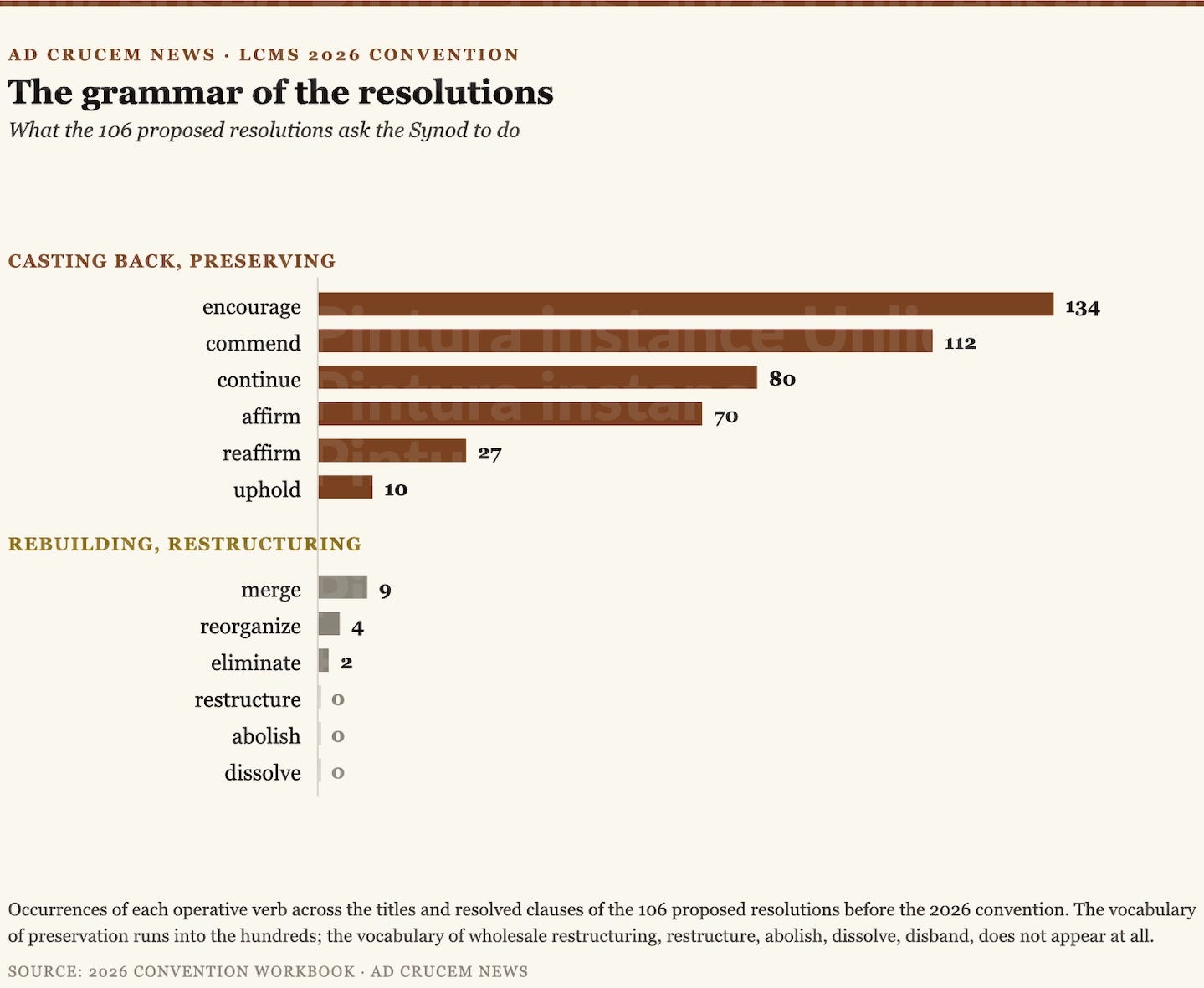
Whoever succeeds Harrison after this final term will inherit the same problems that the 2026 convention will not confront, and fewer years in which to answer them. Therefore, a leadership group will have to emerge in the meantime to deliver what 2026 has failed to. This group’s new order of business, regardless of Synodical reactionaries, sclerosis, and inertia, needs to begin work immediately post Convention:
Transparency and finance
Total financial transparency: Every Synod institution, including auxillaries and Recognized Service Organizations (RSOs), must publish (posted online not less than 7 months after the financial year end) annual GAAP-compliant financial statements with variances to budget and explanations for any variance exceeding $10,000.
Publication of names and packages for highly compensated individuals (top 10% of compensated staff for an organization; mimic Form 990 disclosures).
Centralized administrative parish support services (accounting, payroll, retirement, PTO, insurance, contact management, web site creation and management, copier leasing, bulletin production, background checks, and advisory legal) with voluntary paid subscriptions.
Every district must complete an annual census to determine (and publish in an aggregated, anonymized form) the average and median compensation of its rostered staff broken down by category, location, and years of service.
Governance and structure
Rebuild a system of dispute investigation and adjudication to replace the failed reconciliation model.
An overhauled governance structure based on a “Duty to Prevent” model.
Divide the Office of the President between a business/executive function and a clerical/doctrinal function (Chief Theological Officer vs Chief Executive (Mission?) Officer.
Termination of the national Council of Presidents (COP) and reconstitution of the Districts into manageable parcels (DP must be attached to an altar and actively serving at least once a month; able to drive no more than three hours each way to visit his parishes and circuits).
An aggressive review of conflicts-of-interest, such as CTCR members reviewing their own work, which is one way the Large Catechism with Annotations became an unmitigated disaster.
Competence and personnel
Difficult “civil service” exams that test men for competence before advancing them to senior Synod, seminary, district, and circuit offices.
Qualification starts with at least seven consecutive years in parish ministry and fluency in one of the Biblical languages (Greek or Hebrew to the standard of being able to conduct a Bible Study from an original text) and, preferably, one of the ‘clerical’ languages (Latin or German).
Individuals currently occupying seats without meeting the standard should be asterisked until they term out or take another call.
Formation and mission
Free hymnals and Small Catechisms for every LCMS parish, underwritten by Concordia Publishing House’s (CPH) gargantuan net assets line.
Commence planning for a new lightly copyrighted (Creative Commons) Bible translation that will remove the licensing bondage that the Synod agreed to by adopting the English Standard Version (ESV).
Radical reduction of foreign mission spending and ending the welfare that props up the International Lutheran Council (ILC) and its members. It is a disgrace and damning that we know more about Dominica than Maine.
Implement a Vicarage and Pastoral Support Initiative (VPSI).
Raise seminary pastoral qualification and formation standards dramatically.
Cover illustration: ChatGPT
Note Harrison’s proximity to the powerful circle of John Pless influence that has pumped Fordeian theology into Seminary formation, CPH publications, and para-Synod ministries.
Biermann’s Lutheran “virtue ethics” has attracted scorn and criticism from “Confessionals” fretting that his framework will automatically tip people into legalism, pietism, or anthropocentric moralism.
The 1981 CTCR report titled Human Sexuality: A Theological Perspective is the Synod’s primary theological document addressing contraception, though it was commended for study and guidance rather than adopted as an official doctrinal position. The report states that while marriage is expected to be open to children, “there need be no objection to contraception within a marital union which is, as a whole, fruitful,” provided the methods do not destroy life after conception.
I was just wondering aloud, commiserating perhaps, with one of my members the other day up here in Maine. Is there some special reason that the Lutheran congregations (all 3 of them) up here can't get a little help financially? Seems like money can go elsewhere to get new church buildings/school buildings/etc. I don't know. Just wondering aloud again. I'll always appreciate when you put a spotlight on the LCMS in Maine (selfishly perhaps, as the only non-retired LCMS pastor in the state at the moment). I advised the congregations up north recently to only call guys who are willing to go overseas, because that's what's required to get a guy to come up here.
Dr. Wood, sir. First, what an excellent publication you have here. Thank you.
I have only read a few lines, so I will only comment on a few lines. If you made opposite points down the page, then I am a dummy again.
Demographic crisis. I don't get it. The Missouri Synod didn't cause this mass insanity and falling away. They will come in in hoards when their foolishness comes home to roost by way of disaster, famine or war here. I do not have any information that God intends this church body to be growing in numbers right now. Everything I can think of right now says otherwise. Preach law properly, which is a thing missing, and expect it to get a lot worse. The Lord can do otherwise, but He does not promise, does He? So the synod shrinks a lot. Get the change agents out, the ones that actually have the sincerity to leave, and it gets even worse. To every thing, there is a season.
Geriatric candidates. We want wisdom and experience. What is possibly gained with less of that? Shortcomings in these two candidates are not about their age or vitality.
Every pastor knows not to unnecessarily alienate members of his flock. Harrison was and is a pastor. No layman, including me, really understands this in a completely internalized way. I think Harrison does not want to lose a single sheep, and that is nothing but good. So he is careful not to create unneeded offense, therefore the perception that he isn't doing anything about the problems. He does have many achievements in bringing our church body back to health. He is a theologian and a pastor. You imply some place that the two are barely distinguishable. I think that is way wrong. The other candidate had no such pastoral resume, and made a big and controversial (divisive) error (an academic one yet!) in a badly done publication that wasn't just a blog post or something, but the LC itself. I don't see how it's possible to downplay that.
Thanks for your great publication, but the first few lines of this article are wrong.