
The Pastoral-Formation Convention
LCMS Convention Floor Committee 6 carries the largest workload. The overtures compile into two camps, as expected, along with a process party and a content-defense flank.

The 2026 LCMS Convention Workbook routes more overtures to Floor Committee 6, Pastoral Ministry and Seminaries, than to any other committee, with eighty-eight against the next-largest, Floor Committee 4 at fifty-six, and Floor Committee 9 at fifty-two. Committee 6 will spend its preparatory weekend and the floor’s working hours on what amounts to a referendum on the question that has dominated Synod discourse for at least two triennia: by what route, or routes, does a man become a pastor in The Lutheran Church — Missouri Synod (LCMS)?
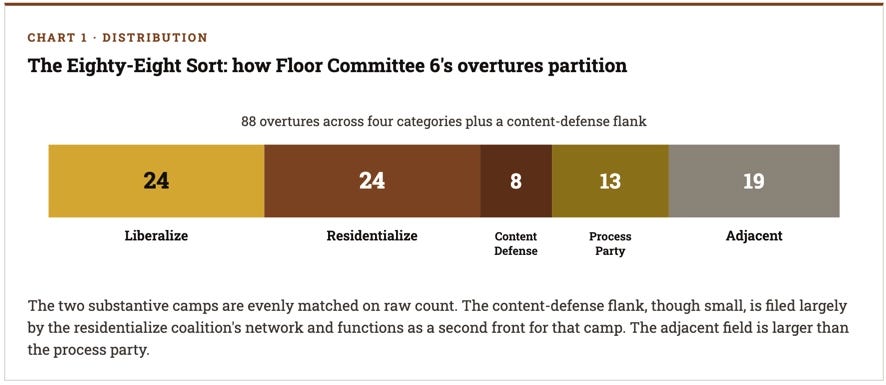
Read together, the overtures cluster along a predictable geometry.
Twenty-four overtures ask the convention to liberalize, broadening the existing Specific Ministry Pastor (SMP) program, authorizing online or non-residential Master of Divinity tracks, celebrating the variety of routes already in use, and reducing the restrictions on each.
Twenty-four ask the opposite, narrowing pastoral formation to the residential seminary path, tightening the SMP program (or suspending new admissions to it altogether), and affirming the exclusive use of Concordia Seminary, St. Louis, and Concordia Theological Seminary, Fort Wayne.
Thirteen ask the convention to defer the question, calling for a koinonia process, an expanded Pastoral Formation Committee, and the publication of enrollment data on which a future convention could decide.
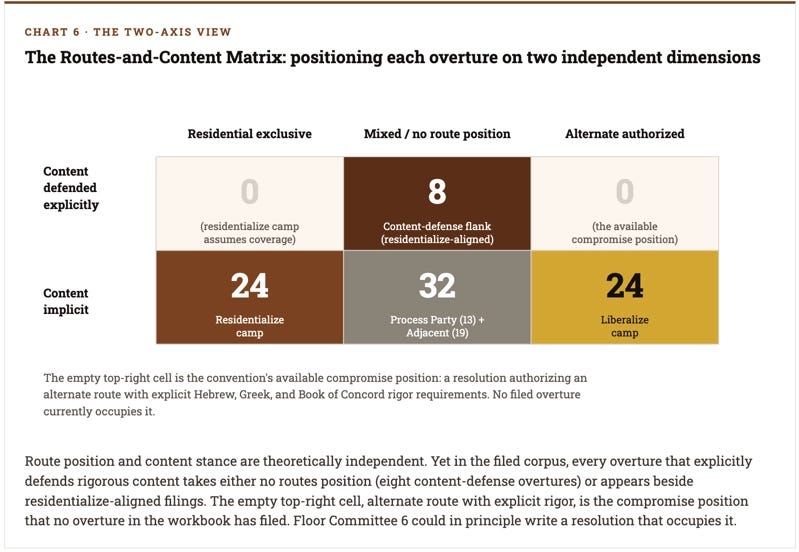
Eight defend the content of seminary education without taking a substantive position on routes, and the submitter overlap between those eight and the ‘residentialize’ coalition is sufficient to treat them as a coordinated flank rather than as an independent third axis.
Methodology
Each overture was read in title and substantive body and assigned to one of four primary buckets:
Liberalize with alternate tracks covers any overture asking the Synod to expand the routes by which a man may be ordained, whether by establishing new tracks (online, hybrid, distance) or by broadening existing tracks (SMP).
Narrow to residential only covers any overture asking the Synod to affirm the exclusive use of the two Synod seminaries, restrict alternate routes already in use, or make the residential M.Div. the only normatively recognized route.
Defer the question covers any overture proposing neither but asking for a process, namely, koinonia conversation, governance reform of the Pastoral Formation Committee, increased transparency, or refinement of an existing program in a direction not clearly aligned with either substantive pole.
Adjacent covers any overture whose substantive request is pastoral-formation-related but does not land on the residential-versus-alternate axis at all.
A fifth category, content defense, holds eight overtures that defend rigorous Scripture study in the original languages, sustained engagement with the Book of Concord, and theological competency for ecclesiastical oversight. Those overtures are cataloged separately because their content is independent of the routes question, yet their submitter overlaps with the residential coalition, which is sufficient to treat them as a coordinated flank rather than as a third independent voice.
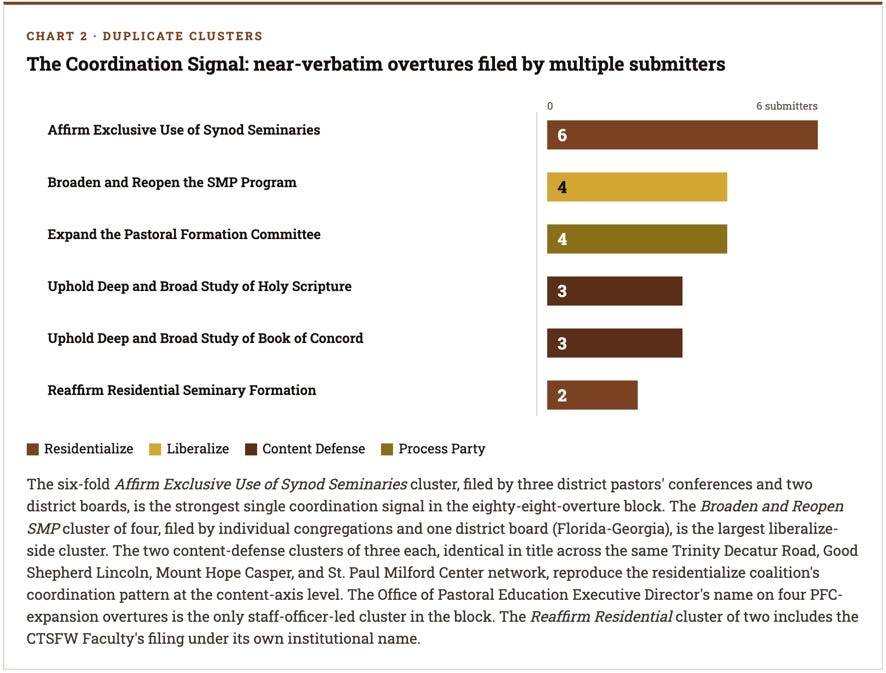
Where the workbook prints near-verbatim overtures from multiple submitters, each is counted separately for the tally, and the duplicate cluster is itself noted. Indeed, the duplicates are themselves a finding: six near-verbatim filings of Affirm Exclusive Use of Synod Seminaries point to one coordinated network on the ‘residentialize’ side, and several other near-verbatim clusters point to comparable coordination elsewhere.
Camp 1: Liberalize with Alternate Tracks
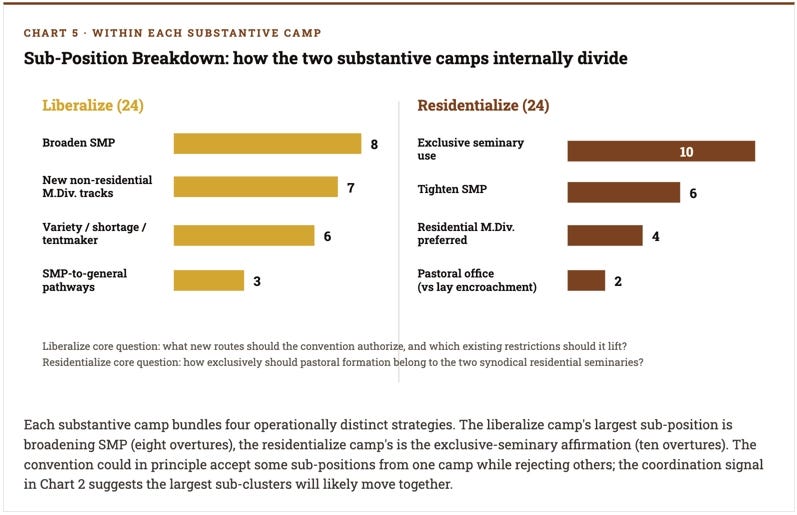
The liberalize camp partitions into four operationally distinct sub-positions.
A. Authorizing new non-residential M.Div. tracks (seven overtures)
Overtures 6-29 (Circuit 29 and the Texas District), 6-30 (Christ, Greenfield, Gilbert AZ, with Circuit 28 of the Pacific Southwest District), 6-31 (Circuit 16, Faribault, with the Minnesota South District), 6-32 (South Lake, League City TX), 6-33 (Board of Directors, Nebraska District), 6-34 (directing the Pastoral Formation Committee to bring a recommendation to 2029 for new routes), and 6-36 (Southeastern District) ask the Synod to authorize a pilot or full online, hybrid, or distance-learning M.Div. program. Several share a common preamble citing Bylaw 3.10.4.2, Seminaries will implement new routes to ordination only upon approval by resolution of the Synod, and ask the convention to provide that resolution.
B. Broadening the SMP program (eight overtures)
Overtures 6-55 (Christ, Milford MI), 6-56 (Christ, Greenfield AZ and Faith, Rochester NY), 6-57 (Emmanuel, Kahului HI), 6-58 (Board of Directors, Michigan District), 6-59 (Trinity Mission, KS) and 6-60 (Circuit 16, Faribault, with the Minnesota South District, near-verbatim of 6-59), and 6-62 (Florida-Georgia District) ask the Synod to restore SMP to its 2007 original scope, remove the November 2025 Pastoral Formation Committee policy’s forty-year age requirement, and reduce post-ordination restrictions. The Florida-Georgia filing is the only district-level liberalize submission on the SMP question, and the others come from individual congregations and a single district board.
C. SMP-to-general pathways (three overtures)
Overtures 6-47, 6-48 (amending Bylaw 2.13.1 to provide a pathway for SMP pastors to receive full pastoral certification), and 6-45 (regularizing non-residential routes under the SMP classification) ask that SMP ordination not be terminal.
D. Variety, shortage, and tentmaker ministry (six overtures)
Overture 6-38 (Atlantic District, Give Thanks to God for Many Existing Routes), 6-39 and 6-40 (near-verbatim, Celebrate and Encourage Variety of Routes), 6-46 (encourage equal outcomes in routes), 6-35 (ensure ministry during times of shortage), 6-79 (support bi- and co-vocational pastors), 6-80 (encourage secular vocational training for ministers), and 6-37 (encourage innovative training) ask the Synod to recognize that the present multiplicity is itself a good. The Atlantic District’s 6-38 is the strongest single statement of the position, citing the district’s 2006 home-grown mission-leader program by name and reporting that “well over 100 men and women have been developed, trained, and sent.”
Consequently, the internal logic of the liberalize camp runs along the harvest-is-plentiful theme (Matthew 9:37, Luke 10:2), reinforced by the demographics-and-shortage argument: the seminaries are graduating fewer M.Div. candidates than the Synod’s congregations need, the long-vacancy average is real, and residential M.Div. cost and time function as barriers the Synod can no longer treat as absolute. The camp does not deny that residential is valuable; it denies that residential is exclusive.
Camp 2: Narrow to Residential Only
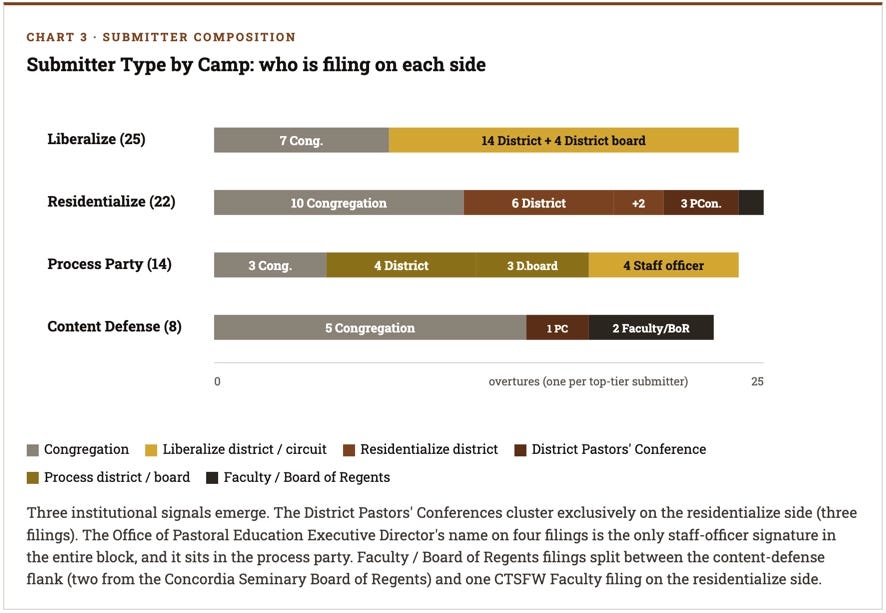
The residentialize camp also partitions into four operationally distinct sub-positions; however, its submitter roll is markedly more institutional than the liberalize camp’s.
A. Exclusive use of the Synod’s residential seminaries (ten overtures)
Overtures 6-14 (Good Shepherd, Lincoln NE and Memorial, Houston TX), 6-15 (Circuit 3 of the Southern Illinois District), 6-16 through 6-20 and 6-24 (six near-verbatim filings titled Affirm Exclusive Use of Synod Seminaries from, respectively, Emmaus Fort Wayne with the Pastors’ Conferences of South Wisconsin and Wyoming Districts; the Pastors’ Conference of the Mid-South District; St. Paul Milford Center OH; Good Shepherd Lincoln NE again; the Board of Directors of the Southern Illinois District; and the Pastors’ Conference of the Indiana District), plus 6-22 (Grace, San Mateo CA, defending seminary authority under Constitution Article VI 3) and 6-23 (the Missouri District) ask the convention to affirm that pastoral formation belongs exclusively to Concordia Seminary, St. Louis and Concordia Theological Seminary, Fort Wayne. The six-fold duplicate cluster from district pastors’ conferences and district boards is the single strongest coordination signal in the entire pastoral-formation block.
B. Residential M.Div. as preferred or normative (four overtures)
Overtures 6-41 (Circuit 5, Mitchell, with the South Dakota District), 6-42 (Iowa East District), 6-43 (Trinity Decatur Road, Fort Wayne IN), and 6-44 (the Faculty of Concordia Theological Seminary, Fort Wayne) ask the convention to reaffirm residential seminary education as the gold standard. The CTSFW Faculty filing under its own institutional name is procedurally unusual and reads as the seminary’s first-person voice in the workbook; the absence of a parallel filing from the CSL Faculty is itself a data point.
C. Tightening or restricting the SMP program (six overtures)
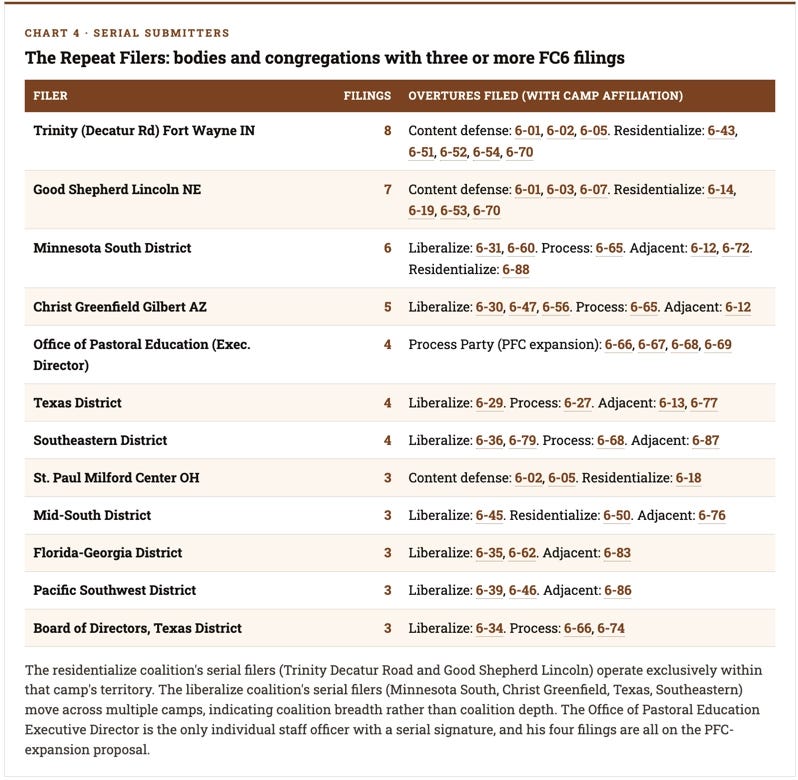
Overtures 6-49 (Board of Directors, Mid-South District) and 6-50 (Mid-South District again) ask the Synod to require completion of academic requirements before SMP ordination. Overtures 6-51, 6-52, and 6-54 (Trinity Decatur Road, Fort Wayne three times) ask the convention to clarify appropriate uses of SMP, affirm its established parameters, and strengthen post-ordination supervision. Overture 6-53 (Good Shepherd, Lincoln NE) asks the convention to suspend new SMP admissions altogether pending conformity with the Synod in convention. Trinity Decatur Road appears as the lead filer on the SMP-tighten side in three of the six positions.
D. Defending the pastoral office against lay encroachment (two overtures)
Overture 6-70 (retain the current structure of the Pastoral Formation Committee, against the proposed expansions on the third-way side) and 6-88 (affirm that the functions of the pastoral office belong to that office, against lay administration of Word and Sacrament).
Moreover, the internal logic of the residentialize camp runs along the historical-theological theme, namely, the apostles’ roughly three-year residential formation under Christ in Acts 1:21-22, the unbroken Synod tradition of residential M.Div., the patristic and Reformation continuity, reinforced by the institutional-quality argument that residential formation produces a depth of doctrine, communal discipline, and accountability that distance modes cannot match. The residentialists do not argue against more pastors; they argue against more routes, on the premise that route determines quality.
The Process Party: Defer the Question (thirteen overtures)
Meanwhile, a third grouping does not propose a substantive position on routes at all. Its overtures share the posture that neither side should win outright in 2026 and that the convention should authorize a process by which the question is answered rather than the answer itself.
A. Koinonia and brotherly speech (three overtures)
Overture 6-25 (Board of Directors, Nebraska District) and 6-26 (St. John, Seward NE) ask the Synod to seek koinonia on pastoral formation and routes to ministry, citing 2016 Resolution 4-05A. Overture 6-27 (Circuit 9, Texas District) asks the Synod to encourage brotherly speech about all approved routes and to review the SMP pathways collaboratively.
B. Reforming the Pastoral Formation Committee (seven overtures)
Overtures 6-65 (Christ Greenfield AZ with Circuit 16 Faribault and Circuit 28 Pacific Southwest District), 6-66 (jointly filed by the Executive Director of the Office of Pastoral Education with Trinity, Lexington Park MD, the Texas District Board of Directors, and Circuit 8 of the Southeastern District), 6-67 (the same Executive Director with Christ, La Mesa CA and Circuit 9 of the Indiana District), 6-68 (same Executive Director with the Southeastern District Board of Directors), 6-69 (same Executive Director with the Michigan District Board of Directors), and 6-71 (St. John, Seward NE) ask the convention to amend Bylaw 3.10.4.6 to expand the PFC, revise its composition, or broaden its representation. The recurring joint submitter is the most operationally significant signature in the block: the Executive Director of the Office of Pastoral Education is the staff officer of the body the overtures propose to expand, and his name appearing on five filings indicates that the proposed expansion is itself a Synod-staff initiative rather than a grass-roots one.
C. Process, transparency, and refinement (three overtures)
Overtures 6-09 (clarify SMP mentorship and oversight terminology), 6-28 (Christ, La Mesa CA with Circuit 9 Decatur of the Indiana District, Discuss Online Theological Education, an explicit request for conversation rather than decision), 6-61 (clarify and strengthen the SMP program, neither expanding nor contracting it categorically), and 6-74 (Board of Directors, Texas District, Direct Seminaries to Publish Annual Enrollment Numbers Every Fall, the data the rest of the debate is trying to argue from).
Consequently, the internal logic of the process party is institutional patience, anchored in 2016 Resolution 4-05A and in the historic Synod habit of consensus-building. The PFC-reform overtures argue that the body presently charged with route-recommendation, namely, the Chief Mission Officer (chair) plus the two seminary presidents plus a non-voting executive, is too small and too closely held to the seminaries to render an impartial reading.
The Content-Defense Flank (eight overtures)
Eight overtures defend the content of seminary education rather than its mode of delivery. Overtures 6-02, 6-03, and 6-04 (each titled Uphold Deep and Broad Study of Holy Scripture in Synod Seminaries) defend rigorous Hebrew, Greek, and exegetical training. Overtures 6-05, 6-06, and 6-07 (each titled Uphold Deep and Broad Study of Book of Concord in Synod Seminaries) defend rigorous Confessions training. Overture 6-01 defends seminary formation that faithfully teaches all doctrines of Scripture and the Confessions. Overture 6-08 (Pastors’ Conference of the Oregon Northwest District) extends the rigor concern from the seminary to the District President’s office.
The submitter pattern matters. Of those eight overtures, five (6-01, 6-02, 6-03, 6-05, 6-07) come from a coalition consisting predominantly of Trinity Decatur Road Fort Wayne, Good Shepherd Lincoln NE, Mount Hope Casper WY, and St. Paul Milford Center OH, three of which appear repeatedly on the residentialize-camp overtures. Two more (6-04, 6-06) come from the Concordia Seminary, St. Louis Board of Regents, institutionally aligned with the residentialize position. Only 6-08 comes from a submitter (Oregon Northwest Pastors’ Conference) that does not otherwise file on the routes question. Five of eight is sufficient to identify the content-defense overtures as the residentialize coalition’s second front rather than as an independent third axis, filed in the apparent expectation that route-defense alone may not carry the floor and that an additional content-defense layer creates redundancy.
Nevertheless, the content axis is theologically distinct from the routes axis, and a future convention could in principle pass a resolution authorizing an online or hybrid M.Div. with rigorous Hebrew, Greek, and Book of Concord requirements that satisfies the content-defense overtures without satisfying the route-restrictionists. The residentialize camp’s habitual conflation of residential with rigorous is the position; the content-defense overtures themselves, read on their own terms, do not require that conflation.
The Adjacent Field (roughly nineteen overtures)
The remaining overtures sit adjacent to the core question without landing on its central axis. They cover recruitment (6-76, 6-77, 6-78), continuing education and sabbaticals (6-81, 6-82, 6-83), vacancy compensation (6-85), lay service (6-86, 6-87), commissioned offices not in question (6-84, establishing a commissioned male diaconate), faculty governance and review (6-10, 6-72, 6-73), placement priority (6-75), colloquy procedure (6-11, 6-12, 6-13), and committee structure unrelated to PFC composition (6-64, concluding the Pastoral Formation Committee altogether). Overture 6-63 (imploring the Council of Presidents to fulfill 2019 Resolution 6-03A on SMP supervision) sits on the line between the residentialize camp and adjacent, since it strengthens SMP supervision without itself arguing about routes.
What Floor Committee 6 Actually Faces
Floor Committee 6 receives eighty-eight overtures across these positions. Net of the major duplicate clusters, the substantive count is closer to 70 distinct proposals, but the duplicates themselves are the political fact. The residentialize side has filed Affirm Exclusive Use of Synod Seminaries under six different cover letters, predominantly from district pastors’ conferences and district boards, and the liberalize side has filed Broaden and Reopen SMP under at least four cover letters, predominantly from individual congregations and one district (Florida-Georgia). The two sides are evenly matched on raw count; however, they are not evenly matched on submitter weight: the residentialize coalition’s filings come from coordinated district-level bodies, and the liberalize coalition’s filings come from a more dispersed congregational base.
The process party’s thirteen overtures, though fewer in number, hold the procedural keys. The koinonia process, the PFC-expansion proposals, and the request for enrollment-data transparency would each defer the substantive decision past 2026 and into 2029 in a manner that disadvantages both substantive poles. Indeed, the Executive Director of the Office of Pastoral Education’s name on five distinct PFC-expansion overtures is the most operationally consequential signature in the eighty-eight, because the staff officer of the body being proposed for expansion is also the principal advocate of its expansion.
Moreover, three additional observations carry weight. First, Good Shepherd Lincoln NE and Trinity Decatur Road Fort Wayne IN appear as serial filers on the residentialize and content-defense sides of this triennium’s debate, with Trinity Decatur Road’s signature on seven separate FC6 overtures and Good Shepherd Lincoln NE on five. Second, the CTSFW Faculty’s filing under its own institutional name (Overture 6-44) is the seminary’s first-person voice in the workbook on this question, and the absence of a parallel CSL Faculty filing suggests that the two seminaries may not be aligned on whether to make residential exclusivity a floor-level fight. Still, the Florida-Georgia District is the only district-level body filing on the liberalize side of the SMP question, which means the residentialize coalition has aggregated district-level submitter weight and the liberalize coalition has not.
The committee’s decision in 2026 will not resolve the substantive question of routes, but it will resolve the procedural question of who gets to keep arguing about routes and on what terms. The most plausible outcome reads as follows:
The residentialize coalition wins a resolution affirming exclusive seminary use,
The koinonia overtures are referred for further committee study without being formally lost,
the liberalize coalition fails to authorize any new track and attempts to regroup for 2029, and
the content-defense overtures pass largely uncontested as a redundant doctrinal affirmation.
Less plausibly, the process party’s PFC-expansion package carries, the routes question is referred to a reconstituted committee on a 2029 timeline, and neither substantive pole gets a resolution this triennium.
The convention’s pastoral-formation question is the central institutional question. It will probably not be decisively decided this year, but it does seem that the liberalize faction is being steadily marginalized by virtue of its weaker demographics and fading Synodical power.
Source: The 2026 LCMS Synod Convention and 2026 Convention Workbook, The Lutheran Church, Missouri Synod, Floor Committee 6 (Pastoral Ministry and Seminaries). Overtures are cited by number from the published workbook. Submitter attributions are taken from the workbook’s printed submitter rolls and reconciled where the printed text combines multiple filers under a shared title.