
The Disarmed Sanctuary
Dr. Joel Biermann has softened his teaching on lethal force on nearly every front since the 2023 Large Catechism With Annotations was issued.

For the better part of three years, Dr. Joel Biermann, the Waldemar A. and June Schuette Professor of Systematic Theology at Concordia Seminary, St. Louis, has been answering concerns that his teaching on the Fifth Commandment forbids a Christian to defend his own life, and for the better part of three years, he has been revising the answer. It deserves more scrutiny now that he has accepted the nomination to be elected as LCMS Synod President.
The record is a substantial one at this point. It begins with Biermann’s 2023 essay “The Fifth Commandment: Lawful, Lethal Force,” published in Luther’s Large Catechism with Annotations and Contemporary Applications by Concordia Publishing House, and with the companion broadcast he gave on Issues, Etc. to expound it. It runs through a long 2025 exchange with Pr. David Ramirez on Christian nationalism, in which the two men spent most of an hour on lethal force in the pew and in the home. It continues into a 2026 conversation conducted under the shadow of the synodical presidency, and into the two-part series he recorded in February and March of 2026 with Dr. Jeffrey Oschwald for the seminary’s Tangible podcast. Finally, his most recent interview with Rev. Dr. Jordan Cooper is especially revealing. Read together, these sources establish two findings that pull against each other.
What Remains Unchanged
Across all his writing and appearances, Biermann grounds the use of force in vocation and in service to the neighbor rather than in any personal right; he takes the Sermon on the Mount, and the command to turn the other cheek in particular, as binding upon every baptized Christian rather than as counsel reserved for the seminary or vestry. He has been consistent in locating the sword of justice in the office, the Amt, of the magistrate, so that private citizen actions are reserved to derivative actions and in the magistrate’s stead. He denies that Scripture grants any right of self-defense or any right to bear arms, allowing the second of these as a civil grant of the American constitutional order and nothing more; and he makes the witness of the church to the watching world the controlling consideration in every case.
None of that has shifted between 2023 and 2026, and the reader who believes Biermann is a hippie pacifist or a crypto Anabaptist is wide of the mark. He affirms the magistrate’s sword, the appropriateness of a just war, and the legitimacy of capital punishment. When the accusation of quietism was leveled at him during the Ramirez debate, he rejected it without qualification, calling Christian quietism always wrong. He holds a recognizably Lutheran two-kingdoms position, and the controversy has never really been about that core.
What Has Moved and Twisted
However, the second finding is that nearly everything built upon that original spine has moved. In the 2023 Annotated Large Catechism essay, the formulation was absolute, and the operative sentence, the one his critics clip and circulate, holds that lethal force “is never exercised for the sake of self, but always and only for the sake of the neighbor.” In the same essay, he wrote that the legitimate use of the sword “does not provide a scriptural foundation for a right to bear arms.” When pressed publicly on the man who defends his household, Biermann waved the argument away as a convoluted thing and compared the one who makes it to Samson, which is to say to a man whose violence Scripture does not hold up for imitation.
By 2025, under sustained and specific questioning from Pr. Ramirez, that absolute had given way. Biermann now granted that Luther permits lethal self-defense as a natural understanding of how the world works, even while insisting that the Christian is not obliged to avail himself of it, and he called the vocational argument for protecting one’s charges the compelling argument, a solid argument he was not going to dispute. By the 2026 conversation with Cooper, the concession had hardened into a settled habit of speech, so that the husband who reasons that protecting himself is protecting those who depend on him was now making, in Biermann’s own word, a legitimate argument, qualified only by the worry that it is overused. And the whole ethic had acquired a slogan, the “preferential option for nonviolence,” (also called pragmatic pacifism) a defeasible default standing in the place where the 2023 text had stood an unqualified never.
Two features of this drift from Biermann’s original stance deserve to be marked now, because they will matter when the argument about the divine service comes into view. The disputed ground has narrowed to lethal force as such, for Biermann now licenses without hesitation every form of resistance short of killing, the tackle, the block, the baseball bat, so that the perimeter he is defending is now far smaller than the absolute language of 2023 implied. Meanwhile, his renunciation of violence, where it touches his own person and rights, has, if anything, grown more severe rather than less, since in the Ramirez debate he professed himself unsure that he even bears a sword as a private man and located his protection in the providence of God rather than in his own hand.
The last point is the hinge, and the most recent sources confirm it. In the February 2026 Tangible episode, Dr. Oschwald read Biermann a line from his own published chapter on individual rights, that the Christian's task is not to defend his rights but to accept his place within the community, and asked whether a Christian ever puts himself first. Biermann answered that he had not changed a bit, that he held the point more firmly than before, and that the answer was never. So the principle that the Christian dies to self and claims no rights has grown more absolute, while the application that once flowed from it, that he may not use lethal force even to save his own life, has been narrowed and hedged. The drift is a man hardening the rule while loosening its sharpest consequence, often in the same season and sometimes within the same paragraph.
Premature
The reason this should trouble the churchman is its provenance. A theologian may revise himself in conversation as often as the evidence demands, and the church is better for watching him do it. But the 2023 formulation was not offered for discussion; it was declared fit for publication by the LCMS Commission on Theology and Church Relations (CTCR) and printed as final declaratory catechesis. “Never for the sake of self” was taught, with borrowed authority, to readers with every reason to take it as the settled doctrine of the Evangelical Lutheran Church.
Set that beside what Biermann has said since. The absolute position of 2023 has, by 2025 and 2026, conceded the original argument it was meant to exclude, narrowed the prohibition to lethal force alone, and told his interviewers more than once that he is still sharpening the account and has loose ends to tie up. A teaching cannot be finished enough to catechize and unfinished enough to need three more years of public revision. The charge is not that Biermann reversed himself, because on the governing principle, he has done the opposite and said so. Nevertheless, a still-forming application was given the authority of a Confession and handed to the laity and teachers of the church as fixed because it was paired with the Large Catechism.
Again, it raises serious concerns about the doctrinal review that received Biermann’s paragraph and let it stand as catechesis without asking whether its author had finished thinking it through. His own continued revising is the strongest evidence that the sentence should never have been printed where it was.
The Still Firm Position
On one matter, and one alone, Biermann has not given an inch. The divine service, he holds, must remain a place where the faithful are disarmed. The congregation is not to arm its own members, not to deputize its ushers, not to meet a threat to the assembly with lethal force of its own. If protection is wanted, the congregation is to import it from outside, the local police, the sheriff, a patrol car in the lot, or the men who actually hold the magistrate’s Amt. He treats the home as a different, softer case. The sanctuary, he does not. And the reason he gives is a theological one of real seriousness, namely that the divine service is the hour and the place in which the church most fully shows the world who Christ is, the people of God gathered around word and sacrament and willing, if it comes to that, to be helpless and to trust him.
However laudable the motive, the mechanism does not work. It fails the moment one asks what the imported officer actually accomplishes. Biermann forbids the congregation to defend itself with lethal force because such force, deployed by the body of Christ at worship, would compromise the witness and make the church look like every other frightened institution that fights to preserve itself. He then instructs that same congregation to arrange for exactly that lethal force, supplied by a man in a different uniform (with a different confession?) standing at the door. The trigger is the same trigger; only the hand and the conscience have changed. To the attacker and to the watching world whose perception is the entire point of the argument, an assembly that has stationed an armed officer to potentially kill in self-defense on its behalf has not displayed a willingness to be helpless. It has displayed a willingness to be defended by a gun, but it was careful to avoid the bad press of holding it itself.
The Saint James Church Massacre
Shooting Back: The Right and Duty of Self-Defense is a book and documentary by Charl Van Wyk that argues self-defense is a Christian duty to protect innocents. Van Wyk, a missionary, details his experience during the 1993 St. James Church massacre in South Africa, where he used a concealed firearm to stop terrorists and save lives.
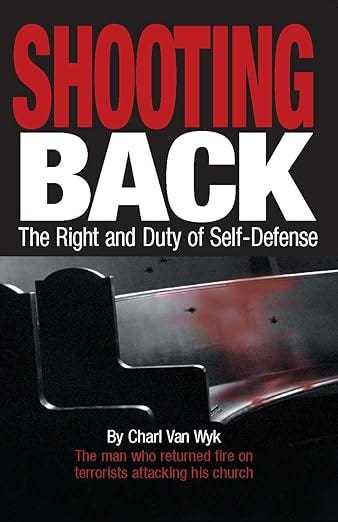
What Biermann offers as the church trusting God to provide turns out, on mild scrutiny, to be providence with a uniform and a duty roster, and the witness he means to protect is one only the congregation’s own conscience can see, invisible precisely to the world he says he is addressing.
The obvious reply, that the officer belongs to the left-hand kingdom and is merely doing the magistrate’s God-given work in its proper sphere, does not rescue the distinction, because the act under evaluation is not the officer’s but the congregation’s, and the congregation has procured lethal protection for the body at worship just as surely as if it had armed an elder. The two-kingdoms doctrine explains who may bear the sword. It does not convert the deliberate hiring of the sword into an act of helpless trust.
A second difficulty goes to the warrant rather than the mechanism. Biermann rests the disarmed sanctuary on the imitation of Christ, on the congregation looking as Christ looked. Yet when the cohort came for Christ in the garden, he neither summoned the temple guard nor accepted the armed defense his disciples offered him. He rebuked the sword drawn and used on his behalf, and submitted to his illegal detention and trial. The Lord, who is the model of the disarmed assembly, did not contract his protection out to the authorities, and a congregation that follows Biermann’s counsel does the very thing the garden forbids, which is to secure by the magistrate’s sword the safety that Christ declined to secure by anyone’s. The argument from imitation, pressed honestly, runs counter to the arrangement Biermann has constructed.
A third difficulty arises from the place itself. If there is one location in the Gospels where Jesus is recorded using physical force, it is the temple, the courts of the house of worship, which he cleared with a whip of cords while overturning the tables in zeal for the purity of his Father’s house. Whether the cords left welts and scars on the backs of men doesn’t need to be settled here; that the act was forceful, disruptive, and located in the place of worship is not in dispute. The sanctuary, then, is not a precinct from which force is categorically excluded. It is the one precinct in which the Gospels show the Lord himself wielding it to preserve pure doctrine.
The fourth difficulty dissolves the stated rationale altogether. Biermann does not, in the end, forbid the congregation to act; he forbids it only to kill and presumably only with a weapon. He permits the tackle, the block, the bat, the man who throws himself in front of the bullet, and he says as much in plain words. But a tackle is not helplessness, and a man who knocks an assailant to the floor of the nave has not made himself a martyr. Must a man recuse himself if he is trained in martial arts, which raises the likelihood of a lethal outcome? Which means the willingness to be helpless was never the operative rule in the sanctuary at all; the operative rule was a line drawn at lethality. A line drawn at lethality cannot be defended by the witness argument, because it cannot explain why the lethal force of an imported officer leaves the witness intact while the identical force of a deputized member destroys it. The watching world sees an armed guard either way. Biermann’s helplessness was rhetorical, and he crossed his own line the instant he invited the sheriff through the door.
Bonhoeffer Against Himself
Biermann does not leave the witness argument resting on his own authority. He grounds it, by name, in Dietrich Bonhoeffer’s Ethics, and specifically in the manuscript “Christ, Reality, and Good,” invoking Bonhoeffer’s warning that a church which sets about fighting for its own survival ceases in that very moment to be the church. The warning is reasonable, and the instinct behind it may be sound at first hearing. However, the trouble is that the body of work Biermann invokes is the same one that condemns his conclusion.
The center of Bonhoeffer’s Ethics (as opposed to The Cost of Discipleship) is not non-resistance but responsibility. The Christian is answerable for the flesh and blood neighbor placed in front of him, and the work of life in this world is to preserve the life actually before him. Bonhoeffer names two ways to fail at this. One is to grasp at earthly security as though it were ultimate. The other is to despise earthly life and throw it away for the sake of something higher. He calls that second error radicalism.
The man in the pew beside a child whom an attacker means to molest or kill is exactly the case Bonhoeffer has in mind: a concrete neighbor, a life to be preserved even at the expense of an assailant’s life. To take the barrel of an attacker's gun and place it on your forehead while singing “Take My Life and Let it Be” just because you’re in the divine service is the pious radicalism Bonhoeffer criticizes.
Ultimately, Biermann’s real gripe seems to be with the Second Amendment, a point echoed in his strange conception and distortions of American Christian nationalism, which we will tackle in a follow-up article.
Conclusion
Biermann’s critics who read the 2023 paragraph in its plain sense, as a denial that a Christian may use lethal force to preserve his own life, read it correctly, and Biermann’s steady retreat from that paragraph across the years since is their vindication rather than their refutation. The single position from which he has not retreated, the disarmed divine service, is the one that collapses most completely under even light examination. A congregation guarded by a paid imported gun is a pointless contradiction if the highest value of the divine service is to turn the other cheek so far that it may produce the needless death of your neighbor.
Biermann has been honest enough to keep revising his position in public, but that raises a great deal more questions about the CTCR’s decision to include his undercooked essay on the Fifth Commandment.
✝
The Record
Joel Biermann, “The Fifth Commandment: Lawful, Lethal Force,” in Luther’s Large Catechism with Annotations and Contemporary Applications (Concordia Publishing House), together with his accompanying interview on Issues, Etc. (2023).
Joel Biermann, interview by Jordan B. Cooper, A Conversation with Joel Biermann on Disagreeing Well, Lutheran Unity, and Two Kingdoms, YouTube, 2026,
Public debate with Pr. David Ramirez on Christian nationalism (2025), including the extended exchange on lethal force in the sanctuary and the home.
Joel Biermann and Jeffrey Oschwald, “American Politics, Part I: Tangled Authority” (Feb. 16, 2026) and “Part II: Christian Witness” (Mar. 3, 2026), Tangible: Theology Learned & Lived, Concordia Seminary.
Dietrich Bonhoeffer, Ethics (Dietrich Bonhoeffer Works, vol. 6), manuscripts “Christ, Reality, and Good,” with the account of the ultimate and the penultimate and of responsibility for the concrete neighbor.
Cover Photo by Kian Kamyabi on Unsplash
"And let the one who has no sword sell his cloak and buy one..." This passage in Luke 22 was Jesus telling the disciples to protect themselves in His absence. At His arrest, Peter's intention was to start a physical war for the kingdom, and Jesus had come to wage war for us on the cross. The Gospel is not proliferated by the sword, but Jesus was pretty clear that we're allowed to protect ourselves and the church from those who mean us harm.
I carry, and I’ve done so in church. My conscience has no issue with conceal carrying for the benefit of myself, my family, and my neighbor. Contemplating the matter is certainly worthwhile. I have no problem with the good professor modulating on this issue, but it certainly shouldn’t be forced upon the church nor put in a catechism. I have heard that conceal carrying would be an affront to Jesus’ command to turn the other cheek. But Jesus was never teaching that we should acquiesce to murder and mayhem. Turning the cheek, doesn’t mean letting your wife or children be raped or murdered. The Christian needs to be able to bear under some injustice as I have practiced as well - and literally turned the other cheek. Christian love demands the protection of others if one has the capability to neutralize an attacker, even if that means, regrettably, killing the attacker in a just, legal, and moral way.