
The Cost of Being a Watchman at Immanuel Lutheran Church, Easton, MD
Couple banned from church property and facing expulsion for faithful whistleblowing.

On April 24, 2026, at 6:04 PM, two members of Immanuel Evangelical Lutheran Church (ILC), Easton, Maryland, received an email from their pastor, Rev. Mark D. Tooley, informing them that they are advised to “voluntarily pull your membership,” that the Board of Elders is “calling a special Assembly meeting to expel you from membership if necessary,” and that they will be receiving “a letter of injunction through USPS, prohibiting you both from the property of Immanuel Lutheran Church.” Failure to comply, the letter warns, will result in the Board of Trustees filing a “Peace Order” with the Talbot County Sheriff’s Office.
The email was cc’d to Rev. Dr. Bill Harmon, District President of the LCMS Southeastern District (SED), and Rev. Michael Thress, Circuit Visitor of the Delmarva Circuit, as well as the full Board of Trustees and Board of Elders lay leadership.
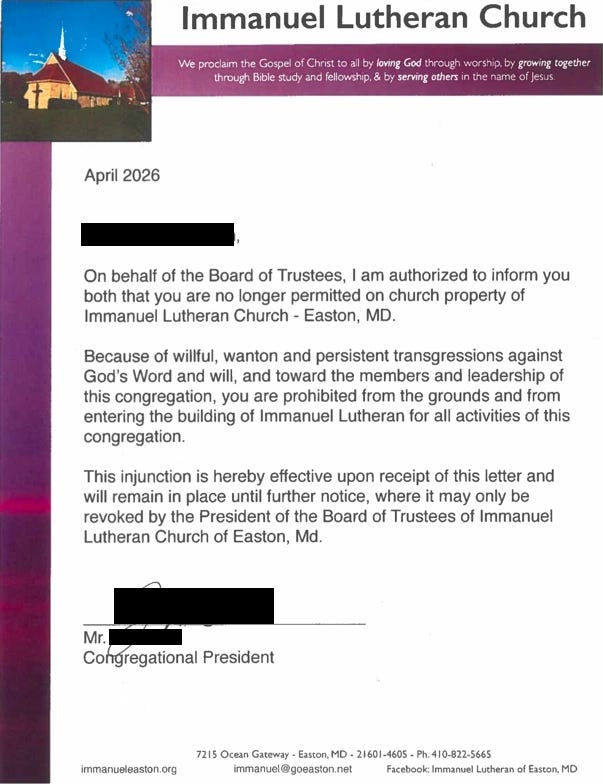
Pastor Tooley’s stated basis for these actions is: “willful, wanton and persistent transgressions of the 5th and 8th Commandments; causing division, strife, contention, factions, quarrels, slander and confusion within the congregation; going beyond the Scriptural admonitions of bearing with one another in love and reconciliation by collaborating with an independent news outlet, bypassing the Biblical and normal structures our church has put in place to reconcile areas of concern; and breaking the public promise of putting the best construction on all things between congregation and pastor.”
The “independent news outlet” is Ad Crucem News.
One of the ILC Members is a former officer of Immanuel Lutheran Church and a Certified Fraud Examiner with decades of legal compliance experience. The other has a background in law. They are not new to raising concerns at Immanuel: one brought to light seven years ago that Immanuel was not an incorporated body despite its constitutional requirement to incorporate, and nearly five years ago that Immanuel’s paid-off mortgage had not been recorded in Maryland Land Records. In each case, the intervention corrected or exposed a problem that leadership had failed to identify on its own. For more than a year, they have been warning Immanuel’s leadership about potential federal harboring liability under 8 U.S.C. § 1324, tax compliance failures involving potential unrelated business taxable income, and financial opacity, the same concerns documented in the three preceding articles in this series. They used the appropriate internal channels and raised their concerns privately, in writing, and in formal meetings with the Board of Trustees, the Board of Elders, and the pastor. They escalated to the District President and Synod President. They were ignored at every level for months, with no substantive response to their documented concerns.
Now they are being expelled, not for heresy or immorality, but for talking to a journalist, because their own church, district, and Synod leadership refused to address critical problems that touch on many Commandments.
What Immanuel’s Constitution Requires for Expulsion
Immanuel’s constitution and by-laws, approved by the Voters’ Assembly on November 18, 2018, and approved by the Southeastern District, contain a specific provision governing expulsion. By-Laws Article I, Section B.5, titled “Expulsion,” states:
“Expulsion is necessary when a member persists in living as a ‘manifest and impenitent sinner.’ The offense must be a willful, wanton, and persistent transgression against God’s Word and will. A member may be expelled only after persistent admonitions as prescribed in Matthew 18: 15-17. When he has resisted all efforts by the Pastor and elders to amend his life, he shall be declared expelled upon the recommendation of the Board of Elders and after an affirmative vote of two-thirds of the next Voters’ Assembly.”
This provision includes several procedural requirements, and the question of whether any of them have been satisfied warrants careful examination.
First, Matthew 18:15–17 prescribes a specific, graduated sequence:
private admonition between the two parties; then admonition in the presence of witnesses;
then admonition before the church; and
only then, if the member refuses to listen at every stage, may the member be treated “as a Gentile and a tax collector.”
The constitutional provision requires “persistent admonitions as prescribed in Matthew 18:15-17” before expulsion can proceed. The ILC Members maintain that no private pastoral visit or admonition occurred prior to the April 22 phone call from Pastor Tooley, the Head Elder, and the Congregational President requesting an urgent meeting. In their April 25 response letter, the ILC Members stated plainly: “at no time have you met with us to discuss such transgressions pursuant to Matthew 18:15-20.” Whether the Matthew 18 sequence has been followed is, in our opinion, a question the Voters’ Assembly should examine with extreme care before casting any vote.
Second, the offense must be a “willful, wanton, and persistent transgression against God’s Word and will.” Pastor Tooley’s letter characterizes the ILC Members’ conduct as violations of the Fifth and Eighth Commandments, that is, harm to the neighbor’s body or life, and bearing false witness against the neighbor.
The ILC Members, for their part, maintain that they raised documented, factual concerns about legal and financial compliance through proper channels over a period of more than a year, and that they turned to Ad Crucem News only after months of unanswered correspondence to the pastor, the boards, District President Harmon, and LCMS President Harrison. Whether raising governance concerns with a journalist constitutes a “transgression against God’s Word and will” is a theological characterization that, in our opinion, should trouble any Lutheran who has read the words of Martin Luther on the duty to speak truth to, and resist, unjust authority. As the ILC Members observed in their response: “the LCMS has no blanket prohibition of any kind of its members talking to the media.”
Third, the constitution requires that “he has resisted all efforts by the Pastor and elders to amend his life.” The documentary record, as we will demonstrate below, shows that it is the ILC Members who have been persistently seeking engagement with the pastor and elders, and the pastor and elders who have declined to respond to their substantive concerns. The ILC Members did not refuse to meet on April 24. They asked three questions first, and received no answers.
Fourth, expulsion requires a two-thirds vote of the Voters’ Assembly. Under By-Laws Article II, Section A.4, all meetings must “be announced to members in writing at least fifteen (15) days prior to convening.” A quorum is defined as 30 voting members (Section A.5). The same Voters’ Assembly that has never been informed, according to the ILC Members, of the harboring risk, the UBTI question, the suppressed financial review, or any of the other governance concerns documented in this series, is now being asked to expel two members for making public the very information that leadership has refused to share with them. Similarly, this congregation has not had a proper budget and accounting in place for some time1, but now wants to get serious about potential excommunication.
Property Ban
Separate from the expulsion process, a signed letter of injunction, executed by the Congregational President on behalf of the Board of Trustees, bans the ILC Members from “the grounds and from entering the building of Immanuel Lutheran for all activities of this congregation.” The ban is effective immediately.
Two baptized, confirmed, communicant members of Immanuel Lutheran Church have been barred from attending worship services, receiving the Lord’s Supper, hearing God’s Word preached, and participating in the life of the congregation, before any vote of the Voters’ Assembly has occurred, before any formal expulsion, and while they remain, as of this writing, members under the constitution.
The letter threatens that if the ILC Members set foot on church property, the Board of Trustees will file a “Peace Order” with the Talbot County Sheriff’s Office. For those unfamiliar with Maryland law, a Peace Order is a civil protective order typically sought in cases involving harassment, stalking, or threats of bodily harm. It is a legal instrument designed to protect individuals from physical danger. Immanuel Lutheran Church is threatening to use this instrument against two of its own members, a husband and wife, whose documented conduct consists entirely of raising governance concerns and speaking with a journalist.
The irony of a church denying access to Word and Sacrament while simultaneously accusing the ILC Members of spiritual transgressions requiring pastoral absolution is, in our opinion, not lost on anyone who has read Luther on the purpose of the church. However, this is the second example of such behavior with a Southeastern District congregation.
Three Unanswered Questions
Pastor Tooley’s letter states that he “attempted, with civility and openness, to meet with you and avail you of such this last full week of April, 2026. You refused in like kind, as per your emails below.”
The emails below, which Pastor Tooley included in his own communication, tell a different story.
On April 22, 2026, at 9:30 PM, following a phone call initiated by Pastor Tooley, the Head Elder, and the Congregational President, one of the ILC Members responded in writing. He did not refuse to meet. He asked three questions, one of each man, and said the ILC Members would attend the proposed meeting once the questions were answered. He wrote: “Your responses will demonstrate to us your trustworthiness.”
The questions were specific and, in our view, entirely reasonable:
To the Head Elder: The Head Elder had allegedly stated during the phone call that the last time he reached out to the ILC Member as an Elder, the member had responded “extremely callously and disrespectfully” by email. The ILC Member challenged this characterization, noting that the Head Elder had historically reached out by telephone, not email, and that after reviewing his entire email and text history with the Head Elder, he found “no evidence of a single incident” of such conduct. He asked the Head Elder to produce the evidence. The ILC Member also noted that he had honored every request the Head Elder had ever made of him, including personally driving to the Caroline County Detention Center the prior week at the Head Elder’s request to visit an individual who specifically asked for him.
To Pastor Tooley: At the October 30, 2025, meeting, the ILC Members were handed a document titled “Corporate Confession & Absolution,” a scripted text they were expected to recite, attesting to their being sinners present to receive forgiveness and absolution from the leadership. The ILC Member asked Pastor Tooley to “provide the standard doctrinal or liturgical provision you used as the basis to convene a private gathering of officers of the congregation with two specific members in a private room at Immanuel for a ‘Corporate Confession & Absolution’ session.”
To the Congregational President: Two months earlier, the Congregational President and the treasurer had received the ILC Member’s written request, which itself forwarded a prior unanswered request from November 2025 to a previous president. The ILC Member asked the Congregational President to indicate why he did not respond.
Twenty-four hours later, on April 23, 2026, having received no answers, the ILC Member followed up. He noted the ILC Members’ puzzlement “in light of the fact that we honored your urgent request to us that we meet with you as soon as possible.” He gave a deadline of 10:00 AM on April 24 for responses.2
No answers came. Instead, at 6:04 PM on April 24, the ILC Members received the property ban and expulsion notice.
The Real Agenda
Pastor Tooley’s letter frames the proposed meeting as an act of pastoral care: “I desire to absolve you of these confessed sins and attempted, with civility and openness, to meet with you and avail you of such.”
The ILC Members’ April 25 response letter reveals what actually happened on the April 22 phone call. Pastor Tooley “disclosed no agenda, intent, or purpose of the proposed meeting until I expressly requested toward the end of your call, ‘What is the agenda here, the topic?’” Tooley’s answer: “The agenda [of the meeting] is surrounding the two Ad Crucem letters.”
Both ILC Members witnessed this statement and memorialized it in contemporaneous notes.
The significance is plain. The proposed meeting was not, by the pastor’s own words during the call, about confession, absolution, or spiritual welfare. It was about the Ad Crucem News articles. The pastoral framing in Tooley’s April 24 letter, the language of spiritual concern, of desiring to absolve, appears to have been layered on after the fact. The ILC Members’ own April 23 email, which Tooley himself attached to his letter, confirms as much: “with regard to the Ad Crucem articles you intended to [be] the basis for meeting with us, we can only suggest the following.”
Consequently, the pastor told the ILC Members on the phone that the meeting was about the journalism. He then wrote a letter two days later, characterizing it as an offer of absolution. The ILC Members’ refusal to attend without first receiving answers to reasonable questions was recast as a refusal of pastoral care, a reframing that mirrors the same pattern leadership employed in October 2025, when the ILC Members’ administrative and legal concerns were absorbed into a “reconciliation” process that produced emotional theater rather than institutional action.
A Reconciliation Process in Name Only
The ILC Members’ April 23 email included a passage central to the legal and procedural analysis of what followed:
“Pastor, please be advised that if you three are unable to honor the requests we’ve made, we will be unable to henceforth ever meet with you without a neutral party, an independent mediator of our choosing, to attend with us. This is primarily because, pursuant to LCMS Bylaws on Dispute Resolution and Standard Operating Procedures, the prior ‘reconciliation process’ that occurred last October was misused.”
The email went further:
“That mediator we choose will not be [the Head Elder] or [the Congregational President], or [a former Congregational President], or any other member of the BOE or the BOT as witnesses or helpers. Instead, it will be one whom we choose from among SED-trained reconcilers and mediators, perhaps Ambassadors of Reconciliation (AOR), or our own lawyer/mediator as counsel to keep things God-pleasing and fair.”
The ILC Members were citing, by name, exactly the right process.
The Lutheran Church—Missouri Synod (LCMS) maintains a formal Dispute Resolution Process under Bylaw Section 1.10 of the LCMS Handbook. The Synod describes this process as “the exclusive and final remedy” for resolving disputes within its member congregations. The process is graduated:
it begins with informal face-to-face efforts,
proceeds to a single trained reconciler,
then to a dispute-resolution panel of three reconcilers drawn at random from across the Synod, and
finally to an appeal panel of three district presidents.
Each LCMS district trains approximately four reconcilers for this purpose. The training is provided by Ambassadors of Reconciliation (AoR), an LCMS Recognized Service Organization based in Billings, Montana, which has prepared over 160 reconcilers since 1997.3
Critically, Bylaw 1.10 specifically provides that the dispute resolution process is available to “members of member congregations of the Synod” when they “challenge the procedures used in their excommunication.”4 This is not an obscure provision. It is a right explicitly afforded to members facing exactly the situation the ILC Members now find themselves in.
The Southeastern District itself appears to agree that this process matters. On March 9, 2026, six weeks before Pastor Tooley’s letter, the SED published an article on its official website titled “Walking Alongside: The Work of SED Reconcilers,” promoting its trained reconcilers and inviting members to seek them out. The SED’s own published materials confirm that trained reconcilers are available within the district and that Ambassadors of Reconciliation provides additional resources.5
The timeline is, therefore and in our view, devastating:
On April 23, the ILC Members asked, by name and citing the correct Synod bylaws, for the very process the LCMS prescribes, and the Southeastern District promotes.
Less than twenty-four hours later, Immanuel’s leadership responded not by offering a reconciler but by escalating to the most severe ecclesiastical penalty available: a property ban, a demand for voluntary withdrawal, and a special Voters’ Assembly for expulsion.
They bypassed the entire graduated dispute-resolution framework designed precisely for situations like this.
Pastor Tooley’s letter states that these actions are taken “in full agreement with the Board of Trustees, the Board of Elders, myself as your pastor, and with full knowledge of Bishop Bill Harmon and Circuit Visitor Michael Thress.” If that is accurate, then District President Harmon and Circuit Visitor Thress were aware that the ILC Members had requested the Synod’s own dispute resolution process and approved the congregation’s choice to bypass it. The SED’s own website was, at that very moment, promoting the reconciler program that the ILC Members had asked for and that the congregation declined to use.
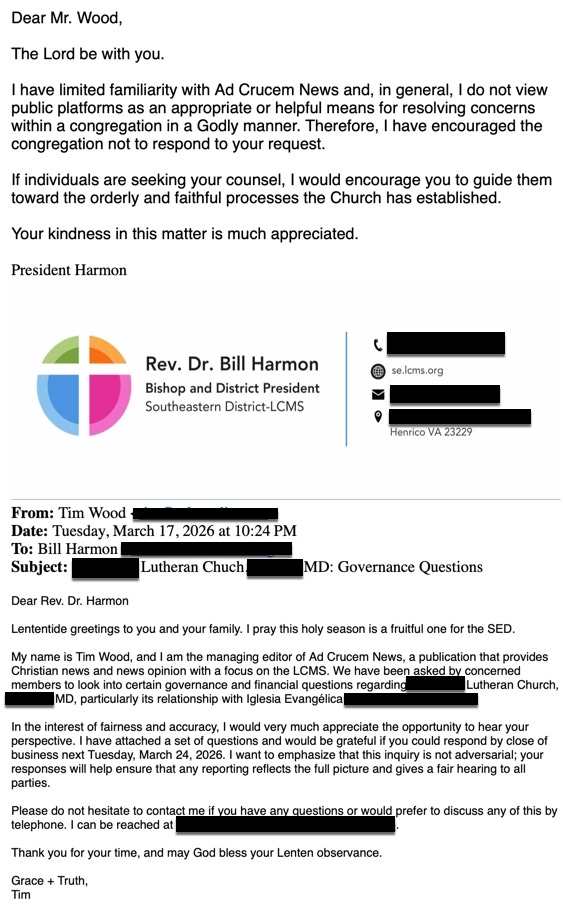
DP Harmon advised ILC leadership not to respond to detailed questions from Ad Crucem News sent on March 17, 2026, as shown below.
ILC Members Invoke Bylaw 1.10
On April 25, 2026, at 6:00 PM, less than twenty-four hours after receiving Pastor Tooley’s letter, the ILC Members sent a formal response. Their letter was addressed to Pastor Tooley and cc’d to the full Board of Trustees and Board of Elders lay leadership, District President Harmon, Circuit Visitor Thress, and LCMS President Matthew C. Harrison.
The letter is precise and measured. The ILC Members state that they “neither desire nor intend to enter onto Immanuel Lutheran Church Easton’s property.” They note that Tooley has “provided no substantiation” for his claim that they transgressed the Fifth and Eighth Commandments. They observe that the sole basis identified in his letter is their “collaborating with an independent news outlet” and that “at no time have you met with us to discuss such transgressions pursuant to Matthew 18:15-20, which calls into question your characterizing them as persistent.”
They then invoke their rights directly:
“We exercise now and hereafter our right, pursuant to LCMS Bylaw 1.10 and the Synod’s formal dispute resolution process, to challenge the procedures at work in your attempted ‘expulsion.’ This is consistent with what we communicated to you and the two Immanuel leaders in our April 23, 2026, email that you attached to your email letter.”
The ILC Members further specify that any mediation will occur “not at Immanuel Lutheran Church Easton but at a remote location,” and that the mediator will be either an SED-trained reconciler from Ambassadors of Reconciliation or their own legal counsel.
The formal invocation of Bylaw 1.10 is now a matter of record. The ILC Members have exercised the right that the Synod’s own bylaws afford to members challenging the procedures of their excommunication. The question now is whether the Southeastern District and the Synod will honor the process that their own governing documents prescribe, or whether the same ecclesiastical authority that was silent for eight months while the ILC Members sought help will now attempt to circumvent their procedural rights as well.
Immanuel’s Constitution Silent on DR
There is a structural dimension to this failure that warrants attention.
Immanuel’s constitution contains exactly one reference to the LCMS’s Dispute Resolution Process, and it appears in Article VII.C, which governs the dismissal of pastors, not the discipline of members. That provision states: “The congregation shall follow the principles found in Matthew 18: 15-17 and the established procedures of the Lutheran Church—Missouri Synod’s Dispute Resolution Process relative to such actions.”
The member expulsion provision in By-Laws Article I, Section B.5, requires the Matthew 18 sequence, persistent admonitions, a recommendation from the Board of Elders, and a two-thirds vote of the Voters’ Assembly. It contains no reference to the LCMS Dispute Resolution Process, no provision for an independent mediator, no mechanism for a member to request a neutral reconciler, and no procedural safeguard beyond the Voters’ Assembly vote itself.
Immanuel’s governing documents, therefore, provide more procedural protection for a pastor facing dismissal than for a member facing expulsion. A pastor is entitled to the Synod’s formal dispute resolution process. A member, under Immanuel’s by-laws as written, is entitled to admonitions from the very leadership that is prosecuting the case, followed by a vote of a body that leadership controls the information flow to.
This does not mean the ILC Members are without recourse. Bylaw 1.10 of the LCMS Handbook operates at the Synod level, above the congregation’s own governing documents, and it explicitly grants members the right to challenge expulsion procedures.
A Familiar Pattern in the Southeastern District
Readers of this publication will recognize this pattern. It is the same pattern documented at Our Savior Lutheran Church and School (OSLCS) in Arlington, Virginia, also in the Southeastern District, also under the ecclesiastical supervision of District President Harmon.
At OSLCS, members and parents who raised concerns about a pastor's conduct were subjected to a governance process that appeared designed to silence dissent rather than address the actual complaints and evidence. Harmon presided over a congregational meeting at which, according to records, voting rights were questioned, social media was blamed for the congregation’s problems, and the pastor who was the subject of the complaints was given the option to resign rather than be defrocked. The complainants were never interviewed as part of the District’s investigation.
At Immanuel Lutheran Church, Easton, MD the pattern is repeating with even sharper clarity: the ILC Members raised documented governance and legal concerns; leadership declined to act; the ILC Members persisted; and the institutional response was not to address the concerns but to remove the people who raised them. In both congregations, District President Harmon was a common denominator. In both congregations, the complainants’ substantive concerns were, in our opinion, subordinated to the institutional priority of maintaining the authority of existing leadership and papering over problems. It is little wonder that voices critical of clerical authority are growing louder in the LCMS.
The question is not whether Immanuel has the constitutional authority to expel members; it does, through the process outlined above. The question is whether expulsion for speaking publicly about unaddressed governance failures constitutes the kind of “manifest and impenitent” sin that the constitutional provision contemplates, or whether it is retaliation given a pastoral veneer.
Comfort Dogs and a Prejudicial Press Release
The institutional response to the Ad Crucem News series includes at least one additional measure that needs scrutiny.
On the Third Sunday of Easter (April 19, 2026), Immanuel hosted a visit from Lutheran Church Charities’ K-9 Comfort Dog Ministry. The Comfort Dog program provides trained therapy dogs to “communities experiencing grief, trauma, or crisis.”
On or about April 20, 2026, Lutheran Church Charities published a press release on its website titled “Comfort Dogs Help Small Church Community Find Peace and Comfort.” The release named Immanuel Lutheran Church in Easton, MD, and stated that “the church has been navigating a period of stress and sadness following a difficult situation involving REDACTED BY AD CRUCEM NEWS.” It continued: “In recent weeks, concerns REDACTED BY AD CRUCEM NEWS… many members were left shaken and struggling to process what had unfolded.”
The press release described a deployment of two LCC K-9 Comfort Dogs, Amos (Our Savior’s Way, Ashburn, VA) and Kezia (Emmanuel, Baltimore, MD), who arrived for the 8:30 AM service and remained through fellowship time and the 11:00 AM service.
There are several problems with this press release, each of which raises serious concerns about the judgement of Pastor Tooley, ILC leadership, and LCC.
First, the release publicly identified an individual by name and title, and described an incident, all in a document published on the website of a nationally known LCMS RSO. Publishing the individual’s name alongside characterizations of him and a description of an incident on the website of a nationally recognized church ministry, accessible to the general public, including potential jurors in Caroline County, is, in our opinion, extremely reckless. It is, at minimum, deeply imprudent for a ministry organization to publish the name of a person facing court proceedings, and it raises the question of whether anyone at Immanuel or Lutheran Church Charities cared enough to consider the likely prejudice to the individual before publishing.
Second, the press release’s narrative does not match the documentary record. The Comfort Dog deployment was not precipitated solely by the specific incident. It occurred in the weeks following the Ad Crucem News series documenting governance failures at Immanuel (until now, unnamed), the same series that prompted the leadership to initiate expulsion proceedings against the ILC Members. By framing the deployment entirely around the incident that occurred on the Friday before the dogs were brought in, and omitting any mention of the Ad Crucem News investigation, the press release presented a selective account of why the congregation was in distress. The question of who provided the framing and wording to Lutheran Church Charities is one the congregation needs to discover and address.
Third, the release described the situation in pastoral and sympathetic terms, “the close-knit nature of the church community, where relationships are deeply intertwined,” which does not reflect reality at the congregation. The comfort, it appears, was offered selectively.
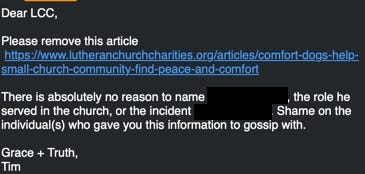
After Ad Crucem News raised concerns about the press release with Lutheran Church Charities6, the release was removed from public access, and comments were closed. We commend Lutheran Church Charities for its responsiveness. We would have appreciated a receipt acknowledgment, a note to readers explaining why the content was deleted, and a full apology to the individual concerned. The fact that such a release was published at all, containing what amounts to prejudicial gossip, raises serious questions about what information Pastor Tooley and Immanuel’s leadership communicated to Lutheran Church Charities about the nature of the “crisis,” and whether the organization was given a complete and accurate picture of the situation into which it was deploying its dogs.
Selective Engagement
Pastor Tooley’s April 24 letter states that the actions against the ILC Members are taken “with full knowledge of Bishop Bill Harmon and Circuit Visitor Michael Thress.” Both are cc’d on the email.
This is worth pausing on. For months, the ILC Members attempted to engage both Harmon and Thress on the substance of their governance concerns. Harmon’s October 28, 2025, letter, which, as we have previously reported, rendered a legal conclusion about harboring law that he was not, in our opinion, qualified to make, was his only substantive communication. The ILC Members’ written communication to Immanuel’s leadership on February 18, 2026, containing detailed documentary evidence, received no response. Their March 9, 2026, letter directly to Harmon, noting that Harmon’s October letter “offers no value in addressing the situation” and that Harmon appeared to have acted “in direct contradiction to LCMS President Harrison’s stated position,” received no response. Their March 19, 2026, letter to LCMS President Harrison himself, in which the ILC Members described the “Corporate Confession & Absolution” session as an “ambush,” reported that Immanuel had cycled through five Congregational Presidents in just over three years (two of whom were reportedly asked to resign), and asked that the Office of the President “discourage any personal attacks we may receive as a result of simply trying to save this church from itself,” also received no response.
Yet when the time comes to ban two members from church property and initiate their expulsion, bypassing the Synod’s own dispute resolution process that one of the members had explicitly requested the day before, Harmon and Thress are engaged, informed, responsive, and apparently supportive. The contrast speaks for itself: ecclesiastical authority was unavailable when the ILC Members sought help with documented governance failures, but fully available when Immanuel’s leadership needed to punish them for making those failures public.
The SED’s own March 9, 2026, article on reconcilers, published the same day the ILC Members’ letter arrived at Harmon’s desk, makes the contrast all the more stark. On March 9, the SED was telling its members that trained reconcilers are ready to “walk alongside” them. On March 17, 2026, SED DP Harmon received questions about ILC from Ad Crucem News that should have triggered a reconciliation process from his office. On April 24, Harmon was cc’d on a letter that bypassed the reconciliation process entirely in favor of the most punitive action available.
The Timeline
August 19, 2025 — Immanuel’s Board of Trustees minutes record discussion of ICE activity in the area. Pastor Tooley contacts a local sheriff about the “harboring test.” Guidance reviewed for potential ICE raid during services. A dinner with Luz de Vida leadership is scheduled for the following evening.
October 14, 2025 — Circuit Visitor Rev. Michael Thress affirms District President Harmon’s response to Pastor Tooley. Neither, according to the ILC Members, conducts an independent investigation of the facts.
October 22, 2025 — Pastor Tooley reframes the ILC Members’ administrative and legal concerns as a matter requiring spiritual “reconciliation.”
October 25, 2025 — The ILC Members respond in writing, reiterating that the concern is “exclusively an administrative/business one.”
October 28, 2025 — District President Harmon sends letter concluding that “Immanuel’s circumstances do not meet the legal definition of ‘harboring’”, without having investigated the underlying facts, according to the ILC Members.
October 30, 2025 — Meeting with BOT, BOE, and Pastor Tooley. Meeting opens with an unscripted “Corporate Confession & Absolution” session. ILC Members present harboring and UBTI concerns. Concerns acknowledged and validated. No action taken.
February 18, 2026 — The ILC Members send detailed written communication to the BOT, BOE, and Pastor Tooley, accompanied by numbered documentary evidence. No response.
March 9, 2026 — The ILC Members forward the entire package directly to District President Harmon. No response. On the same date, the SED publishes an article promoting its trained reconciler program.
March 17, 2026 — Ad Crucem News sends detailed questions to District President Harmon and ILC leadership.
March 19, 2026 — Having received no response from Harmon after ten days, the ILC Members escalate to LCMS President Matthew C. Harrison, forwarding the complete chain of correspondence. No response.
March 24, 2026 — District President Harmon responds to Ad Crucem News and writes,
“I have limited familiarity with Ad Crucem News and, in general, I do not view public platforms as an appropriate or helpful means for resolving concerns within a congregation in a Godly manner. Therefore, I have encouraged the congregation not to respond to your request.
If individuals are seeking your counsel, I would encourage you to guide them toward the orderly and faithful processes the Church has established.
Your kindness in this matter is much appreciated. “
March–April 2026 — Ad Crucem News publishes a series of articles (more to come) documenting governance failures at Immanuel Lutheran Church, Easton, MD (unnamed until this article).
April 20, 2026 — Lutheran Church Charities Comfort Dogs deployed to Immanuel. A press release is subsequently published and then removed after Ad Crucem News admonishes LCC via email for publishing prejudicial information.
April 22, 2026 — Pastor Tooley, the Head Elder, and the Congregational President initiate a telephone call to the ILC Members requesting an urgent meeting. When pressed for the agenda, Tooley states it is “surrounding the two Ad Crucem letters.” The ILC Members respond at 9:30 PM in writing with three questions, one for each man, requesting substantiation of claims and responses to unanswered correspondence.
April 23, 2026 — The ILC Members follow up at 10:43 PM. Note that the prior “reconciliation process” in October 2025 was misused. Request an independent mediator, citing LCMS Bylaws on Dispute Resolution and naming SED-trained reconcilers and Ambassadors of Reconciliation as the appropriate mechanism. Set a 10:00 AM April 24 deadline for responses. No answers provided.
April 24, 2026 — At 6:04 PM, Pastor Tooley issues a letter banning the ILC Members from church property, advising them to voluntarily withdraw membership, and announcing a special Voters’ Assembly to expel them. The letter reframes the proposed meeting as an offer of absolution. The letter states actions are in “full agreement” with the Board of Trustees and Board of Elders, with “full knowledge” of District President Harmon and Circuit Visitor Thress.
April 25, 2026 — At 6:00 PM, the ILC Members send a formal response to Pastor Tooley, cc’d to all boards, Harmon, Thress, and LCMS President Harrison. They formally invoke their right under LCMS Bylaw 1.10 to challenge the expulsion procedures through the Synod’s dispute resolution process. They note that no Matthew 18 admonition was ever conducted and that the LCMS has no prohibition on members speaking to the media.
The documentary record reveals a pattern that, in our opinion, is indefensible: for eight months, the ILC Members’ substantive governance warnings went unaddressed and unanswered at every level of ecclesiastical authority. Within weeks of those concerns becoming public through Ad Crucem News, and less than twenty-four hours after the ILC Members formally requested the Synod’s own dispute resolution process, they were banned from their own church and placed on the path to excommunication.
The pattern is identical to what happened at Our Savior Lutheran Church & School in Arlington, VA, where whistleblowers were stonewalled and harassed until they appealed to Ad Crucem News for help. Then the church leadership and District President moved with alacrity to entrench themselves and abused the church Constitution and Bylaws to attack the complainants. To this day, justice has been denied to the OSLCS whistleblowers.
What “Love Covers a Multitude of Sins” Does Not Mean
Pastor Tooley’s letter invokes the language of spiritual care: “I am concerned for your spiritual welfare.” It frames the expulsion as a response to sin: “willful, wanton and persistent transgressions.” It presents the property ban as a reluctant measure taken only after the ILC Members refused a meeting.
The ILC Members did not refuse to meet; they simply asked for clarity before agreeing to a specific date, time, and agenda. The questions were not answered, and the ban followed within hours of the ILC Members’ own deadline passing.
The Scriptural injunction that “love covers a multitude of sins” (1 Peter 4:8) is a call to forbearance and forgiveness within the Body of Christ. It is not a directive to conceal governance failures, suppress financial audits, ignore federal compliance obligations, and punish members who bring these matters to light. If “love covers a multitude of sins” is to be invoked at all in this situation, it might more appropriately be directed at the leadership of Immanuel Lutheran Church. Two members spent more than a year, quietly, through proper channels, at high personal cost, trying to protect their congregation from legal and financial risk before ever speaking to a journalist.
Immanuel’s letterhead reads: “We proclaim the Gospel of Christ to all by loving God through worship, by growing together through Bible study and fellowship, & by serving others in the name of Jesus.” The ILC Members would say they were trying to do exactly that.
The Deeper Question
This is the fourth article in a series that began with a broad examination of governance failures at Immanuel Evangelical Lutheran Church, Easton, and has progressively revealed a pattern of institutional self-protection at the expense of transparency, accountability, and the welfare of the congregation’s own members.
The deeper question is not whether Immanuel has the right to expel the ILC Members. Under its constitution, it does, through the process outlined in its by-laws, with the safeguards of Matthew 18 and a two-thirds vote of the Voters’ Assembly. The question is whether the leadership has followed that process, whether it has offered the dispute resolution mechanisms the Synod provides and the ILC Members explicitly requested, and whether the real offense here is spiritual transgression or institutional inconvenience.
The deeper question is what it says about an institution when the only members it moves to discipline urgently are the ones who begged for governance correctives for years.
Immanuel’s leadership did not call a special Voters’ Assembly when it learned that its building-sharing arrangement with Luz de Vida might expose the congregation to federal harboring liability. It did not call a special assembly when it learned that its financial practices might create UBTI obligations. It did not call a special assembly when it was told that its articles of incorporation had never been filed despite constitutional requirements and public representations to the contrary. It did not act when members resigned over the Luz de Vida arrangement, or when a former president of the guest congregation was reportedly apprehended by ICE, or when its own Board of Trustees discussed what to do if federal agents arrived during a church service. Nor did it call a Voters’ Assembly to look into its accounting problems.
The ILC Members have now formally exercised their right, under LCMS Bylaw 1.10, to challenge the procedures used in their attempted expulsion through the Synod’s formal dispute resolution process. That process will involve scrutiny of whether the Matthew 18 sequence was followed, whether the Synod’s own reconciliation mechanisms were offered or deliberately bypassed, and whether the expulsion was procedurally sound or a vehicle for retaliation.
Ad Crucem News will continue to report on this matter because we care about sin, justification, and Christian justice. The pattern of the Southeastern District in the two cases we have covered is contrary to Scripture and needs to be corrected with force and clarity. We continue to invite Pastor Tooley, Immanuel’s Board of Trustees, District President Harmon, Circuit Visitor Thress, and the LCMS Office of the President to respond. Our contact information has always been, and remains, publicly available.
Series: This is the fourth in a series examining governance failures at Immanuel Evangelical Lutheran Church, Easton, Maryland, in the LCMS Southeastern District.
Sources and citations referenced in this article:
1 Peter 4:8 — “Love covers a multitude of sins”
Matthew 18:15–17 — Process for church discipline
8 U.S.C. § 1324 — Federal harboring statute
Maryland Peace Orders — Maryland Judiciary
“Doctrine, Governance, and Process Dispute at LCMS Congregation” — Ad Crucem News
Immanuel Evangelical Lutheran Church Constitution and By-Laws — Approved by Voters’ Assembly, November 18, 2018
Pastor Mark D. Tooley, email to the ILC Members — April 24, 2026, 6:04 PM
ILC Members, response letter to Pastor Tooley — April 25, 2026, 6:00 PM (cc: boards, Harmon, Thress, President Harrison)
ILC Members, email to Pastor Tooley, Head Elder, and Congregational President — April 22, 2026, 9:30 PM
ILC Members, follow-up email — April 23, 2026, 10:43 PM
ILC Members, letter to LCMS President Matthew C. Harrison — March 19, 2026
ILC Members, letter to District President Bill Harmon — March 9, 2026
ILC Members, letter to BOT, BOE, and Pastor Tooley — February 18, 2026
Signed Letter of Injunction — April 2026, signed by the Congregational President
Lutheran Church Charities, “Comfort Dogs Help Small Church Community Find Peace and Comfort” — April 21, 2026 (subsequently removed)
Documented with evidence from the whistleblowers.
The correspondence to Tooley included an offer of “private and confidential” correspondence to allay any fears that it might be shared with Ad Crucem News.
Ambassadors of Reconciliation — LCMS Recognized Service Organization; reconciler training and mediation services. See also “165 Reconcilers Receive Training,” LCMS Reporter, 2005; and “Message of Cross Forms Basis for Resolving Disputes,” LCMS Reporter, 2009.
LCMS Standard Operating Procedures Manual — Dispute Resolution, Bylaw Section 1.10. The process is described as “the exclusive and final remedy” for disputes within the Synod and is specifically available to congregation members challenging the procedures of their excommunication.
“Walking Alongside: The Work of SED Reconcilers,” Southeastern District, LCMS, March 9, 2026.
April 22, 2026, at 20:50:48 EDT, “Immanuel LC Easton article contains private information - please delete”
Any future meetings between the ILC members and ILC pastor, congregational, or district officials need to be recorded. This is substantiated by Ryan Turnipseed's experience.
I wish I could say I'm surprised, shocked, and appalled. I live in the Michigan District. This behavior has been normalized here during my entire 50 years. I do not see any LCMS President, no matter how good or bad, future, or present, able to do anything about it. 100 years of the best president won't heal the Kieschnick years. And we wonder why people leave for Eastern Orthodox or other churches...