
The Catechetical Supremacy of American Civil Religion
Immigration, fertility, and the rise of American civil religion as the most "competitive" faith complicate any simple account of which church body is winning, who is losing, and why.

In 1972, Methodist minister and civil liberties lawyer Dean M. Kelley published Why Conservative Churches Are Growing. He was employed by the National Council of Churches, and decided, on his own initiative, to find out why the NCC’s liberal mainline member denominations were losing members at an accelerating rate. The root assumption was that they should have been growing because liberals had all the assets and credentials, including prestigious city addresses, highly educated clergy, and social justice bona fides. However, the competing conservative church bodies were easily outpacing the liberal ones, and taking in their sheep despite being in the supposed Dark Ages. Kelley’s answers have aged surprisingly well.

He produced a sociology of faith that has stood the test of time, arguing that religion performs a function that has no equal in society, which he dubbed "ultimate meaning” (Tillich’s “ultimate concern”?). By that, he meant a comprehensive account of why we exist, why we suffer, what we owe each other, and what happens in the afterlife. What he discovered is that the more rigorous and demanding the theological and cultural approach of a church, the more it provided the ultimate meta meaning that parishioners wanted to engage with.1
“People seldom strive hard for, sacrifice much for, tell others about, or are serious about something that makes no serious demands on them.”
Dean M. Kelley, Why Conservative Churches Are Growing (1972)
Rodney Stark and Roger Finke, in Acts of Faith (2000), reframe Kelley’s argument using rational-choice theory. They view religious participation and involvement as a market transaction, and churches demanding a high degree of personal investment retain members because the perceived benefits outweigh the costs. Lowering the cost, however, also diminishes the perceived value and causes people to look elsewhere for deeper meaning.
Christian Smith developed that idea in American Evangelicalism: Embattled and Thriving (1998), coining “engaged orthodoxy.” Evangelicals, Smith found, were not growing despite their tension with the surrounding culture, but because of it. The sense of resisting cultural currents was positively associated with identity formation and community strengthening. A church that agrees with everything the educated professional consensus believes has already conceded the one thing religious communities depend on: the conviction that they possess something the world cannot supply on its own.
Ryan Burge’s data journalism has also provided more denominational evidence that Kelley could only outline. His findings in The Nones (2021) show that the religiously unaffiliated are disproportionately former mainline Protestants and former Catholics, not former evangelicals. They did not migrate to a stricter religion, but rather to nothing at all, because their churches blended their catechisms with whatever the culture demanded.
Kelley was writing before the culture wars had fully ignited, but the tinder was smoldering. Sexual liberation and hormonal birth control were still relatively new, and abortion had not yet been declared a human right, but women had been ‘enfranchised’ across many aspects of life, including in many denominations. There was also the tandem explosion of Hippie “Christianity” in California, with its drugs and sex cocktail that produced the desired cultural demolition that upended normative Christian music and established orders of service.
Nevertheless, Kelley saw trends about doctrinal seriousness, behavioral codes, social cohesion, cultural homogeneity, and missionary zeal. Put simply, Kelley identified that denominations that abandoned strict doctrine, loosened behavioral expectations, and accommodated cultural norms were signing up for membership attrition. The Hippies introduced a counter-variant by appending an expression of ultimate meaning to a dissolute lifestyle.
The data from 2000 to 2024 vindicate the broad Kelley thesis, but it doesn’t address whether the appearance of evangelical success is actually sheer demographic luck (or engineering, depending on your perspective). How much of what looks like theological surrender is really the arithmetic consequence of who joined which churches two generations ago and how many children they had? If we strip away immigration, fertility, and ethnic community formation, what actually remains that is genuinely about theology and evangelism for America’s denominations, unless we go back to the first through third great Awakenings?
If we are looking for the fastest-growing religion in America, are any of the mentioned denominations actually in the running? Instead, should we be looking at something with no recognizable buildings, no apparent clergy, no formal liturgy, and no compiled doctrine and theology, yet commanding the para-religious devotion of tens of millions who spend Sunday on the beach or worshipping in the temples of the NFL?
Exogenous Factors
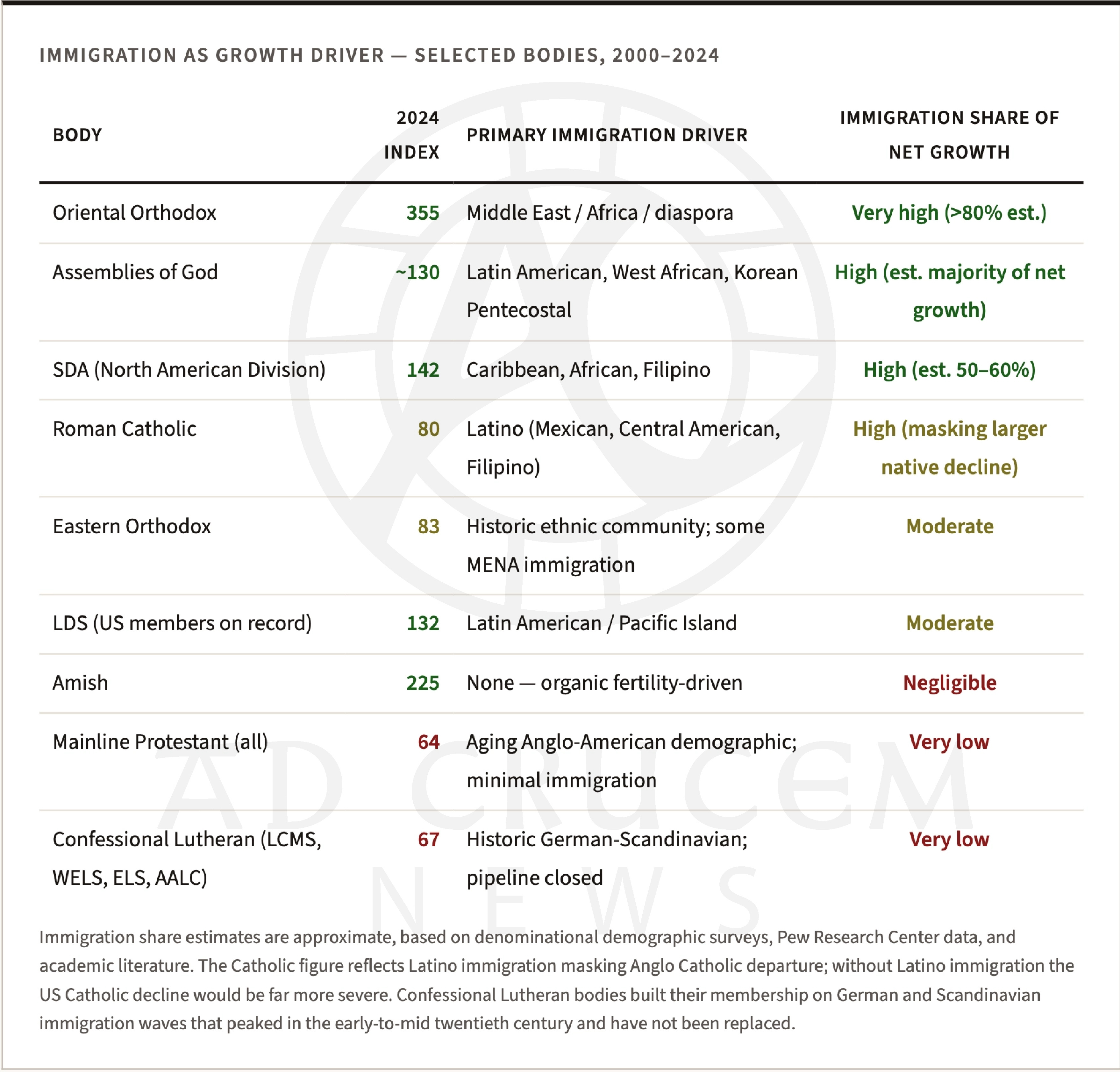
Consider the three most prominent growth stats in the data. Oriental Orthodox communities (Coptic, Ethiopian, Armenian, Syriac) have grown by over 200% since 2000. This is almost entirely immigration-driven. Kelley’s thesis would predict Coptic growth on its own terms, since a demanding liturgy and strict fasting are precisely the kind of high-cost membership markers he identified. But the actual driver is more prosaic: Coptic Christians fled Egypt and other parts of the Middle East and North Africa following the instability of the Arab Spring and its aftermath, settling in communities from New Jersey to California.2
The Amish present a different version of the same phenomenon. Their growth, from roughly 178,000 in 2000 to over 400,000 today, was not due to converts seeking out an austere lifestyle and strict religion. Their growth is driven entirely by a fertility rate averaging six to seven children per family and a community retention rate above 80%. The Amish are not known for their mission work, and they have no public theology/apologetics presence, so their growth is biological rather than evangelical.3
The LDS Church is growing in the United States, although at a significantly slower rate than in previous decades, and its internal data reveals a crisis of activity: Pew Research consistently finds that only roughly one-third of those counted as “members on record” actively practice. Many “inactives” continue to belong to a ward to secure work and not be ostracized, but the secularity is evident. The LDS growth figures are partly a legacy of aggressive record-keeping (“once baptized, always counted”) and partly the product of ongoing immigration from Latin America and the Pacific Islands, where LDS missionary work in the twentieth century was successful and where first-generation immigrants bring their faith with them.
The Pentecostal Immigration Engine
The Assemblies of God requires more attention, because it initially presents a direct falsification of the orthodox-theology-drives-growth thesis. The AoG has historically permitted women in ministry, including senior pastoral roles, pitting it against the complementarian stance of other growing bodies. How is it growing, then?
Pentecostalism has a sadly impressive growth story. It was seeded in America but latched onto in the third world with alacrity. By 2011, Pentecostal and charismatic Christianity reported an estimated half-billion adherents worldwide, concentrated overwhelmingly in Brazil, Nigeria, South Korea, Guatemala, and the Philippines. Latterly, Pentecostals have made extraordinary inroads in Mexico, Honduras, and El Salvador. 4
Those countries have been sending immigrants to the United States in large numbers for decades, and the immigrants bring their Pentecostal faith with them. The growth of the Assemblies of God in the United States is substantially the growth of Latino Pentecostalism, West African Pentecostalism, and Korean Pentecostalism transplanted into the mothership soil. Spanish-language AoG congregations have been among the fastest-growing religious communities in the country for thirty years. The AoG’s position on women’s ordination is largely irrelevant to this dynamic.
Immigrants from Oaxaca or Lagos are not choosing a denomination based on whether a man or a woman delivers the sermons. They are choosing churches like the AoG because it is a tradition they were raised in, services are in their mother tongues, and the congregation is culturally familiar and supportive. In many cases, ethnic “hometown” churches in key locations serve as hubs for immigration services, helping new arrivals find their feet while maintaining connections to their country of origin.
That is not to say theology is completely irrelevant to Pentecostal growth globally. Philip Jenkins in The Next Christendom (2002) and David Martin in Tongues of Fire (1990) argued that Pentecostalism’s explosive spread in the Global South reflects precisely the kind of high-demand, meaning-supplying religious community Kelley described. It was especially true in societies where the alternatives were either the hierarchical and distrusted Catholic Church (regarded as in league with state corruption and repression) or liberal Protestant missions that brought progressive Western theology with strings attached to their aid programs. Kelley’s thesis holds there, but it becomes murkier in the US because immigration plays a much more profound statistical role than endogenous growth.

German Immigration and American Lutheranism
The immigration factor is not new in American religious history, and the current wave of third-world immigration into American churches or their subsets is simply the latest episode in a pattern that goes far back.
American Lutheranism cannot be understood without the Scandinavian and German waves of immigration in the nineteenth and twentieth centuries. The LCMS grew not because of some extraordinary theological persuasiveness in the American marketplace of religious ideas, but because German-speaking immigrants needed German-speaking churches and culturally German communities; the LCMS was there to receive them.5
Similarly, the membership peaks recorded by many Lutheran bodies in the late 1950s and 1960s were not the result of a postwar religious revival, but of immigration and refugee resettlement. Once mass immigration from Germany was cut off, the reality of infused growth was laid bare by the subsequent collapse in membership and attendance.
This was replicated in the Wisconsin Evangelical Lutheran Synod (WELS), which grew substantially through Scandinavian and German immigration in the upper Midwest. The Eastern Orthodox churches were built almost entirely on successive waves of Greek, Russian, Serbian, Antiochian, and Ukrainian immigration. The Catholic Church’s twentieth-century membership was sustained first by Irish, then Italian and Polish immigration, and finally by Filipino and Mexican immigration. At every point, what looked like a denomination’s vitality was, to a large degree, an institutional expression of an ethnic community. When that community stopped arriving, the growth stopped too.
America’s Fastest-Growing Religion
The fastest-growing religious identity in America is not a member of the Association of Statisticians of American Religious Bodies. It is the church of American Civil Religion (ACR). In its more aggressive contemporary forms, the secular moral progressivism of the educated urban professional class, and the nationalist populist faith of the rural and exurban working class.
Robert Bellah, who coined the term in a 1967 essay,6 meant something relatively benign by it: the symbols, rituals, sacred texts, and moral commitments that a society holds in common alongside its more particular religious traditions. His insight was that America, shaped as it was by Protestant assumptions and explicitly Christian founding documents, had developed a shared public religion alongside Christianity rather than identical to it. It was a civic faith able to contain all citizens, invoking God without specifying Christ, and mixing its symbols from the Republic (flags and civil rites of office) and the Church (hand on the Bible, “so help me God”, etc). However, what began as a comfortable complement to institutional religion has since morphed into a functional replacement for it, centered on highly personalized leisure and pleasure.
The rise of the “nones” (atheist, agnostic, or “nothing in particular”) illustrates the power of this reframed American Civil Religion as a competing church body. The nones have risen from approximately 8% of the adult population in 1990 to 28–31% by the early 2020s, which is the largest single shift in American religious identification in recorded history, and it overwhelms any change in denominational membership in aggregate. “Nothing in particular” is a misleading category because its members are not irreligious in a functional sense if you study their behavior. Their tribe, composed of tens of thousands of clans, holds strong moral commitments and expresses them with quasi-religious fervor.
They also have sacred texts and authors. They also have rituals: marches, rallies, social media confessions, and accountability practices. They also have saints, heretics, orthodoxies, and heresies, often enforced with a zeal that would make an old-time Baptist preacher envious.
The United States has arrived, by the long passage of time, some stealthy “nudging” and common custom, at a functional national religion that the First Amendment never anticipated and cannot address. America remains a highly religious nation, and it’s just a question of which religion its people practice, and can the formal churches actually compete for their attention and dollars?
Burge’s data has established that the nones are disproportionately former mainline Protestants and former Catholics. These were people raised in institutions that, having imported secular progressive culture over a generation, gave them no compelling reason to remain once the social pressure to attend dissipated. They did not, for the most part, leave for a more demanding religion. They left because the secular world already substituted everything the church offered, at lower social cost, with rising status, and without doctrinal baggage. Many churches made themselves redundant and handed the offspring of their accommodating generations to the culture.
Conclusion
Kelley’s observations remain generally true insofar as religious communities that maintain high-cost, boundary-enforcing membership requirements retain and reproduce members more effectively than communities that minimize those costs by accommodating prevailing cultural norms. However, the absolute size of an American church body at any given moment is also substantially determined by immigration flows, fertility differentials, and the ethnic demography of its founding community. Those factors operate largely independently of theology and are hard to control for.
Consequently, it cannot be claimed straightforwardly that traditional theology and liturgy are necessarily winning the American religious marketplace, even though recent media attention points to isolated examples. Likewise, the decline of confessional Lutheran bodies cannot be simply attributed to theological failure. They are moving in a tide where the fastest-growing religion in America is one with no denomination at all: the old mainline churches, without God.
Source validation: Anthropic Sonnet 4.6
Dean M. Kelley, Why Conservative Churches Are Growing: A Study in Sociology of Religion (New York: Harper & Row, 1972; revised ed. 1977). The most important critical engagement is Dean R. Hoge and David A. Roozen, eds., Understanding Church Growth and Decline, 1950–1978 (New York: Pilgrim Press, 1979), which argued that social context factors were at least as important as internal strictness. Kelley’s response largely stands. See also Rodney Stark and Roger Finke, Acts of Faith: Explaining the Human Side of Religion (Berkeley: University of California Press, 2000) for the rational-choice extension; Christian Smith et al., American Evangelicalism: Embattled and Thriving (Chicago: University of Chicago Press, 1998) for the “engaged orthodoxy” elaboration.
Alexei Krindatch, ed., Atlas of American Orthodox Christian Churches (Brookline, MA: Holy Cross Orthodox Press, 2011); US Religion Census 2000, 2010, 2020 (ASARB). ‘On Coptic emigration’: Carolyn M. Jones Medine and Nelly van Doorn-Harder, eds., Copts in Context (Columbia: University of South Carolina Press, 2017).
Donald B. Kraybill, Karen M. Johnson-Weiner, and Steven M. Nolt, The Amish (Baltimore: Johns Hopkins University Press, 2013); Young Center for Anabaptist and Pietist Studies, Elizabethtown College, annual Amish population estimates.
Philip Jenkins, The Next Christendom: The Coming of Global Christianity (New York: Oxford University Press, 2002); David Martin, Tongues of Fire: The Explosion of Protestantism in Latin America (Oxford: Blackwell, 1990); Allan Anderson, An Introduction to Pentecostalism, 2nd ed. (Cambridge: Cambridge University Press, 2013). On AoG demographic composition: Arlene Sánchez-Walsh, “Latino Pentecostalism in the United States,” in The Cambridge Companion to Pentecostalism (2014).
On LCMS founding and German confessional immigration: Carl S. Meyer, Log Cabin to Luther Tower (St. Louis: Concordia, 1965); Walter O. Forster, Zion on the Mississippi (St. Louis: Concordia, 1953). On postwar German expellee resettlement: R.M. Douglas, Orderly and Humane: The Expulsion of the Germans after the Second World War (New Haven: Yale University Press, 2012); LCMS historical records, Concordia Historical Institute, St. Louis.
Robert N. Bellah, “Civil Religion in America,” Daedalus 96, no. 1 (Winter 1967): 1–21. Ryan P. Burge, The Nones: Where They Came From, Who They Are, and Where They Are Going (Minneapolis: Fortress Press, 2021).
Three years ago, I started compiling what I saw as the overarching beliefs and practices of what you're calling "American Civil Religion." I've called it "modern American spirituality." Selections from my notes follow as a complement to the anthropological work you've done in this article.
I think it's broadly appropriate to speak of two major sects within the ACR as we look at the right/left divide in America (your "urban professionals" and "exurban/rural workers").
- - -
SOTERIOLOGY OF MAS
Reincarnation
Realization of individual potential classified as “salvation”?
ESCHATOLOGY
Presence of ancestor spirits watching over the individual - Related? “Your angel” / “guardian angel”
Focus on the actions of humans bringing about the “end” of what is known - For conservatives, societal change and erosion of morals into anarchy - For liberals, disastrous climate change and dystopia
ETHICS
Tolerance; “judge not” - Moreso on the left
Focus on exterior justice over/against individual righteousness - Both a left and right thing
“Science” - Not exclusive to the left, but more common. Still, anecdotally, the scientistic worldview is seen in right-leaning individuals
RITUALS
Elf on the shelf?
“Visualizing” / law of attraction practices
Blessings of objects
THEOLOGY
Gnostic god of emanations at work through minor spirits
“The universe” as a god-figure
Deification of public figures - Occurs on the left and right.
“Deification” in the very same way that Augustus was deified. On the right, people are aware that they’re only supposed to “believe” in Jesus. On the left, people deny the existence of a god. Yet what else do you call the canonization of our cultural saints?
- - -
Thank you for this article.
Over the past 10 years or so I have made it a part of my Christian outreach to move away from siloed implementations of "church" and to actively seek out brothers and sisters who happily exist in the "invisible" ecclesia, wherever they might be. I don't have statistics for this, but in my experience, there are a lot more followers of Jesus in the bucket that is often pejoratively termed "nones" than many in the mainstream want to acknowledge (hence my identification with Gary Larsen's furry little mammal in the cartoon opposite snickering dinosaurs who are ill-prepared for the coming climate change) . These refugees are in general agreement regarding the basics of Christianity's tree including the inerrancy of scripture and moral requirements of discipleship, but they have intentionally eschewed the thousands of leaves and twigs of modern Christian practice and polity. They're looking for Jesus and simple fellowship and accountability. The pushing and shoving over social issues like race, sexuality, women's roles, blah, blah, blah interfere with a simple expression of the Acts 2 fellowship and worship they are seeking.
Reasons they've left Christian icons behind are varied, but it seems to me that many are simply tired of the seemingly unstoppable drift inside Christianity's increasingly inert structures toward whatever has become the latest religio/cultural fad. Many in mainline bastions will sniff that they have accepted less-than-robust systemic theologies. Perhaps, but the consistent message I'm hearing is these "nones" are wishing to anchor in the solid bedrock of Christ without a whole boatload of additional requirements that mainline churches seem to feel driven to add to the the growing list of what it takes to be in their good graces. They sincerely desire to be followers of "The Way" rather than "Church.com"
Just one observation. Undoubtedly each reader's mileage will vary.