
Reading the 2026 LCMS Convention Ballot As a Distribution
Every name on the published candidate slate was parsed; here’s what the aggregates reveal.

The 2026 LCMS Convention will seat 150 candidates across 15 parent slates and 164 ballot positions. We pulled every Biographical Synopsis into structured records and asked the boring question: What does the pool actually look like? The answer turned out to be interesting.
The 2026 LCMS Convention will seat 150 candidates across 15 parent slates and 164 ballot positions. We pulled every Biographical Synopsis into structured records and asked the boring question — what does the pool actually look like? The answer turned out interesting.
Some of what we found:
The First Vice-President race isn’t really an election. Peter K. Lange’s 804 nominating votes are 80% of the 1,004 ballots cast. The runner-up is at 50. The bottom of the ballot is a seven-way tie at three votes apiece. Statistically this looks closer to a ratification.
The presidential race isn’t far behind. Matthew Harrison’s 900 votes are 51% of the 1,758 presidential ballots. The fall-off across the top five is 51 / 19 / 18 / 8 / 4. Power-law shape, top-heavy.
A quarter of the slate didn’t have to be nominated. Bylaw 3.12.3.4(d) puts sitting incumbents back on the ballot automatically — no re-nomination required. 38 of the 150 published candidates, exactly 25%, are incumbents standing for re-election. The incumbency share is structural, not competitive: it’s what institutional continuity looks like when a Synod writes it into its constitution.
Twenty-four candidates appear on more than one parent slate, and five of them stand for three different ballots at once. The cross-listing pattern is denser than the bios alone make obvious — many First-VP candidates are also Regional-VP candidates for the region they live in, several board candidates double up across institutional layers, and four candidates have to declare a single seat if elected across the executive / oversight divide.
The surname Lange shows up three times — Peter, Eric, Michael — across three different slates. Peter K. and Michael R. are brothers; Eric T.’s relationship to them, if any, isn’t recorded in the bios.
The most common congregation names are Our Savior and Trinity (six each), Messiah and Good Shepherd (five each). All four are Christological or Trinitarian. The top ten contains no First Lutheran, no St. Paul’s, no civic naming convention at all — LCMS congregations name themselves for what they confess, not where they sit.
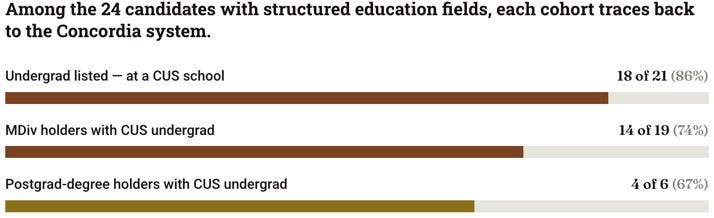
86% of candidates with a structured undergrad on file attended a Concordia. The three exceptions are Brady Finnern (Gustavus Adolphus), Matthew Harrison (Morningside), and Christopher Esget — Berklee College of Music.
Four cities house 11% of the entire nominee pool: St. Louis, Houston, Alexandria, and Fort Wayne.
The generational cut is exact. Among the 24 candidates with structured birth years: 11 Boomer, 11 Gen X, 2 Millennial. Almost nobody in the published bench was born before 1957 or after 1981.
The full breakdown — gender by slate, top-five nomination charts, the German-surname pipeline, the four-city institutional cluster, the Concordia → Fort Wayne feeder, the four-year-member adult convert, the 75-year incumbent — sits in the article on the site.
ACN Esoterica of the 2026 Convention nominee pool: "And of the six who hold a postgraduate degree (PhD, STM, DMin, EdD, or LittD), four (67%) have a CUS undergrad behind the terminal credential."
One of the candidates for Great Plains Region Vice President is Scott C. Sailer, whose LittD from Concordia University-St. Paul is listed in "Other Degrees." However, rather than a postgraduate academic degree, this is an honorary Doctor of Letters degree awarded to Scott Sailer on May 6, 2023, during the university's commencement ceremony.
In the United States, the Doctor of Letters is usually an honorary degree. In a few U.S. schools as well as in the Commonwealth nations, the LittD degree is a non-honorary degree.