
Now Available: Faith and Science for the Classroom

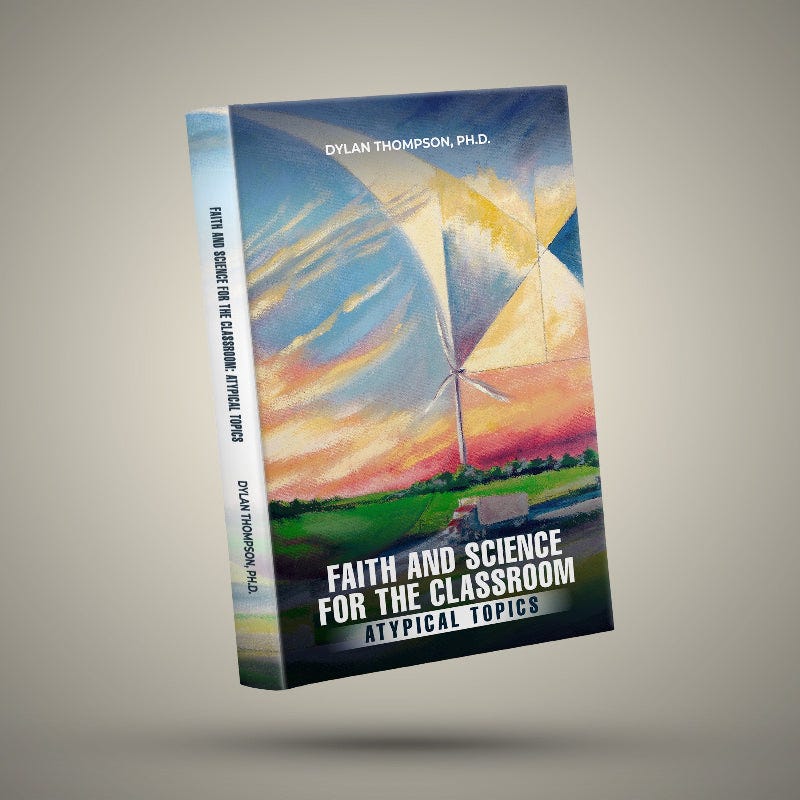
Faith and Science for the Classroom: Atypical Topics is intended as a homeschool or parochial school textbook, but it could just as easily be a volume any Christian picks up to better understand the forces, both sinister and benevolent, behind modern science and our culture today.
PRE-ORDERS WILL BEGIN SHIPPING IN ABOUT TWO WEEKS.
ISBN: 979-8195719661
Binding: Hardcover, Softcover, Kindle
Pages: 188
Publisher: Ad Crucem Books
Published: 2026-05-04
Language: English (American)
Dimensions: 6x9 inches
Weight: 4 lbs
Amazon, $30 (hardcover)
Ad Crucem Books, $35 (hardcover)
Dr. Dylan Thompson still remembers the notebook, the one his mother kept, where a boy young enough to have newly learned cursive painstakingly wrote out “I want to be a science teacher.” He did not realize then that he could be a chemistry professor, or that there was a difference, but the trajectory was set. What the notebook could not record was the reading, the years spent devouring books when he should have been focusing on math and science, the summer before college at the International Academy of Apologetics, Evangelism, and Human Rights (decades younger than the average age that year), or the split focus between science-based apologetics and literary apologetics that has characterized his work ever since. Thompson has written on both: a small book called Science and the Church Militant, presentations on literary apologetics, service as a judge and mentor in a Christian novel contest.
The overlap between the two fields, he discovered, runs deeper than the obvious science fiction genre. Abductive reasoning and symbolism touch both the scientific and literary worlds, and both appear in this book.
A decade of teaching at Concordia University Wisconsin was where Thompson discovered that his students, particularly seniors in the chemistry major and the Bachelor of Science in Pharmaceutical Sciences program, entered his senior seminars with an acquired idée fixe of “evolution – evolution – evolution” but little preparation for the actual assaults they faced: psychedelic drugs, anti-depressants, demonic interference, in vitro fertilization, the reduction of the human person to a meat-based algorithm. The fact that many young people are so unprepared for the unceasing assaults on their faith and conscience has troubled Thompson since he first noticed it. This book is his response.
When Thompson sat down to write Faith and Science for the Classroom: Atypical Topics, he did not set out to produce another warmed-over creationism textbook rehashing arguments about fossil layers and carbon dating. He wrote a field guide for Christians who want to walk through what G. K. Chesterton called “Modern Elfland”, the world where iron and steam and DNA helices preach the glory of God to those who have eyes to see it. The book, now available through Ad Crucem Books, is a confessional Lutheran engagement with the natural world that refuses to surrender either scriptural authority or scientific rigor, and it tackles subjects most Christian curricula carefully avoid.
The cover used the artwork of Gary Thompson, Dylan’s father. The cover uses the golden section ratio and the Fibonacci spiral to frame a field of wind turbines, structures that, as the author writes in the preface, proclaim God’s order even in their engineering constraints. A massive turbine can only have three blades or four: the number of the Trinity or the shape of the cross. “The only way to avoid preaching God’s truth in engineering or in art,” Thompson observes, “is to make useless and ugly things.” Indeed, that sentence could serve as the book’s thesis: creation is not a neutral laboratory specimen to be dissected under fluorescent lights. It is the handiwork of an Artist who, in hemoglobin’s iron-based oxygen transport and the horseshoe crab’s copper-based hemocyanin, demonstrates that one solution to a problem is never enough when you are God.
Seven First Principles
The book opens with what Thompson calls “First Principles”, seven foundational commitments that govern all Christian engagement with science. These are not sentimental pieties about “seeing God in nature.” They are theological pillars with real consequences for how students approach everything from chemistry labs to evolutionary biology.
First Principle Zero establishes that God does not lie, neither in Scripture (special revelation) nor in Creation (general revelation). This means that where Scripture is clear and scientific understanding is genuine, they cannot contradict, not because Scripture must be tortured into conformity with the latest Nature article, but because the same God authored both books. First Principle One confronts the gnosticism that has infected even Christian discourse: the spiritual and the material are not at odds. The physical creation is not intrinsically fallen, not a prison for the soul, not a lower order of being. God made it, called it very good, and then became incarnate in it. Any Christian anthropology or natural philosophy that treats matter as the problem has already lost the plot.
Principles Two and Three form a paradox only to the careless reader: Creation is simultaneously incomprehensible (infinite in its complexity, the work of an infinite mind) and comprehensible (ordered, knowable, governed by rules God does not capriciously change). This is not a contradiction, but a description of what happens when finite minds encounter the artwork of an infinite one. You can study it your whole life, make genuine discoveries, and die knowing you have barely scratched the surface.
Principle Four, “Do Not Extrapolate Too Far” is where Thompson’s Lutheran formation and identity become explicit. Creation’s “normal way of working” has changed at least twice: at the Fall, when all Creation fell with Adam, and at the Flood, when God explicitly altered the rules governing human interaction with the natural world. (Thompson suggests a third possible change at the Incarnation, when God’s physical presence in Creation may have lightened the curse under which it groans and travails.) Scientific knowledge developed in a post-Flood, post-Fall world does not map cleanly onto the antediluvian period, and any pronouncement about the world before Noah should be made with appropriate caution. This is not anti-scientific obscurantism, but a recognition that historical events recorded in Scripture have ontological weight.
The remaining principles, that God demonstrates His artistry in Creation, that you do not know enough (guard against pride), and that you know plenty (guard against intellectual timidity), round out Thompson’s framework and provide the interpretive lenses through which every subsequent chapter is read.
Atypical Topics
The book’s subtitle promises “atypical topics,” and Thompson delivers. Chapter Four addresses chemistry and medical interventions with a theological seriousness most Christian curricula avoid. Chapter Five, “Signs and Interpretations,” explores semiotics, the study of symbols and their meanings, and includes an assignment asking students to catalog the “semiotic load” of symbols they encounter in daily life, from brand logos to alchemical diagrams to the rainbow. (One essay assignment asks students to compare the biblical meaning of the rainbow in Genesis 9 with the “pride rainbow” of contemporary usage. The question is not rhetorical. The assignment expects theological precision.)
Chapter Six, “Creation and Abiogenesis,” is where Thompson’s background as a PhD chemist becomes decisive. The chapter opens with a satirical fable about the first flowering plant, a rhizome at the bottom of a pond that somehow “knows” flying insects exist in the air above it and therefore evolves flowers, pollen, nectar, and the entire apparatus of sexual reproduction to exploit a resource it cannot detect.
Thompson’s treatment of evolution is, as he puts it, “atypical”, not because he concedes ground to materialist orthodoxy, but because he recognizes the landscape has shifted. When Thompson defended his chemistry doctorate at Purdue in 2014, his committee included a Muslim man born in Turkey, a Hindu woman born in India, and an agnostic man born in China. “Do you think the Christian Creationist vs. Evolutionist debate meant anything to them?” he asks. These are the people training the people who teach science in schools, and the archetype of the evolutionist science teacher is fading fast. He is not being replaced by anything better. The world of science right now, Thompson writes, is as if the leaders in tech and science all watched Blade Runner and Ghost in the Shell and read That Hideous Strength and took all the wrong lessons.
This is characteristic of the book’s rhetorical strategy. Thompson does not soft-pedal. He identifies the motte-and-bailey fallacy at the heart of evolutionary apologetics, where macro-evolution (speciation between kinds, requiring plants to be quasi-omniscient and quasi-omnipotent) retreats into the motte of micro-evolution (observable genetic variation within kinds, driven by concrete environmental pressures) whenever challenged. The distinction is qualitative rather than quantitative. Grizzly bears and polar bears, descended from a common ursine ancestor that walked off the Ark, represent micro-evolution driven by the demonstrable evolutionary pressure of surface-area-to-body-mass ratios in arctic climates. A cow evolving into a whale by gradually atrophying its legs and relocating its trachea to the back of its neck is macro-evolution, and it requires the cow to possess foreknowledge of an aquatic future it has never experienced. The former is an observable adaptation within a kind. The latter is a fairy tale.
Chapter Seven, “Alchemy and Science,” explores the continuity and rupture between pre-modern natural philosophy and modern empiricism, and Chapter Eight, “Body and Soul,” addresses anthropology and the unity of the human person, a necessary corrective in an age that treats the body as hardware and the soul as software, if it acknowledges the soul at all.
For Whom Is This Book Written?
The book is designed as a homeschool or parochial school textbook for high school students, complete with learning objectives, glossaries, and assignments ranging from essay prompts to concept maps to presentation projects. Thompson, himself homeschooled until college, wrote the book with a view to being “homeschooler-friendly” as well as usable in a classroom. But his pedagogical philosophy shapes more than the format. Thompson has spent his career as a professor teaching students to be able to solve any problem at any time, rather than learning by rote how to solve a curated set of memorized problems. The book reflects that commitment: it teaches systems of thought, not memorized facts.
But it is not only a textbook. The prose is too good, the arguments too carefully constructed, the theological stakes too clearly articulated. A pastor preparing to address the intersection of faith and science from the pulpit would benefit from it. A parent trying to answer a teenager’s questions about evolution without retreating into young-earth talking points would benefit from it. A layperson who suspects that the regnant scientific consensus on origins is built on sand but lacks the technical vocabulary to articulate why would benefit from it. Thompson wrote the book because he watched his students arrive unprepared for the unceasing assaults on their faith and conscience — and he hopes this book on “atypical topics” will equip students to be less unprepared for the weird, the uncanny, and the openly demonic assaults that await them in their interaction with the STEM and medical fields.
The book assumes its reader is part of the LCMS or a confessional Lutheran tradition, but it does not assume specialized training in theology or science. Thompson writes for the educated layperson, defining terms (axiomatic, intrinsic, abiogenesis, tetrahedron) as he introduces them, and providing recommended reading lists at the end of each chapter. The recommendations are eclectic: Dickens’ Our Mutual Friend, Tolkien’s The Smith of Wooten Major, Charles Williams’ The Place of the Lion, Michael Behe’s Darwin’s Black Box, and a philosophy-of-chemistry monograph on how symbolic notation shapes scientific thought.
This is a book that takes both Scripture and science seriously. It does not do so by pretending they address the same questions in the same register, but by insisting they cannot contradict because the God who does not lie authored both. It refuses the gnostic temptation to treat matter as fallen and the materialist temptation to treat matter as all there is. It teaches students to ask the right questions, to recognize when they are being sold a fairy tale dressed in the lab coat of empirical rigor, and to approach the created order with the wonder appropriate to standing before the Almighty's artwork.
Faith and Science for the Classroom: Atypical Topics is available now through Ad Crucem Books at adcrucem.com.

Thank you for this! As a homeschooling momma of 5 (oldest entering high school) and a former student of a LCMS parochial school this is sorely needed. As a child I wasn't taught the apologetic side until I discovered AIG through teaching my own children. For me, this was so faith affirming. LCMS specific or geared towards curriculm are sorely lacking in the homeschool arena. I'm thrilled to see others noticing the void and working to develop materials!
As a former research chemist and current pastor/theoologian, I am looking forward to adding this title to my science/faith library.