
Missouri's Missing Word is Becoming a Habit
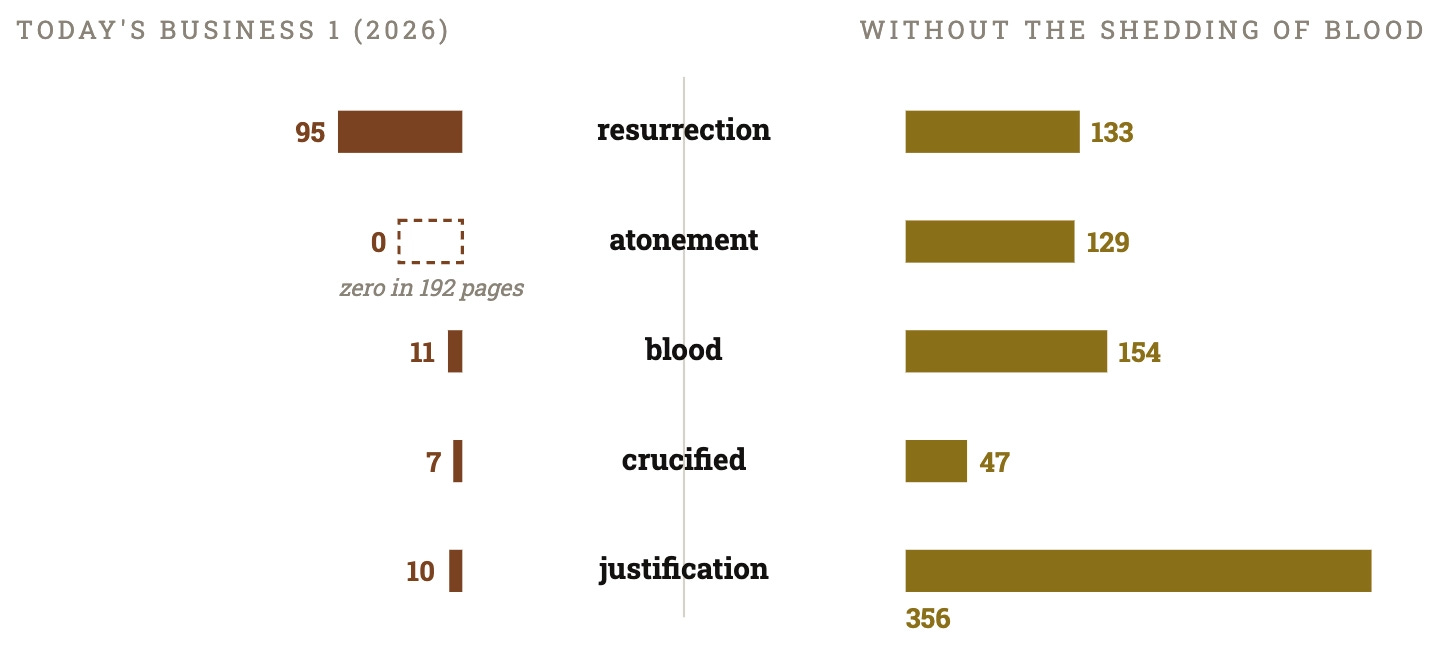
The resurrection appears 95 times in Today's Business, and the atonement never. Scaer called the aberration this May & Schwan named it in 1862. Our working vocabulary keeps proving them right.

The first edition of Today’s Business, the 192-page volume carrying the 106 proposed resolutions, the three omnibus resolutions, the standing rules, and the theological front matter of the 69th Regular Convention, mentions the resurrection ninety-five times. It mentions the atonement zero times. A full-text search returns nothing, and the adjacent dogmatic vocabulary fares little better: propitiation, zero; vicarious, zero; redemption, as a noun, zero. A convention gathering under the theme “Christ Is Risen Indeed” has produced a working document in which our most critical doctrine, that gives the resurrection its saving content, never appears by name.1 The Synod’s most senior teacher warned about this persistent failing a month ago.
Prophetic Warning
Speaking at the Gottesdienst Conference this spring, in remarks transcribed in full by Ad Crucem News on May 17, Rev. Dr. David Scaer named the condition before Today’s Business arrived:
“If Christ is not the atonement for sin, which is the current aberration among us, then don’t sing Christians to the Paschal Victim. Don’t sing it, because you don’t mean it.”
His complaint was not that Missouri’s preachers get justification wrong but that they recite it as a formula detached from the doctrines that carry it, for, as he put it, the Lutherans insist justification is the article by which the church stands or falls, “but I think other doctrines take precedence, the atonement, the resurrection.” He even named the logical endpoint: a theologian’s claim that Christ’s death was not strictly required since an omnipotent God could simply declare sins forgiven, and answered it: God “cannot deny the work of Jesus.” Four weeks later, the floor committees published 192 pages that read like an exhibit in support of his argument.
The Ninety-Five
Roughly ninety of the ninety-five occurrences of “resurrection” sit in a single document, President Matthew Harrison‘s “President’s Report, Part 2”, his Floor Committee Weekend essay on the convention theme, which opens with the Easter acclamation and declares the resurrection “the heart of all Christian faith and life.” The essay is a sustained defense of the bodily resurrection of Christ against Enlightenment criticism. On its own terms, it is a vigorous and defensible stock Lutheran preaching. Yet, the word atonement does not occur (“atonement is made” did appear in his initial workbook report) blood occurs five times, and justification ten. Outside the essay, the opening Prayer for Our Synod asks God for confidence that “our debts [are] satisfied by Christ’s all availing sacrifice,” and exactly two of the 106 proposed resolutions, 3-07 and 5-11, use the word resurrection at all.
Vicarious satisfaction does surface twice, and both places are instructive, because neither is composed prose. The first is the prayer just quoted, which is a liturgical inheritance. The second is Resolution 6-03, which quotes Augsburg Confession IV verbatim: people are justified freely for Christ’s sake through faith, “By His death, Christ made satisfaction for our sins.” Consequently, the atonement enters the 2026 convention’s working text only where older texts are quoted into it; nowhere in 192 pages does any writer of 2026, in his own sentences, reach for the word. Nor did the congregations: the 374 overtures in the Convention Workbook are equally silent, so the absence runs the entire length of the pipeline, from the parish that filed in 2025 to the floor committee that drafted in 2026.
The Scaer Standard
Scaer’s May remarks condense the argument of his book Without the Shedding of Blood, whose title alludes to Hebrews 9:22: "without the shedding of blood there is no forgiveness of sins.” The book mentions the atonement 129 times, and the instructive fact is that it mentions the resurrection 133 times alongside that count. Scaer binds the doctrines rather than playing them against each other, arguing that “justification depends on Jesus’ resurrection, which in turn depends on the incarnation,” an interlocking order he compares to the persons of the Trinity, in which no article can be subordinated or sent into retirement. Indeed, he presses Luther into service on exactly the present point: the notion of forgiveness by imputation without atonement is, in Luther’s words, a “miserable and shocking opinion and error,” for if it were true, “the entire New Testament would be nothing and useless.”
In Scaer’s grammar, the balanced columns on the right side of the chart are not a stylistic preference but what the doctrine looks like when it is whole.
The chart displays the disconnect clearly. The right side holds resurrection and atonement in near-perfect balance, 133 against 129, because for the Synod’s most revered living theologian, the empty tomb and the shed blood are one article seen from two sides. The left side preaches the resurrection ninety-five times above a dashed outline where the atonement should stand, and the supporting vocabulary thins accordingly: blood eleven times against 154, justification ten against 356.
A Leading Indicator
No resolution in the Convention content denies the atonement; no overture questions it; and the AC IV quotation in Resolution 6-03 states it cleanly. This simply highlights vocabulary drift, not heterodoxy, and it roosts in the seminaries from where it spreads to the parishes and the rest of the Synod. However, a church body’s working vocabulary is a leading indicator, and Missouri has historical reason to know it: the Robert Preus era’s objective-justification controversy turned on what happens when justification floats free of what makes it fact. A convention that can produce 192 pages on an Easter theme without once writing the word that explains why the crucifixion saves has not lost the doctrine, but it might have stopped exercising it, which can lead to its eventual loss.
A Second Witness, From the Preaching Side
The census above counts an absence; Rev. Dr. Adam Koontz, on his podcast A Brief History of Power, explains the mechanism that produces it. In the episode transcribed below, “The Law’s Misuse and the Truth of the Gospel,” Koontz reaches Scaer’s ground from the pulpit side: a Missouri preaching culture that proclaims Christ’s passive obedience while letting his active obedience fall silent drifts, usually unintentionally, into an antinomianism in which, as he says of the influence of Gerhard Forde and Stephen Paulson on the reading lists of both seminaries, “it’s not even totally clear why Jesus was crucified.” His prescription restates the census’s empty column as a call: return to the vicarious satisfaction, “His blood shed to stay God’s wrath and to propitiate him,” the precise vocabulary that appears nowhere in the 192 pages of Today’s Business.
The historical frame is critical: Koontz draws his categories from Henry Schwan’s 1862 theses on unevangelical practice, which are found in At Home in the House of My Fathers, the anthology of early Missouri sources edited by President Matthew Harrison
Rev. Dr. Adam Koontz · A Brief History of Power
Transcript, lightly edited for clarity. Obvious transcription errors corrected; the speaker’s voice retained throughout.
I. Theory Beneath Practice
Welcome to A Brief History of Power. This is Dr. Koontz, coming to you with the second in our series, For the Future, on some issues, some problems. This one I mentioned on the Monday show, but I want to get into it now.
I called it theological or theoretical on Monday. I want to be clear that “theoretical” I’m using there in an ancient sense, of something having to do with ideas, which doesn’t mean that it’s nothing. It means that it’s behind practice. It’s underneath practice. It’s practice’s source. We talked about the practice of bivocational ministry and how I think that differs between the scriptures and the way that we’re generally talking about it today. This one is a little bit more serious, in the sense that I think it’s underlying a lot of problems in our practice, but also within our understanding of simply who Jesus is and what he came to do, and, more than that, what he actually accomplished in his work.
II. Schwan’s 1862 Theses
This is underneath, and generally recognizable in, two different practices or ways of Christian practice that are identified in an 1862 speech, along with a set of theses, by Henry Schwan. He was president of The Lutheran Church, Missouri Synod.
He began by talking about the way that America had been overtaken by moral laxity and self-destruction with the onset of the Civil War. That’s a topic we’ve mentioned here or there; I’m certainly willing to get into that another time if you are interested. Just let me know. But at the time, everyone thought that the world, and certainly the United States of America, was, as God’s judgment, becoming more and more lax, more and more morally permissive, more and more self-destructive. They thought that in 1862. People think that in 2026. Maybe they’re both right.
But I want to talk about two ways of practice that he identifies as not the way that any evangelical Lutheran practices. Once I identify those, they’ll be fairly familiar. I’ll give brief descriptions of them, and I want to talk about why evangelical Lutheran practice needs to be different, because of our different understanding, from many Christians and even from many people who claim to be evangelical Lutherans today, of what Christ has actually done.
Let me just describe the two practices that Schwan identifies in his 1862 theses. You can find this in the book At Home in the House of My Fathers, which has a bunch of different early Missouri sources. Whether you’re interested in Lutheranism or you’re interested in American religious history, it’s going to be worthwhile to you.
III. Two Unevangelical Practices
The two things that he identifies are antinomianism, opposition to God’s law, as well as legalism, a way of justification having to do with the use of the law to justify rather than the gospel.
We could describe the first as squeamishness about God’s law. It may be full-throated opposition, but very often in confessional Lutheran circles it comes off as squeamishness, an opposition to the third use of the law to guide Christians in good works, or, the way that he describes this, a norm to recognize those good works that the gospel naturally creates in a believer. You don’t want to even describe the norm. You don’t want to talk about the norm. You don’t want to enjoin the law as the norm by any means, even if you can see a document in the scriptures themselves doing so, like the last verse of 1 John. So: law-squeamishness, sometimes called antinomianism.
On the other hand, there is the thing that he identified in 1862 in the Missouri Synod. Not in America generally; he saw America generally as pretty antinomian. But the Missouri Synod at the time, in 1862, he saw as largely, he said, un-evangelical, and specifically legalistic. So you could be un-evangelical, non-gospelish, by being antinomian. You can also, and he finds this to be much more frequent in his own circles, that is, in our circles as it were, be unevangelical in a legalistic way. That is, specifically, that one’s main aim is to see to it (this is Schwan) that the law gets its due, and that one tries to accomplish through the law, or even through laws, lowercase L, what only the gospel can accomplish. The whole point becomes doing a certain number of things. And so his theses go into great detail about unevangelical practice that is legalistic, because it’s what he sees happening everywhere.
I think what is quite interesting about this is you might have said, “No, antinomianism is far more common,” and I would agree with you in general. I might even agree with you when talking about any given church body. But what he identifies as legalism, I can also see as possibly ascendant, as a reaction to prevalent moral laxity. Either way, what is identified is unevangelical. So it’s fundamentally a misunderstanding of what the gospel is.
The antinomian believes that the gospel is there to dissolve the law. The legalist believes that the gospel is there to get you to fulfill the law. An evangelical Christian, a gospel Christian, a Lutheran Christian believes that the gospel is there to be announced as the good news concerning Christ Jesus, which is received solely by faith. That’s different. It’s a third thing.
IV. Christ’s Active and Passive Obedience
The difference here does have to do with something that you could describe in technical terms. If you are a pastor, you should already know this term; if you’re not, maybe you still should probably know this term already, because it’s in our catechetical tradition, certainly within the evangelical Lutheran church: we talk about Christ’s obedience in our stead. And we talk about that in two different ways.
What is Jesus Christ actually doing? Jesus Christ is passively suffering the penalty due to us for our sin. That’s the purpose of his death. He is also actively (his active obedience is that he is) fulfilling the whole will and law of God as a man on our behalf. So the entirety of God’s law is perfectly fulfilled by Jesus Christ. Both God’s wrath and His punishment upon sin, but also His entire law, is completely fulfilled. That’s why Lutheran Christians can admit openly that they do not perfectly fulfill God’s law. That’s why we read Romans 7, in its second half roughly speaking, as a description of the Christian’s present state, because we can be honest that we do not keep God’s law perfectly.
What’s interesting about that is that what I just described as his active obedience, you would think, “Oh, that’s kind of obvious.” But it is the very thing that you will very often not find described, by either an antinomian who is misusing the law in one way, or a legalist who is misusing the law in a different way.
V. The Antinomian Collapse: Forde and Paulson
The antinomian may not even believe that Christ was specifically fulfilling anything. You can find this probably most readily, and most influentially, at least in an American context, in the writings of Gerhard Forde and Stephen Paulson: that the law just comes as a kind of arbitrary demand that we suffer. And then you have to get rid of it somehow. You have to get rid of its demands. No one is perfectly fulfilling anything. Life has no particular shape. That’s why this tends to be more antinomian. Life has no particular shape, either for Christ, nor therefore for the Christian.
So the Christian who is in Christ carries out spontaneously the good things that God desires of him when he has been called by the gospel, because he’s in Christ. There’s no specific shape for our good works if there’s no specific shape for Christ’s works. There’s no law he actively fulfilled. There’s nothing he actively did. He just kind of suffered.
And this is where, particularly in Forde and Paulson most notably (not everybody goes there), they’re not even exactly sure. It’s not even totally clear why Jesus was crucified. Once the active obedience no longer has any particular shape, the shape of the passive obedience becomes still less clear. Why was Jesus crucified? Why did he shed blood? Why did he give up his spirit? Why do these things happen? And all of it comes to seem to be a kind of accident, like a guy just getting hit by a drunk driver. And that’s because there’s no specific shape to anything up to the cross. So why would there be any specific shape, any specific purpose, any specific goal in the cross?
So that’s antinomianism.
VI. The Legalist Collapse: Scrupulosity Against Liberty
Legalism has a different problem, but with the same issue. It might be perfectly willing to use the term, particularly because the term was used in the past. This is common among us; having many of the same temptations, some of the same thickets of idols, that Schmemann identified with the Eastern Orthodox, it might be the case that because the term was used in the past, we use the term. But the sense is rarely if ever discussed, which is: if Christ has perfectly fulfilled the law, then our whole description and our method of proceeding in Christianity cannot be what Schwan, in his theses on unevangelical practice, identifies as a constant cutting and trimming, being overly scrupulous, being obsessive, and especially constantly turning things that are mere adiaphora into matters of Christian conscience and necessities.
So he says the very thing that we are most ready to give up is Christian liberty, because we have no clear understanding (now, this is me saying this) of how Christ has perfectly, completely, and utterly forever fulfilled the law of God. So the law of God still feels to us like it’s something we have to do, rather than something that we are fulfilling as we are in Christ, rooted and renewed in him, bearing abundant fruit according to his promise.
VII. Nervous Around the Law
What you notice in both cases, both the antinomian and the legalist, is that they are nervous around the law. Maybe the antinomian doesn’t want to say it. Maybe the legalist is very insistent, he’s nervous, that you yourself listen to his articulation of the law, so that you do what he needs you to do. But either way, there’s a certain nervousness. There’s an unease around the law. The reason being: the law remains, for both the antinomian and the legalist, something that Jesus has not actually fulfilled.
So there’s an issue with their understanding of Christ himself, of his work, and therefore also of us, and of our work, our needs, our purpose in this life.
VIII. Why This Matters: Whom We Reach and What We Say
Now why do I bring this up? I partly bring it up because Gerhard Forde is still prominent on all kinds of reading lists. Both seminaries, I think; certainly a lot of pastors were trained to think as a Lutheran using Gerhard Forde, and I don’t think he’s actually articulating the gospel. So there’s that.
In addition to which, if you think the gospel sounds like the law has been gotten rid of, then your articulation of the gospel to other people is going to be attuned really only to those who themselves have probably come from legalism. I think this is the theological reason (we could talk about sociological reasons, we could talk about historical reasons, we could talk about geographical reasons), I think this is the theological reason that my church particularly (yours might be different), but my church particularly, has shifted from saying “we’re not Catholic” to “we’re not evangelical, we’re not non-denominational.” Because I think we recognize, possibly only implicitly, maybe explicitly, that the appeal, the way we’re saying the gospel, which in our times usually comes out mostly in what I would describe as an antinomian way, is a way of describing Christ’s work that isn’t the total vicarious satisfaction of God’s law, actively and passively. His blood shed to stay God’s wrath and to propitiate him. That’s our classical articulation. That’s the biblical articulation.
Thank God we got it right at one point. That’s all over Francis Pieper, whatever you may have heard. That’s the center of his three-volume work. All over: vicarious satisfaction, active and passive obedience to God’s law, perfectly fulfilling it in our stead.
Because we’re not really saying that (we might be saying the passive part; I think the vast majority of us are still doing that), because we’re doing the passive part and not the active part, our articulation comes out as, results in, a kind of unintentional (sometimes intentional, usually unintentional) antinomianism, where there is no specific shape to Christian life. And for people who have been wrongly shaped by a legalistic articulation, usually somewhere within evangelical Christianity, that sounds great.
And guess what? We get to benefit from the things that they were taught, that we’re not teaching them, that were correct, that do have to do with a good guide to Christian life, such as sacrificial giving, Bible reading, daily prayer, and so on. We might not be saying that, but we’re benefiting from the fact that some legalistic Baptist pastor or Reformed pastor was saying that, and was actually teaching a correct norm of Christian life in those three cases, for example.
So our appeal, our sense of where we are and what we’re for, therefore becomes limited to people who are suffering from, or coming off, what they have correctly recognized as legalism. That limits our thinking about the application of the gospel to every creature, a phrase we brought up from Mark’s gospel in the previous episode, and probably the link between Monday and Thursday here.
IX. The Appeal That Applies to Anybody
Our articulation of the gospel, because it’s a complete satisfaction, actively and passively, by the Lord Jesus Christ, of God’s entire law, should create great ease in preaching both the law and the gospel to anybody. Because the appeal is not based on “oh, you were hurt in this way by other Christians; we’re okay; come here.” Our appeal is: you are not what you should be. Christ has been and is what you must be. Trust in Him.
That applies to anybody. Anytime, anywhere, whether they know anything about church or Christianity or daily Bible reading. So the issue here is: if we don’t get the gospel right, we don’t even understand who we’re supposed to be talking to and what we’re supposed to say.
So please return to the old ways. Return to the biblical gospel. Return to the vicarious satisfaction, Christ’s suffering of God’s wrath on our behalf, and his utter, total, complete fulfillment of God’s law, also on our behalf, so that we can rest in Him.
This is A Brief History of Power. You can find us at briefhistorypower.com.
God love you and God bless.
Sources:
2026 Today’s Business, 1st Edition, The Lutheran Church, Missouri Synod, 69th Regular Convention (full-text term census by the author); “President’s Report, Part 2,” pp. 19 ff.;
Resolution 6-03, quoting Augsburg Confession IV; the Prayer for Our Synod in Convention;
David P. Scaer, remarks at the Gottesdienst Conference, “You Can’t Preach Justification Without the Cross and Empty Tomb,”
Ad Crucem News, May 17, 2026; David P. Scaer, Without the Shedding of Blood There Is No Forgiveness of Sins (Ad Crucem, 2024), including its citations of Luther on imputation without atonement.
The 2026 proposed resolutions are indexed at lcms2026.adcrucem.news/resolutions.
As a partial aside, President Harrison frequently quotes Hermann Sasse approvingly, as does his close circle of compatriots, especially John Pless who has a new book coming out published by CPH. Alas, Sasse “was a critic of the Lutheran Orthodox doctrine of Scripture’s verbal inspiration and of The Lutheran Church—Missouri Synod’s doctrine of biblical inerrancy” and was sympathetic to Evolution. So, perhaps we need to be more cautious about pushing him forward so aggressively.
Prof. Ben Mayes's central charge is that Sasse's openness to Evolution was not a freestanding reading of Genesis but the necessary product of his rejection of verbal inspiration: having denied that the words of the text bind as God's own utterance, he was free to treat Genesis 1–3 as revelation accommodated to an outmoded ancient cosmology, a principle he stretched even to Christ's statements about the created world. His post-1951 retention of "inerrancy" did not repair this, because inerrancy forbids only error in what Scripture asserts, and accommodation let him define down what Genesis asserts (theology, not nature) until the label survived precisely by emptying the text of any falsifiable factual claim. He thus surrendered Scripture's authority while keeping its inspiration, installing astronomy and paleontology rather than sola Scriptura as the arbiter of how the world and man were made, and inverting the order of the fathers, for whom the historical fact of Adam's fall grounded the doctrine of sin rather than being reasoned back to from it.
The reductio is decisive: the same accommodating move would dissolve the resurrection and the real presence, yet Sasse rightly refused to allow it against the verba of the Supper, exposing the openness to Evolution as inconsistent rather than principled, the rejection of verbal inspiration wearing the borrowed clothes of "inerrancy." See Benjamin T. G. Mayes, "Creation Accommodated to Evolution: Hermann Sasse on Genesis 1–3," Concordia Theological Quarterly 87 (2023): 123–150, esp. 144, 149.
I am open to a properly informed and intended rebuke here, and I'm sure I am bad, but I have started to bristle when _expected_ to exclaim "He is risen indeed" more than a couple of times, even on Easter.
It's not to the point of the response demanded for "Amen?" but I guess it could get there.
Maybe every Lutheran should do time in an SBC church for a few months. Some might be lost, so I can't be sure this is a great idea, but it's sure tempting.
AC,
Thanks for the article. I have some questions I'm hoping Pastor Koontz might be able to answer.
In his 1862 theses/speech found in the book At Home in the House of My Fathers, then-LCMS President Henry Schwan evidently said:
-legalism [is] a way of justification having to do with the use of the law to justify rather than the gospel.
-the legalist believes that the gospel is there to get you to fulfill the law.
It seems that there is an important distinction here in these definitions.
I wonder what kinds of practical examples of legalism Schwan saw in hi day (I will try to track down the book)
I think the the following two questions are critical for Lutherans today, and I wonder how Schwan would have responded to them:
"Do you agree that the Apostle’s Creed is intended to help us do that which according to the 10 Commandments we ought to do? Increase in us faith and the fulfilment of the Ten Commandments, and that God would remove everything that is in our way and opposes us therein?”
Given the content of Schwann's essay, would he agree with this? Or is this “gospel… there to get you to fulfill the law”?
Back in 1994, a book called The Goal of the Gospel was published by CPH. It was removed for doctrinal reasons shortly thereafter. I do believe it is appropriate to talk about goals of the Gospel.
+Nathan