
Lead Time- LCMS Too Strict
Reflections on my conversation with Lead Time and my hopes for the future of the LCMS.

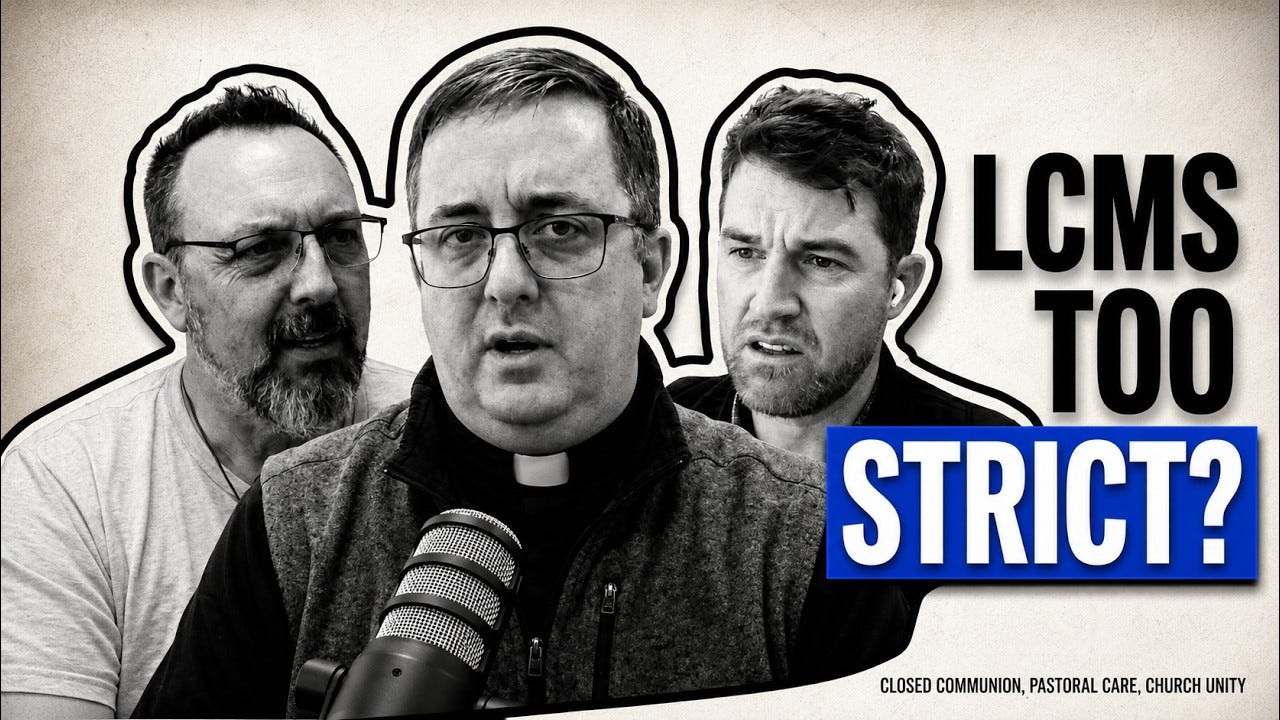
I had the privilege of joining Tim Ahlman and Jack Kalleberg on the Lead Time podcast. Both were gracious and respectful hosts, and I genuinely enjoyed the conversation. It was my first time appearing on a podcast, and we discussed several topics where we have genuine disagreements, including routes to ordination, worship practices, and closed communion.
Our conversation lasted an hour and forty-five minutes.
The questions they asked me were:
What is giving you joy in your ministry?
How did you become a pastor in the LCMS?
What do you love most about the LCMS? What frustrates you about the LCMS?
Why do you believe that additional routes to ordination would create more problems?
What are your top three prayers for the LCMS over the next ten years?
Here are my brief answers.
1. What is giving you joy in your ministry?
I love being a pastor because I love the people I have the privilege of serving. The clerical collar often serves as a passport into conversations I never would have experienced otherwise. Whether it is sitting at the bedside of someone nearing death, teaching the Small Catechism to middle school students, singing hymns with little children, or proclaiming Christ during the darkest moments of someone’s life, it is a tremendous privilege to serve God’s people.
2. How did you become a pastor in the LCMS?
I entered the LCMS through the colloquy process.
3. What do you love most about the LCMS? What frustrates you?
I joined the LCMS because we confess that the Bible is the inspired and inerrant Word of God, and that the Lutheran Confessions faithfully confess what the Scriptures teach.
The Synod’s commitment to the faithful practice of closed communion was also a significant reason I came into the LCMS. If we confess that Christ truly says, “This is My Body” and “This is My Blood,” then we should also take seriously St. Paul’s warning in 1 Corinthians 11 that one may eat and drink judgment upon oneself by receiving the Sacrament improperly. Because of that, I believe closed communion is not a lack of love but an expression of faithful pastoral care.
I also deeply love the liturgy. We have a rich heritage of pastors who faithfully preach Christ crucified while leading congregations in the historic Divine Service. I wanted to serve alongside those men.
One frustration I have is that sometimes we seem uncomfortable with who we are. In some places there is a tendency to downplay or abandon closed communion, the liturgy, or even the institutions that have faithfully formed generations of pastors—especially our two seminaries.
At the same time, I am thankful for the faithful leadership God has given our Synod and districts. President Matt Harrison, in particular, had a profound influence on my desire to join the LCMS. Having previously worked for the United States Air Force, I learned that good generals matter. The same is true in the Church.
4. Why do you believe more routes to ordination could create more problems?
I believe our two seminaries have done an excellent job preparing generations of biblical, confessional, and liturgical Lutheran pastors.
My concern is that continually expanding alternative pathways to ordination could deepen existing divisions within the Synod. I am not convinced that a love for the liturgy, faithful closed communion, and our confessional identity will necessarily be preserved if candidates are formed primarily in congregations where those practices are not present.
I also worry that the vetting process could become weaker. A congregation that has known a candidate for years may unintentionally overlook concerns about character that an outside faculty or broader church body would be better positioned to identify and address.
Pastoral care is another concern. If finances become the primary reason for avoiding the traditional route to ordination, we risk sending the message that practical considerations outweigh faithful formation.
As pastors, we are often called to say difficult things. For example, if an unmarried couple says they must live together because of financial pressures, a faithful pastor should lovingly encourage them either to live separately or to consider getting married sooner rather than delaying marriage for a more elaborate wedding. Faithfulness often requires sacrifice, and doing things in good order matters—not only for marriage, but also for preparing men for the Office of the Holy Ministry.
5. What are your prayers for the LCMS over the next ten years?
My prayer is that we continue to raise up faithful pastors who love the Holy Scriptures, cherish the Lutheran Confessions, and faithfully preserve our confessional and liturgical practice in the Divine Service.
I have had the privilege of caring for people suffering from Alzheimer’s disease and dementia. Many never remembered who I was, but they could still sing the liturgy by heart. Watching those familiar words bring them peace and comfort has deeply shaped me.
I pray that future generations of pastors will continue to treasure the liturgy, so that if I someday suffer from dementia—or if one of my own children does—the Church will continue to place those same timeless words on our lips, just as I sang them to my children when they were babies.
I love the LCMS. I am grateful to serve alongside the faithful pastors on our roster, even when we disagree on important questions. My prayer is not for greater division, but for greater faithfulness and genuine unity under God’s Word.
As we head into Synod convention, please join me in praying that the Lord would grant our Synod wisdom, humility, faithfulness, and unity in Christ.