
LCMS Pastoral Formation Fight Becomes One-Way Traffic
Monday's LCMS Convention agenda revealed an interesting strategy to put the highly contested pastoral formation resolutions to the floor

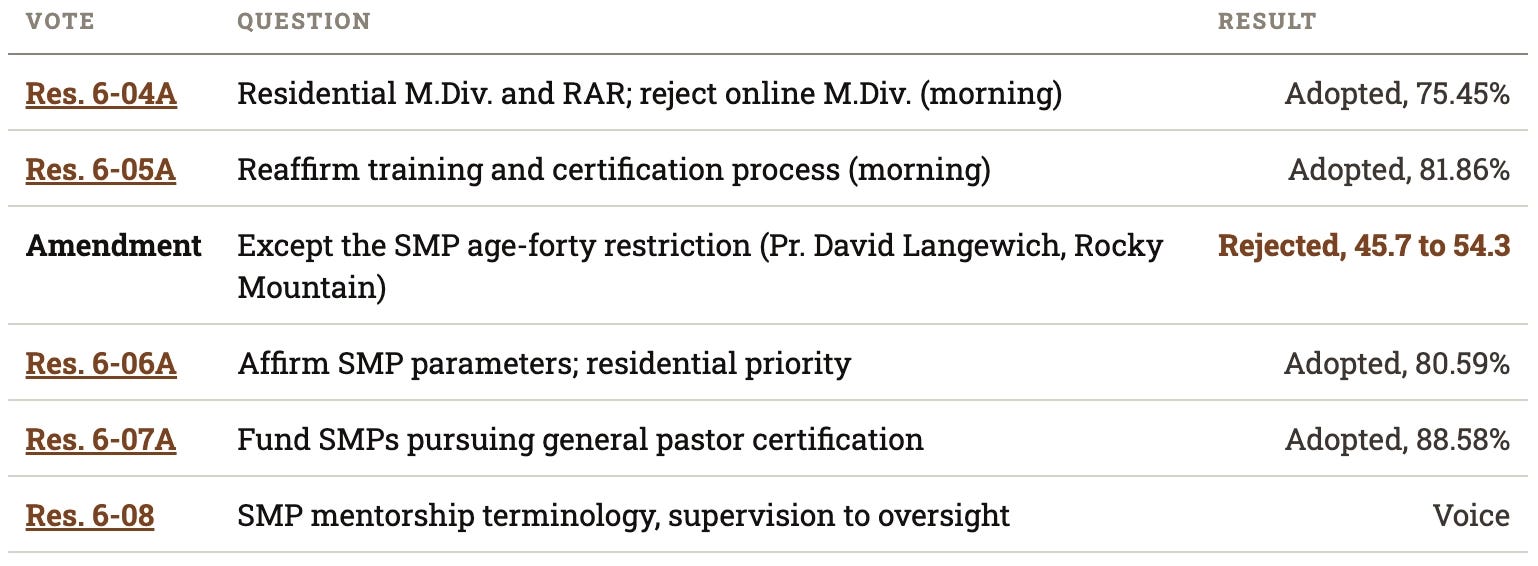
On Monday morning, the Synod in Convention reaffirmed a strong preference for residential seminary education, passing related resolutions by a three-to-one margin. In the afternoon, the battle was much tighter as the issues went to specifics and emotional appeals: whether a man under forty may be ordained into LCMS ministry via the Specific Ministry Program (SMP). The Convention agreed that the age gate should be retained, voting for it by 54.3 percent.
Resolution 6-04A rejected online M.Div. and Residential Alternate Route (RAR) education at 75.45 percent, and Resolution 6-05A reaffirmed the Synod’s certification process at a significant 81.86 percent. Those margins were wide enough that the formation question this publication had marked as potentially the week’s most contested was effectively settled by lunch. The fight did arrive in the afternoon, when Floor Committee 6 returned with the SMP docket and a Rocky Mountain District pastor moved to strike one clause. What ensued was a twenty-minute argument, with data on one side and a nuclear submarine on the other, about what age a man must be before the church will make him a pastor by the alternate route.
Locking the SMP gate
The SMP is the Synod’s side door into the one Office of the Holy Ministry: a hybrid, distance-based route, with four years of coursework layered onto a man’s existing job and congregation. It was originally created so that small, impoverished, and/or remote congregations that cannot call a traditionally formed pastor are not left without Word and Sacrament. Resolution 6-06A, “To Affirm and Support Established Parameters of Specific Ministry Pastor Program,” binds district presidents and congregations to the program’s approved policies, has the seminaries and the Council of Presidents keep the program under regular evaluation, insists the route’s contextual limits “do not diminish the dignity of the one Office of the Holy Ministry,” and gives thanks for the men who serve by it. Among those approved policies is that an applicant has to be forty years old before commencing the program (the parallel Residential Alternate Route has a thirty-five-year age limit).
Pastor David Langewisch of the Rocky Mountain District, himself the supervisor of an SMP pastor, moved to amend the resolution so that adherence to the policies would come “with the exception of the age restriction.” He said the pastoral-formation committee had done “great work” on the rest of the policies, but the age floor “is unique to this pastoral formation route,” and if younger men wash out at higher rates, “I don’t think the answer is saying, let’s cap it at 40… allow our other criteria to determine whether or not we should accept them.”
Seminary arithmetic
St. Louis seminary SMP director, Rev. Dr. Mart Thompson, answered with the numbers. The policies, he said, are “done in good faith, and they are very student-centered”. Internal research shows attrition among SMP students in their twenties and early thirties running “about four times higher” than among the older men, roughly 25 percent against 6 percent for students fifty and over, because the program stacks some fifteen hours of weekly coursework, plus vicarage and parish duties, on top of a full-time job and a family. The residential M.Div., for comparison, loses about 7 percent across its four years, a figure relayed to the floor from Ft. Wayne Seminary President Jon Bruss. There is an exception mechanism: a district president may petition the Council of Presidents for a younger applicant a congregation genuinely needs, an exception a New England delegate noted is written into the printed policies.
The submarine and the furnace
What followed was at times an exasperating floor debate, but it was also the most meaningful to date. Pastor James Cleland of the California-Nevada-Hawaii District, who entered the SMP program at thirty-three while teaching full time in a Lutheran school and raising two new children, testified for the amendment from both sides of the divide: “It was very hard, and I am a better pastor because of it… young men who can make it through that, you will have for the rest of their lives as pastors.” He later finished the residential program at St. Louis and pronounced it, Hebrew and Greek excepted, “a cakewalk” after SMP. Dr. David Zimmerman of the Northwest District gave the stirring speech of the day: before he was twenty the Navy trained him to drive a nuclear submarine, “120 souls and 16 missiles, two and a half months under the water off the coast of Russia,” and the Marine Corps entrusted him with an M-16; the Synod entrusts commissioned ministers “not yet 23 years old” with classrooms full of God’s children; and had a pathway like SMP existed when he was a thirty-one-year-old father moving his family from Seattle to Fort Wayne, “I would have embraced it in a heartbeat.” His close was scriptural and aimed at the lay delegates: “Let’s not make age a barrier where God has not… Paul didn’t tell Timothy to come back when he was older.”
The other side answered with the furnace. Pastor Ron Stevens of Indiana argued the program exists for small congregations that cannot afford a residential pastor, and that a man in his twenties or thirties belongs at the seminary, where the cross-bearing itself is the formation: “You will come through that furnace… much stronger for it. Nobody in this room would take their car to a mechanic who watched a couple YouTube videos.” A Texas delegate, Scott Heitzhusen, turned the seminary’s own logic around with some relish, observing that the floor was being asked to believe SMP is too difficult for the young, who should therefore be diverted to the residential route because it is easier: “let’s let the smart people do what God has called them to do in the avenue that he has called them to do it.”
The floor closed debate at 77 to 23 and refused the Langewisch amendment, 45.7 to 54.3. It was the third amendment of the day to die in the mid-forties, after the 45.65 percent that wanted Charlie Kirk named and the 46.97 percent that wanted the CTCR’s 1994 dissent read, and the pattern is now unmistakable: this convention’s majorities are large, and its minority is almost always the same size. Resolution 6-06A then passed at 80.59 percent; the issue is as settled as it can be.
A ladder from the side door
The committee’s next resolution showed the other face of the same policy. Resolution 6-07A encourages Specific Ministry Pastors to climb toward general pastor certification, asks pastor, congregation, district, and seminary to fund “all tuition and fees” of the climb, and has the seminaries bend their schedules to working men. The GPC, the committee explained, lifts an SMP to the educational level of the Residential Alternate Route, Greek included, from the roughly 39 percent of an M.Div.’s education the base program provides.
The sharpest words against it came from inside the program: an SMP pastor from the Northwest District, three-quarters through his own GPC, argued that the Synod’s special supervision and remedial ladders “effectively maintain two distinct offices of public ministry,” and that the resolution “depends upon the assertion that several more years of online education will redeem the first four years of online education.” Against that stood Homer, Alaska: a lay delegate gave thanks for the SMP vicar now serving her congregation, “or we would not have anyone serving us.” The floor took the ladder over the objection, 88.58 to 11.42, and then passed Resolution 6-08, a bylaw repair retitling the SMP “supervisor” a mentor with oversight, by voice, the chairman observing that it “should have been in a consent agenda, frankly.”
Loose threads at orders of the day
The session frayed a little as it closed. A Missouri District pastor who had twice queued to offer an amendment and twice been cleared by the system told the chair, to laughter, “That really hurts my esteem”; a delegate then tried to move a standing-rule change against the double cloture motions that keep cutting amendment and resolution off together, and was sent away to put it in writing, the chair adding, “Go back and do a little homework, grasshopper.” And Heitzhusen returned to a graver matter: he charged that the morning’s debate had “sinned against our brother” Dr. Jeffrey Kloha, whose openness to discussing online formation had been recast on the floor as advocacy, proposed “confession and absolution” as the remedy. He was directed by the chair to Matthew 18 and the committee chairman, the charge pronounced “rather a stretch” before moving the Convention on with greetings from the LCMS Foundation.
Two electorates
It is worth pausing over how wrong the spring arithmetic looked by Monday evening. Joel Biermann’s 47.9 percent among the congregations in June, five votes short of forcing a fourth presidential ballot, had intimated a Synod divided nearly in half, and pastoral formation, twenty overtures deep and carrying the online M.Div. question, was widely expected to supply the close fight of the week; this publication’s own delegate guide marked it as likely definitive and hotly fought. The fifty-fifty questions never came. The advocates of online and alternate-route formation lost every counted vote by margins that read as routs: the online M.Div. rejected at 75.45 percent, the certification process reaffirmed at 81.86, the SMP parameters held at 80.59, and even the age amendment, their best showing of the day, trailing by eight and a half points. The delegate floor in Phoenix is a different electorate from the congregations that nearly retired Matthew Harrison, and at every test it has voted more confessional than the presidential election intimated: the officer sweep, the worship commission at sixty-eight percent, and pastoral formation by three to one. Whatever the 47.9 percent measured in June, it is not seated in the Phoenix Convention Center.
Conclusion
Ultimately, the Synod is fiercely in favor of residential pastoral formation by three to one, retained the SMP age limit by eight and a half points, and then voted by nearly nine-to-one to help the men already inside alternate tracks to climb toward the formation it demands. That is a coherent position, and it is also a revealing one because the sharpest argument of the day was not between left and right, but between generations and vocations.
Method and source. The tallies and quotations are from the convention floor of Monday, July 20, 2026, transcribed from the convention livestream and provisional until the Monday minutes and Today’s Business, Issue 4, are published; the morning percentages (6-04A, 6-05A) are those of the LCMS Reporter’s official daily coverage. The attrition figures (about 25 percent for SMP students in their twenties and early thirties, 6 percent for students fifty and over, about 7 percent across the residential M.Div.) were given on the floor by the St. Louis seminary’s SMP director and, for the residential figure, relayed from Seminary President Jon Bruss; the 39 percent education comparison was a delegate’s figure the committee did not dispute. Resolutions 6-06A, 6-07A, and 6-08 carry their floor results on this site, and the day-by-day decisions log holds all forty-three decisions of the convention so far. The morning session and the rest of the day are compiled in “Day Two: The Seminary Holds”; the delegate guide’s load-bearing classification is in “Where LCMS Convention Delegates Need to Invest Time & Effort.” Compiled by Ad Crucem News; editorial analysis, no Synod imprimatur.
On the one hand, I see the value of the traditional seminary education. However, on the other, I also see the value in not artificially constraining alternate routes to the OHM for those for whom a traditional seminary education isn't the best method. Admittedly, the LCMS offers more robust pathways than my WELS does, so I applaud that. I am also in favor of "vigorous" programs both traditional and alternate, so long as we don't take that word "vigorous" into the land of absurdity. Is it good that a pastor can read Hebrew and Greek? Yes. Does that ability make a pastor a good pastor? No, it does not. Is a residential seminary education guaranteed to produce a good pastor? No, it is not. Are either of those things a biblical requirement for one to be in the OHM? No, they most certainly are not.
I've seen some pastors who graduated from the traditional seminary education path who are HORRIBLE pastors because they've been in school for so long that they simply don't know how to deal with average people who don't give a flyin' hoot about their ability to read Greek or Hebrew or write and preach a sermon that hits every point of the chosen scripture passage in the pericope and has the perfect balance of law and gospel - instead a lot of those people need their pastors to talk to them on a person-to-person level and offer spiritual guidance, which is far more important than being able to read Hebrew and Greek! And I have seen pastors who have gone through an alternate route that put some of the better seminary-trained pastors to shame because their real-world experiences have molded them into a better shepherd for a flock of Christians than any seminary education could even hope to produce. Just like teachers who got C's and D's when they were in school tend to be better teachers than the straight-A students who become teachers.
I get that we Lutherans take pride in our pastoral education systems but let's be real - we're in an age where both synods have dozens of pastoral vacancies and not even enough young men in the seminaries to keep up with natural attrition rates of parish pastors retiring or passing away, so it seems to me that our approach should be a "yes, and" method instead of putting restrictions on the pastoral ministry that Holy Scripture does not. We've gotten spoiled when the "times were good" and now we're dangerously close to worshipping the golden calf of our seminaries so much that we can't (or WON'T) adapt when the times aren't so good. Out of one side of our mouths we're praying that the Lord sends us more candidates for the OHM, but the other side of our mouth is saying "we'll let them be a pastor only if they fit OUR definition of what a pastor is!"
As we're finding out in the education world - another field where there is a lack of candidates (I'm a teacher, trained at WELS' Martin Luther College), the "traditional pathway" of teacher education at a 4-year university + student teaching isn't actually the best way to guarantee you get a good teacher. If anything, today's education programs start the burnout we're seeing in the teaching professions - so much so that states whose teachers' unions control government like my state of Illinois that is 100% beholden to the Chicago Teachers Union and are desperately trying to shut down alternate pathways and want to require state control over private schools, has authorized several alternate paths to become a licensed professional educator.
If we stick to our guns on this issue of insisting that residential seminary training is the ONLY real way to become a "real pastor," then we're going to run out of "real pastors" just like the school systems across the country are finding that they're running out of "real teachers."
Every convention has its magic "ratio." Almost every resolution will pass or fail by the same margin. It is difficult to impossible to compare the election numbers for the president, which were synod-wide, to the actions of the convention delegates. The choice between Harrison and Biermann was not really much of a polarity. Both would be considered "conservative" Lutherans. The choice seemed to be more of incumbent vs new face. That having been settled, I don't think there would really be much difference in the convention had Biermann been elected.