
LCMS Election Math Favors Harrison, Even if Turnout Rises
Seven statistical models predict Rev. Ben Ball's endorsement will be decisive in pushing Rev. Dr. Harrison to a narrow victory over Rev. Dr. Joel Biermann, potentially as early as the third ballot.

The certified second ballot of the Missouri Synod’s presidential election left the incumbent, Rev. Dr. Matthew Harrison, just fourteen votes ahead of his challenger, Rev. Dr. Joel Biermann, out of 4,842 cast, a margin so thin that the contest became a genuine dead heat, and every defensible projection of the rounds still to come favored Biermann. That was based on the single transition the record had so far produced; the movement from the first ballot to the second had broken better than two to one in Biermann’s direction. That projection has now been overturned, though not by a withdrawal. Rev. Benjamin Ball, who received 212 votes on the second ballot and remains a candidate on the third, used a June 18 letter to the congregation he serves to ask the men who had voted for him to instead cast their votes for Harrison. That the request, if his voters honor it, does not merely narrow Biermann’s path to a majority but closes the greater part of it.
Ball’s offer
Now I hope that those who have voted for me would vote for President Harrison this 3rd round and allow him to try and accomplish the goals he has for his last term.
Ball’s name will, therefore, appear in the third round alongside Harrison’s and Biermann’s, with Rev. Brady Finnern already eliminated after the second. Consequently, two outcomes are open. If Ball’s voters follow the request in sufficient numbers, Harrison’s gains carry him past fifty percent on the third ballot and the contest ends there; if a remnant of Ball’s support lingers on his own line, as a candidate who remains on the ballot tends to retain, neither leader reaches the majority, the fourth ballot drops Ball as the lowest, and the runoff arrives one round later than a withdrawal would have brought it. The model finds Harrison the winner in either event.
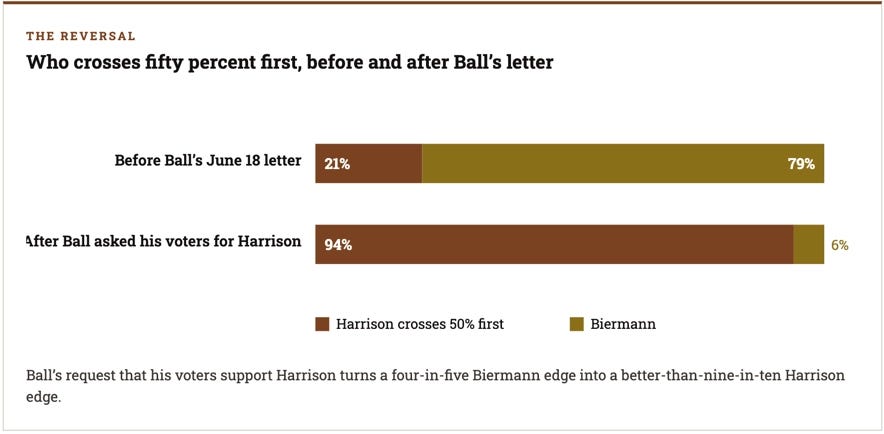
The arithmetic of the larger bloc
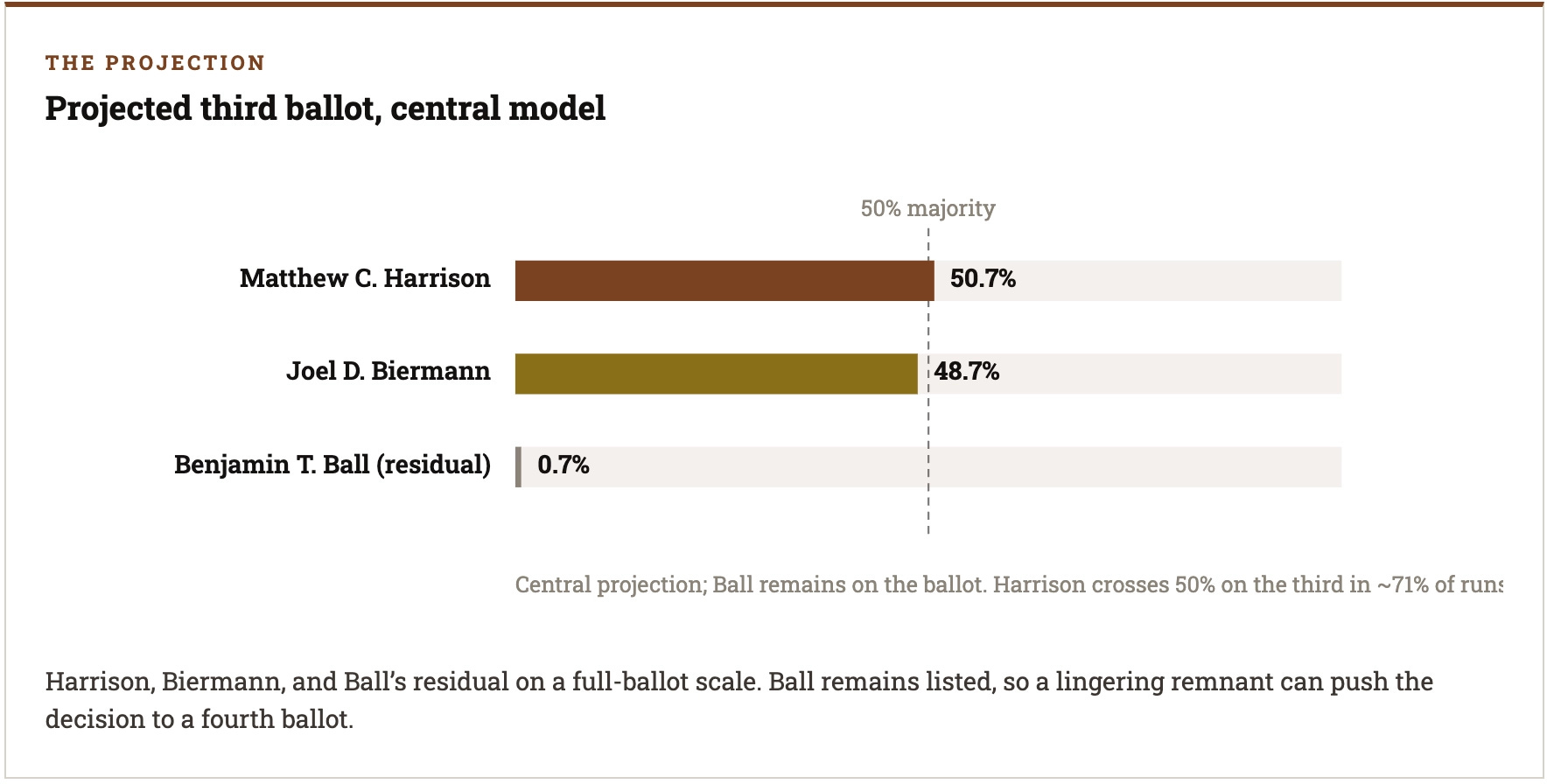
The arithmetic is unforgiving for the challenger, and the reason is one of size and direction together. Harrison and Biermann enter the third round with committed cores of 2,243 and 2,229, a fourteen-vote incumbent edge, and the votes in motion are Finnern’s 158, released after the second ballot, and Ball’s 212, now pointed toward the incumbent. Before the endorsement, those 370 leaned Biermann’s way, and the pivot sat at 51.9 percent, meaning the challenger needed only a hair over half of them to overturn the core deficit and win. The endorsement turns the larger of the two blocs the other way, and the pivot turns with it. Indeed, were Ball’s voters to honor his request at seventy percent, Biermann would need better than four-fifths of Finnern’s voters merely to hold even, a share no trailing bloc in this race has yet delivered to anyone. The central projection, therefore, carries Harrison to a bare 50.7 percent on the third ballot, Biermann to 48.7, and Ball to a residual seven-tenths of a percent, the incumbent crossing on the round he has fallen short of three times.
Seven models, one direction
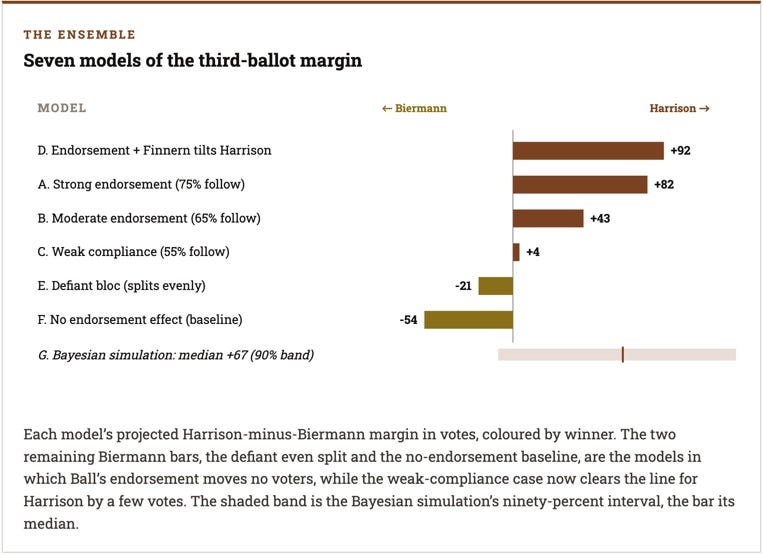
We ran the projection through seven models, each carrying a distinct theory of how a directed bloc actually moves, and the consensus is plain. Only two models still award the contest to Biermann: the ‘defiant even split’ and the ‘no-endorsement baseline’, the pair in which Ball’s request does no work at all. Meanwhile, every model in which the instruction moves even a slim majority of his voters lands on Harrison, the weak-compliance case among them, where a fifty-five percent follow now carries the incumbent past the line by a handful of votes rather than leaving him a hair behind. A Bayesian simulation drawing the share of Ball’s voters who follow him from a distribution centered near two-thirds puts Harrison across the line first in 94 of every 100 runs, crossing fifty percent on the third ballot in roughly seven of ten of them and on a fourth ballot in most of the remainder.
The hinge
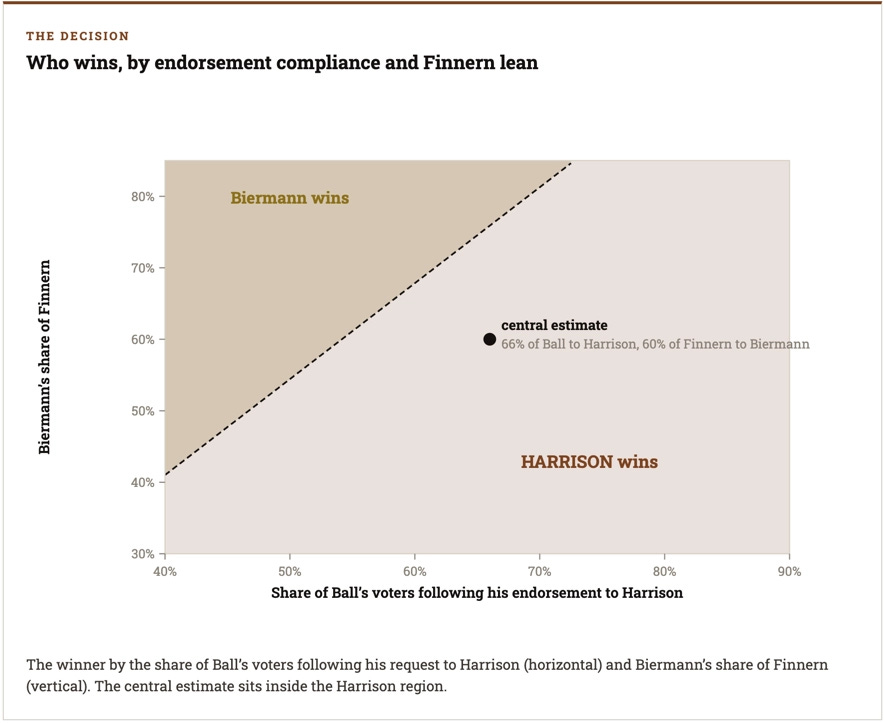
Everything now rests on a single quantity that the Synod’s published returns cannot reveal in advance, the fidelity of Ball’s bloc to Ball’s instruction. The request is a strong cue, a named candidate telling the men who preferred him over both leaders to spend their votes on the incumbent, and in a delegate body that knows its principals by name and standing, such an instruction carries real weight. Nevertheless, a cue is not a transfer, because Ball’s voters chose Ball over Harrison at the first asking, and some unknown remainder of them hold Biermann, not Harrison, as their true second preference and will decline to follow the ask across that line. Biermann’s surviving path is consequently narrow and specific: it requires the request to misfire, Ball’s voters to decline it in sufficient numbers while Finnern’s hold their lean, and both conditions at once. The map of who wins under what shows how little room that leaves him.
The second unknown, turnout
The compliance of Ball’s bloc is not the only quantity the third round leaves open, because the size of the electorate that casts it is itself in motion. The Office of the Secretary’s own returns show turnout climbing from 85.4 percent on the first ballot, when 4,676 of the 5,478 seated delegates voted, to 88.4 percent on the second, a rise of 166 delegates against a fixed ceiling, so each further point of participation is worth very nearly fifty-five votes, and a forecast that holds turnout frozen at its second-ballot level is the anomaly rather than the safe default. The question is therefore not whether the third round will seat a larger electorate, which on the trend it plainly will, but what a larger electorate does to a contest decided by a majority of whoever appears to vote.
The answer runs against the intuition that a swelling turnout favors the man in front. Every added point of participation lifts the majority bar by roughly twenty-seven votes, the bar being half of a denominator that has just grown by fifty-five, while a newcomer pool splitting evenly between the two leaders returns Harrison only about twenty-seven of those votes, so the bar climbs as fast as he can fill it and his cushion above the line holds near twenty-two votes whether turnout rises one point or three. Turnout at an even split is consequently inert, and the lever that decides the round remains the transfer of the released blocs rather than the head-count that records it.
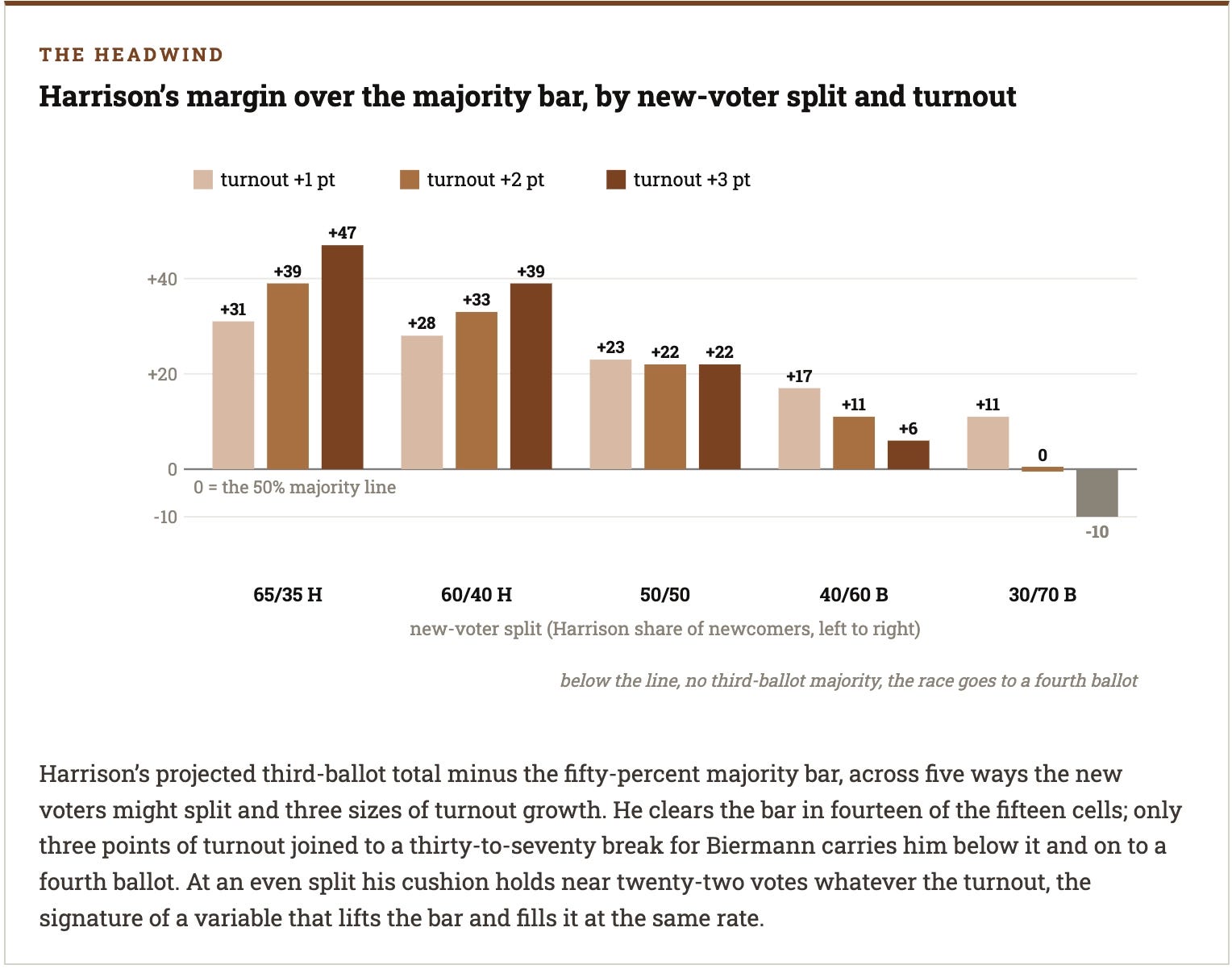
Harrison’s projected third-ballot total minus the fifty-percent majority bar, across five ways the new voters might split and three sizes of turnout growth. He clears the bar in fourteen of the fifteen cells; only three points of turnout joined to a thirty-to-seventy break for Biermann carries him below it and on to a fourth ballot. At an even split, his cushion holds near twenty-two votes, whatever the turnout, the signature of a variable that lifts the bar and fills it at the same rate.
Turnout begins to bite only when new voters arrive in lopsided numbers, and even then, the threshold is steep. Harrison fails to reach a third-ballot majority only if the newcomers break to Biermann past ninety-one percent at one added point, past seventy percent at two, and past sixty-four percent at three, so a single point of growth leaves his crossing all but untouchable while three points joined to a near two-to-one Biermann break is the one corner of the grid that denies him the round. Even there, he leads the count and forfeits only the majority, the unresolved third ballot dropping Ball and carrying the contest to a fourth on which the incumbent’s structural lead reasserts itself unless the lopsided surge persists intact into the next round.
Set against the model as a whole, the turnout variable does not so much move the verdict as disclose where the verdict’s uncertainty had been hiding. Hold turnout at its second-ballot level, and Harrison wins very nearly every run, crossing on the third ballot in better than four of five; let turnout grow along the certified trend, and the same model returns the published figures, a ninety-four percent eventual Harrison win that crosses on the third in roughly seven runs of ten. The whole of Biermann’s surviving six percent, and the bulk of the path that carries the contest to a fourth ballot, is manufactured by the rising electorate and by nothing else in the model.
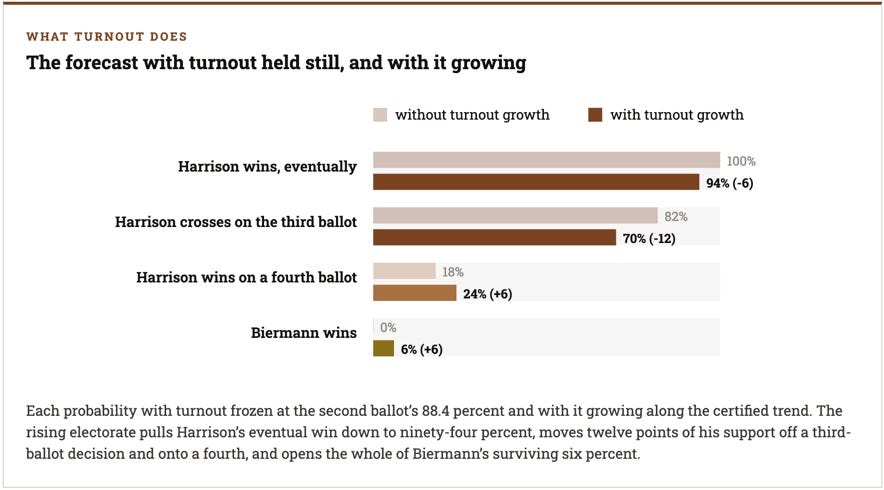
Each probability with turnout frozen at the second ballot’s 88.4 percent and with it growing along the certified trend. The rising electorate is the whole of the difference, pulling Harrison’s eventual win down from a near-certainty to ninety-four percent, moving twelve points of his support off a third-ballot decision and onto a fourth, and opening the entirety of Biermann’s surviving six percent.
Biermann’s hope, stated precisely, therefore lives in a conjunction rather than in turnout alone. He needs a sustained turnout surge of three points per round, coupled with a vote-transfer environment that breaks his way, with Finnern’s voters leaning to him, Ball’s bloc defecting from its instruction, and the newcomers themselves arriving at better than two to one for the challenger. Each condition is on its own plausible, and the joint of all of them at once is not, which is why the larger electorate the convention is likely to seat alters the texture of the forecast, but does not overturn its direction.
The verdict
The verdict the model returns is, therefore, the reverse of the one it returned before Ball wrote. Harrison is now the favorite to cross fifty percent, most probably on the third ballot itself, and on a fourth, should a remnant of Ball’s support keep the third short of a majority, and the contest that the second ballot had tilted toward the challenger has been tilted back by the request of the man who ran fourth and stayed in the race. The larger electorate the third round is likely to draw works against the incumbent at the margin, lifting the bar he must clear, yet at any even division of the newcomers, it raises that bar no faster than his own gains fill it, and it rescues Biermann only in the narrow case of a sustained surge that breaks better than two to one for the challenger. The third-round count, which closes after the Saturday to Tuesday window, will settle the question without further inference. On the present evidence, the results fall for the incumbent, unless Ball’s supporters prove conspicuously unwilling to follow him to the candidate he has named.
Method and source. The standings are the certified first- and second-ballot results from the Office of the Secretary (second ballot: Harrison 2,243, Biermann 2,229, Ball 212, Finnern 158; 4,842 cast, 88.4 percent turnout). Rev. Ball did not withdraw; in a letter dated June 18, 2026, he asked the voters who had supported him to vote for President Harrison on the third round while affirming that he would serve if elected, and his name remains on the ballot. The model accordingly treats Ball’s 212 as a directed bloc, dividing it among compliance with Harrison, defection to Biermann despite the request, a loyal residual that keeps voting for Ball, and abstention, and it carries that residual to a fourth ballot, where Ball, as the lowest, would be dropped. Transfer rates are inferred from the net change between rounds, because the Synod publishes no ballot-linked data tracking which voter moved to which candidate. Source: Rev. Benjamin Ball, congregational letter, “This Man Receives Sinners,” June 18, 2026. This is a model projection under stated assumptions and not a prediction; the single irreducible unknown is whether Ball’s bloc honors his instruction. Compiled by Ad Crucem News; editorial analysis, no Synod imprimatur.
It's God's will that Ball remains on the ballot.
What did He mean by this?
An excellent analysis. Thank you for your hard work on this.