
LCMS Convention Day One: The Easy Yeses
The convention's opening day of floor business adopted eleven items and defeated none, most by voice or by ninety-plus percent. The single real fight was over the Commission on Worship.

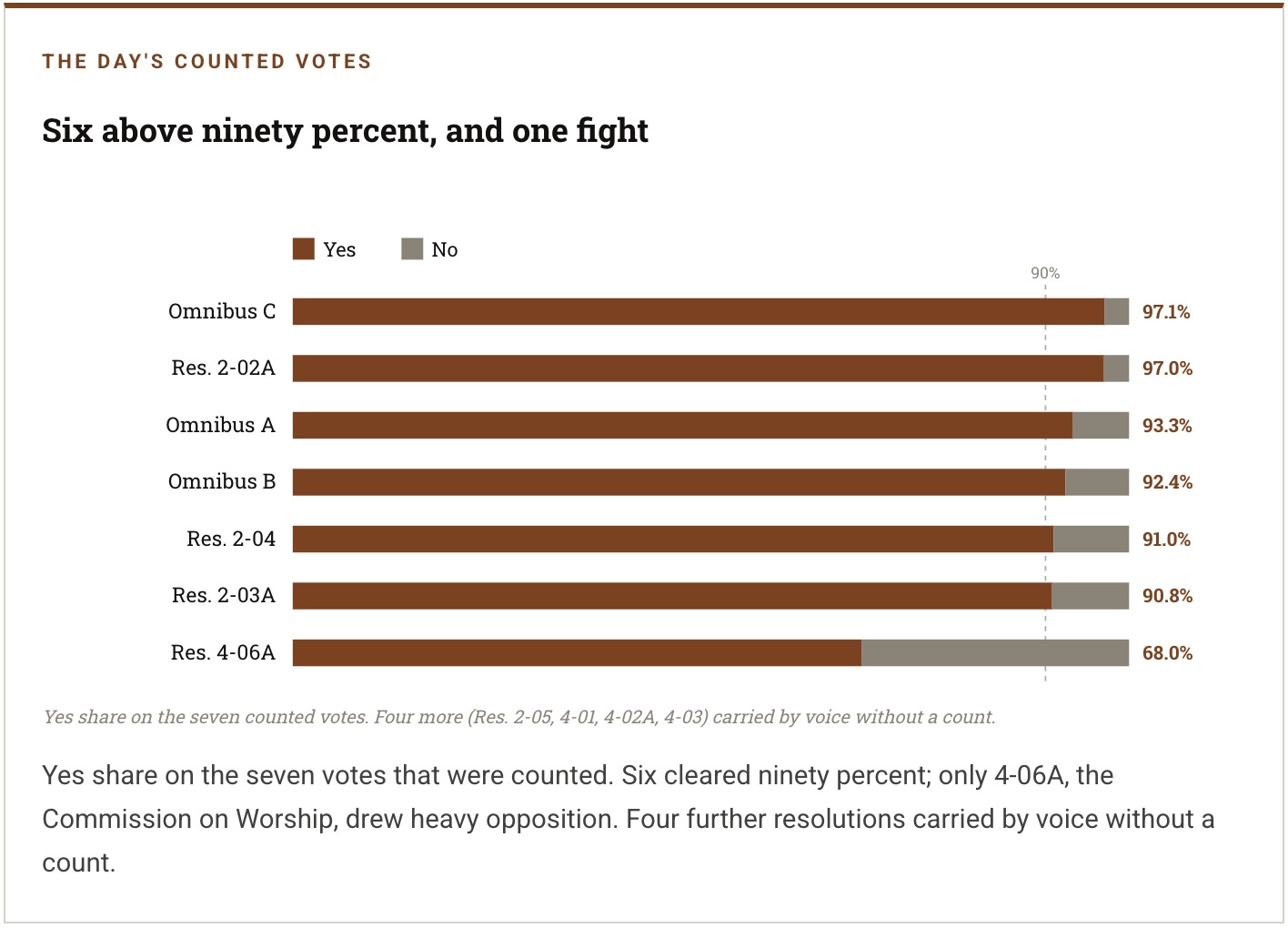
The Missouri Synod on the floor this Sunday was a day of yeses. In its opening working session, the convention adopted eleven items, including three omnibus resolutions and eight individual ones, and defeated nothing. Four passed by voice vote without a count, and of the seven that were counted, six cleared ninety percent. A convention’s first day is when it gets into its stride, bulleting through the resolutions that command broad agreement so that the floor hours to come can be spent on the ones that do not, and the docket obliged.
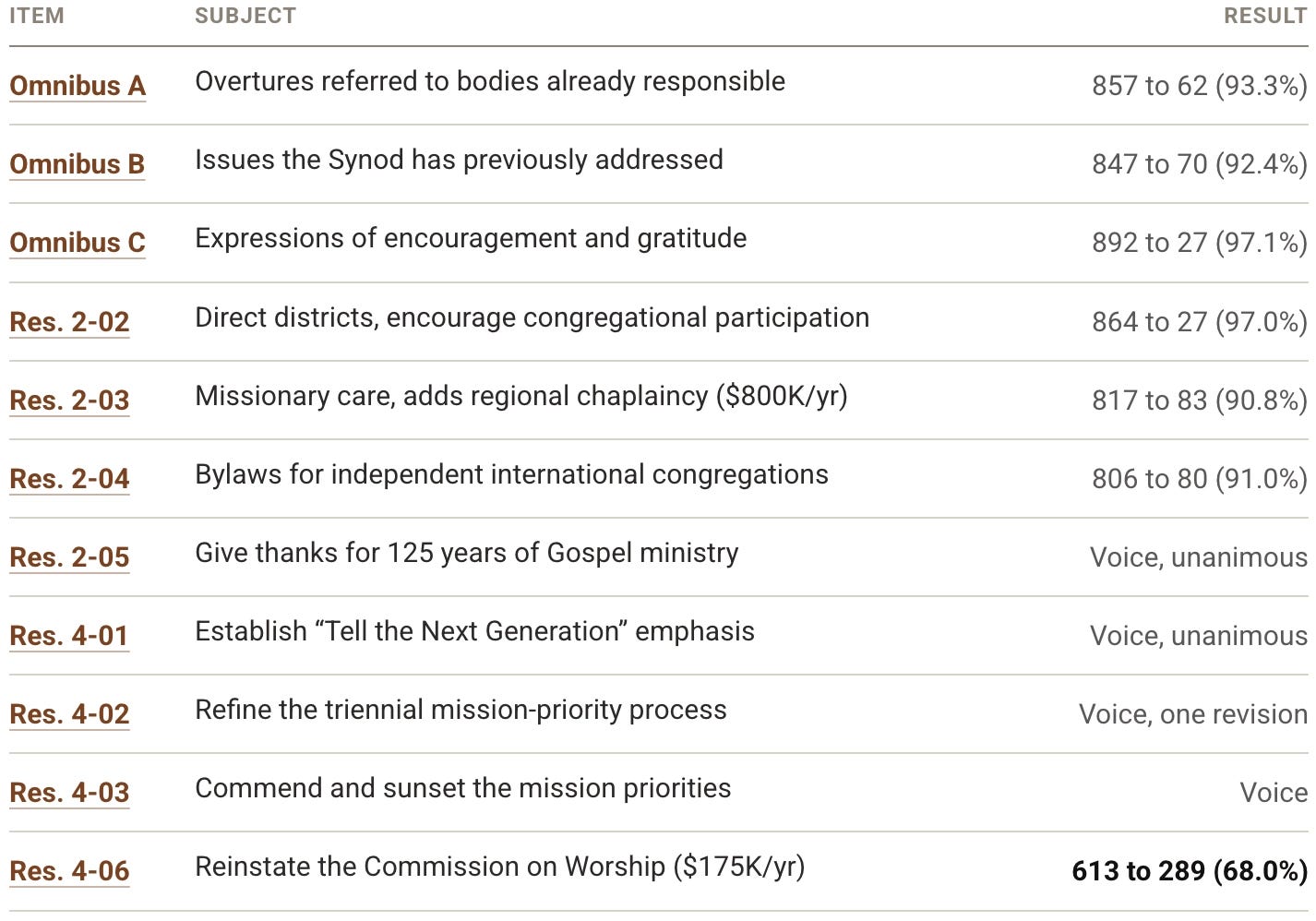
The eleven above are the whole of the day. This site keeps a running log of every floor decision, ordered by the day and by the sequence in which the convention took each item up, and the harder votes of Monday through Wednesday will land there as they happen.
One real fight
The lone exception, and the day’s demonstration of what a contested vote looks like here, was Resolution 4-06A, which reinstates the Commission on Worship the Synod had allowed to lapse. It carried, but only 613 to 289, sixty-eight percent, the single item all day to draw a No vote north of ten percent. The tell is worth reading. This site had already marked 4-06 as the one resolution on the whole docket that plainly builds rather than blesses, reviving a commission and attaching a hundred seventy-five thousand dollars a year to run it, and it was duly the hardest call of the day. A floor parts with money and machinery less readily than with thanks.
The adiaphora fault line
Strip away the dollar figure, and 4-06A reaches a quarrel the Missouri Synod has carried for decades. The reinstated commission would do more than assemble the next hymnal: its proposed bylaw empowers it to guide the development and revision of the Synod’s official agenda and hymnbooks and to “review and, at its discretion, exercise approval over all material related to corporate worship in liturgy and hymnody” produced across the Synod’s offices. That reach lands on the oldest question in Lutheran worship, namely, what in the Divine Service is commanded and what is adiaphora, a thing neither commanded nor forbidden, in which the church has liberty (Formula of Concord X; AC VII, which holds that the true unity of the church does not require uniform ceremonies). One wing of the Synod reads the forms of worship as adiaphora and the proper business of the local congregation, and hears in a churchwide commission a fence around a freedom Scripture leaves open. The confessional and liturgical wing answers that the way a congregation prays teaches what it believes, that the resolution’s own preamble rests the commission on the membership condition of Constitution Art. VI 4, the exclusive use of doctrinally pure agenda and hymnbooks, and that stewardship of the church’s common song is no housekeeping matter. For many of the 289 who voted no, the objection was less the line item than a churchwide body holding approval over what they take Scripture to leave the congregation free to choose.
What waits
The easy yeses are a poor guide to the week. The resolutions that will actually define this convention have not yet reached the floor. The pastoral-formation fight of Committee 6, twenty overtures deep and carrying a rejection of the online Master of Divinity; the fellowship declarations, the closed-communion question, and the reaffirmation on women and the pastoral office in Committee 5; the study that could restructure the Concordia university system; the response to sexual misconduct by rostered workers; and the governance and elections amendments of Committee 9, all of it waits for Monday through Wednesday. This publication’s guide to the docket sorted the one hundred six resolutions into the fifty-three that carry real weight and the rest, and day one disposed almost entirely of the rest. The fifty-fifty questions are still coming.
The verdict
The convention began where conventions begin, with the votes that unite it, and the measure of the week will be the votes that do not. On the evidence of a single afternoon, the floor is content to ratify what its committees framed. Whether that contentment survives contact with pastoral formation and altar and pulpit fellowship is the question the next three days will answer. Day one adopted the ninety-percent consensus. The harder arithmetic waits.
Method and source. The figures are the convention floor tallies for the first day of business, as reported. These figures are transcribed in real time from the convention livestream and may contain errors; Today’s Business, the official convention record, carries the definitive tallies in its later editions. All eleven items are adopted; none were defeated. Each adopted resolution carries its own floor result on this site, and the omnibus pages include the full amendment history, including the nine motions to pull an overture out for individual action, all of which failed. The full day’s slate, and every floor decision to follow, is gathered in the day-by-day decisions log. Vote shares are of the ballots cast on each recorded vote. “Load-bearing” and “plainly builds rather than blesses” follow the classification in “Where LCMS Convention Delegates Need to Invest Time & Effort.” Compiled by Ad Crucem News; editorial analysis, no Synod imprimatur.
The reinstitution of the commission on worship concerns me quite a bit. Anecdotally, my congregation has still not fully recovered from the transition from TLH to LSB. The liturgical habits of the laypeople have been disrupted. This is not a condemnation of one or another, but an observation that major changes create confusion and divide generations. If the commission exists to promote and perpetuate the best of what we already have then I am all for it.
I am curious, is there any indication as to the composition of the commission and what we should expect from their work?
Following the motions for Omnibus A and Omnibus B, there were approximately ten amendments offered to pull one or another overture out of the omnibus resolution Some of these overtures were conservative in nature, others liberal, and others neither. It was pointed out by the parlimentarian that no discussion was allowed for such motions. Each individual motion was then defeated by a 4-to-1 to 3-to1 margin. Finally, for each omnibus resolution, someone called the question and there was a chorus of "Second"s.
The prevailing mood among the delegates appear to be one of avoiding adding more resolutions to the agenda. There was even a call to shorten the number of seconds a delegate was allowed to press the button to vote, which Chairman Harrison said would be done in the following days.