
How One Divorce Exposes the LCMS’s Abdication of Its Chain of Ecclesiastical Supervision
The Synod insists its discipline binds across church-body lines, yet when asked to honor one of its own congregations' discipline, every officer looked away.

Ad Crucem News has reviewed a dense file of correspondence spanning more than two years that documents one family’s attempt to obtain basic pastoral care from multiple rostered pastors and leaders of The Lutheran Church—Missouri Synod (LCMS). The identifying details of the persons and congregations involved have been withheld, not only as a courtesy to a family already gravely wounded, but because anonymity serves the argument we wish to make. This account never attempts to establish which spouse bears the guilt for the destruction of the marriage, which omission is deliberate, because the documented scandal does not depend on an answer to expose untenable governance failures. Whichever spouse sinned, the mechanisms the LCMS maintains for dealing with such matters, and the ecclesiastical supervision it advertises in its constitution and bylaws, were asked to engage at every level, from parish pastor to the Office of the President of the Synod, and at every level its representatives failed in the fulfillment of their bylaw-bound duties and obligations.
Essential Facts of the Case
A married couple, members of a non-LCMS Lutheran congregation, were in a marriage crisis several years ago. Because their parish was in a pastoral vacancy, it formally delegated the care of the family to a rostered LCMS pastor from a nearby congregation. He counseled the couple over a period of months and then, when a health crisis ended his involvement, rendered a written determination: there was sufficient blame on both sides, but neither spouse had biblical grounds for divorce or for continued separation.
One spouse rejected that determination and filed for divorce. The congregation, following the order orthodox Christians have maintained for millennia, placed the filing spouse under the minor ban. The other spouse felt obliged to file for divorce when the original case was dismissed for jurisdictional reasons. When the divorce was finalized a year later, the congregation proceeded to excommunicate the spouse who allegedly abandoned the marriage. The disciplined spouse, meanwhile, had relocated to another city and begun attending an LCMS congregation there, whose pastor, duly informed of the discipline, gave the impression of hoping for reconciliation and never once claimed to the disciplining congregation that any grounds for the divorce existed. However, according to an account of a much later meeting between that pastor and the appealing spouse’s current pastor, the LCMS pastor had allegedly been admitting the disciplined spouse to the altar throughout, had privately concluded that the divorce was justified, and regarded the sister congregation’s exercise of the keys as carrying no weight whatsoever. Notably, he kept that judgment to himself for the better part of two years. The other spouse, meanwhile, followed the Synod’s instructions for a wronged party. That spouse appealed, in writing, up the entire chain of ecclesiastical supervision, only escalating with each systematic rebuff from every level of failed supervision. What follows is the documented result of each appeal.
A Chain of Silence
The first appeal went to the pastor, who is now the shepherd to the disciplined spouse. The file contains a series of lengthy text messages, sent over several weeks, that lay out the case, share the counseling pastor’s written determination, and ask three direct questions about whether the discipline would be honored. The messaging application recorded that these messages were read. Not one of the messages received the courtesy of an acknowledgment or a reply.
The second appeal went to the district president. His response, and it is to his credit that he responded at all, since he is nearly alone in the file in having done so, was that because the appealing spouse’s congregation was no longer a member of the Synod, the matter lay outside his purview, and that he would entertain no further correspondence. Readers who have followed this publication’s reporting on district governance will immediately recognize the posture. Consequently, a situation involving two rostered pastors of his district, a communicant family of one of his congregations, and the integrity of the Office of the Keys as exercised between altar-fellowship-adjacent congregations was declared to be none of the district’s business.
The third appeal was a formal complaint against the receiving pastor, alleging specific misconduct in the earliest days of the marriage crisis. The district president never responded to it. The appealing spouse subsequently learned that the complaint had allegedly been received, read, and relayed to the pastor whom it accused. If that account is accurate, the disclosure inverts every principle of due process that the Synod’s dispute-resolution bylaws purport to guarantee and that we are told are so critical to LCMS justice and Godliness.
The fourth appeal was occasioned by the disciplined spouse reportedly coming under the care of a second LCMS congregation. The appealing spouse wrote to the district president again, citing the bylaw that expressly extends the right to file a formal complaint for persons outside the Synod, and addressed the pastor concerned, quoting the district’s own published guidelines for the conduct of its called servants. The pastor granted only one in-person conversation, declined to say, in that conversation, whether any accusation justifying divorce had ever been made, promised only to speak with the disciplined spouse, and then refused all further communication. The district president never answered at all, according to the available evidence.
The fifth appeal went to the Office of the President of the Synod, with the complete documentary record attached. No written response ever came, though a telephone call to the office reportedly produced an assurance that the President or one of his vice-presidents would travel to the region within the week and speak with the relevant parties. Whether any such conversation occurred, the correspondence does not show; however, the appealing spouse never heard another direct word from the Synod’s highest office.
The sixth appeal, sent as the divorce neared finalization, was simultaneously sent to four additional ordained officers of the district, charged with ecclesiastical oversight of the congregations involved. Four overseers of the church received a documented account of a soul fleeing discipline and into their district’s care, along with a request that they do anything at all. They did nothing at all.
A Dodge the Synod Rejects When Aimed at Herself
The purview defense deserves more scrutiny than it has received because the LCMS has recently argued the precise opposite position in public, in its own convention Workbook, and against a fellowship partner. Readers of Ad Crucem News will recall the Synod’s dispute with The American Association of Lutheran Churches over the AALC’s installation of a man who had been removed from the LCMS roster, a dispute in which President Harrison’s office pressed the claim that the Synod’s exercise of discipline demands recognition beyond the Synod’s own borders. Of the two cases the LCMS Workbook cited against the AALC, Dr. Larson conceded that only one involved actual discipline, and in that case the candidate had been off the LCMS roster for nearly a decade by the time he approached the AALC; the protocol documents between the two church bodies address pastors currently under discipline and are silent on pastors removed years before, and Larson treated the elapsed decade as, in effect, another life of the same man. Nevertheless, the Synod’s position was that its keys followed the man through a roster removal, across a decade, and across the boundary between two distinct church bodies, and that the AALC’s failure to honor that discipline was grave enough to memorialize before the whole Synod in convention.
Consequently, we need to set that position alongside what is alleged in this case. Here, the discipline was not ten years old but still relatively current and active; the determination underlying it was rendered by a rostered LCMS pastor; the disciplining congregation communicated its actions promptly and repeatedly to the LCMS pastors involved; and the disciplined party was received and communed while the ban was in force and known to the officers involved. Yet the district president’s answer was that none of it fell within his purview, and the operative principle that emerges from holding the two cases together is not any coherent doctrine of the portability of church discipline, but a simple asymmetry: the keys bind absolutely when the Synod has turned them, and bind no one, not even the Synod’s own rostered pastors, when the Synod is asked to honor another congregation’s exercise of the same office.
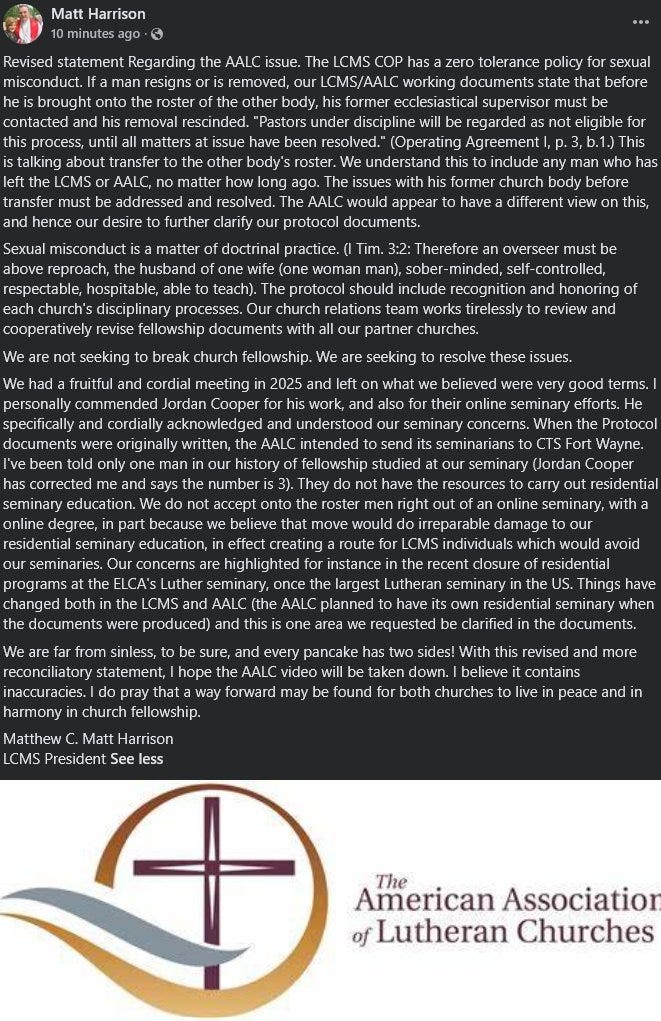
President Harrison has now framed the AALC matter in his own words in a public statement posted on social media in July of 2026, and his framing provides the standard by which his own officers must be measured. The Council of Presidents, he writes, “has a zero tolerance policy for clergy who are guilty of sexual misconduct”; the LCMS/AALC working documents require that before any man is brought onto the roster of the other body, “his ecclesiastical supervisor (District President) must be contacted first”; the failure to do so “caused great offense to congregations, people, pastors and district presidents within the LCMS”; and the whole question, he insists, “is a matter of doctrinal practice,” grounded in 1 Timothy 3:2. We quote that zero-tolerance language for the contact-first protocol it establishes and for nothing further, because no party in this account is accused of sexual misconduct in the ordinary meaning of the phrase, the complaint against the receiving pastor having concerned an alleged abuse of pastoral authority rather than any violation of the Sixth Commandment.
Conclusion
The matter of the verdict remains: it was eventually rendered, though not by any person or body competent to render it. More than two years after the spousal separation began, and only when a pastor from the appealing spouse’s new congregation finally secured a face-to-face meeting, did the receiving pastor disclose his position, again according to the account of that meeting preserved in the file: that he had determined the appealing spouse guilty of malicious desertion, that this determination justified the divorce, and that since no LCMS congregation had ever disciplined the party he received, his private judgment was binding and true. Set aside, for the moment, that malicious desertion is a specific canonical category with a settled definition in Lutheran literature. If the account in the file is accurate, the procedural facts are damning enough on their own, because the accusation was never communicated to the accused, never investigated by anyone who spoke to both parties, never tested against the contrary written determination of the pastor to whom the case had actually been delegated, and never reviewed by the district officials who were told, repeatedly and in writing, of two irreconcilable exercises of the keys.
The case now sits before a new district president as a docket of formal disciplinary charges, and he has at least indicated a willingness to hear them, which distinguishes him from every officer who preceded him in this evidentiary file. Perhaps he will investigate. However, nothing in the record to date gives grounds for optimism, because the pattern established is not one of isolated oversights but of a supervisory culture in which almost every officer, from parish pastor to the Synod’s president, found a reason to avert their attention.
The reader may ask which spouse was in the right, and the honest answer is that this publication has not attempted to know it. However, the more important answer is that the LCMS does not know either, because it never asked. A church body that maintains so many layers of supervision, at least on paper, paired with dispute-resolution bylaws, ethical codes for its called servants, and a president’s office staffed to receive appeals, possessed every officer and instrument necessary to ascertain the truth and to render the pastoral care requested of it, and it employed none of them, even as it went on receiving and communing one of the two parties whose guilt or innocence it declined to examine. LCMS parishioners do not expect or want their clerics to behave this way, and the persistent problem of selective supervision needs to be addressed urgently.
Cover Photo by Sasun Bughdaryan on Unsplash
It's rare these days to see our pastors and congregations even attempt to evaluate whether or not a party in a divorce should be disciplined. Far too often, it seems that pastors and congregations turn a blind eye to the divorce and then celebrate when each party finds a new spouse...
Overall point and my takeaway is, we have 'rules' in our Synod but at times they are not applied, up and down the ecclesial chain-of-influence [from DP to individual members]. When a report of a legitimate wrong or error is actually ignored and the reporter pushes for the appropriate authority to address that ignored sin, the proper authority either takes appropriate action, OR makes minimal incomplete action, OR the 'reporter' is told to back off. But purposefully delaying, burying, and or ignoring a needed address of error or sin is always wrong.