
How Eighty-Eight Pastoral Formation Overtures Became Thirteen Encouragements
The most contested zone for the upcoming Synod Convention revolves around

The eighty-eight overtures that Floor Committee 6, Pastoral Ministry and Seminaries, carried into the committee weekend in St. Louis, sorted into their competing camps in the third article in the series, have come back from the committee room as thirteen proposed resolutions and one omnibus of declines, and the first thing a careful reader notices, before any question of routes or seminaries or the Specific Ministry Pastor, is the grammar. The committee answered its mailbag in the hortatory mood with governing verbs like encourage, commend, reaffirm, and give thanks, so that a block of memorials demanding bylaw amendments, new designations, age-limit repeals, and enforcement teeth has been handed back to the floor wrapped in cotton wool.
From overtures to resolutions
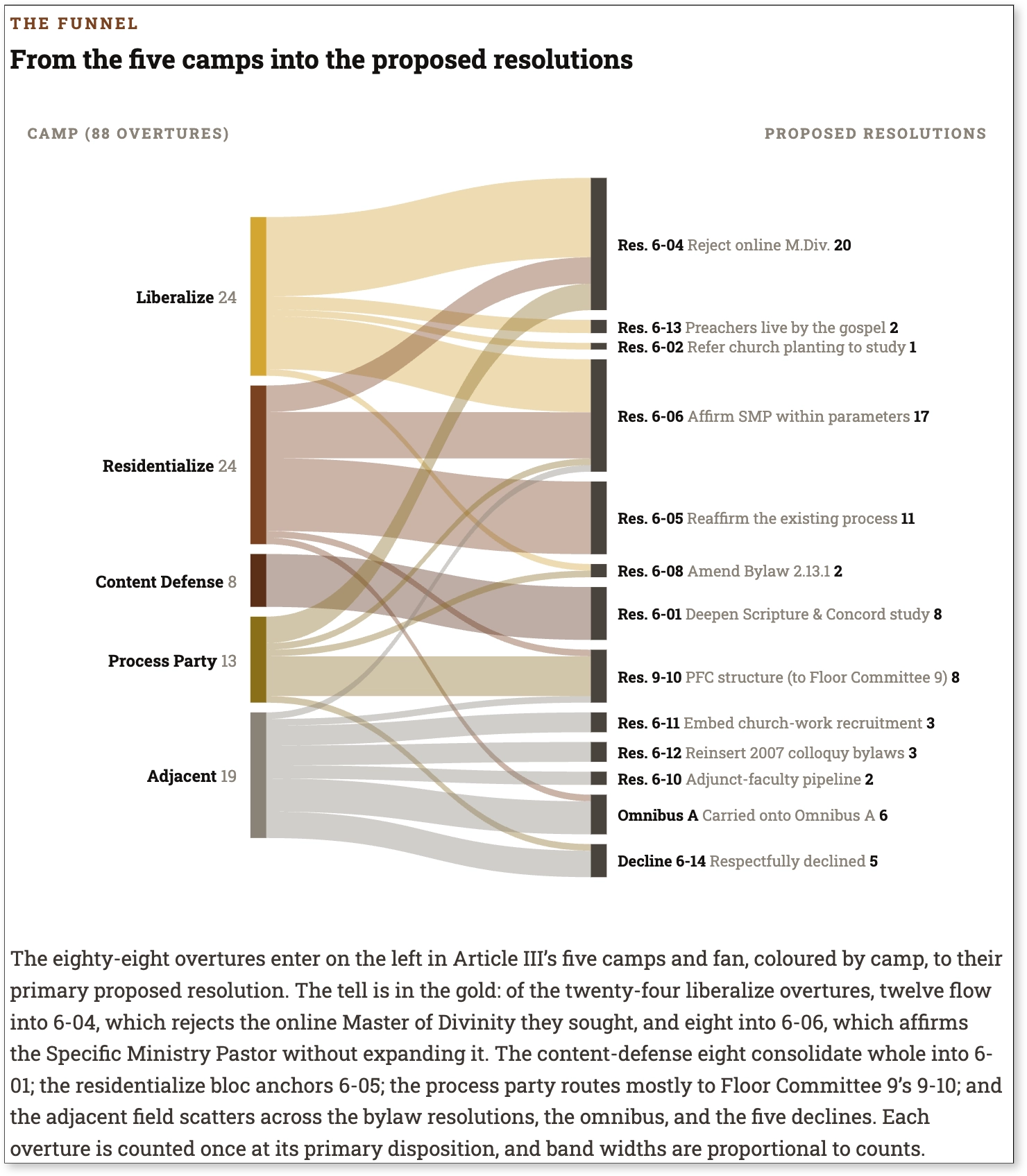
Floor Committee Six’s eighty-eight overtures were sorted into their competing camps: twenty-four asking the convention to liberalize pastoral formation, twenty-four to narrow it to the residential seminary, and the rest to defer or to defend the curriculum. This article follows those same overtures into the committee’s output, the thirteen proposed resolutions, and the omnibus bill printed in Today’s Business, and asks what the consolidation is steering toward.
What follows is an editorial analysis of the published texts. The committee has not stated its intent, and the inferences drawn here are the author’s reading of the resolutions themselves. The analysis carries no Synod imprimatur.
Verbs Tells the Story
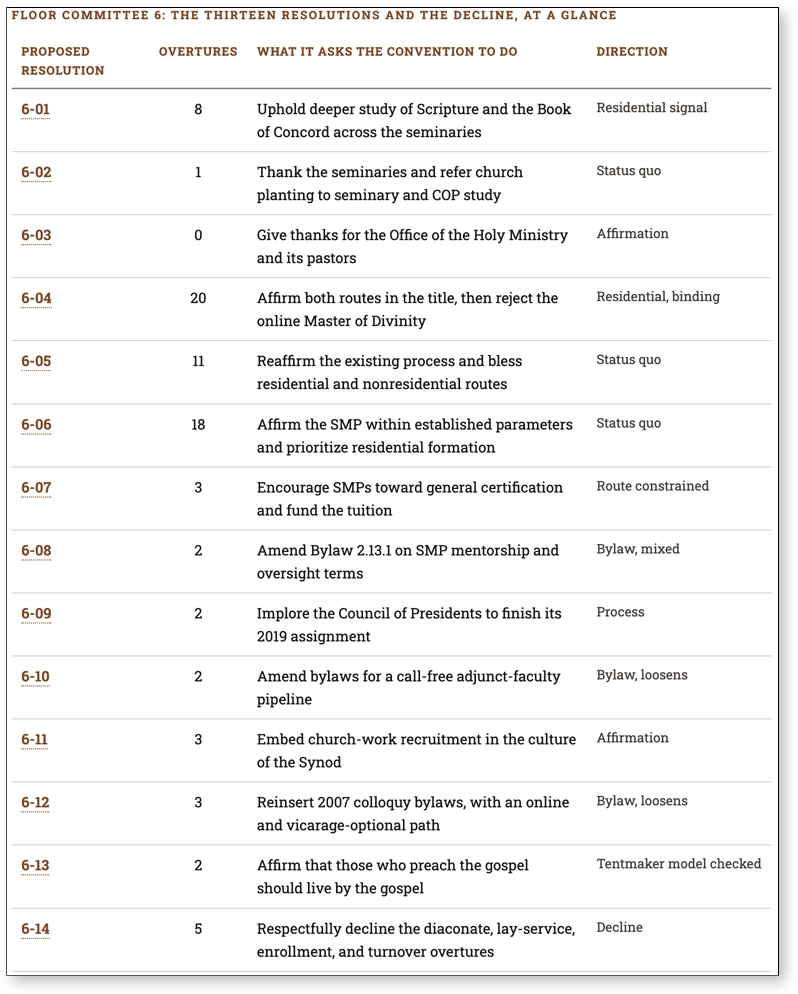
Of the eighty-eight overtures, seventy-seven were folded into the thirteen proposed resolutions, five were declined on the record in Proposed Resolution 6-14, and six were carried into omnibus. If you read the resolutions in sequence, a single editorial habit governs most of them. Where an overture asked the convention to do something, to amend a bylaw, to create a designation, to strike an age limit, or to suspend admissions, the resolution asks the convention to affirm something already in place. The Michigan District’s demand for a new church-planter track is driven by existing coursework. A cluster pressing for a residential mandate becomes a re-citation of the bylaws now on the books. The verbs do the steering, and the verbs almost all encourage.
Three of the thirteen break the hortatory pattern and amend the Synod’s bylaws outright, and those three matter precisely because they are the only places where the committee wrote expectations for enforceable law rather than encouragement. Two of them, as the closing section shows, loosen the formation regime, which is the first sign that the committee’s ‘residentialism’ lives mostly in its adjectives.
The Both-And Title
The clearest specimen of the committee’s method is Proposed Resolution 6-04. Its originating cluster is the largest the committee has handled: twenty overtures, most of them tilting toward expanding non-residential formation, several arriving in coordinated and near-identical language to request an online or distance Master of Divinity. The committee gathered all twenty under a banner that reads as a peace treaty: To Support Residential Master of Divinity and Alternate Route Pastoral Formation for the Sake of the Flock. The conjunction is the diplomat in action. When the reader reaches the operative resolution, the diplomacy drops away, and a verdict takes its place. The convention is asked, in the committee’s own words,
to reject online M.Div. education since it is insufficient for achieving the high standards of the Office of the Holy Ministry.
The flagship concrete reform that the largest bloc of overtures requested is foreclosed by name, in the single resolution whose title promised to hold both routes together. The banner says and. The body says no.
What makes 6-04 important, rather than one contested call among many, is that everywhere else a hard question arose, the committee declined to answer it. It referred church planting to study in 6-02. It routed the scope of the Specific Ministry Pastor program back to existing policy in 6-06. It re-cited the bylaws and blessed both routes in 6-05. In 6-04 alone, the committee decided, and it decided against the most-filed concrete ask, in the residential direction. That asymmetry, between deferring every other contested question and closing this one door, is the residue of steering that no account of neutral housekeeping fully absorbs.
Reaffirm, Refer, Repeat
Around 6-04, the committee built a ring of resolutions whose common move is to answer a concrete demand with a reaffirmation of present practice. The Board of Directors of the Michigan District asked, in the lone overture behind 6-02, for a new Specific Ministry Pastor church-planter designation and the removal of the under-forty age restriction. The resolution thanks the seminaries for outreach coursework already produced and requests that the seminaries, in consultation with the Council of Presidents, identify specialized areas of training, the abbreviation SMP never once appearing. The eleven overtures behind 6-05, several pressing for a residential mandate and presidential discipline, draw a re-citation of the bylaws already in force and an operative blessing of residential and nonresidential routes alike. The eighteen overtures behind 6-06, the largest cluster touching the Specific Ministry Pastor directly, produce a resolution that affirms the program within its established parameters and directs districts to prioritize residential seminary formation whenever feasible, binding the program to the policy package the boards of regents adopted in November of 2025 rather than to anything the overtures requested. The age-forty cap the liberalizing overtures wanted struck survives, carried in by reference to that policy package rather than written into the resolution itself.
Even the cost objection is absorbed the same way. The overtures behind 6-07 complained that the path from Specific Ministry Pastor to general certification is too costly to walk. The committee answered by leaving the requirement in place and resolving that the congregation, district, and seminary will fund all tuition and fees for the men who pursue it. The bar stands where it stood. The convention is asked to pay for the climb rather than to lower it.
Where the Committee Stood Firm
For all the residential warmth in the adjectives, the three resolutions that actually amend the Synod’s bylaws point the other way, and they are the honest complication any reading of this committee has to carry. Proposed Resolution 6-10 writes a call-free pipeline for seminary adjunct faculty into the bylaws, sparing the seminaries the administrative burden that the overtures identified as cumbersome and counterproductive. Proposed Resolution 6-12, reinserting the 2007 pastoral colloquy provisions into the Handbook, goes further and hard-codes a path on which
The committee may assign residential and/or online seminary coursework, mentored readings, and/or a formal vicarage or a shorter informal internship.
The online coursework that 6-04 forecloses for the Master of Divinity reappears here, for the colloquy path, as potentially enacted bylaw. However, a committee with a uniform residentialist hand on the scale does not hand the other side two enforceable wins on the formation machinery. The truer reading is narrower and sharper than some residentialist coup to be outraged about. The committee is protecting the settlement already in place, tightening the rhetoric where tightening costs nothing and loosening the law where the seminaries themselves stand to benefit.
The Decline Omnibus
The five overtures the committee declined on the record, gathered in Proposed Resolutions 6-14, are worth reading for the kinds of requests that warrant an open refusal. A proposal for a commissioned male diaconate, trained and certified by the seminaries, is declined as inconsistent with seminary formation and synodical practice. Two memorials celebrating and encouraging lay service are declined for lack of clarity. The expansion of the offices and the expansion of lay function are the requests the committee was willing to refuse by name.
Two further declines are quieter and point back at the institution itself. A request that the seminaries publish their annual fall enrollment numbers is turned aside with the note that the information may be requested from the seminaries, and a study of seminary-professor term limits and parish sabbaticals is declined alongside it. The committee that encouraged so freely elsewhere preferred, on the narrow question of publishing its own enrollment figures, to leave the seminaries unaudited by convention mandate.
What the Committee Is Steering Toward
Set the thirteen resolutions and the one decline beside the eighty-eight overtures that produced them, and the steer comes into focus. The committee is moving the convention to ratify the settlement already in place. Residential formation is named the standard, in the adjectives and the whereas clauses if not always in binding law. The Specific Ministry Pastor and the alternate routes are preserved and praised, kept subordinate to the residential model, and expanded nowhere. The online Master of Divinity, the single concrete reform the largest bloc of overtures requested, is foreclosed by name. The expansion of office and lay function is declined on the record. And where the committee did reach for the bylaw pen, it enlarged the seminaries’ own discretion.
The method throughout is the warm and conjunctive title carried by hortatory and status-quo-affirming substance, so that a convention voting yes down the slate will rise believing it affirmed everyone, while it has in fact ratified the residential model, paid to keep the alternate routes narrow, and closed the one door the reformers most wanted open. Proposed Resolution 6-04 is the whole method on a single page: a both-and banner over a categorical no.
Compiled by Ad Crucem News from the 2026 LCMS Convention Workbook and Today’s Business of Floor Committee 6, Pastoral Ministry and Seminaries. Resolution titles and quoted clauses are reproduced from the committee’s published texts; the camp framework and steering analysis are editorial and are the author’s opinion. This article is not a publication of The Lutheran Church, Missouri Synod, or of its floor committees, and it carries no Synod or related institution imprimatur. Companion to The Pastoral-Formation Convention.