
Hermann Sasse and the Slipped Halo
Sasse’s acceptance of biblical inerrancy came with the provision that he could not accept the creation and fall accounts in Genesis 1-3 as historical.
Rev. Dr. David P. Scaer (b. March 13, 1936) is a prominent Lutheran pastor, dogmatician, and professor known for his work in systematic theology and New Testament studies. He is the David P. Scaer Professor Emeritus of Biblical and Systematic Theology at Concordia Theological Seminary, Fort Wayne (CTSFW), where he served since 1966 until his recent retirement.
I have already written of my admiration for Hermann Sasse as a defender of the faith for students during St. Louis seminary (Concordia Seminary) days, when some professors, wittily or unwittingly, had taken up neo-orthodoxy in which biblical history was subsumed under the “Word.” This allowed interpreters to avoid coming to terms with whether something reported in the Scriptures really happened; with this method, biblically reported events remained at arm’s length from answering whether they did. This concept, more than any other, was at the root of the 1974 walkout of the St. Louis faculty and ensuing disruptions in the LCMS.
One man, Hermann Sasse, a member of the theological faculty at the University of Erlangen and for some time its dean, stands out from other German scholars as an advocate of traditional Lutheran theology. An adviser to LCMS president John Behnken, he warned against the impending alliances of German territorial Lutheran churches with the Reformed and Union churches. A clarion call for adherence to Lutheran doctrine during this time was Sasse’s This is My Body, a defense of Luther in his debate with Ulrich Zwingli on the Lord’s Supper. Only later did it become evident to me and perhaps others that Sasse had offered an historical exposition of Luther’s encounter with Zwingli at Marburg and not a biblical exposition of the words of institution. Sasse was not unlike his German contemporaries in doing theology not only from a biblical perspective but also from historical, philosophical, and scientific perspectives. Such was the case with Werner Elert, and more conspicuously with Rudolf Bultmann, who incorporated the existentialism of his Marburg University colleague Martin Heidegger into his understanding of the doctrine of justification.
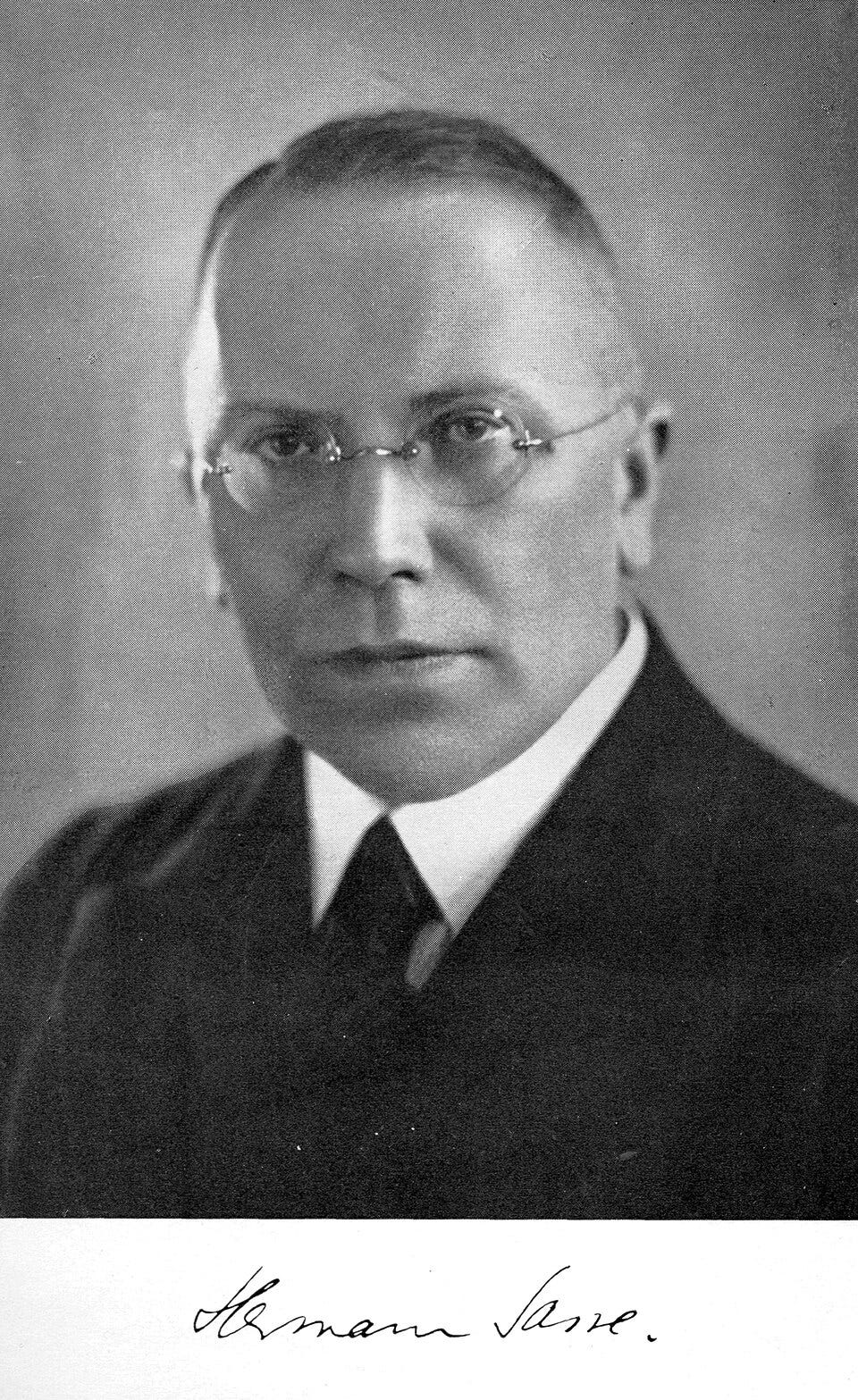
What brought Sasse to mind was a rereading of Ben Mayes’ incisive essay, “Creation Accommodated to Evolution” in the Concordia Theological Quarterly 87/2 (April 2023): 123-150, to which I have already responded. During discussions between the two Lutheran synods in Australia that led in 1966 to a united church in the subcontinent, Sasse came to accept biblical inerrancy in which our late colleague Kurt Marquart participated. Sasse’s acceptance of biblical inerrancy came with the provision that he could not accept the creation and fall accounts in Genesis 1-3 as historical in what he called the normal sense of the word ‘historical.’ With this codicil that he did not accept biblical inerrancy as defined by the LCMS, which he said had been taken over from Fundamentalism, especially as it was found in the American Midwest. This view was discredited by Robert D. Preus, who in his Inspiration of the Scriptures argued that biblical inspiration and inerrancy belonged to the legacy of 16th and 17th-century Lutheran Orthodoxy.
At the heart of Sasse’s concerns about biblical inerrancy are the contradictions between the two creation accounts in Genesis 1 & 2. Rather than seeing them as myths or sagas, a widely held view, Sasse defines them as pure word of God (127), which makes no assertions about the natural world, a view that comes with its own problems. As pure word of God, these accounts would be exempt from historical or literary analysis (125-126). Then there is the prior question of whether what is called the pure word of God would be accessible to human beings. Mayes references Preus to draw a sharp line between those who accept the Genesis accounts as they are described and those who say that what they describe is beyond possibility (123). Here, Sasse leaves us hanging on what he means by biblical inerrancy. To some, historical inerrancy, that is, the events described in Genesis happened the way they are described, may not be all that important, but on these narratives rest such questions as the origin of sin and Christ’s person and work of Jesus Christ as the second Adam, and even more lately, the relation of man and woman to each other.
Sasse attributes his hesitancy regarding the two creation accounts by placing them side by side and noting a contradiction: the first takes six days, while the other takes one day. In concluding that there are two accounts of what appears to be the same event, Sasse makes no attempt to harmonize them, and he is under no obligation to do so, but this does not prevent him from responding. Though like other sections of the Scriptures, especially the gospels, the same events can be described from different perspectives. So is the case with the accounts of the crucifixion and resurrection. In the case of Genesis, the perspective of the first account is that of the creator looking in from the outside at what He had done and finding it good. The perspective of the second narrative is that of Adam, as the crown of creation, and with whom God converses and prepares for the third chapter, in which Adam ignores what God has said and gives ear to Satan, whose promise of being like God himself trumps what God has said. The basic tenets of what Christianity would look like are preparatory for his fall into sin in the third chapter to contrast everything Adam once possessed as God’s favored creature, imaged after himself, and which he lost. This perspective, in which he has so lost God’s image that he will return to the dust and eventually die, persists from Genesis through the death and burial of Joseph (Gen 50:26) and then to the last of the five books of Moses (Deut 34:5-6). The terms that Adam and his descendants must and will face propel the consequences of Adam’s sin to the conclusion that he and his descendants are sentenced to death, which will be reversed by the conquest of the Serpent by one of Eve’s progeny. Adam’s descendants resolve their alienation from their creator either by ignoring it or by attempting to resolve it, but fail. With that, justification was placed at the center of the theological task in each person attempting to explain to himself or others that he is morally acceptable and even worthy of commendation for doing the good thing. One’s sense of moral inadequacy provides an opening to recognizing that Jesus, Eve’s promised descendant, has destroyed Satan’s accusation by taking upon himself the curse laid upon her descendants because of Adam’s perfidy in giving preference to Satan’s promise of equality with God.
One is at a loss to understand that a leading Lutheran theologian did not and could not argue backward from the doctrine of justification through the atonement to recognize that the first three chapters of Genesis set forth the foundation of biblical revelation, the Christian faith, and the hope of salvation. Sasse was unable to recognize that parallel accounts in other parts of the Scriptures are not contradictory but rather serve to inform one another. In the Old Testament, 1 & 2 Kings look at Israel’s history from a different perspective than do 1 & 2 Chronicles, and in the New Testament, the four gospels - for all their similarity - each lay out the life of Christ differently. The Psalms, in poetic form, speak of the glory of God’s creation, without in any way compromising the creation set forth in the Genesis narratives. Astoundingly, Sasse’s bypassing the question of the historical character of the Genesis creation accounts by classifying them as pure word of God sets him in the direction of Karl Barth, who subsumes the historical character of the Bible under the word of God, thereby robbing it of its historical character. Sasse had a point that the Scriptures should not be read as scientific textbooks, a claim he lodged against Francis Pieper.
What should be agreed upon is that the Scripture uses illustrative stories, parables and metaphorical languages; however the use of a metaphor in what purports to be an historical account does not suggest that it did not happen. If metaphors describing ordinary events compromise their historical reality, then nothing could be known for sure; in fact, we might understand nothing, and language itself would be challenged. Theology or doctrine as pure word of God is more likely to approach incomprehensibility for many, since it is often defective in the use of metaphors.
At the heart of Sasse’s challenge to the Genesis accounts is an academic environment in which theology is treated as a discipline alongside other disciplines, each of which informs the others. While this is common in the Western world, it is particularly so in the German university. Take, for example, Werner Elert, who taught alongside Sasse at the University of Erlangen, who lectured on a full range of topics from history to philosophy and geology. In addition to being assigned required lectures in their discipline, professors are allowed to address the university on a wide range of topics of their choosing.
Behind this lies the history of the formation of a union between the two Lutheran synods in Australia, the one in fellowship then with the LCMS and others affiliated at one time or another with the synods that would make up the ELCA. Prominent in these discussions centering on biblical inerrancy were Sasse and later Fort Wayne professor Kurt Marquart with the result that Sasse was said to accept the controverted doctrine. This agreement has since unraveled, with the Lutheran Church in Australia finding no reason to disallow ordaining women pastors. Dissidents have organized an alternative Synod that will align with the LCMS on this issue. Since Sasse was prominent in forming the union, his understanding of inerrancy should be reexamined.