
Floor Rejects Harrison Resolution to Return Presidential Election to the Convention
The confessional majority that has swept the week so far declined to resume being the presidential electorate.

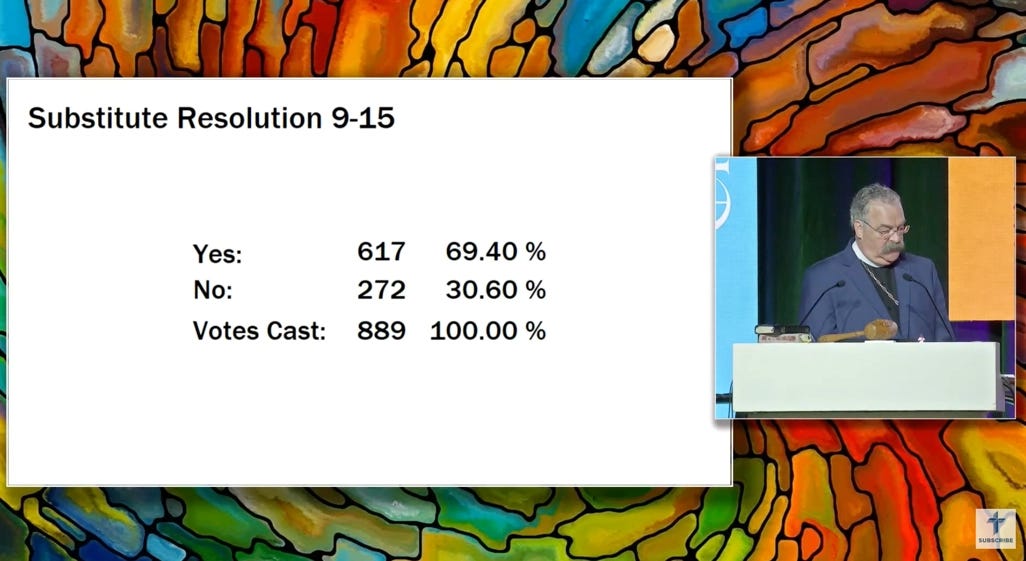
The most consequential governance question of the 2026 convention was put to the floor on Wednesday by LCMS President Harrison. Floor Committee 9 brought Resolution 9-18 , which would have amended Bylaw 3.12.2 to return the election of the Synod President to the convention and its delegates, overturning the pre-convention electronic balloting in place since 2010. A delegate from the Texas District moved an amendment, which the floor adopted at a hefty 69.4 percent to 30.6 percent, leaving the vote with the congregations. It was a surprising development for a convention that had spent four days more or less doing the President’s machine’s bidding.
Harrison’s ask
Resolution 9-18 came at President Harrison’s request; in the third part of his report on Sunday: “I have requested that Floor Committee 9 prepare for debate a resolution to return the presidential vote to the convention. I have no dog in this fight, since I will not stand again.” Harrison’s case, as the committee relayed it, rested on the machinery of the current system and the culture that has grown up around it.
The technical difficulty of running a synod-wide electronic election.
A registration rate Harrison put at 58.64 percent of eligible voters, well short of the participation the 2010 change had promised.
The labor the current process imposes, sending workers “hunting for registered voters who fail to vote on previous ballots,” which he argued politicizes the count.
The “often shameful online activity and vitriol displayed for weeks on end to the world” that a months-long congregational ballot invites.
The economy of the alternative, in which “the voting will take minutes, with all congregations represented and all eligible voters present and accounted.”
The resolution kept the nomination process untouched at the five ordained ministers who draw the most nominating votes, and reverted the election itself to the 2010 language: “prior to all other elections the convention shall elect the President, each voting delegate entitled to one vote, the candidate with a majority declared elected”. On its face, it was a return to the way the Synod had chosen its President for most of its history.
The substitute, and the committee’s hedge
Before the debate could turn on Harrison’s reasons, Rev. Tim Eden (a voting ordained pastoral delegate of the Texas District) rose and moved a substitute, Resolution 9-15, the committee’s own resolution to raise congregational participation in the existing electronic election. His argument inverted the President’s: the problem is not participation but registration. He noted that the electronic elections have drawn more than five thousand voters apiece, against the nine hundred or so delegates seated in Phoenix, and that the voting rate among registered congregations reached 96 percent at the last election. The remedy, he argued, is to register the congregations that never opted in, which is what 9-15 sets out to do through congregation profiles, district-president education, and circuit visitors working with vacant parishes, rather than to take the franchise away from five thousand congregations without their input.
The committee then revealed its hand. Under Rule 21, it had two minutes to respond, and its representative acknowledged that it had drafted 9-15 as the fallback all along: “It was fully the intention of the floor committee that should 9-18 fail, based upon your discussion and debate, the committee would bring 9-15 to the convention floor.” The floor voted to consider the substitute, and the contest was set: not Harrison’s reasons against the status quo, but 9-15 against 9-18, which means improving participation rather than winding the clock back.
The same ugliness, argued both ways
The 9-18 / 9-15 debate was the first meaningful engagement on the floor, and it was notable that the core argument was claimed by both sides. Everyone agreed the run-up to the June election had produced ugly online politics, but they disagreed entirely about what that proved or required as a remedy.
The delegates who wanted the vote moved to the convention read the ugliness as an argument for the decorum and selectivity of the floor. Aaron Silletto, an Indiana District Lay Voting Delegate, said he had been against 9-18 until recently, and that what changed his mind was precisely “how frankly ugly the online discussion has been,” a spectacle he believed a face-to-face convention would replace with Christian conversation. Rev. Chris Hall, an Oklahoma District ordained pastoral voting delegate, made the institutional version of the point: this is the body that elects the vice-presidents and every other officer, and the President belongs with them, decided together where delegates can talk to one another before and after.
The delegates who wanted to keep the vote with the congregations read the same ugliness as a verdict on human nature rather than on any ballot. A Missouri advisory delegate, Jenny Asher, answered that the Synod’s primary problem “is that we are sinners,” that she had watched the same slander at in-person conventions in years past, and that the only difference now is that the sin is “publicized for everyone in the world to see on social media.” Texas ordained pastoral voting delegate Rev. Alex LaHue reached back to a Synod founding father, invoking C. F. W. Walther’s 1879 essay on the duties of an evangelical Lutheran synod and its warning that the Synod must not “assume a dictatorial role” over its congregations but help them in an advisory way. English District pastor and CSL Regent, Rev. Dr. Adam Koontz, put it very plainly with a firm American overlay: the trouble “is not in the process of democracy itself,” it is in the people who work it, and the answer to sin is not fewer voters.
One delegate tied the vote to the resolution the floor had passed an hour earlier. Having just adopted 9-13A , which tightens electoral-circuit parameters and, absent the floor amendment that survived, would have concentrated more congregations behind each delegate, the convention was now being asked to hand those same delegates the presidential vote as well. Moving both together, he argued, would draw the election inward twice over, away from the congregations and toward the room.
The meaning of the margin
The floor voted to end debate, then adopted the substitute 69.4 percent to 30.6. Resolution 9-18 died with that vote, and 9-15 carried in its place, committing the Synod to keep the electronic congregational election and to work at the registration problem Harrison and his opponents both conceded is real.
The result is the week’s signal departure from the established pattern. A convention that came within five votes of forcing President Harrison to a fourth ballot in June and then seated a floor demonstrably more confessional than that June electorate, which had every structural incentive to bring the decision of the presidency back in-house. It refused. The bloc that’s controlled the elections all week, and that has been losing only the least doctrinal down-ballot seats, declined to convert its floor advantage into control of the one office that has divided the Synod most, and it did so by better than two to one.
The vote has two potential meanings. The first is principled: a genuinely Waltherian congregationalist instinct that reflexively distrusts moving a franchise from five thousand congregations to nine hundred delegates. The second is prudential: with the 2026 result freshly and narrowly decided, reclaiming the presidency for a floor that had just re-elected the incumbent would have looked less like reform than like a winner rewriting the rules to shore up his post-presidency legacy. As one advisory delegate put it, “a close election has prompted this unnecessarily.” The pews retain some power with 9-18 refused.
Method and source. Quotations and the account of the debate are transcribed from the convention proceedings of the Wednesday, July 22, 2026 session; the speaker attributions by district are drawn from the same transcript and remain provisional until the official minutes are published. President Harrison’s reasons are quoted as the committee read them from Part 3 of his report of Sunday, July 19. The tallies and dispositions are recorded on this publication’s decisions log , with the resolution texts of 9-18 and 9-15 from Today’s Business. Ad Crucem News is an independent publication; this analysis is editorial and carries no imprimatur of The Lutheran Church—Missouri Synod or its officers.
It also has to do with the changing of electoral circuits. Many circuits will be combined and reduce the voice of individual congregations