
Election for Synod President a Dead Heat After Round Two
Challenger Rev. Dr. Joel Biermann has continued to gain momentum as the balloting enters a third round, and DP Brady Finnern is eliminated.

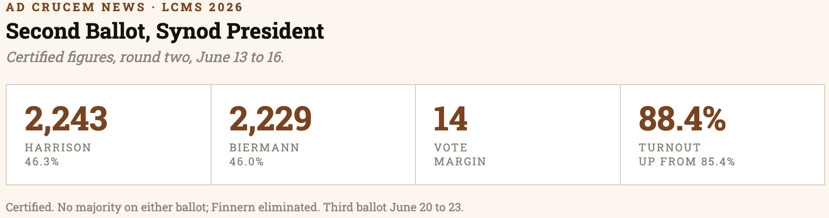
Certified. The Office of the Secretary has certified the second-ballot count reported below. The third ballot runs from June 20 to 23.
For the second time, the Missouri Synod has balloted for its president and produced no majority. The certified second-ballot count gives the incumbent, Rev. Dr. Matthew C. Harrison, 2,243 votes against the 2,229 of Rev. Dr. Joel D. Biermann, a separation of fourteen ballots out of 4,842 cast, which is 46.3 percent against 46.0, with Rev. Benjamin T. Ball at 4.4 percent and Rev. Brady L. Finnern at 3.3. No candidate has reached the majority the bylaws require, and the contest now passes to a third ballot from which Finnern, as the lowest finisher, is removed.
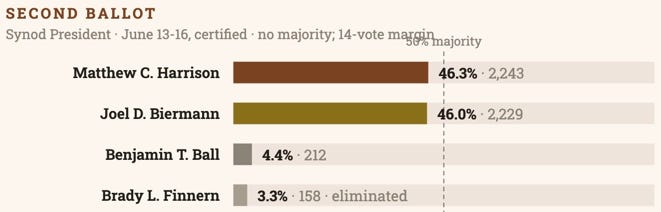
The figure that matters is not either man’s share but the distance between them, and that distance has been closing on a straight line. On the first ballot of June 6 to 9 Harrison led Biermann by 4.8 points, 43.8 to 39.0; on the second he leads by 0.3. Between the two ballots Harrison added 193 votes and Biermann added 407, and the turnout rose rather than fell, from 4,676 ballots to 4,842, so the swing was fed both by the support that came loose, the votes Rev. Peter K. Lange carried out of the race after the first ballot together with the ground Ball and Finnern have since shed, and by new voters drawn to a tightening contest. Of the roughly six hundred votes the two leaders gained between them, Biermann took better than two in three.
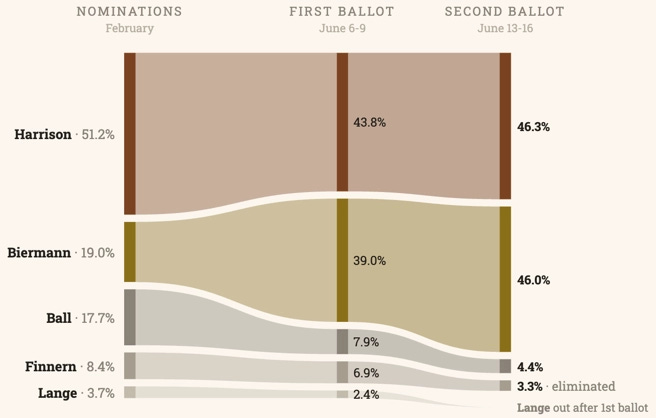
Where It Broke
The chart shows in one view what the toplines conceal, because it begins where the race began. In February, the congregations handed Harrison a nominating share of 51.2 percent against Biermann’s 19.0, a lead of nearly three to one, and his band enters on the left as the heavy column. From there, it only contracts to 43.8 percent on the first ballot and, even with a small recovery, to 46.3 percent on the second, while Biermann’s band swells across the same span from a thin fifth of the room to all but Harrison’s equal. The difficulty for the incumbent is legible in the shape of his own band, since he is not so much losing his voters as failing to draw the votes the trailing candidates keep releasing. Ball and Finnern, who together held better than a quarter of the nominating ballots at 26.1 percent, are down to 7.7 between them on the second, and the ground they have surrendered at every stage is the fuel that has powered the convergence.
The Third Ballot
Under the bylaw procedure, the third ballot, which runs from June 20 to 23, drops only Finnern, the lowest of the four at 3.3 percent, and puts the same question to the floor among Harrison, Biermann, and Ball. The arithmetic that decides it is now small and exposed. Harrison stands 3.7 points short of the majority; Biermann stands 4.0 short; and the redistributable ground, Finnern’s 3.3 percent, together with whatever continues to peel off from Ball’s 4.4, comes to roughly 7.7 points, almost precisely the margin either man needs. The election will turn on which way Ball’s and Finnern’s voters move, and the two ballots already counted have established the direction of that movement rather clearly.
What hangs in the balance is not only a term of office but the tenor of the Synod. Harrison won the presidency on the convention floor in 2010 and took the next four elections on the first ballot, the last of them making him the first president since 1947 to reach a fifth term; he entered this convention with a nominating advantage of nearly three to one, 900 ballots to Biermann’s 334. That advantage is now gone, spent down to three-tenths of a point across two ballots, and the man who has not needed a second ballot in sixteen years is waiting on a third. Whichever way it falls, the result will be the narrowest presidential margin of his tenure, and it may be the end of it.
Sources: certified second-ballot figures from the Office of the Secretary (Harrison 2,243 votes / 46.3 percent, Biermann 2,229 / 46.0, Ball 212 / 4.4, Finnern 158 / 3.3; 4,842 ballots, 88.4 percent turnout); first-ballot figures from the same certified record (4,676 ballots, 85.4 percent). The third ballot runs June 20 to 23. The full slate, the nomination tallies, and each ballot as it is confirmed are tracked at lcms2026.adcrucem.news/2026/elections. Background on the first ballot is in Shock Collapse for Harrison Reelection Campaign.
This article has been updated to reflect the certified vote counts.
A key detail that needs attention is the voter turnout - the first ballot had 4,676 votes (85.4% of electorate), the second 4,842 votes (88.4% of electorate). As a result, the raw vote totals prove more helpful than the percentages, as it wasn't simply a matter of shifting votes from the first ballot, but also of votes from those who didn't participate in the first ballot.
Vote totals from first to second round:
Total: 4,676 -> 4,842 (+166)
Harrison: 2,050 ->2,243 (+193)
Biermann: 1,822 -> 2,229 (+407)
Ball: 371 ->212 (-159)
Finnern: 321 -> 158 (-163)
Lange: 112
If you add together the Lange total and Ball defections between rounds, 271 votes result, which probably accounts for most of the 193 new Harrison votes. Assuming that some unknown number of voters voted for Harrison in the first but not at all in the second ballot, it seems likely that most of Biermann's increase in support came from Finnern defections and the 166 new ballots cast.
My suspicion is that the remainder of Ball's vote is a Harrison protest vote and will (eventually) move to Harrison, which is more than enough to reach 50%, but there may also be a number of people who consider forgo voting in the final round if it comes down to a choice between Harrison and Biermann. The biggest question is not so much where votes move, but if turnout holds up in the next round, and, if it does, who turns out. Either way, we're in for another week of uncertainty over razor thin margins. It's like the NBA Finals all over again.
Happy season of happenings.