
Commanded or Permitted? Sorting Fact from Fracas in the Cooper–Bugenhagen Dispute
Fact-checking and ethically rating the slavery controversy on Lutheran X: misrepresentation or theological nuance?

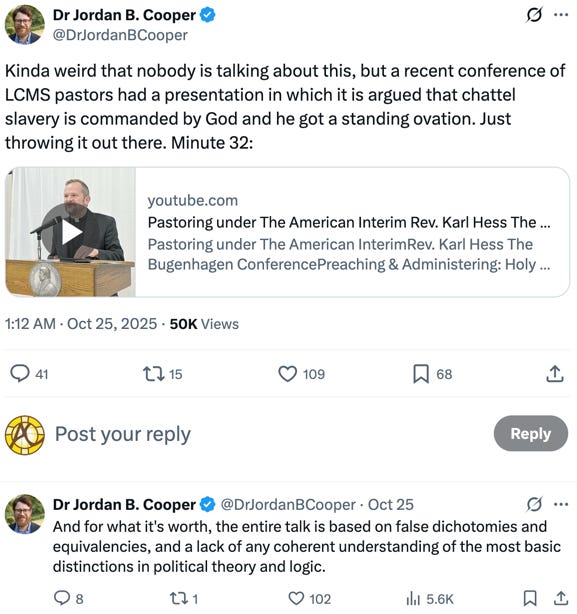
Rev. Dr. Jordan Cooper, Professor of Lutheran Dogmatics at the American Lutheran Theological Seminary (AALTS), recently accused Rev. Karl Hess, Pastor of Emmaus Lutheran Church in Redmond, OR, of claiming that God commanded chattel slavery.
The accusation, posted October 24, 2025, quickly triggered outrage and vituperation across Lutheran circles online.
1. The accusation
Cooper’s post links to a lecture at the 2025 Bugenhagen Conference, recorded and hosted by Gene Wilken (@FlaneurRecord). Cooper said that Hess “argued that chattel slavery is commanded by God” and “got a standing ovation.”
The tweet—and surrounding replies—carry several layers of explicit and implied accusation:
Moral/Theological: That the talk promotes or defends slavery in a way sympathetic to or promoting racial superiority.
Intellectual: That the lecture “lacks any coherent understanding of the most basic distinctions in political theory and logic.”
Institutional: The applause indicates unacceptable attitudes among LCMS pastors.
2. What the lecture argued
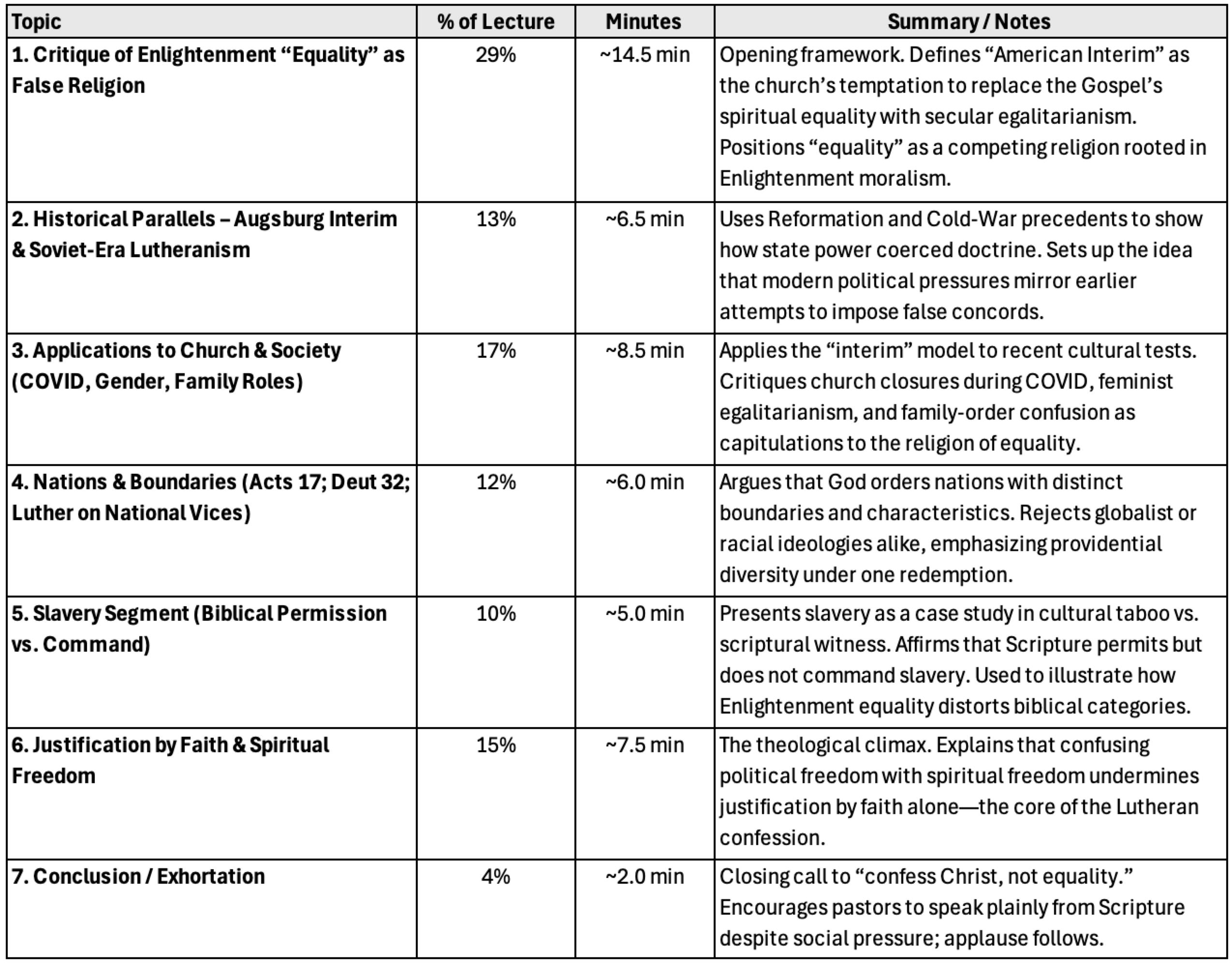
Hess’s lecture critiques modern Enlightenment liberalism, especially its idolization of equality, as a “false religion” that tempts Christians to conform Scripture to culture. He compares this to past church “interims,” such as the Augsburg Interim or the compromises of Soviet-era Lutheranism.
His thesis: yielding to cultural norms on gender, nationhood, sin, or slavery undermines the gospel’s central article—justification by faith alone.
“God never forbids slavery as such… God permitted what is now called chattel slavery1 in his law.”
“The Bible does not forbid slavery. That doesn’t mean that everything a slave owner does is permitted.”
Hess cites Genesis, Paul’s instructions in 1 Timothy 6:1, and Luther’s Admonition to Peace to argue that condemning slavery per se confuses spiritual freedom in Christ with political equality.
“I’m not arguing for a reinstitution of slavery… but if slavery is a sin per se, this undoes the whole gospel.”
He acknowledges the “evils that happened in American slavery,” while insisting Scripture’s teaching cannot be rewritten to satisfy modern moral sentiment.

3. Commanded vs. Permitted
Hess argues Scripture permits slavery; he never says God commands it.
In Lutheran theology, that distinction matters profoundly: permission is not mandate. His argument is exegetical, not prescriptive. It is a defense of biblical integrity, not a political proposal.
Cooper’s tweet erases that critical distinction and nuance. Charitably speaking, it could be rhetorical shorthand warped by X’s algorithm-fueled discourse, but the result badly distorts the lecture’s intent and substance.
VERDICT: Cooper’s “commanded by God” claim is false.
4. The “Standing Ovation” Claim
Yes, most of the audience rose to applaud at the end of the lecture. But the applause came at the conclusion of a 50-minute address, not in response to any single statement about slavery, and slavery was a minority topic overall.
Cooper’s wording implies that pastors were cheering a pro-slavery declaration. The video shows standard end-of-session appreciation for a forceful confessional talk at a Bugenhagen Conference.
VERDICT: The “standing ovation for slavery” claim is misleading at best.
5. The “White Nationalism” Subtext
Replies under Cooper’s tweet quickly linked Hess’s comments to “white nationalism.” The lecture itself contains no racial hierarchy, slurs, or ethnic supremacist rhetoric.
Hess discusses “equality of the nations,” quoting Luther on “national vices”
(Germans “eager for novelty”, Italians “arrogant”, Galatians “foolish”)
to illustrate providential diversity among peoples, not superiority.
“If you even start to broach [differences between nations]… you’re maligned.”
He critiques modern “racial justice” ideology as a form of Enlightenment moralism that seeks equality of outcomes rather than justification by faith.
Still, Hess’s tone and phrasing, particularly on sex and slavery, risk misinterpretation when stripped of theological framing. Critics will read it as an endorsement of racial and social hierarchy; Hess presents it as biblical fidelity and realism.
VERDICT: The charge of promoting racial supremacy finds no support in the lecture’s content, though its rhetoric on slavery will alienate audiences shaped by contemporary views of America’s historical injustices as irredeemable original sins (e.g. 1619 Project).
6. Evaluating Cooper’s critique of “false dichotomies”
Cooper’s second tweet in the thread accused Hess of “false dichotomies and equivalencies.” There’s some merit: Hess paints with broad strokes by comparing COVID church closures to historical “interims,” or equating Enlightenment egalitarianism with a “false gospel.”
However, those analogies are theologically polemical, not politically precise. Context matters: this was a pastoral conference talk, not a graduate seminar in political theory. Judging it by academic standards risks missing its homiletic and confessional intent.
VERDICT: Cooper sidesteps Hess’s theological specifics by reframing the dispute as a logical shortfall rather than doctrinal debate, resulting in a meta-detour that echoes engagement farming and leaves core misrepresentations, like the slavery claim, unresolved.
7. Slavery in the context of the whole lecture and Q&A
Total time spent directly on slavery: ~10%
Time on broader equality/culture/interim themes: ~90%
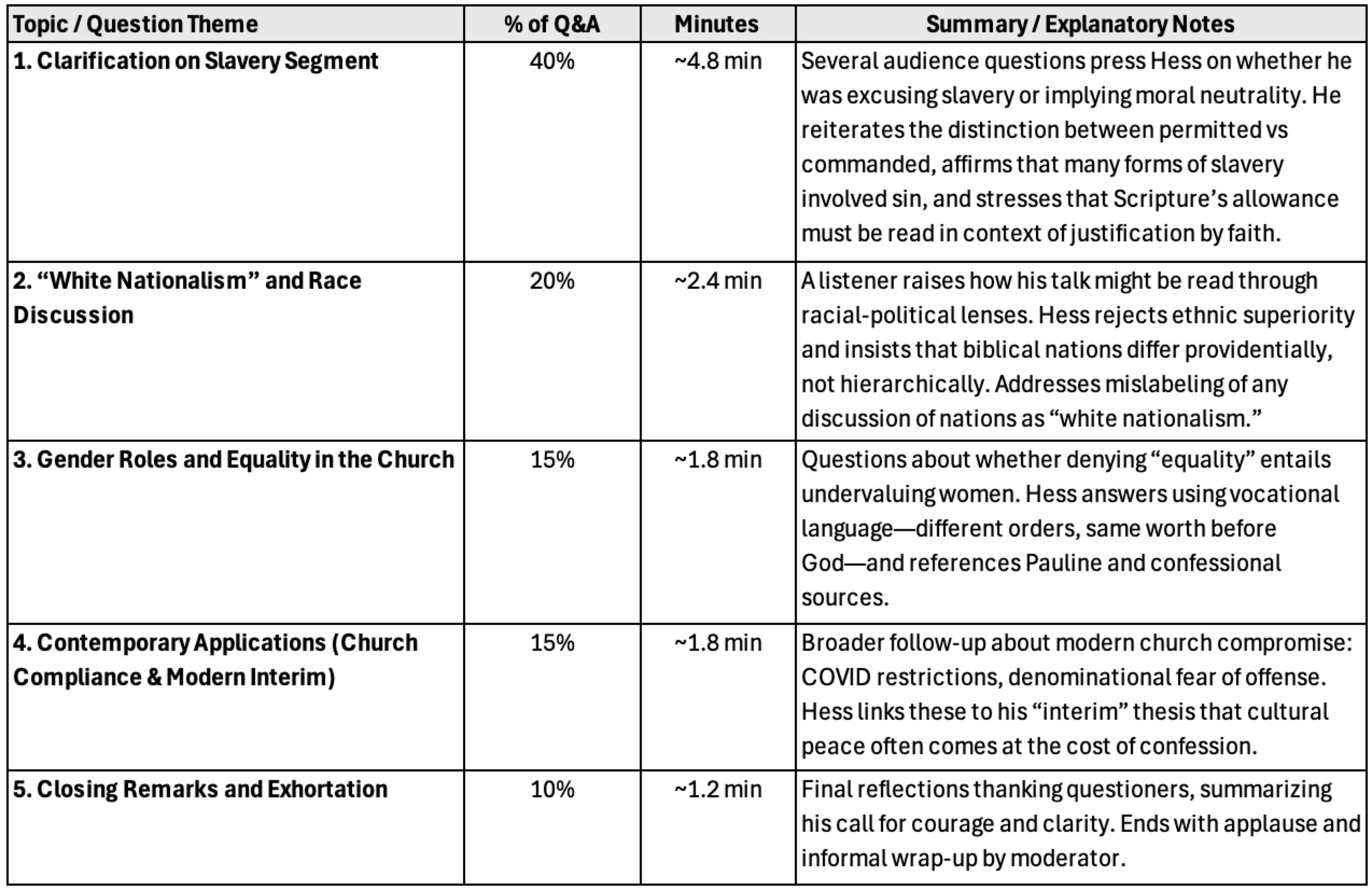
Slavery-related Q&A: ~4–5 minutes out of 12 minutes (~40%)
Non-slavery (race, gender, interim, closing): ~60 percent
The “slavery” discussion functioned as one illustrative case study, not the thematic core of the talk. In total, it occupied perhaps ~5 minutes out of 50, framed as an example of how cultural taboos silence biblical speech.
8. Final ethical verdict based on the Eighth Commandment
Hess’s lecture may be theologically provocative but it is not an endorsement of slavery as a moral good. He employs traditional Lutheran exegesis to critique modern egalitarianism as a cultural “interim” that pressures the church to compromise on biblical teachings once taken for granted. Cooper’s tweet amplified its most inflammatory phrasing while sidelining key clarifications, historical context, and nuanced distinctions, resulting in a distorted portrayal.
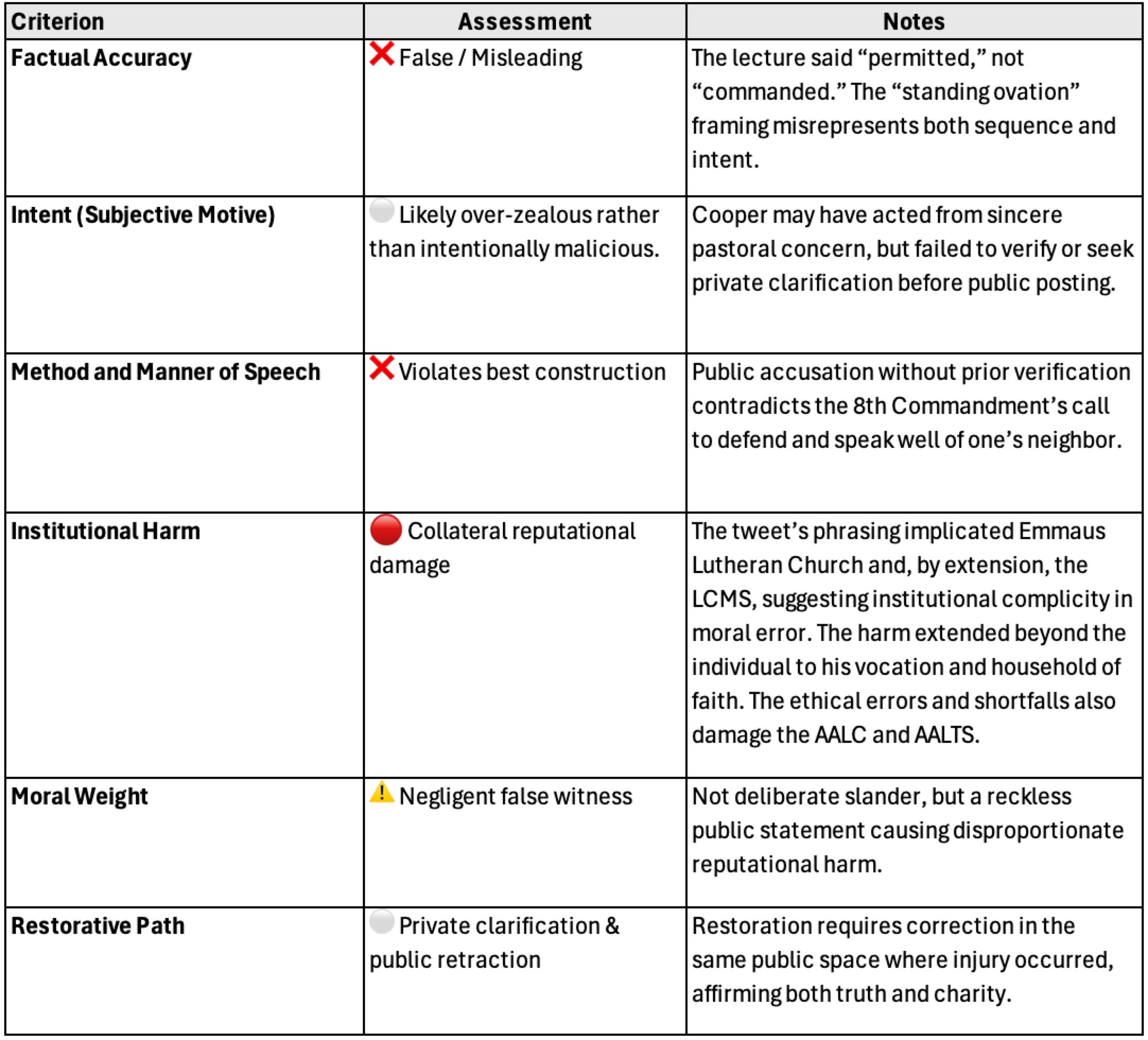
The Cooper post cannot be considered “good-faith” speech under the Eighth Commandment. It reflects pastoral zeal ungoverned by the discipline of charity. It sums to an act of careless witness that injured both a brother’s name as well as the church and institution he serves. The remedy is not outrage, but repentance, retraction, and restoration.
Watch the full lecture here:
In chattel systems, there is no path to freedom except through manumission (owner’s voluntary release), and enslaved people lack any autonomy or protections beyond the owner’s conscience.
Excellent analysis, well-presented. Based on your observations and analysis (I have not watched the lecture), I would surmise that the theological position mirrors that of CFW Walther during the Civil War in which Walther would not join with the abolitionists on theological grounds, drawing considerable moral outrage from those who viewed the abolition of slavery as “gospel.” Unfortunately, social media is not conducive to theological nuance, nor are those who have made a career out of being social media influencers in the Luthersphere.
I watched and found it edifying