
An Easy Fix for Missouri’s Ballot Screens
It's critical to reduce delegate dependence on the session chair.

With two decades of experience organizing mass-attendance events in the United States and around the world, we can offer suggestions for the most visible technical shortcomings observed at the 69th Regular Convention of the LCMS, now underway in Phoenix. The balloting mechanism is the place to start, because it is an easy fix that would pay for itself immediately: faster proceedings, critical information made independent of any speaker’s memory or performance, and a working history of results that survives in multiple forms. What the hall sees today is a letterboxed slide floating inside a decorative border, with the camera feed parked over one corner, a red “Please vote now!” in place of a clock, and a plain table where the arithmetic of elimination happens off-screen, in the chair’s head, one microphone announcement at a time.
Screen composition
Screen composition is attention allocation, and the current screens are dispersing it. Right now, every element carries equal visual weight, so nothing tells the eye what matters now, what is about to matter, and what is merely context or background noise. Consider a delegate who walks in mid-session, after taking a coffee break. Can he tell, within five seconds and without a word from the podium, what business is before the house, whether a vote is open, and how long he has to act? On the current screens, the answer is emphatically no, because the slide was designed to be read aloud rather than read from the floor. A ballot screen should not be a PowerPoint slide but an instrument panel, and it should be composed the way instrument panels are composed, with a fixed layout and any motion graphics reserved for what’s important or urgent.
Information access
After the first few warm-up sessions, delegates become familiar and comfortable with any layout, provided it stays consistent, with the same information in the same place every time. The screen should answer six questions at a glance, continuously, without anyone at a microphone:
Who is chairing the session, and on whose authority is the item on the floor?
Is the agenda tracking to the orders of the day, and how much of the scheduled block remains?
What business is being conducted, stated plainly, with its Today’s Business reference?
Which floor committee is responsible for it?
What is the ballot state: open or closed, which round, how long remains to vote?
Where does the supporting material live: the biographical synopses page for each candidate, the bylaw governing the count?
You’ll see this as the standard “furniture” of any broadcast scoreboard, flight-information board, and trading screen in the world.
Automation
The deeper win is that balloting is a solved data problem pretending to be a live-performance problem.
Wire the ballots to the record. The slates, the revised resolutions, and each day’s Today’s Business already exist as structured documents. A balloting screen fed from a central database cannot misspell a candidate, skip a floor nomination, or display a stale revision. Every tally it shows is captured for the minutes at the moment it is shown, rather than reconstructed afterward. The results can also be wired up to an API to rapidly distribute results from a central source of truth.
Automate the arithmetic. Eligibility and run-off rules are written bylaws, and their logic can be coded into slates. For example, Handbook Bylaw 3.12.4.2 (e) drops the lowest candidate and everyone under 15 percent of votes cast, and it carries its own edge case: for when fewer than two candidates clear the 15 percent line, the three highest candidates constitute the next ballot instead. A system that ‘knows’ the rule, edge cases included, can strike the eliminated candidates, restate the ballot, and open the next round on a single push of the chair’s button, with the bylaw quoted on screen so nine hundred delegates see why a name has grayed out rather than trusting that they heard it correctly or the parliamentarian was on his toes.
A working demonstration
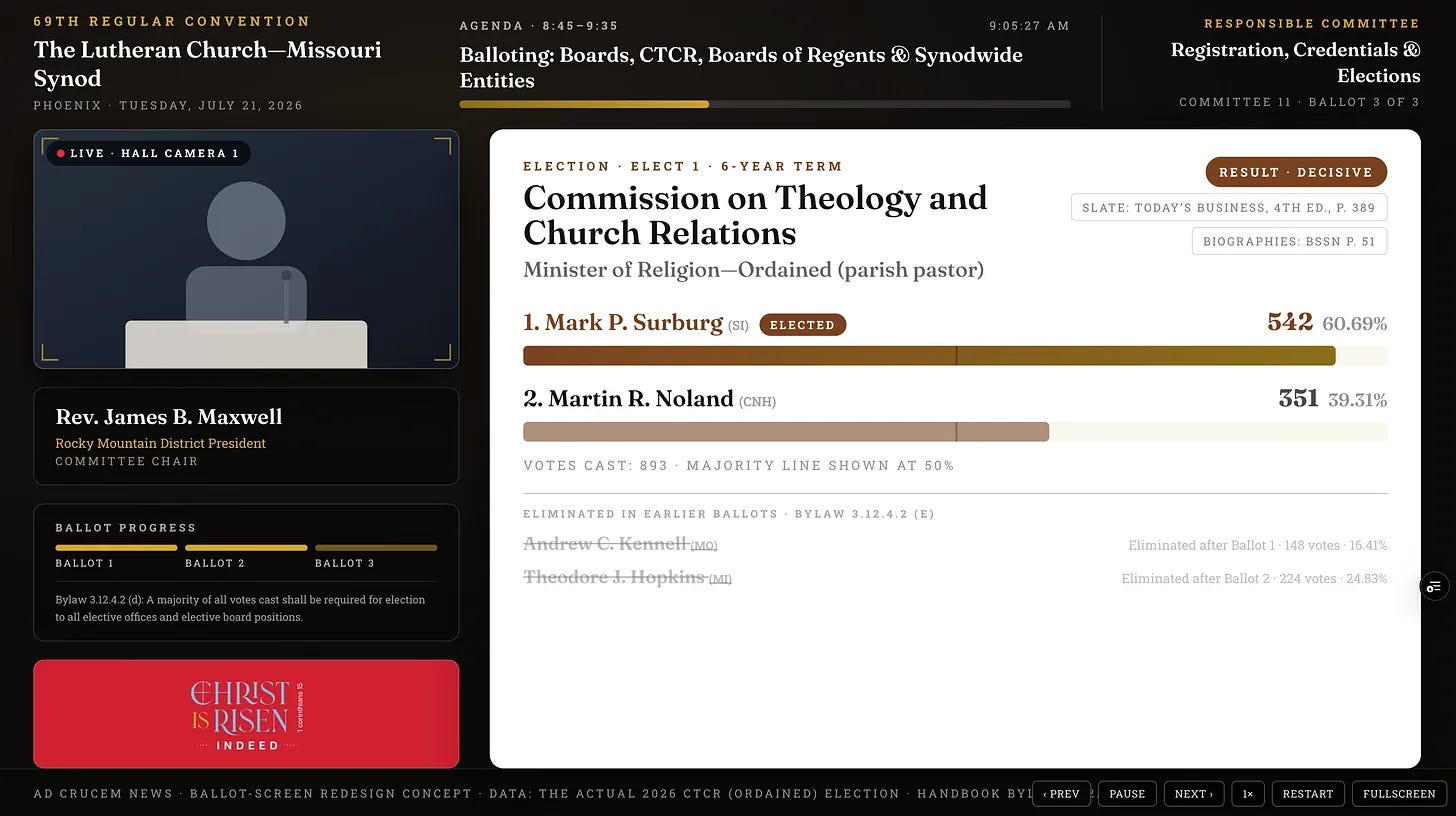
Rather than argue the point in the abstract, we built it. Our ballot-screen demonstration runs the actual election of Tuesday morning for the Commission on Theology and Church Relations parish-pastor seat, through its three real ballots: Mark Surburg opening at 39.80 percent against a field of four, climbing to 49.67 as Andrew Kennell is struck under the bylaw, and closing at 60.69 over Martin Noland after Theodore Hopkins falls away.
The demonstration composes a full 1920×1080 frame (it could be reworked to any ratio) with the speaker feed fixed at left and never overlapped, the presiding officer named beneath it, the agenda block and its elapsed-time bar across the top, the responsible committee in the header, candidate pills carrying their biographical-synopsis page numbers, a flashing vote prompt with a twenty-five-second rundown that turns amber at six seconds and red at three, tabulated results as counts against a marked majority line, the governing bylaw quoted at each run-off, and a final screen that resolves to the winner’s photograph, vocation, and record of service. Every figure on it comes from the official record
What it would take
The Synod already owns everything the fix requires: the structured documents, the voting keypads, the projection hardware, and a secretariat that publishes each day’s business with genuine discipline. What is missing is the layer between them, and that layer is a decision, a small budget, and a few days of competent work. Since the convention spends a measurable fraction of its floor time reading ballot mechanics aloud, waiting on manual arithmetic and slide replacement, and re-announcing what the screen failed to say, the project would be paid for several times over, and the delegates would appreciate it.
Method and source. Observations from the convention livestream and hall screens of the July 19-21 sessions. The demonstration at lcms2026.adcrucem.news/2026/elections/ballot-demo uses the official tallies of the CTCR (Ordained) election as recorded in the Tuesday morning session, the slate and biography references of Today’s Business, 4th Edition, and the balloting rule of Handbook Bylaw 3.12.4.2; results match this publication’s floor election results.
Ad Crucem News is an independent publication. This analysis is editorial and carries no imprimatur of The Lutheran Church—Missouri Synod or its officers.
100% agree. I have experience in software development so if something like this ever get’s off the ground I might be able to help.
That would help immensely. I'm in the front row and paying attention, but sometimes I'm struggling to stay on top of things.