
Ad Crucem News Stakeholder Survey Results
What readers think of Ad Crucem News - the unvarnished truth.

This week, Ad Crucem News invited subscribers to participate in a voluntary reader survey about the role of church journalism in reporting and commenting on news affecting the church in the wake of the arrest of Rev. Michael Mohr. We also asked for feedback about the publication’s own editorial work.
Methodology
As of the close of data collection:
Total subscribers: 2,570
Total responses: 463
Response rate: 18%1
Margin of error: ±4
Subscription tier: 100% free
Weighting: none applied.2
Metadata weighting for all Ad Crucem News subscribers:
Clergy: ~56%
Laity: ~44%
Male ~67%
Female ~33%
Average age: ~42 (a full generation younger than the average age of LCMS members)
WELS, ELS, Brethren, Other: ~3%
The sample size provides an estimated margin of sampling error of approximately ±4 percentage points at the 95% confidence level, using conservative assumptions.3 Where confidence intervals are shown in accompanying charts, they reflect this uncertainty.
Responses mirror the opinions of engaged readers. As with all voluntary surveys, results should be interpreted accordingly. Platform metadata indicates that approximately 90% of subscribers are in the United States. Roughly 97% of survey respondents are based in the U.S., reflecting the LCMS-specific issues at the time.
Although we did not explicitly weight clergy versus laity in the survey, the majority of all subscribers are clergy. The survey results reveal that the clergy is not an institutional monolith ring-fencing LCMS Inc.
Aggregate Findings
Readers support journalism that combines factual reporting with accountability probes.
They prioritize truth and victim protection over institutional reputation and protectionism.
They favor early and transparent governance review.
They interpret transparency as beneficial to the Church’s witness, and secrecy as harmful.
They place doctrinal faithfulness at the center of institutional integrity.
They express high confidence in the reporting and sourcing by Ad Crucem News.
They register some concern about the publication’s tone, though not at dominant levels.
These results reflect a readership that is simultaneously confessional, institutionally serious, and committed to moral clarity. A tiny minority are diehard institutionalists.
1. The Role of Church Journalism
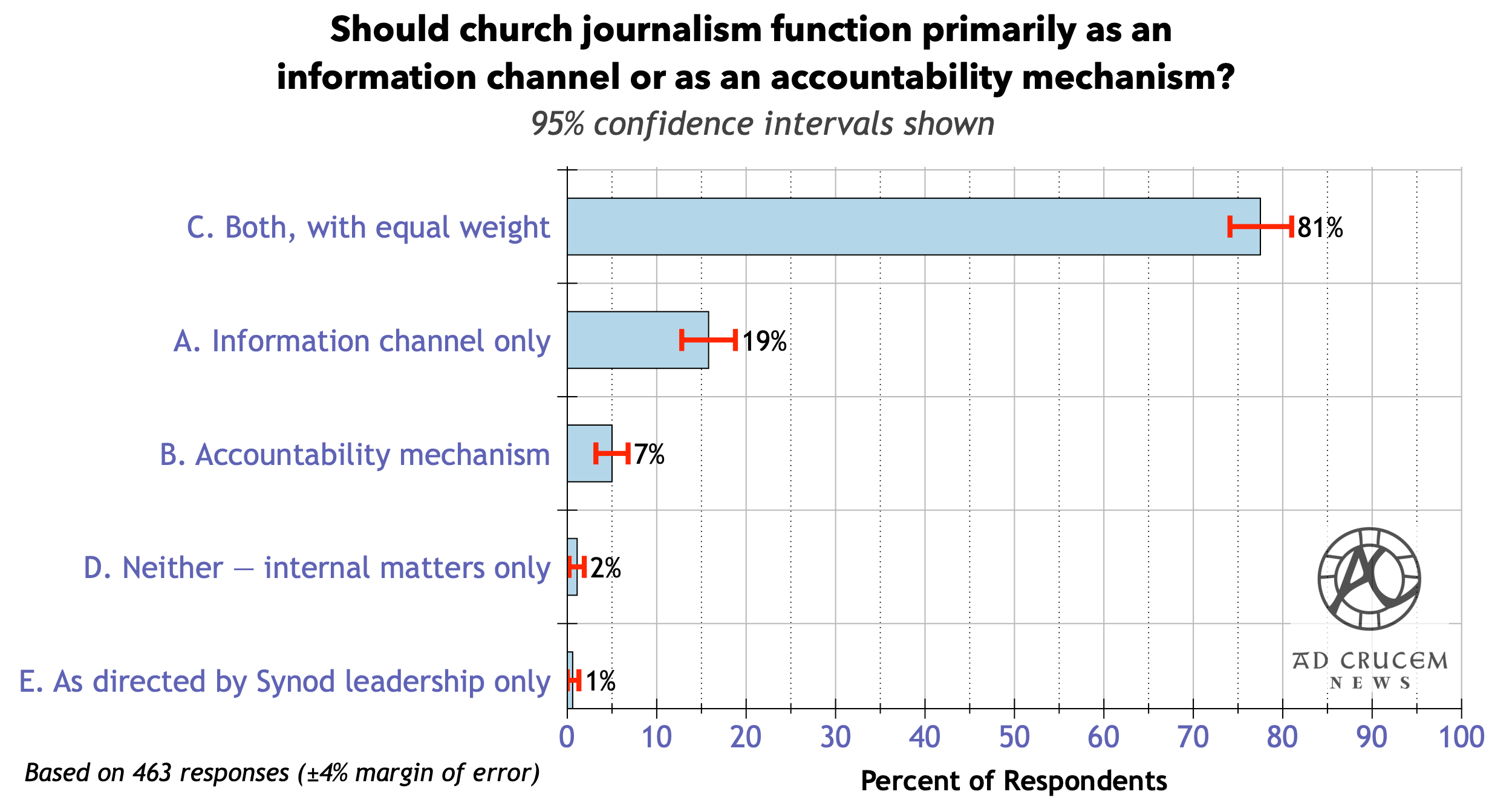
A substantial majority of respondents indicated that church journalism should serve as both an information channel and an accountability mechanism.
This result remains statistically stable even when accounting for sampling uncertainty. Readers are not looking for journalism that simply recycles official statements or primarily serves as institutional opposition. Instead, they prefer reporting that combines thorough factual work with principled oversight.
The data suggest that readers see accountability and information as complementary rather than competing functions.
2. Responding to Pressure to “Lay Off” Coverage
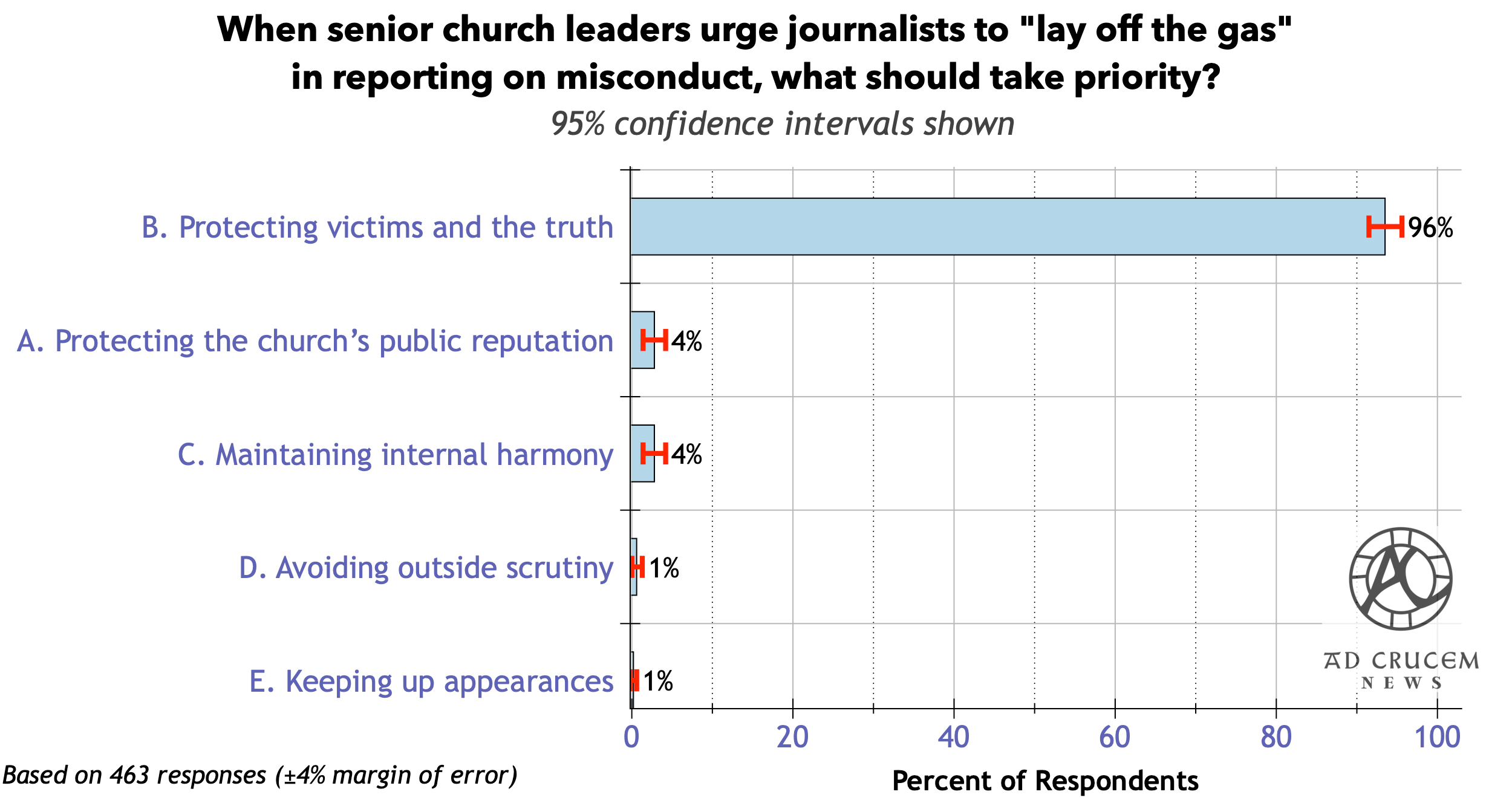
When asked how journalists should respond when leaders call for reducing or halting coverage of misconduct, respondents agreed that the priority should be protecting victims and pursuing the truth.
Even under conservative error assumptions, this position remains very dominant. Institutional reputation, internal harmony, and public relations considerations are infinitesimally small and, therefore, a clear signal to Synod leadership not to be defensive and brittle.
This finding reflects a clear moral orientation among readers: transparency and pastoral responsibility are regarded as primary obligations.
3. Timing of Governance Review
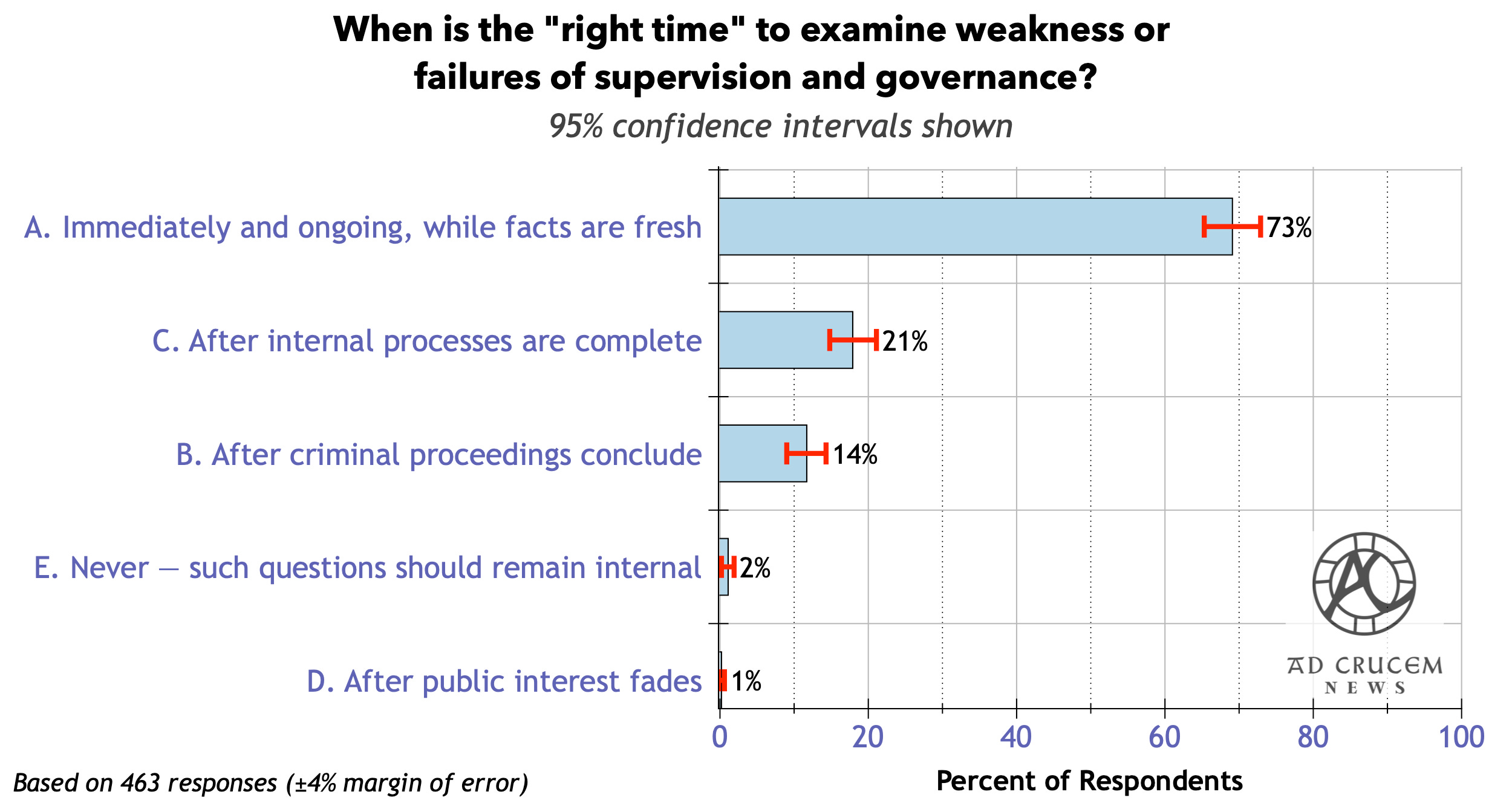
Most respondents want supervision and governance to be examined promptly, rather than deferred until internal or legal procedures are complete. While a not inconsiderable minority favors delayed review, the dominant view supports immediate examination.
It is important to note that external church “discernment” and secular media will report news such as the Mohr arrest without waiting for procedural completion, and will usually provide less context and more errors due to unfamiliarity.
The survey results align with established governance principles in both ecclesiastical and secular contexts.
4. Public Scrutiny and Institutional Harm
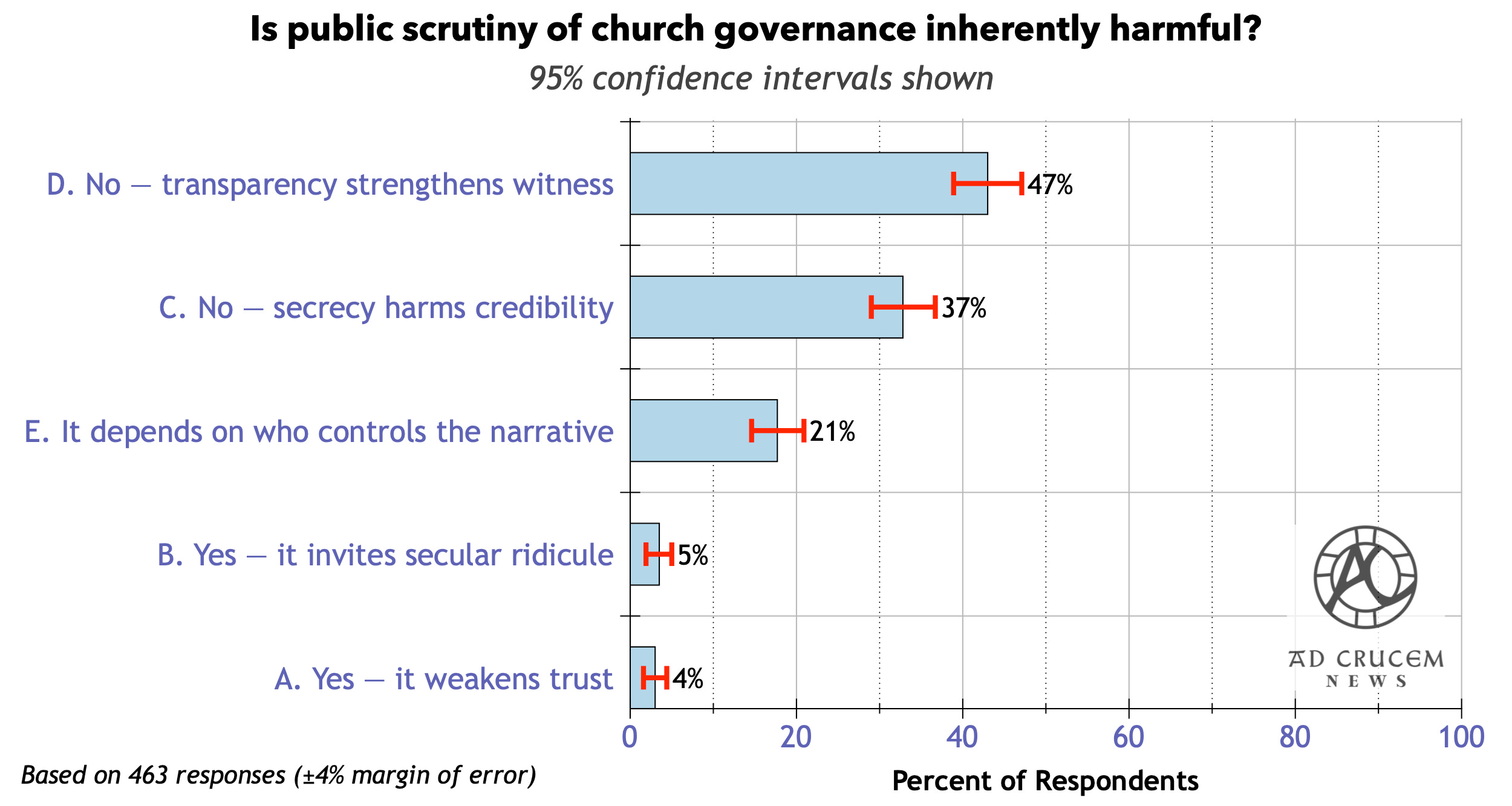
Respondents rejected the claim that public scrutiny of its governance is inherently harmful to a church body.
The two main responses—claiming that transparency increases witness credibility and that secrecy harms it—together account for about three-quarters of participants. Even at the lower ends of confidence intervals, these opinions remain dominant.
Readers interpret transparency as supportive of the Church’s mission rather than corrosive of it.
5. Perceived Long-Term Risks to the LCMS
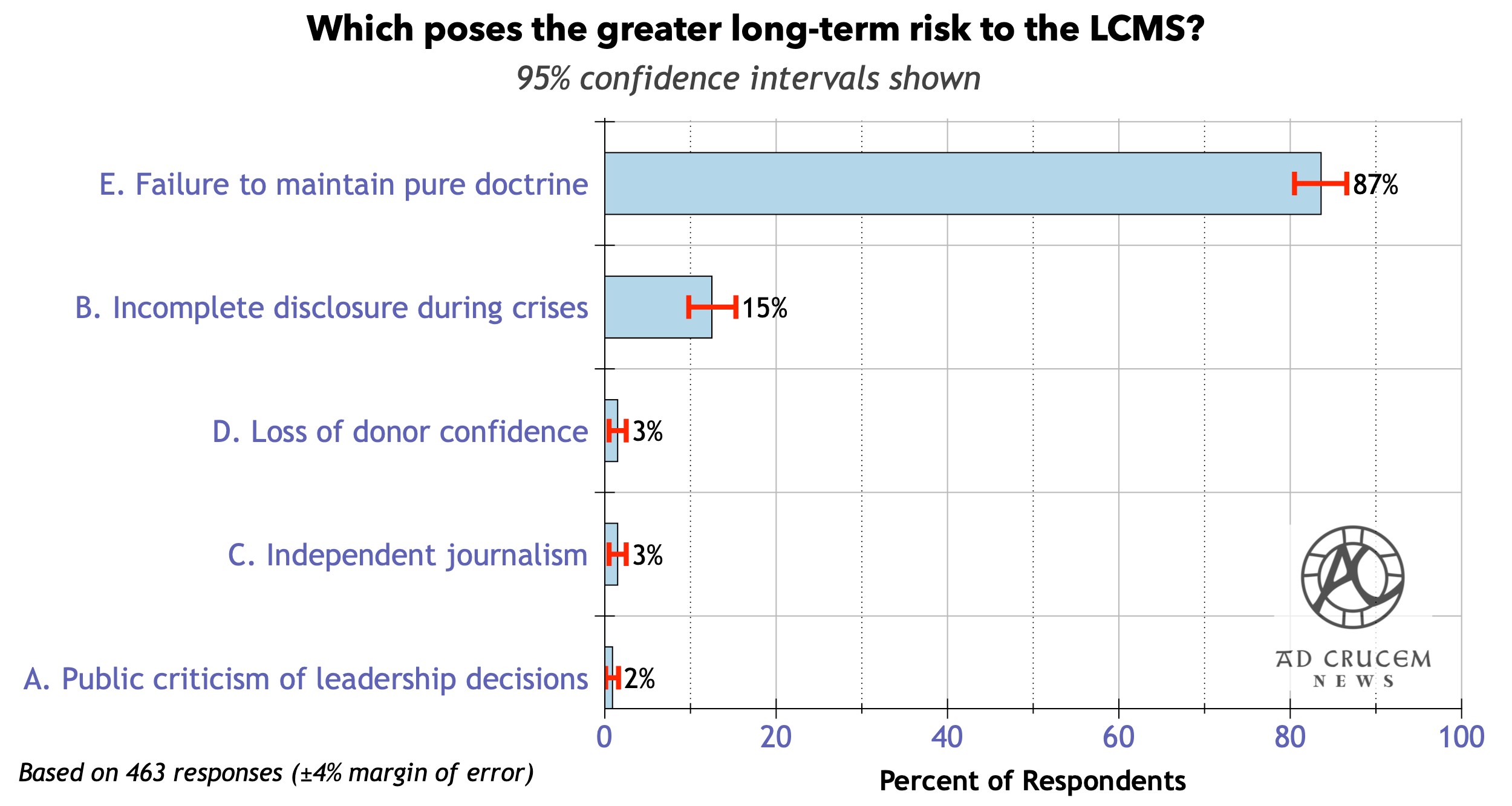
An overwhelming majority of respondents identified failure to maintain pure doctrine as the greatest long-term risk facing the LCMS.
Concerns related to donor confidence, public criticism, or independent journalism ranked so much lower as to be irrelevant.
Respondents evaluate institutional questions primarily through a “believe, teach, and confess” framework rather than a managerial or reputational one.
6. Assessment of Accuracy and Sourcing
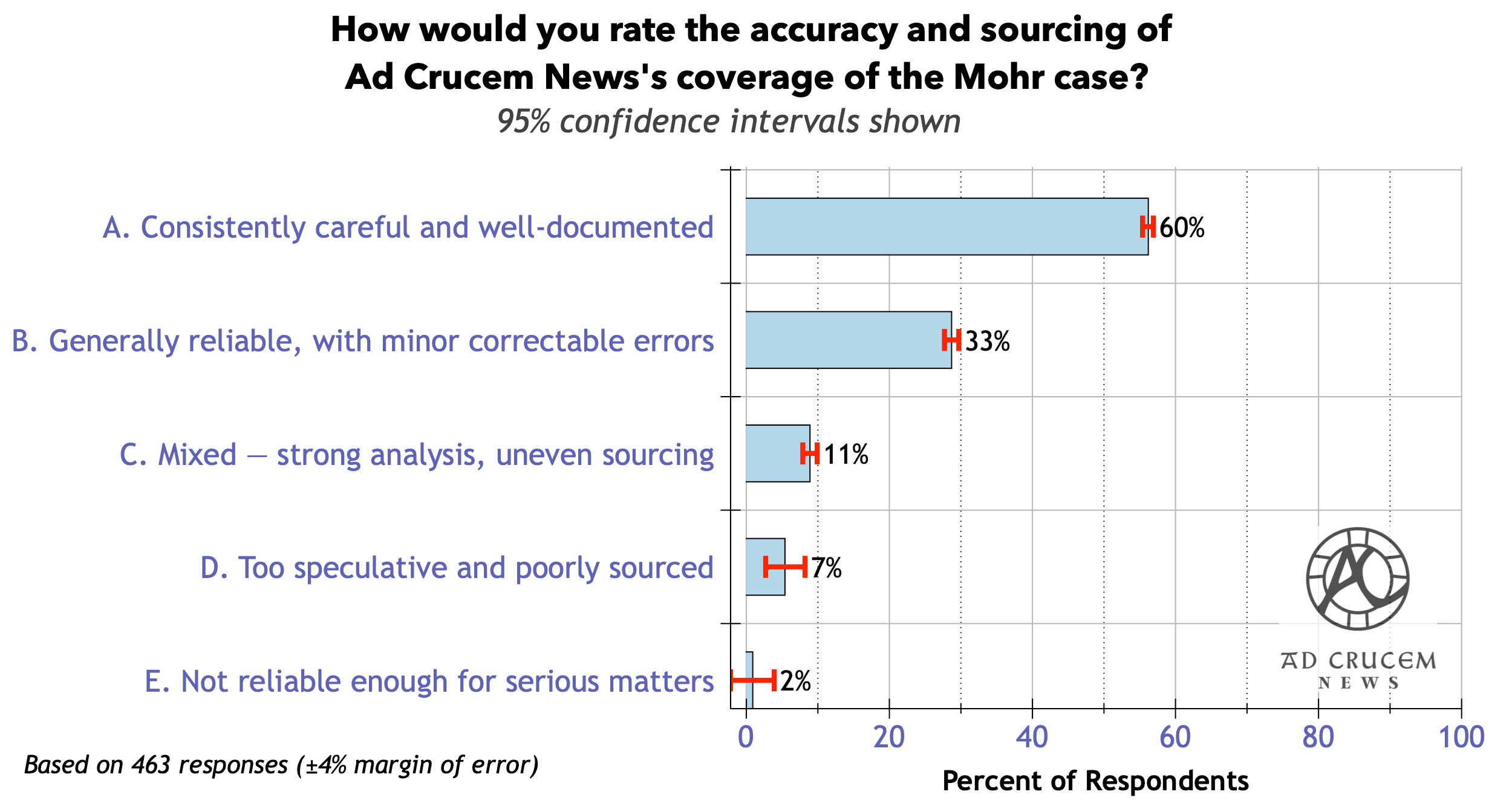
Questions 6 & 7 require interpretation because respondents evidently did not limit their responses to the Mohr case, but rather to Ad Crucem News in its entirety.
All the Mohr reporting was sourced “from the horse's mouth” without any editorial injections. The reporting was followed by a single editorial article that may have dominated short-term memory when completing the survey.
That doesn’t invalidate the results; it just means we should regard the responses as generalizations of Ad Crucem News rather than specific responses to the Mohr case.
Readers rated Ad Crucem News as consistently careful or generally reliable. Combined, these assessments exceed four-fifths of the sample. Critical evaluations remain in the minority across confidence intervals.
Readers have a relatively high level of confidence in the publication’s sourcing and documentation practices.
7. Assessment of Tone and Editorial Judgment
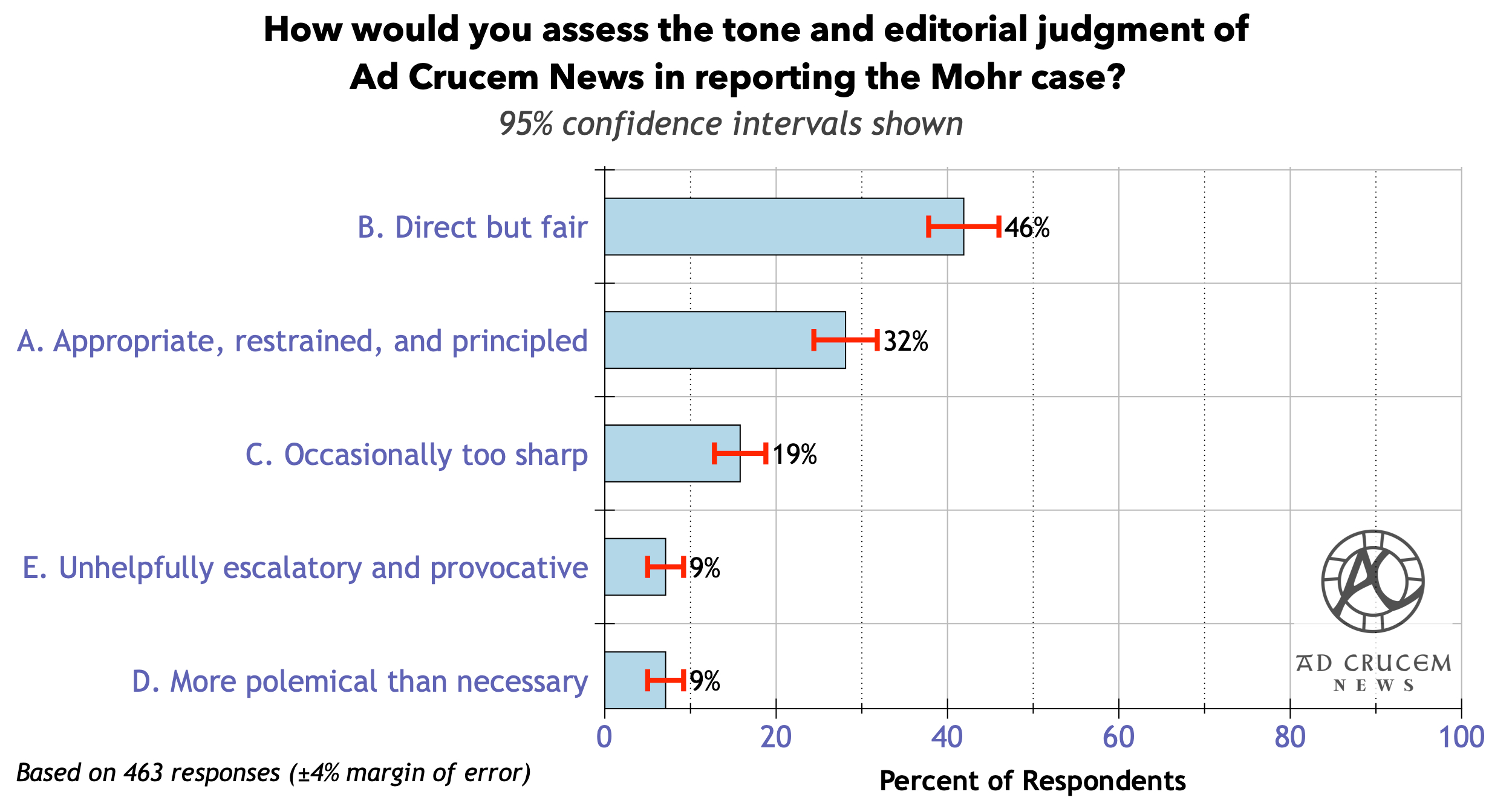
Approximately two-thirds of respondents described the publication’s tone as direct but fair, or appropriate, restrained, and principled. Roughly one-third of respondents characterized coverage as occasionally too sharp or overly polemical.
This pattern is consistent across uncertainty ranges and represents the most significant area of internal tension in the dataset.
Readers broadly support firm and direct reporting. A substantial minority, however, expresses concern about rhetorical intensity. Consequently, Ad Crucem News will take this to heart and be less polemical in general unless absolutely warranted.
Limitations
Several limitations should be noted:
Participation was voluntary, and engaged readers are likely overrepresented.
No demographic weighting was applied.
The survey is a snapshot in time.
The results should therefore be understood as descriptive of the active readership rather than as a definitive and permanent census.
Quo hinc?
This survey provides a statistically meaningful snapshot of how readers understand Ad Crucem News's role and evaluate its work.
The findings outline broad support for accountability journalism grounded in Christian truth and governed by evidentiary discipline. The results also identify areas where more prudence is warranted, particularly regarding tone.
The editorial purpose of this publication has never been to cultivate controversy for its own sake, nor to function as a mouthpiece of institutional public relations, nor to be a political action committee. The purpose is to report on and comment on developments in the LCMS flavor of Lutheranism without fear or favor. The survey confirms that our readers understand and largely affirm that orientation.
Filling a Niche
Synod publications, such as the Reporter and Lutheran Witness, lack the mandate, capacity, or appetite for hard news reporting on issues like the Mohr arrest. Steadfast Lutherans is dormant, and Christian News has a slower news cycle and continues to maintain Herman Otten’s focus on theological “honesty and accountability” for the Synod. It functions as an unofficial watchdog, critiquing those it believes have departed from orthodox teaching and Biblical Inerrancy. Its other central pillar is lambasting Liberalism.
Gottesblog is primarily focused on Confessional brand items, such as the liturgy, and orthodox doctrine & praxis in the Evangelical Church. It is very polemical and often satirical in its defense of High Church traditionalism and resistance to liturgical innovation. Its audience skews older and is heavily weighted to the clergy.
Issues, Etc. is unswervingly loyal to the current Synod administration and generally avoids church body news or politics except to afford special access to President Harrison’s campaign or to critique other denominations. It has a strong catechetical and apologetic component, but also a dominant and highly polemical “cultural exegesis” slant. Like Gottesblog, its audience age profile is estimated to reflect the Synod as a whole, but with a larger lay component.
Truth & Light is a dark money political action committee for LCMS Liberals and is a caricature of Fox News Boomerism. Daystar Journal has faded to obscurity and irrelevance because it was comprehensively thrashed in the political battle over women’s ordination, open communion, historical-critical method absolutism, radical ecumenism, and Evolution. The American Lutheran Publicity Bureau Forum is a Lutheran tableau of a dinosaur graveyard.
Ad Crucem News’s stock-in-trade is institutional transparency and accountability. It has a bias toward data-driven reform advocacy informed by a defense of orthodox Evangelical Lutheranism against both secular culture and the perceived theological drift within the synod. We are analytical and business-minded, which is our strength, even though we might be perceived as too uncompromising and critical. We are also independent of, skeptical of, and cynical about official narratives and centralized power, as Gen X can be.
Consequently, it is unsurprising that Ad Crucem News found and cultivated a niche with a loyal following that places high trust in its news product. In a nutshell, Ad Crucem News is read by the next generation of LCMS Synodical and congregational leadership.
Therefore, it is unsurprising to see the bimodal reaction to so many articles. It’s simply the product of rising generational friction within the Synod and the natural tensions that arise when the leadership mantle is being transferred piecemeal, but the change is underway.
Political, Cultural, and Generational Tensions
We can appreciate that Synod leadership dislikes a publication it cannot control or influence through roster status, funding, favors, or the dynasticism that plagues the LCMS (WELS even more, by all reports). Our stance is not merely opposition or support for its own sake. The current administration benefited handsomely from criticism of the Kieschnick regime when Steadfast and Issues were more active; therefore, it should not become febrile and fragile when the spotlight turns to its shortcomings.
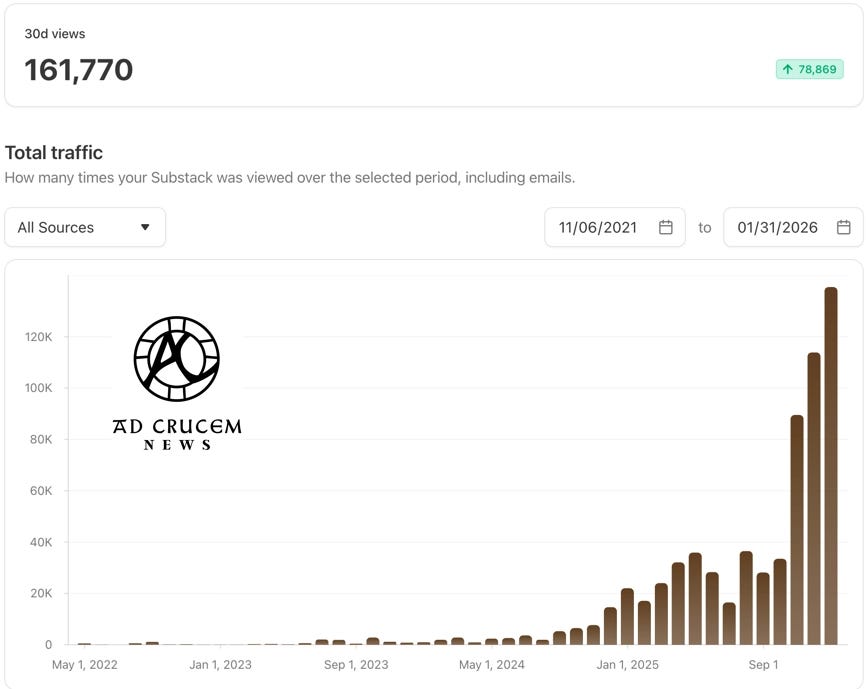
Ad Crucem News was launched to expand the retail shop's customer base, as our other marketing channels were no longer delivering the required return on investment, and the LCMS “market” is essentially walled off by the corporation and its entities. Now, the primary objective of the news and commentary side has shifted to leverage the large audience and significant traffic growth to create a sense of urgency about the accumulating problems that threaten a severe, possibly terminal, crisis for the Synod by 2050.
To that end, Ad Crucem News has proposed several ideas to practically address structural portions of the large set of problems, lest anyone accuse us of merely grumbling to and about Moses. We have also delivered tools such as the Lutheran YouTube Rankings, the Lutheran Missal App, and the RSO Explorer App to complement the shop’s products and publishing arm.
Those solutions and services are, however, useless if we do not address the root cause of the theological problems. We can only point out what we believe are the theological problems; it is up to the pastorate to define and address them. A vast theological rehabilitation and recovery program is urgently needed, starting with picking the most elite cadre of pastors possible.
The Synod has generally lapsed into antinomianism and even universalism, and has been so for some time, as clearly demonstrated by so many loathsome responses to the arrest of Mohr. Unless the church's teachers fix that, nothing else matters (Psalm 127:1).
This excerpt from a recent episode of a Brief History of Power vividly illustrates the problem
For unincentivized online newsletter surveys, typical response rates range from 5 to 15 percent. Rates above this level indicate substantial reader engagement.
Based on subscriber metadata, approximately 56% of subscribers are clergy and 44% are laity. The geographic representation is strongly correlated with LCMS membership in the US. The exception is our home state of Colorado, where Ad Crucem News has roughly double the proportion of readers compared with the LCMS’s proportionate membership.
1. In survey research, a sample refers to the group of individuals who respond to a questionnaire, while the population refers to the full group from which the sample is drawn. In this case, the population comprises all Ad Crucem News subscribers as of the survey's end.
2. Participation in the survey was voluntary. Respondents were not chosen randomly but opted to take part. As a result, readers who are more engaged with the publication are likely overrepresented. This pattern is common in readership and newsletter surveys and should be kept in mind when interpreting the results.
3. The reported results are given with a 95 percent confidence level. This indicates that if the same survey were repeated multiple times under similar conditions, about 95 out of 100 such surveys would likely produce results within the specified margin of error of the true population values.
4. The margin of error estimates how much survey results might differ from the true population values because of random sampling variation. For this survey, the overall margin of error is about ±4 percentage points under cautious assumptions. For instance, a reported value of 75 percent likely falls between 71 percent and 79 percent.
5. Margins of error were calculated using a standard “worst-case” assumption that opinions are evenly divided (50/50). This assumption produces the largest possible error range and prevents understating uncertainty. For results showing strong consensus, the actual margin of error is smaller.
6. Because the survey sampled a significant portion of the subscriber base, a standard finite population correction was applied. This adjustment slightly lowers the estimated margin of error compared with surveys of very large or undefined populations.
7. The ranges or “whiskers” on the charts represent 95 percent confidence intervals. The end of the bar shows the reported percentage, while the red range markers indicate where the true population value is likely to fall, considering sampling uncertainty.
8. No statistical weighting was applied to the results. Weighting is sometimes used to address known imbalances in survey samples, such as overrepresentation of certain demographic groups. In this case, all subscribers are on the free tier, and the survey did not gather demographic information to enable proper weighting.
9. Platform records show that about 56 percent of the subscriber base is clergy, and 44 percent is laity. This distribution was not used for statistical adjustment because respondents were not classified by role in the survey.
10. The margin of error only reflects sampling error, meaning the uncertainty caused by surveying a part of the population. It does not include other sources of uncertainty, such as non-response bias, misinterpretation of questions, or changes in opinion over time.
11. Small differences between response options, especially those of two to three percentage points, may fall within the margin of error and should not be overinterpreted. Larger differences are more likely to indicate meaningful distinctions within the surveyed population.
12. The results should be seen as representing the opinions of engaged readers rather than passive subscribers. Therefore, they are best interpreted as descriptions of the active readership instead of a full census of all subscribers.
13. The survey was processed with OpenAI and tested with Grok.
Steadfast
Steadfast was a good news resource whenever you wanted to see reports of the heavy-handedness of LCMS officials engaging in church growth projects. Steadfast Lutherans had a reputation for identifying problems correctly, but they rarely ever proposed any solutions - especially of the structural kind.
Right after the Harrison administration took over, many long-time Steadfast commentors, including the late Paul McCain, were suddenly banned from commenting without warning. I was one of them! And soon after that, the comments section on the entire website was purged. Articles on that webpage became forgettable, as they began to assume a soft, harmless tone. Coincidence? That website has been irrelevant for the past 15 years.
ALPB
If you enjoy watching retired ELCA pastors and their "woke" laymen allies argue "woke and liberal" theological causes with retired LCMS pastors, have at it! If you want to see a fight, you won't be disappointed. The Seminex battles have been won by the LCMS "confessionals", so ALPB is irrelevant.
Facebook
For fun, feel free to join the CLF group in Facebook and then start critiquing pop-Evangelical theology sometime. I dare you. You won't do that again!
Even if you do happen to get a productive conversation topic going for a week and engage with hundreds of comments, your Facebook post will slowly age and fade away into the archives......never to be seen again.
LCMS ministries
LCMS pastors are asking the laymen: "Pop-Evangelicalism? What pop-Evangelicalism? Hey - Look! Squirrel - I mean: Look at those five or six noisy Christian nationalist guys playing brave keyboard warrior in mom's basement! That's the threat to Lutheran churches. Let's get 'em!"
I just found the Wartburg Watch, which used some of your reporting in their own piece. Not strictly LCMS though, I suppose. I thought their coverage was solid:
https://thewartburgwatch.com/tww2/2026/02/02/lcms-district-president-and-pastor-michael-mohr-arrested-and-detained-on-federal-child-pornography-charges-did-anyone-question-the-backpack-bear/
Also, could you give the BHoP episode number and timestamp of the excerpt you reference in the article? The provided link just sends me to iTunes to the current episode of BHoP I'm listening to. Kindest regards.