
Accreditation Authorities Put the Squeeze on Lutheran Teacher Formation
Minnesota’s licensing board has discontinued Martin Luther College’s teacher programs, and a federal appeals court ruling for Maine’s religious schools signals more pressure to come.

Late last month, the Minnesota Professional Educator Licensing and Standards Board (PELSB) voted to discontinue Minnesota licensure eligibility for the teacher education programs at Martin Luther College (MLC). The New Ulm college forms the teachers of the Wisconsin Evangelical Lutheran Synod (WELS). Not long afterward, the United States Court of Appeals for the First Circuit informed two religious schools in Maine that teaching in accordance with their convictions could not be paired with asking for public education dollars. The two events belong to different states, different legal/regulatory regimes, and to church bodies not in fellowship with each other, but there are critical implications for all religious teacher formation programs that use accreditation as one pillar to market career mobility.
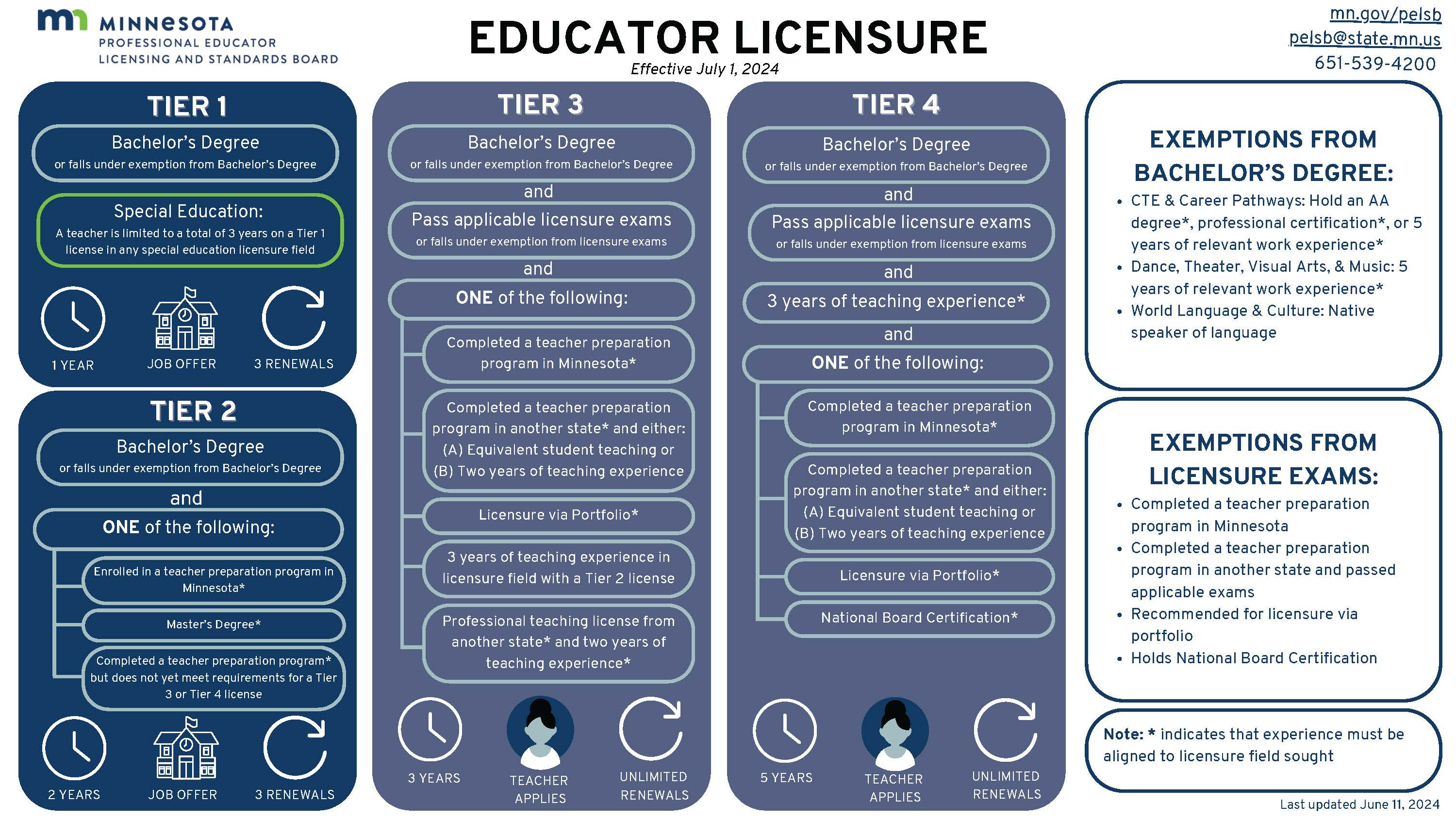
MN Educator Licensure: A Continuous Obligation. Under the tiered system administered by PELSB, "cultural competency" training is a mandatory component of the professional development that every Tier 3 and Tier 4 teacher must complete to renew, recurring every three years for Tier 3 and every five years for Tier 4. The state's formation is therefore owed for the length of a career and is not a one-and-done arrangement at graduation.
The MLC record
MLC’s president, Dr. Rich Gurgel, has characterized the discontinuation as a problem of documentation rather than of confession. The board’s action, in his account, concerns how MLC demonstrates through documented assessment that discipline-specific content standards are consistently met and its programs continuously improved, and he has told his constituency that there is no evidence the recommendation has anything to do with the college’s mission or its confession of faith, and that PELSB has continued to give MLC “room to be who we are as Confessional Lutherans” without compromising its convictions. He has been careful to present the college’s strongest case, noting that PELSB itself affirmed many strengths through MLC’s successful Unit Visit, a passed reading audit, and a passed review of the Standards of Effective Practice. He notes that the college had already begun tightening its assessment and documentation practices in 2024 through a campus-wide initiative called Project Sunrise, undertaken with consultants from the Association of Governing Boards of Universities and Colleges, well before PELSB’s decision. He was candid that a smaller school has struggled to meet the evidentiary reporting burden, that the board itself has acknowledged how difficult that burden has become for schools of MLC’s size, and that the action is a temporary one, falling chiefly on newly enrolling students, while those already in the program will graduate license-eligible. Although PELSB rules contemplate a three-year exclusion before reapplication, a variance may shorten it. MLC remains a fully accredited institution aside from the PELSB gap.
WELS congregant Philip Hahn has criticized MLC for capitulating to PELSB and warns that it may go even further to regain accreditation. Hahn reports that MLC’s Student Teaching I Summative Assessment, the form the college sends to WELS teachers so that they can evaluate MLC student teachers placed in WELS schools, scores candidates on three requirements that no confessional Lutheran institution should submit to:
8710.2000.2D rates the candidate on fostering an environment where identities including “sex and gender, gender identity, sexual orientation” are “affirmed” and students “empowered to learn and contribute as their whole selves.”
2E rates whether the candidate helps students process “dehumanizing biases” and “structural inequities”.
4E rates “anti-racist, culturally relevant” instructional strategies.
3G rates use of “data disaggregated by student race, ethnicity, and home language.”
6C rates grasp of historical foundations that “continue to create inequitable opportunities.”

These items operationalize Minnesota’s revised Standards of Effective Practice1. MLC has effectively adopted the new standards despite their opposition to Scripture and the Confessions. MLC adopted the state’s anthropology of sex, race, and structural grievance, wrote it into its own certifying instrument, and gave it to WELS supervising teachers so that WELS candidates would be scored, in WELS schools, on their competence to affirm what the Synod’s confession denies.
Hahn’s characterization cannot be faulted: the college did not resist capture so much as domesticate itself to remain within the state licensing system. MLC has ultimately internalized the state’s demands into the very assessment form by which it certifies its own graduates
The Maine decision
The First Circuit’s decision was issued in response to appeals filed by Crosspoint Church, which operates Bangor Christian Schools, and St. Dominic Academy, the Catholic school in Auburn. The case has roots in Carson v. Makin, the 2022 Supreme Court decision that compelled Maine to stop excluding religious schools from the program through which towns without their own secondary schools pay tuition for students to attend private schools. Having been compelled to fund religious schools, Maine’s legislature then amended the Maine Human Rights Act to condition participation on compliance with nondiscrimination rules covering religion, sexual orientation, and gender identity, an amendment the schools’ counsel has called a “poison pill designed to deter religious participation by other means”.
In an opinion by Judge William Kayatta Jr., the court largely upheld the district court’s refusal to exempt the schools, holding that combatting sexual-orientation and gender-identity discrimination rises to the same order of legitimate governmental interest as combatting religious discrimination, while remanding a single provision, the Religious Expression Rule, for the lower court to reconsider. The statute the schools now face carries escalating civil penalties, reported at twenty thousand dollars for a first violation, fifty thousand for a second, and one hundred thousand thereafter. Enforcement is in the hands of both the Maine Human Rights Commission and private plaintiffs.
The court expressly rejected the claim that the nondiscrimination rule requires a school to affirm a student’s gender identity or sexual orientation. However, a school may believe what it believes and may teach what it believes, yet once it acts on that belief, the conduct becomes something the state may regulate.
Storm clouds gathering
Hahn makes the point that licensure has a totalizing logic once its legitimacy is conceded in principle. Once you concede one point to retain accreditation, you will eventually concede all your principles. If you have a confession that may be recited in a classroom, but it is banned from governing who is admitted to that classroom, you have undergone nationalization.
The Wisconsin Synod’s exposure is not a curiosity for the LCMS to observe from a safe distance. LCMS entities operate roughly 1,900 schools and early learning centers, making it one of the largest Protestant school systems in the country, and it trains its commissioned teachers through the Concordia University System. The state license is not, strictly, the thing that makes a man a called teacher, since a church body commissions and calls its own on its own terms. However, it means that any prospective student contemplating a teaching career through training at a Christian institution has potentially tethered himself to his church body’s future, which is not especially promising for confessional Lutherans, given long-term trends across all the Synods.
Concordia University, St. Paul (CSP) prepares LCMS teachers as a Minnesota teacher-training provider under the same board, PELSB. It reports: “All teacher licensure programs are approved by the MN Professional Educator Licensing and Standards Board (PELSB).” That raises some questions about how CSP will ultimately remain accredited and satisfy LIMOS requirements. Those standards require more than lip service to the Holy Scriptures and the Lutheran Confessions, which must have the "controlling weight" in all curricula. Set against Minnesota's Standard 2D, an obvious collision is in the works.
In the context of the Main ruling, Concordia University Wisconsin (CUW) trains teachers for a Wisconsin school network that runs largely on parental-choice dollars, the same funding stream that has now been cut off by the First Circuit. Consequently, the exposure and threat are neither hypothetical nor remote. While the church can still hold a credential entirely its own through commissioning and calling, prospective teachers will need more persuading to sign on at church schools, given the threats to career mobility. It is very surprising that the issue did not come up in any of the reports, overtures, and proposed resolutions for the upcoming Synod Convention.
The revised standards shift Minnesota from its previous framework to a nearly exclusive emphasis on cultural responsiveness, equity, systemic bias, and the science of learning. In other words, Woke propaganda.