
AALC Responds to Threat of Termination of Altar and Pulpit Fellowship with LCMS
Nota bene: postsctiptum added to this article

The American Association of Lutheran Churches has formally answered Overture 5-09 and the companion Church Relations report in the 2026 LCMS Convention Workbook. Surprisingly, the reply is not a document, but a YouTube conversation, about an hour in length, between Rev. Dr. Cary Larson, the AALC’s Presiding Pastor, and Rev. Dr. Jordan Cooper, chairman of the AALC’s Commission on Doctrine and Church Relations (CDCR) and a professor at American Lutheran Theological Seminary. The broadcast was moderated by a vicar, John Austin, who also serves as the AALC “Engagement and Communication Advisor”.
The AALC reply comes across almost entirely as a disagreement over contract terms. The AALC says it did not sign a 2025 draft, that it remains bound only by the 2007 protocol and 2009 operating agreement. The procedural points the AALC makes are substantively correct, but they sound like a defense lawyer reading a settlement agreement against a complaint, rather than church bodies discussing points of agreement and disagreement. Ultimately, the video response misses the mark on what question Overture 5-09 is really asking.
Update, see:
Record Shows AALC Committed to Fellowship in Faith and Life

The May 2026 AALC YouTube broadcast in which Rev. Dr. Cary Larson and Rev. Dr. Jordan Cooper answer Overture 5-09 persistently argues that the basis of fellowship between the Synods is doctrine alone, with practice an adiaphoron in which each body’s polity is to be respected. The
Charges in the Workbook
Overture 5-09, To Reconsider Altar and Pulpit Fellowship with The American Association of Lutheran Churches, asks the Synod in convention to call the AALC to repentance for failures in ecclesiastical supervision and church relations, and to dissolve fellowship at the 2029 convention unless those failures are rectified to the satisfaction of the President of the Synod. The whereases identify three grounds:
The AALC has rostered pastors removed from the LCMS roster for cause.
That fellowship between confessional churches is properly recognized on the basis of agreement in doctrine and practice.
The AALC has, by recent conduct, raised doubts about its agreement with the LCMS and about its willingness to function as a partner church.
The companion Church Relations/CTCR report develops those charges in greater detail, and the AALC’s spokesmen treat the two documents as a coordinated pair. However, read together, the two LCMS documents are not narrowly procedural. They are a typical Synodical institutional statement laying out a theological complaint, namely, that what the AALC is doing in matters of rostering, seminary education, and consultation with its sister church is inconsistent with what the LCMS believes a fellowship in confessional Lutheranism entails.
The AALC’s Six Replies
The video answers in six pieces. The first is conceptual. Dr. Cooper denies the doctrine-and-practice framing of the whereas and insists that fellowship between confessional churches is recognized on the basis of doctrine alone, doctrine understood as common subscription to the Lutheran Confessions, with practice an adiaphoron in which each body’s polity is to be respected. The doctrine-and-practice framing the LCMS Workbook now uses, Cooper observes, has historically been the framing of the Wisconsin Evangelical Lutheran Synod (WELS) rather than of the LCMS, and is contradicted by the express language of the 2007 protocol and the 2009 operating agreement (between the LCMS and AALC).
The second concerns the rostered pastors. Of the two cases the LCMS Workbook cites, Dr. Larson concedes that only one involved actual discipline, and in that case, the candidate had been off the LCMS roster for nearly a decade by the time he approached the AALC. The protocol documents address pastors currently under discipline and are silent on pastors removed years before, and Larson treats the elapsed decade as, in effect, another life of the same man. The AALC says it contacted the district president, the national office, and received no substantive response, and proceeded with its own clergy commission review, which Cooper, having served on the commission, attests was theologically rigorous.
The third concerns the seminary. The Workbook refers to American Lutheran Theological Seminary not by name but as “the online unaccredited program of the AALC.” Cooper, who serves as a professor at ALTS and served until recently as its president, observes that the seminary has a proper name, is undertaking formal accreditation, and is one of several confessional Lutheran seminaries that have, for substantial periods, operated without accreditation. The Wisconsin Synod’s seminary is the same (largely irrelevant since WELS men are not welcome in LCMS pulpits, and vice versa).
The fourth concerns a draft protocol document that the LCMS produced for a March 2025 meeting. The AALC says the document was delivered to it two weeks beforehand, with two days for amendment, and was presented for signature. The AALC’s CDCR (Commission on Doctrine & Church Relations), upon later review, concluded that the document conflicted with the AALC’s constitution and bylaws in several places, and the AALC has not signed it. The 2007 protocol and 2009 operating agreement, therefore, remain the instruments in force. The AALC has continued to express willingness to negotiate a new instrument; however, only collaboratively, as the original was negotiated.
The fifth point answers the breach allegation directly. No fellowship violation in the contractual sense has occurred. There has been a disagreement over the interpretation of one clause, and Cooper notes by counter-example that the AALC has on multiple occasions exceeded the protocol’s requirements, refusing to plant congregations where a healthy LCMS congregation already serves, refusing to admit LCMS students at the seminary by an alternate route, and contacting both Concordia seminary presidents directly when concerns were rumored.
The sixth answers the procedural narrative that the AALC has refused to meet. Larson states that the March 2026 meeting was canceled by LCMS Church Relations due to National Convention preparation. A short Zoom slot inside another meeting was later offered, and the AALC’s request for an actual working session, necessary because the underlying document needs to be rebuilt collaboratively, was the operative reply.
What Lands
The AALC is on solid ground that the 2025 draft is not the agreement in force, and on solid ground that a unilateral re-draft delivered with two weeks’ notice and two days’ amendment window is not how a fellowship of equals re-negotiates its terms. Those are real points, and the LCMS owes a real answer to them.
The procedural frame in which the AALC makes those points, however, does the AALC’s own case considerable harm. The frame concedes the LCMS’s implicit premise, namely, that fellowship is the kind of thing whose obligations can be exhaustively located in a written instrument and whose breaches can be parsed by clause and date. We did not sign the document. The document is silent on this matter. The contract requires no further consultation. These are unanswerable as contract readings. They are also, when considered as theological accounts of what altar-and-pulpit fellowship between confessional Lutheran churches actually is, thin to the point of disavowal.
The AALC’s first point against the LCMS is that doctrine and practice is not the right description of the basis of fellowship, that the basis is doctrine alone, by which is meant common confession, and that practice is adiaphoron. If that proposition is true, then the appropriate reply to the LCMS’s complaint is not a lawyerly contract reading but a confessional response.
Fellowship Is in All Things
Fellowship in the Lutheran tradition is communio and koinonia: communion in the body and the blood, in confession and in ministry, in counsel given and received, and in the public character of each body’s witness. That goes far beyond what can be effectively delimited in a legal document. Fellowship is known in its conduct, and all the public and private signs indicate that the relationship has a problem.
By that standard, the LCMS has acted poorly, and the AALC is right to say so. By the same standard, the AALC’s reply has acted poorly as well; it is not the answer of a church in fellowship; it is the answer of a counterparty. A church in fellowship would say, instead of invoking a lack of contractual conclusion, what it wanted to negotiate and what it is doing to honor the relationship in the less tangible matters that the current document pack does not deal with in tiresome detail. Cooper notes near the end that fellowship is recognized by institutions rather than created by them, and that pastors and people of both bodies remain in real fellowship on the ground, which is the right point and ought to have been the governing premise of the whole presentation.
The irony is that the AALC’s contract framing reproduces the very error the AALC accuses the LCMS of making. To say that fellowship is in doctrine and not in doctrine and practice, and then to defend one’s conduct by arguing that the document does not require what is being asked, is to treat practice as a matter of contractual indifference.
Conclusion
Floor Committee 5 will face a difficult decision regarding Overture 5-09, since the AALC response fails as a defense to the overture that the convention is actually being asked to consider. Nevertheless, the larger point is that the AALC has been served notice that it is on thin ice with the LCMS, which is the senior partner, whichever way you consider the facts. The AALC has misread the moment because a fellowship in all things will outlast a contract. A contract, treated as the whole of the fellowship, will outlast neither.
Post script
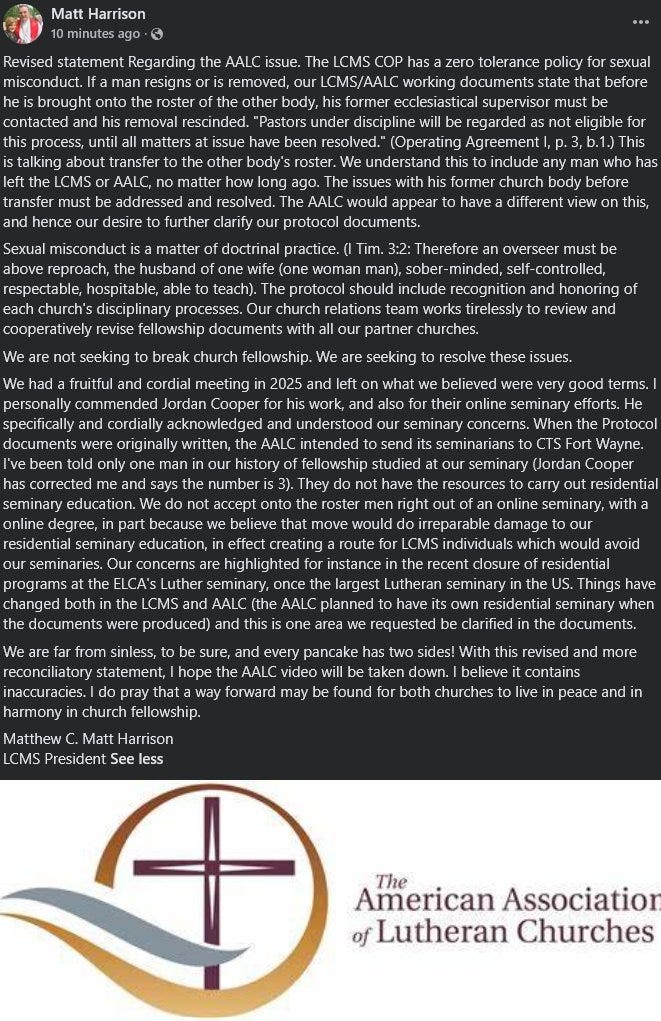
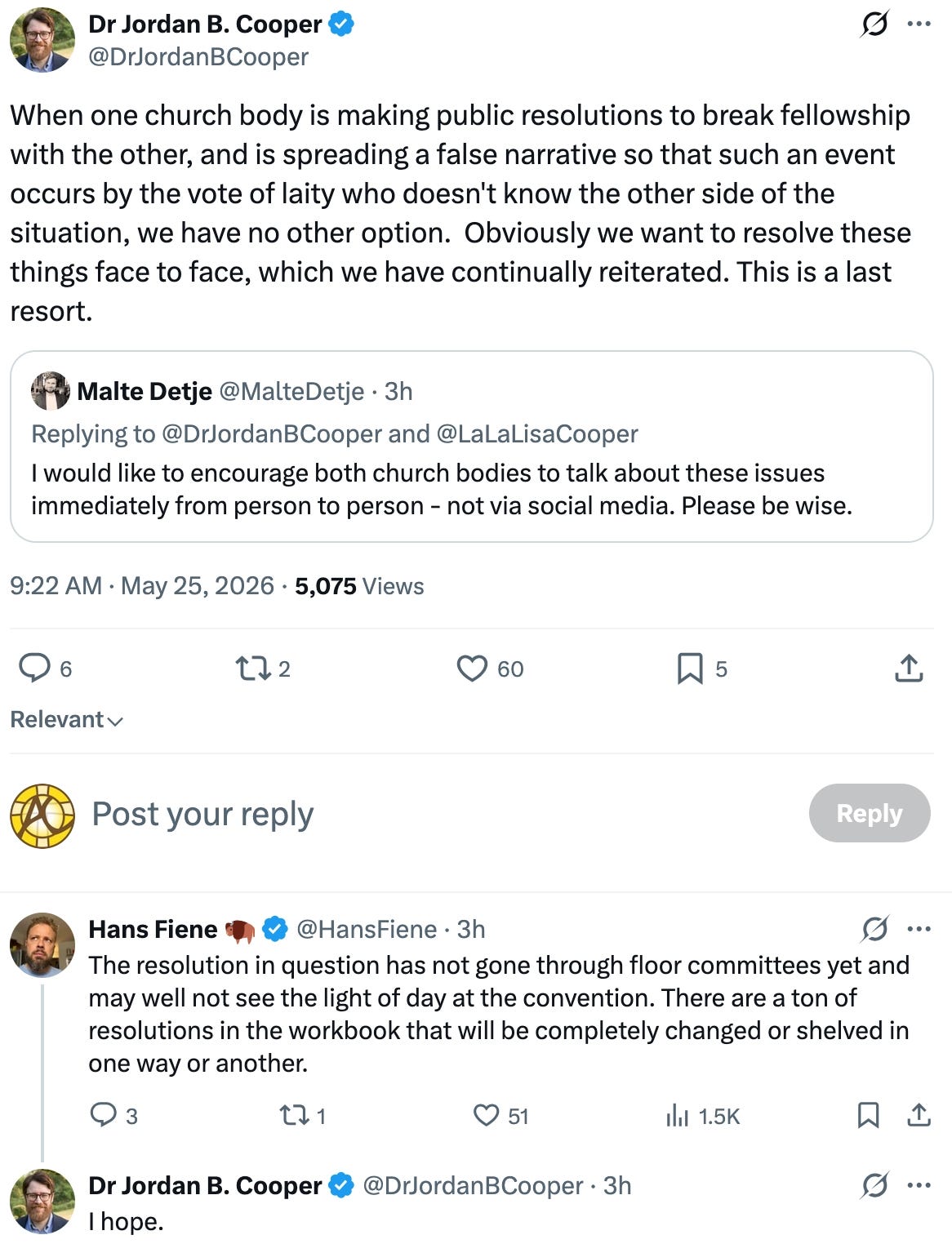
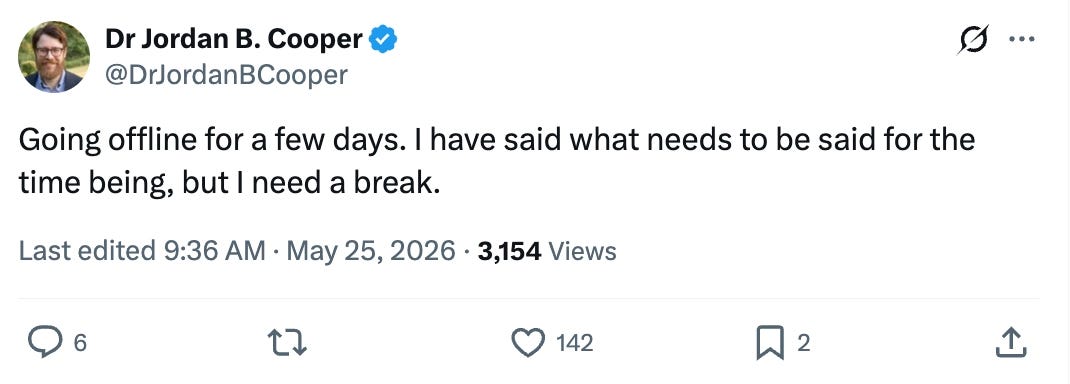
These social media posts point to an inevitable rupture with the AALC even if it does not occur at this convention or the next. All trust has been dynamited.
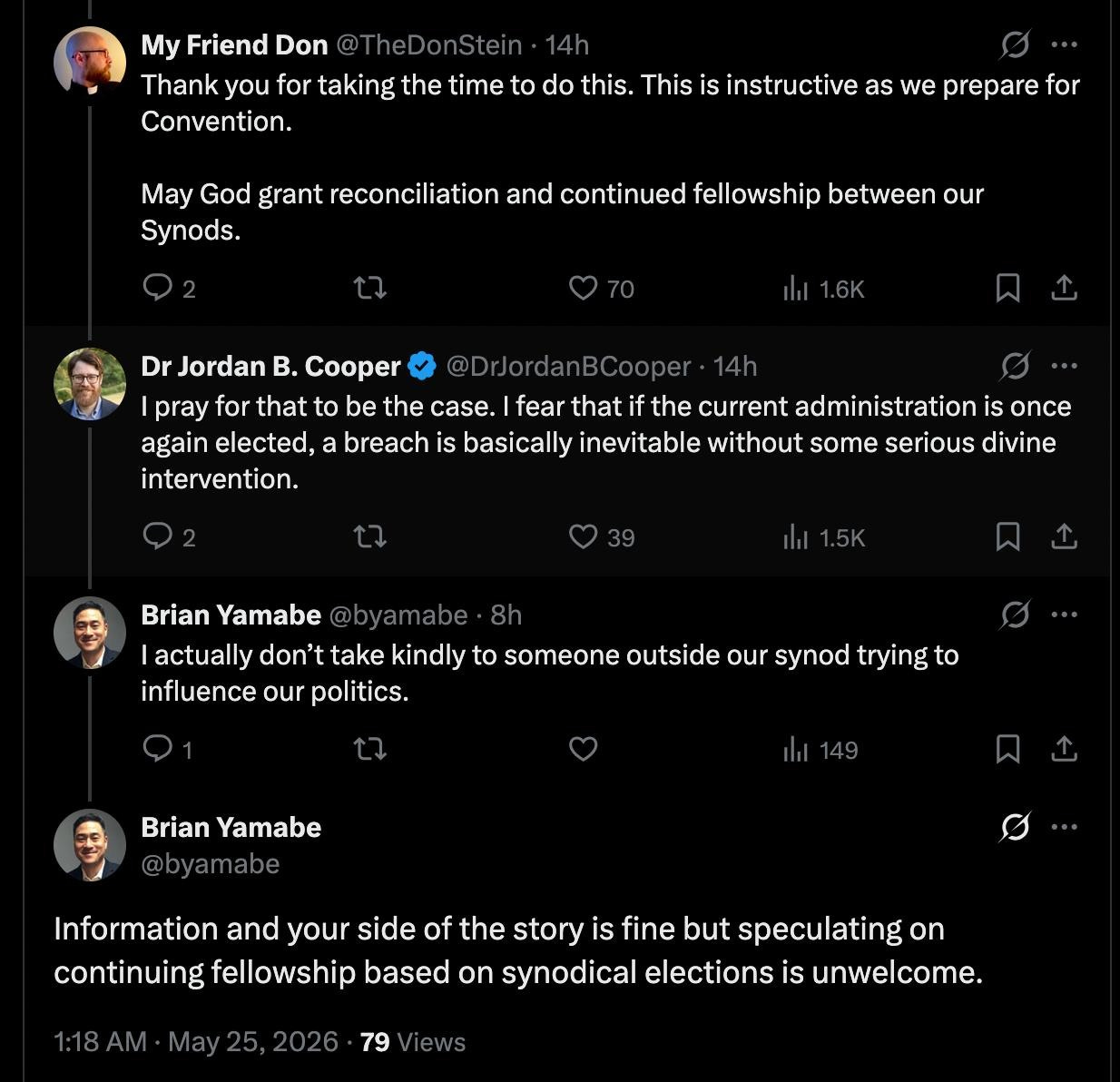
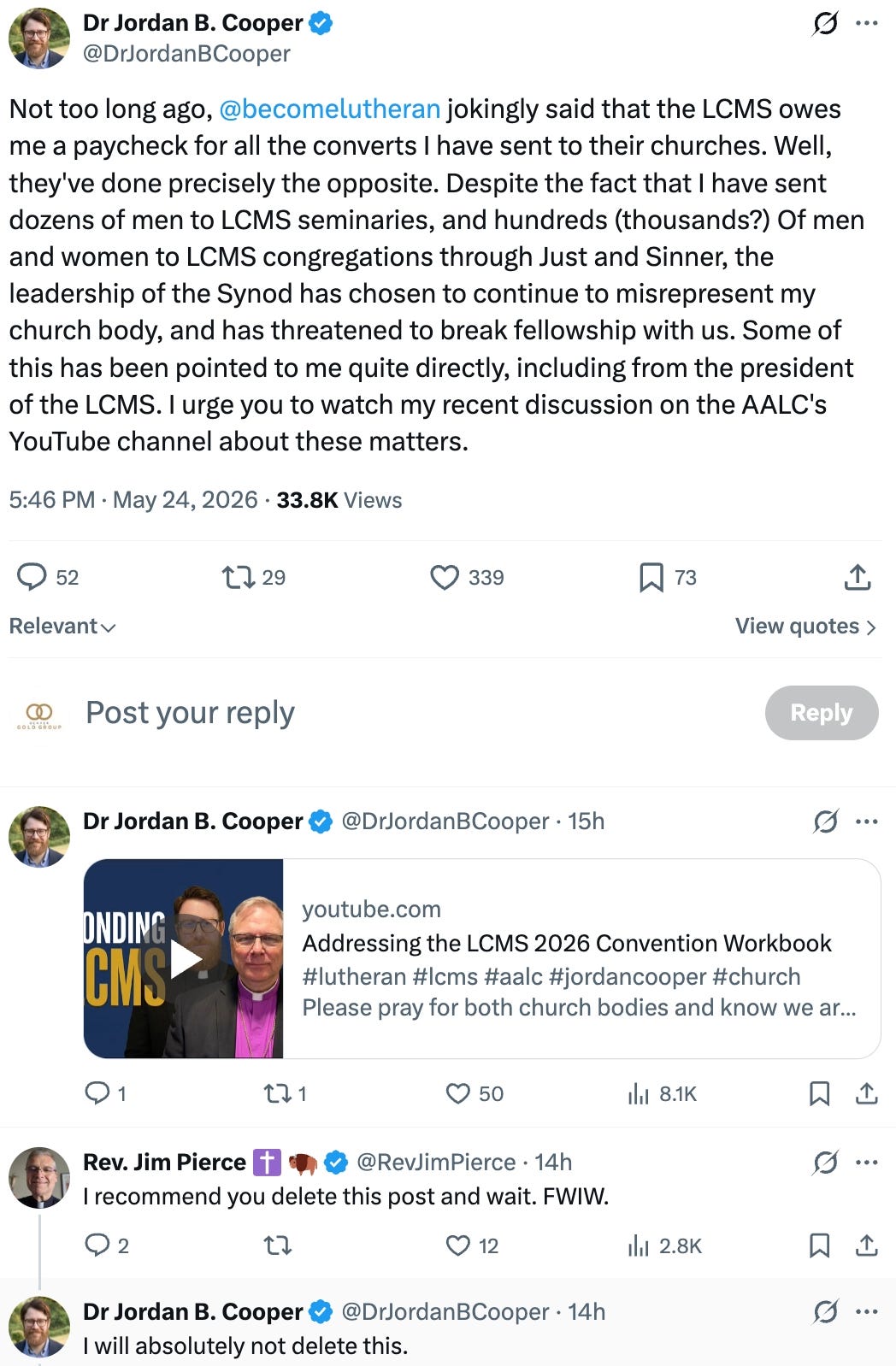
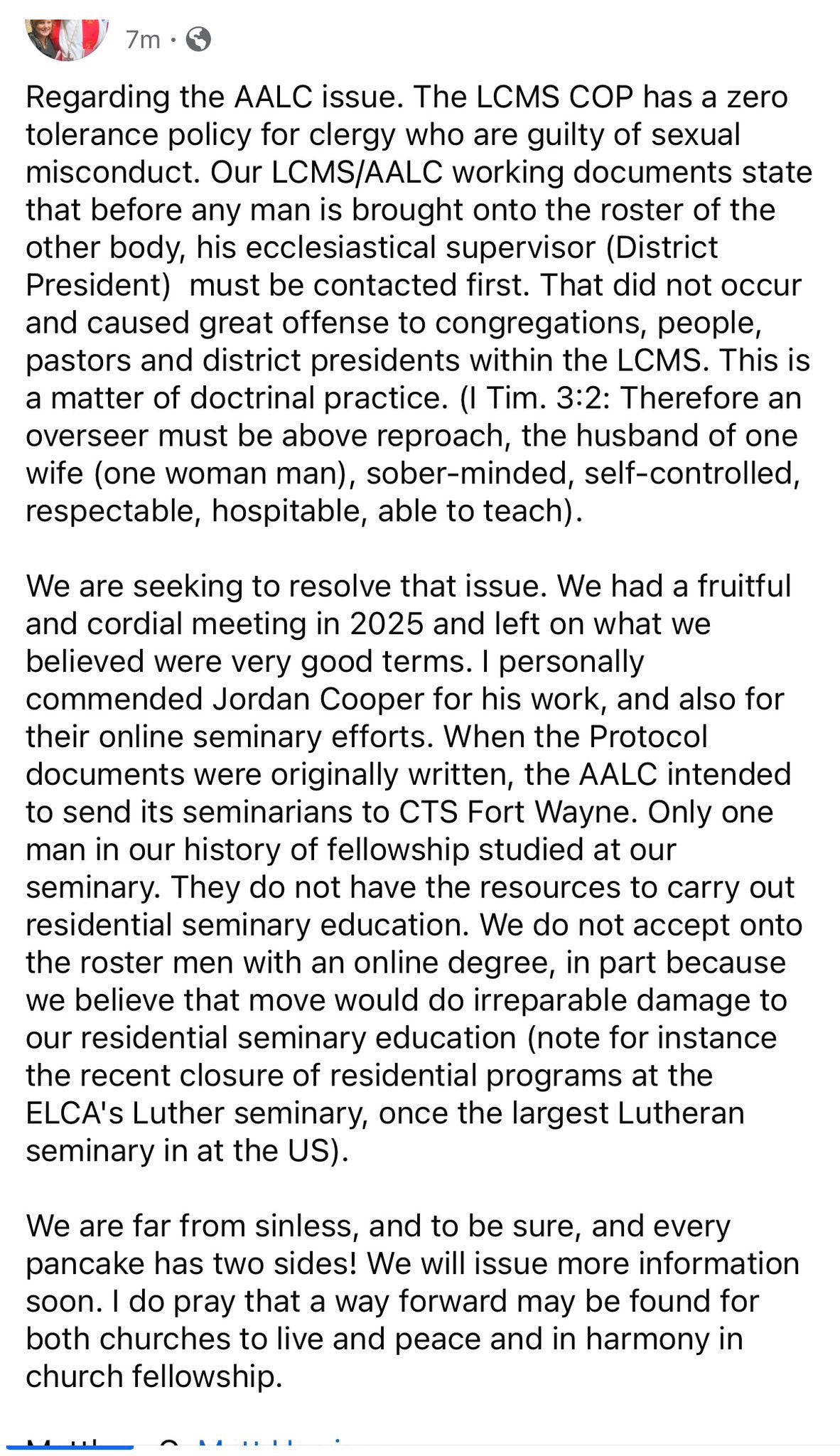
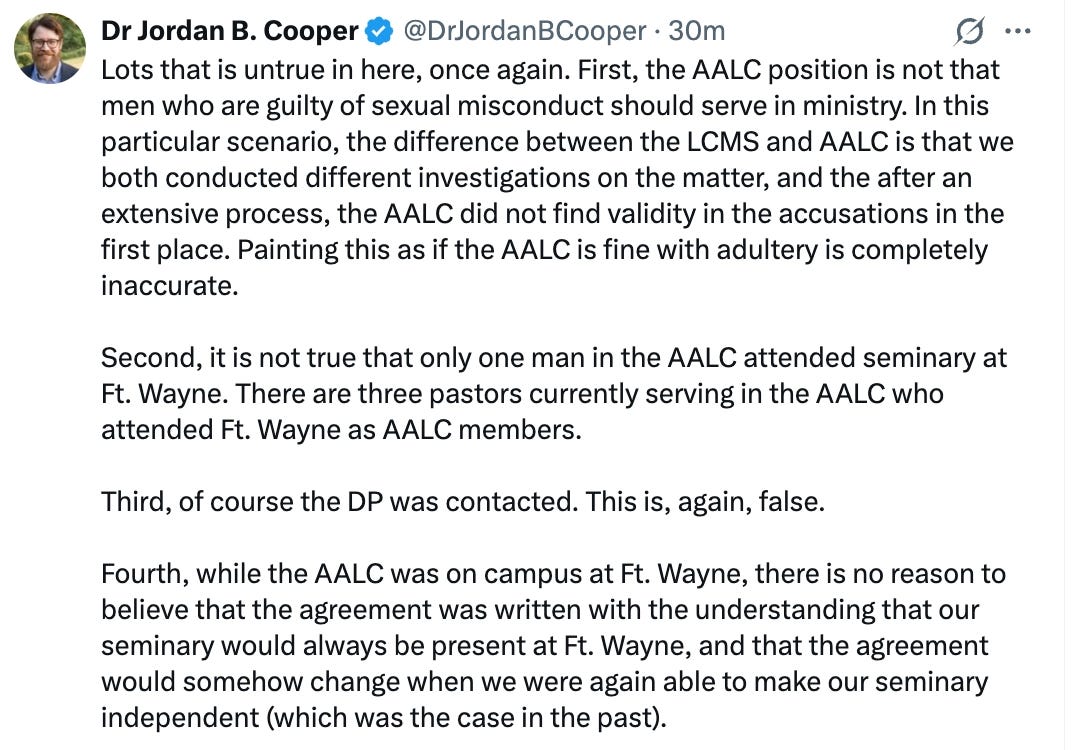
Fellowship in doctrine alone and not in practice as practice is adiaphora: doesn’t that open the proverbial whole can of worms?
One AALC church we visited was communing Baptists and the pastor said he left the LCMS over closed communion. Perhaps this "practice as adiaphoran" could be problematic?