
A First Amendment Primer for Christian Leaders
What a free press is, what it does, and why it remains free even when the institution it covers wishes it would not.

Ad Crucem News has been informed that it is unwelcome at the 69th Regular Convention of The Lutheran Church—Missouri Synod (LCMS), scheduled for July 18–23, 2026, at the Phoenix Convention Center. We had originally requested a booth for the retail store and never sought press credentials for the publication. Given our other priority commitments, we cannot attend the Convention this year, so the issue is no longer relevant.
Nevertheless, the denial of credentials is consistent with what has filtered back to us: the senior levels of the LCMS are displeased that Ad Crucem News reports independently on the affairs of the Synod, and the soft boycott we have observed for some months now appears to be the leading edge rather than the limit. The annoyance, we are told, is considerable.
The displeasure of ecclesiastical authority at independent coverage is itself a fact of public interest, and the appropriate response to it is not to modify what we do, but to explain what it means to be an independent rather than a house journalist in the United States.
The First Amendment
The relevant text of the First Amendment, ratified December 15, 1791, is this:
“Congress shall make no law respecting an establishment of religion, or prohibiting the free exercise thereof; or abridging the freedom of speech, or of the press; or the right of the people peaceably to assemble, and to petition the Government for a redress of grievances.”
Note how the clauses are deliberately juxtaposed. The same sentence that protects the LCMS from state interference with its doctrine, polity, and worship also protects Ad Crucem News, The Federalist, the Daily Wire, and the basement blogger from state interference with their reporting. The protections are not in tension, but actually presuppose one another, creating a wonderful complementarity that was entirely absent when I worked as a journalist in South Africa.
The Free Exercise Clause secures the Synod’s right to teach what it confesses without governmental intrusion. Indeed, the Synod established and supports the Lutheran Center for Religious Liberty (LCRL) in Washington, D.C., to assert its rights in the public square, and the Synod has joined and supported litigation through sympathetic organizations such as the Becket Fund and Alliance Defending Freedom to vindicate its First Amendment rights.
The Press Clause secures the right of citizens, including baptized confessional Lutheran citizens who happen also to be journalists, to gather information about institutions of public consequence and publish what they find.
Neither clause grants a right to favorable coverage, or to approve coverage in advance, or to be informed of stories before publication, or to suppress unfavorable accounts on grounds of institutional dignity or someone’s hurt feelings or vested interests. The American Founders understood that the institutions most insistent on being reported on only favorably were precisely the institutions most in need of being reported on candidly and intensively. Those institutions also have the right and means to gloss their reputations through house publications, which the LCMS leverages through Reporter, Lutheran Witness, Lutherans Engage, KFUO, and Concordia Publishing House.
A free press is not, and has never been, a press that publishes what its subjects wish or demand to see printed or broadcast. Indeed, one critical mark of a free press is that the question “Are the subjects of coverage pleased with the coverage?” is journalistically irrelevant. The mark of an unfree press is that that question is the only one that matters; that is the function of house publications.
The Pastoral Office vs. the Press Office
The Augsburg Confession, Article XXVIII, clarifies that the office of the keys is exercised through Word and Sacrament, and that ecclesiastical jurisdiction does not extend to matters proper to civil authority (John 18:33-37). The doctrine cuts in both directions. Civil magistrates do not preach the Gospel; pastors and ecclesiastical officers do not regulate the press, even when those outlets are operated by members of their own communion.
A District President’s authority is sacramental, doctrinal, and administratively ecclesiastical, but never editorial. Whatever displeasure the Council of Presidents, the Praesidium, or the Office of the President may register concerning the existence of independent Lutheran journalism is merely a private response of private men. It has no weight derived from an office, and it carries no more editorial authority than the displeasure of any other reader who would have preferred a story not to run.
Our treasured two-kingdoms doctrine is not a theological abstraction relegated to a lightly referenced footnote in the Book of Concord. It is the working framework that separates pastoral admonition from coercive censorship, and that protects the pastor from the magistrate’s imperious gavel and the journalist from the bishop’s. When senior officials voice institutional displeasure, they have simply expressed a preference that the press defer to their judgement, which is not possible in America.
Compare and Contrast
The clearest evidence that LCMS Lutherans understand and approve of independent investigative journalism when directed at other institutions and church bodies is the annual programming of the Issues, Etc. “Making the Case” Conference, scheduled this year for Friday, June 12, and Saturday, June 13, 2026, at Concordia University Chicago. The conference draws hundreds of LCMS attendees from across the country, including some high-ranking Synod officials.
The published 2026 speaker lineup showcases six names: Megan Basham, Mollie Hemingway, Erin Hawley, the Reverend Matt Harrison, pastor Bryan Wolfmueller, and pastor Will Weedon. The first two are journalists, the third an attorney. Together, they are public commentators whose professional output consists of independent reporting and advocacy directed at institutions, including ecclesiastical institutions, that would in nearly every case have preferred not to be covered. The latter three are LCMS pastors, including the Synod’s President himself.
The juxtaposition of the speakers tells the whole story. President Matt Harrison is willing to appear on the same stage as Megan Basham, a zealous and effective journalist covering the Baptist and Evangelical world, and Mollie Hemingway, who has shredded several grandees in the media-political complex. We invite the reader to consider what the Issues, Etc. speaker slate proximity means when contrasted with the institutional dissatisfaction about Ad Crucem News.
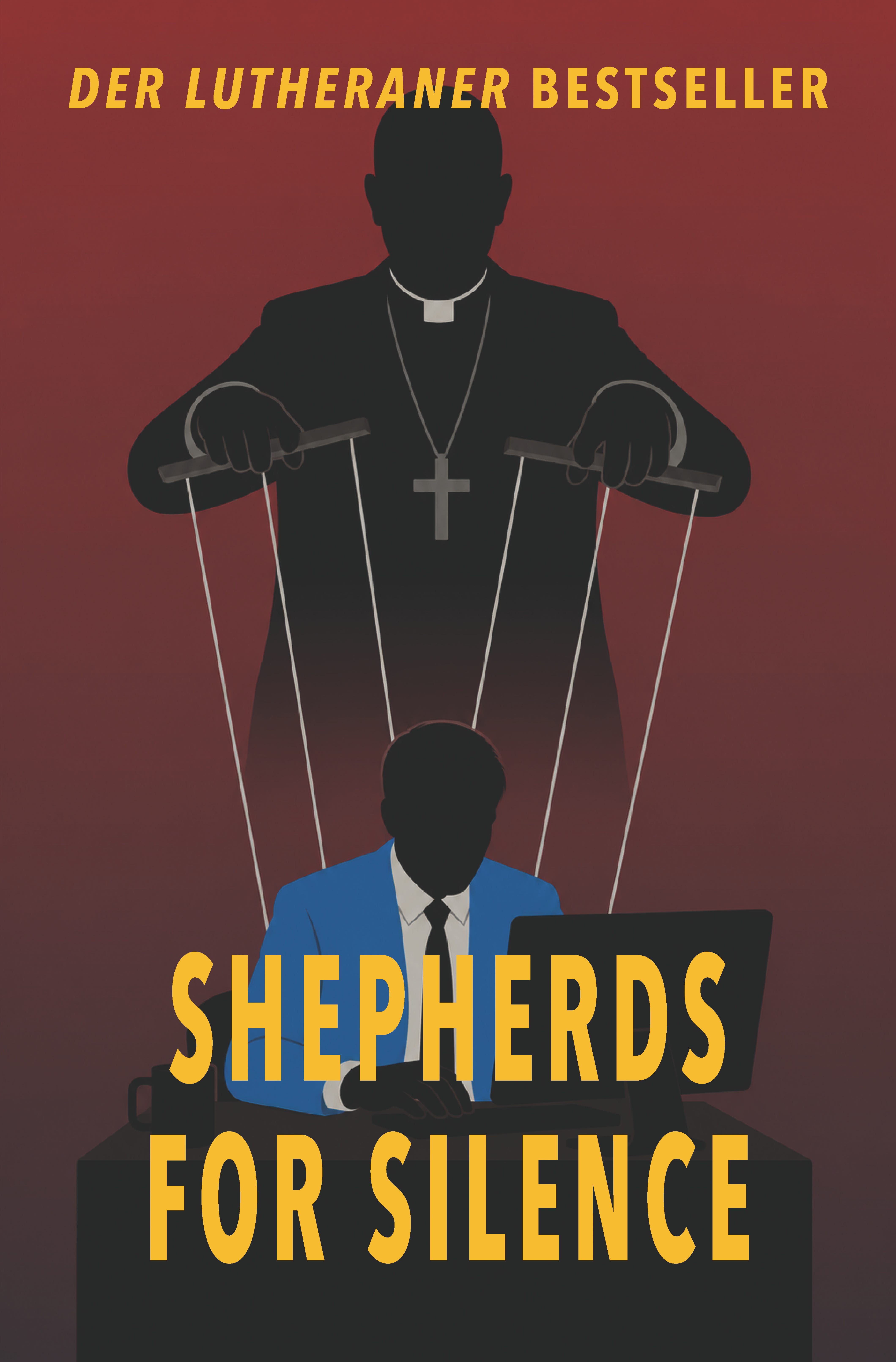
Megan Basham’s 2024 book Shepherds for Sale: How Evangelical Leaders Traded the Truth for a Leftist Agenda is a work of investigative journalism whose method consists precisely of the practices our Bishops reportedly object to when applied to the LCMS. Basham named senior figures and identified serious problems in the Southern Baptist Convention, the Ethics and Religious Liberty Commission, prominent megachurches, and evangelical seminaries. She traced foundation funding flows, documented coordinated public relations campaigns, and politically charged sexual abuse allegations, and published material that the named parties contested vigorously and even viciously. The persons and institutions named were displeased, but that did not constitute an argument against the reporting.
Mollie Hemingway’s Federalist and her book Rigged apply the same investigative method to legacy media institutions, federal agencies, and political operations. Mollie even received an honorary doctorate from Concordia Theological Seminary (CTS), an honor conferred in recognition of her contributions to journalism and public discourse. Her husband, Mark Hemingway, a recurring guest at past Issues, Etc. conferences, is a senior writer at RealClearInvestigations whose primary professional focus is investigating and reporting on institutions that would prefer not to be investigated. Erin Hawley, of Alliance Defending Freedom, is an appellate litigator whose career consists of adversarial litigation against federal agencies and state governments whose policies and practices she contends are unlawful. None of the four would describe their work as service to the convenience of the institutions covered.
Issues, Etc. routinely features journalists who report on the affairs of other church bodies. Joy Pullmann of The Federalist, religion-beat veteran Terry Mattingly, and Kyle Mann of The Babylon Bee have all appeared in recent years.
Here we are: the conference has independent journalists sharing the dais with the President of the LCMS, drawing enthusiastic registration from LCMS clergy and laity who will applaud their reporting, buy their books, line up for signed copies, and return home edified by their courage. This is the audience the Council of Presidents and LCMS institutions serve. This is what the audience already believes about a free press. The audience does not need to be persuaded that even adversarial journalism is legitimate and valuable, and it appears the Synod President agrees, given his participation.
What the senior levels of the Synod and some portion of the laity may need to be made explicit is that the principle they will applaud in Chicago does not change when the subject of coverage changes. If Megan Basham’s investigation of SBC seminary funding is journalism to be celebrated when, then independent reporting on LCMS congregational governance, district administration, and synodical policy is also journalism. If Mollie Hemingway’s coverage of legacy newsrooms is legitimate because she is not employed by those newsrooms and owes them no editorial deference, then Ad Crucem News‘s coverage of the LCMS is legitimate for precisely the same reason.
The structural identity is not difficult to perceive. The only difference is the identity of the institution under examination, and that difference, as a matter of First Amendment principle, is exactly nothing.
What Independence Affords
Ad Crucem News reports on the LCMS because the LCMS is an international institution of public, ecclesiastical, and confessional consequence whose internal and external affairs matter to its members, to its congregations, to its churches in fellowship, and to the broader Christian public that watches confessional Lutheranism in America with various degrees of attention.
We report favorable stories when the facts warrant favorable coverage. We report unfavorable stories when the facts justify unfavorable coverage. We do not submit drafts to district offices for review (although we did alert everyone a week before writing about Arlington, VA and Easton, MD), we do not do ambush journalism, we do not seek prior approval from the International Center, we do not extend veto power to subjects of coverage over their own portrayal, and we do not regard the displeasure of the powerful as evidence that we have erred or are evil. These are not idiosyncratic editorial commitments. They are the bedrock definition of independent journalism we should cherish and protect, as it has been practiced in the United States for somewhat more than two centuries. Nowhere else in the world does this right and privilege exist in the form Americans enjoy, and we should be extremely skeptical of people who want to curb it in any way.
Independent coverage is not hostile by default. It is not, in our case, animated by any desire to embarrass the Synod, to weaken its public reputation, or to advance any agenda foreign to the confessional Lutheran tradition that this publication itself confesses. The purpose is truth and to ensure we, as Christians, are living up to our calling, especially as brothers and sisters in the faith. We may have a higher percentage of negative reporting than positive reporting. Conversely, Synod publications and reports have effectively zero negative news; it is all sunshine and roses or disaster response. We have a particular interest in governance failures, bylaw misapplications, financial irregularities, and theological drift because they are so consequential for a Synod in measurable, rapid decline. The same editorial standard governs both story categories.
The standard is this: We publish what is true. We publish what is verifiable. We publish what is of legitimate concern to the readers of a Lutheran publication that takes both Lutheranism and journalism seriously. We do not publish what we cannot defend. We do not publish what we have not confirmed. We readily correct errors when they are identified. But we do not concede that the displeasure of ecclesiastical authority constitutes a reason to alter any reporting.
We also understand that we are associated with the sainted Herman Otten and Christian News, which is a high honor. Synod presidential nominees paid him respect to win endorsement, and then abandoned him once elected. They marginalized pastor Otten as an eccentric gadfly, thereby blunting many of his valid criticisms. Unfortunately, we expect to experience a similar campaign of marginalization. So be it.
Conclusion
The bosses’ displeasure is noted and may be acted upon by the senior officials themselves in any of several constructive ways. They may decline to comment, which is their right. They may issue corrections to factual errors, which we will publish if warranted. They may grant interviews, which we will conduct in good faith. They may write letters to the editor, which we will print. They may not, consistent with the constitutional order they live under and the confessional tradition they serve, expect that an independent Lutheran press will function as a lapdog.
The same Synod audience that will gather at Concordia University Chicago in June already understands the difference, because the audience will spend two days celebrating reporters who do for other institutions exactly what Ad Crucem News does for the LCMS.
The First Amendment is not difficult. It is brief, it is clear, and it has been interpreted consistently by American courts and American journalism for over two centuries. The two-kingdoms doctrine is not difficult either. It is taught in every Lutheran catechism class and every seminary lecture on Article XXVIII. The combination of the two, applied to Ad Crucem News, yields a conclusion that should require no further elaboration but apparently does. If necessary, ask Mollie Hemingway to do a presentation on press freedom to the CoP, Praesidium, and Board of Directors.
A free press is free. It remains free when the institutions it covers wish it were not. It remains free when the institutions are ecclesiastical rather than civil. It remains free when its publishers are confessional Lutherans and its subjects are confessional Lutheran officials or institutions. The freedom is the entire point, and it is settled, non-negotiable law in America. The appropriate response of clergy who find themselves the subjects of coverage they would have preferred not to receive is the same response any other public figure ought to give. They may answer on the merits or decline to respond.
Ad Crucem News will continue to report. Favorable stories. Unfavorable stories. After all, we are called to be salt and light. Whichever the facts produce. To our readers, our sincere thanks. To our subjects, our continued attention. To the high-ranking officials, Christian truth, grace, and peace.
Keep doing the Lord's work! In season and out of season...
Power corrupts. By denying the Presidium an exclusive monopoly on the crafting of narratives and the curating of information an independent press is a check on the corrupting influence of power.