
Truth That Breaks Us, Mercy That Holds Us
Not self, not spectacle, not “follow me and be saved”, but truth about sin and a clear finger pointed to Jesus Christ.

Rev. Dr. Charles Westby preached this sermon on the Fourth Sunday of Advent, 2025, at Trinity Lutheran Church, Denver. Dr. Westby’s clear preaching clarifies the proper role of the preacher: not the Christ, not a dispenser of personal insight or sentiment, but a servant of the Word. He proclaims the Law without evasion, naming sin and calling sinners to repentance, the Gospel without dilution, pointing away from himself to Christ alone, the Lamb of God who takes away the sin of the world by His atoning death. Such preaching does not leave sinners trapped in guilt, nor does it offer comfort by silence or affirmation; it delivers forgiveness where God has placed it, in the once-for-all sacrifice of Christ, preached into the ears of sinners and given concretely in the Sacraments. Where the preacher can say with John the Baptist, “I am not the Christ,” the crucified and risen Christ is truly revealed and bestowed.
Dear brothers and sisters in Christ, grace, mercy to you, and peace from God our Father and our Lord and Savior Jesus Christ. Amen.
I draw your attention to the Gospel reading, which was read a few moments ago from the first chapter of the Apostle John’s Gospel.
It was the fifteenth year of the reign of Tiberius Caesar when the Word of the Lord came to John the Baptist in the wilderness. Annas and Caiaphas were high priests in Jerusalem.
John began preaching a baptism of repentance for the forgiveness of sins. Crowds of people were going out to him at the Jordan River to be baptized by him, confessing their sins.
He looked like Elijah. That was because he was dressed in goatskin that still had the hair on it—so it was hairy—and because he had a leather belt around his waist.
Malachi, the last prophet in Israel, had proclaimed, “Behold, I will send you Elijah the prophet before the coming of the great and dreadful day of the Lord.” The Lord also said through Malachi, “Behold, I will send my messenger, and he will prepare the way before me. And the Lord whom you seek will suddenly come to his temple.”
Malachi spoke those words about four hundred years before the Word of the Lord came to John the Baptist in the wilderness.
Israel up to that time had been accustomed to prophetic activity. But there had been no prophetic activity in Israel for four centuries. Now all of a sudden John the Baptist was on the scene preaching and baptizing.
He looked like Elijah. He was calling the people to repentance like a prophet.
What was going on? Did John’s activity mean that the great and dreadful day of the Lord Malachi spoke about was about to happen? Was the Lord suddenly going to come to his temple in Jerusalem, as Malachi had said? Was the Messiah coming?
When we take these things into account, it’s not surprising that the Jews sent priests and Levites to John to investigate.
Now, just in terms of setting the scene, the term “the Jews” in this context means the authorities in religious and civil matters among the people of Israel. We get this because they sent priests and Levites as their agents from Jerusalem. Jerusalem was the seat of all religious and civil authority for the people of Israel.
And they sent these priests and Levites to John to investigate who he was and what he was doing—and to do that officially.
So we should understand that, in this context, the term “the Jews” is not referring generally to people who are of Jewish descent, but to the authorities in Israel.
Because the Jews sent their agents to John to investigate who he was and what he was doing, John was required to give testimony—to tell the truth—and so he did.
His testimony is important in two respects—maybe more than that, but there are two that I want to talk about today.
First, it is important with respect to what he said about himself, and what we are to learn from this. Second, it is important with respect to what he said about the One who was coming.
So, with respect to the first consideration—what he said about himself and why that’s important—the priests and Levites were sent from Jerusalem to ask John the obvious question: “Who are you?”
And John goes right to the heart of it, anticipating what the rulers in Jerusalem may have been thinking and concerned about.
The Gospel reading says that John “confessed and did not deny, but confessed, ‘I am not the Christ,’” the Messiah.
To confess here means to make a public declaration and acknowledgment of the truth. So John declared and acknowledged truthfully: “I am not the Christ.”
To deny here means not to agree with what someone else may be thinking or even saying. There was undoubtedly much speculation going on among the people of Israel at that time about who John was. Maybe after four hundred years, God really has sent his Messiah to us. And the ruling authorities in Jerusalem may have been thinking that and were wondering.
So he did not deny the proposition. He made it emphatic: “I am not the Messiah.”
The formula here—“confessed and did not deny, but confessed”—is intended to be emphatic and definite. The repetition also makes it a solemn and serious testimony.
So we should understand that John was making it absolutely clear so that there would be no doubt that he was not the Christ.
The investigative agents still had more questions: “Are you then Elijah?” They were undoubtedly thinking about Malachi. “Are you the Prophet?” This is the One spoken about in the Old Testament reading today from Deuteronomy 18.
And they asked further, “Why are you baptizing if you are not the Christ or Elijah or the Prophet?” They may have expected a connection between baptizing and the coming of the Messiah.
John testified that he was neither of these. “Then who are you? What do you say about yourself?”
John said, “I am the voice of one crying in the wilderness, ‘Make straight the way of the Lord,’ as spoken by Isaiah the prophet.”
John was referring there to Isaiah chapter 40, which begins, “Comfort, comfort my people,” says your God.
John’s reference would have called into memory for the people of Israel all that God said in the fortieth chapter of Isaiah, which is the promise of the Messiah.
Yes—Messiah is coming, John said. And I am the voice of one crying out in the wilderness to prepare his way. But I am not him.
So what can we learn from this testimony of John—saying, “I am not the Messiah,” but just the voice crying out in the wilderness to prepare his way?
There may be many things, but what I’m thinking about today is this: we are to understand that no preacher who has been sent from God refers to himself as the Messiah. In our day and age we might have to say, “herself” as the Messiah.
No preacher sent from God even suggests that the people should regard him as the Messiah. And no preacher sent from God should suggest that if you follow him—his own person, his own so-called revelations—you will be saved.
John would teach us that saving is exclusively God’s authority and jurisdiction. The ability and authority to save is possessed and exercised only by the Person whose name is Messiah.
And that Person was not John. And that Person is not any other preacher sent from God.
Jesus alone is the Messiah.
Preachers are servants of God and God’s people. As Paul says, people should regard us as stewards of the mysteries of God—stewards. That’s from 1 Corinthians 4, the Epistle reading from last week.
God’s people are built upon the Word of God, not upon the person of any preacher. As Isaiah says in chapter 40, “The grass withers, the flower fades, but the Word of our God stands forever.”
What then is the job of the preacher?
Here we get to the second thing we want to learn about John’s testimony.
The job of the preacher is to tell the truth and to testify to the Christ.
The preacher must tell the truth about sin under God’s Law, which John did. He called people to repentance. He spoke boldly God’s Law to Herod the tetrarch when he wanted to marry his brother’s wife.
But the preacher sent from God must not stop there. He must also point to the Christ.
So to those sent from Jerusalem, John said, “I baptize with water. He is standing in your midst whom you do not know, who is coming after me. I am not worthy to even untie his sandal straps.”
Here John sets the example for all preachers who are sent from God.
He points to Jesus. And in relation to Jesus he refers to himself as a servant. This is what he meant by talking about not being worthy to untie Jesus’ sandal straps.
So he points to Jesus.
Who is this Jesus who is coming after John? What does John say about him?
Earlier in chapter one of the Apostle John’s Gospel, John the Baptist said this: “He who comes after me ranks higher than me because he existed before I did.”
Here’s a wonderful mystery that preachers are stewards of.
How can he who comes after John in time have existed before John existed?
We know that John was six months older than Jesus. Yet John testifies that Jesus existed before he did.
Who always exists before any of us exist? Who existed before Adam existed?
We should be thinking: God Himself—Lord and Master.
And yet there is a man, says John, standing in your midst, who existed before I existed—of whom it can be truly and rightly said, “He is coming after me.”
And it is to him I direct your attention, your faith, and the placing into his hands your entire life.
The preacher sent from God points to this One.
If we were to take a little tour through the rest of John chapter 1, we would hear the Apostle John tell us more about this One whom John the Baptist was talking about.
We would learn that he was the Word who was with God at the beginning and who was God; and that he was the Word through whom God made all things, and there was nothing that has been made that was made apart from the Word.
And the Apostle would go on and say, “In him was life, and the life was the light of men—all human beings.”
And then we would hear the Apostle say, “John the Baptist came to bear witness to this Light who enlightens every human being. Yet most human beings do not acknowledge him, believe in him, and give thanks to him.”
And then we would hear the Apostle make this amazing statement: “And he became flesh and dwelt among us, the only-begotten Son of the Father, full of grace and truth.”
But then John the Baptist makes the most astounding and remarkable and awesome proclamation about this One who was the light and life of men through whom all things have been made.
In the very next verse in John chapter 1—right after the reading today—John the Baptist declared, when he saw Jesus coming toward him: “Behold, the Lamb of God who takes away the sin of the world.”
A lamb that takes away sin speaks of a lamb dying a sacrificial death—having his blood shed to make atonement.
That’s what John declares about this One: Jesus.
But how can the Light and Life of men, through whom all things were made, become the Lamb of God—to die as an atoning sacrifice—to take away our sins, even the sins of the whole world?
This is the most awesome thing ever.
By “awesome” I mean literally inspiring awe.
Yes, this strikes human understanding as incredible and unbelievable, which may be one reason why so many do not believe it.
Human understanding thinks: I can atone for myself. I can be good enough to find God on my own terms and on my own strength. I just need someone to teach me how to do it. This is what religion should be about, according to human understanding.
Yet we see John the Baptist, the preacher sent from God, say something entirely different: “Behold, the Lamb of God who takes away the sin of the world.”
You and I can’t do that, but the Lamb of God can.
And that’s what the preacher from God teaches and preaches.
And this preaching shatters human understanding, but at the same time becomes the solid rock under our feet.
Our sins must be atoned for—and we cannot do it.
And so God sent Another to atone for them, even his own Son, as sacrificial Lamb.
And he has, in fact, done it.
This preaching should cause us to grow in recognizing the depth of our sinful corruption: that it would take the death of Light and Life itself, in our flesh, given as an atoning sacrifice as a sacrificial Lamb, to win our forgiveness with God.
But this preaching also causes us to recognize, trust, and give thanks for God’s even greater love for us: that he wanted so much to forgive our sins and to save us from what our sins have merited from him, that he gave us his Son to obtain our forgiveness.
His love is greater than the depth of our sinful corruption.
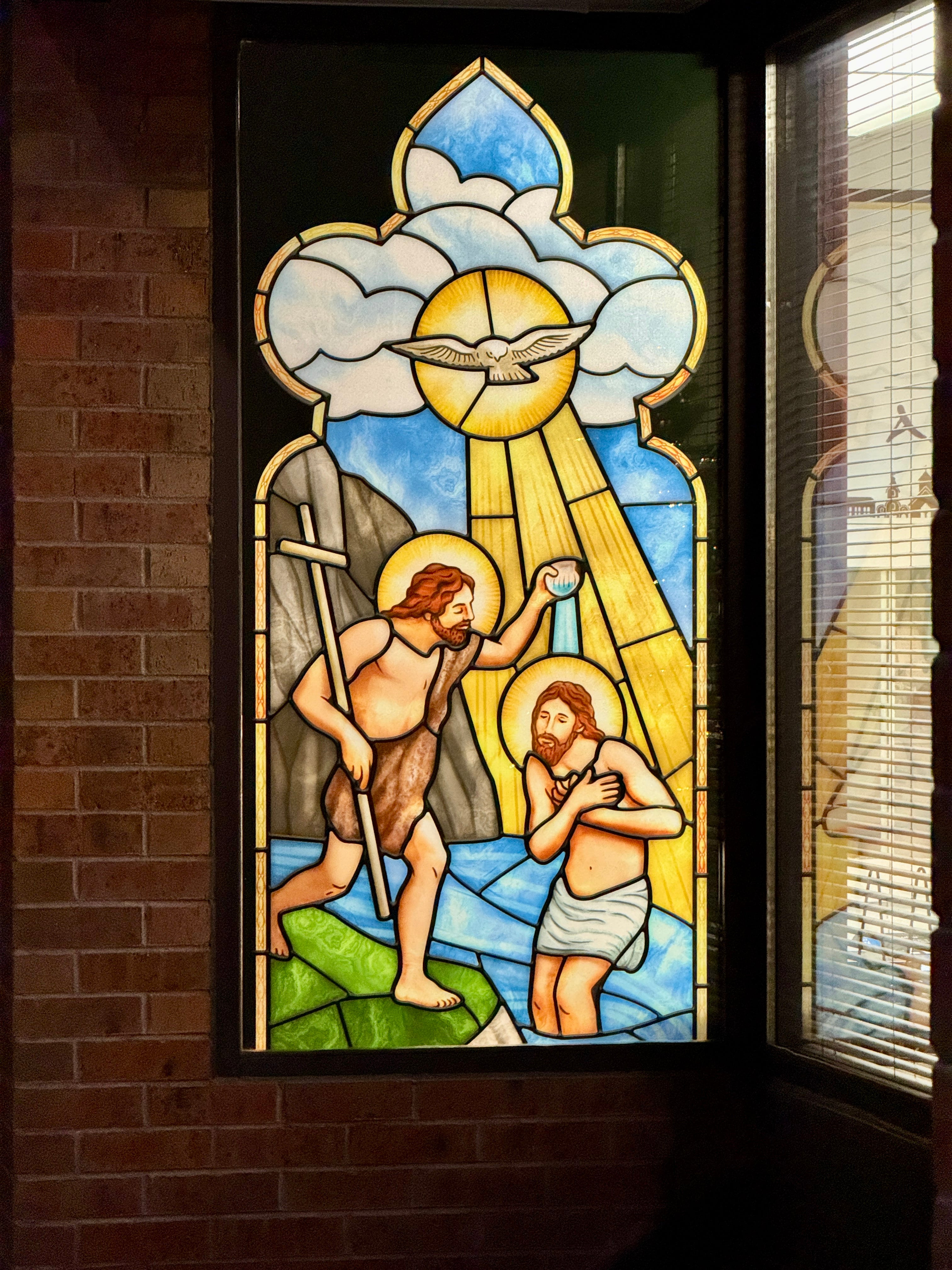
And the preacher sent from God wants you to be assured of that, and to trust it—especially in the storms.
And then, as a result of what his Son’s sacrifice has accomplished, God wants us to believe that he gives us the new birth in his kingdom through Christian Baptism; that he gives his fellowship to us by giving himself to us as Father, Son, and Spirit; that he gives us his kingdom, resurrection from the dead, and eternal life.
And he would have us believe that these are the most precious and important gifts of all gifts that God gives out of his love for us in his Son.
So John teaches us what the preacher sent from God proclaims: Jesus of Nazareth, who existed before us all as the Son of God—the Life and Light who takes away the sin of the world.
Jesus of Nazareth, whom the darkness of sin and death and God’s wrath and the wickedness of the devil cannot overcome, who comes to us now with his gifts in such preaching and in the sacraments.
Thanks be to God for John the Baptist and the message he proclaimed, and the One who came after him—Jesus Christ our Lord. Amen.
Now the peace of God, which surpasses all human understanding, guard your hearts and your minds in Christ Jesus. Amen.
A most beautiful and truthful sermon. A blessing❣️