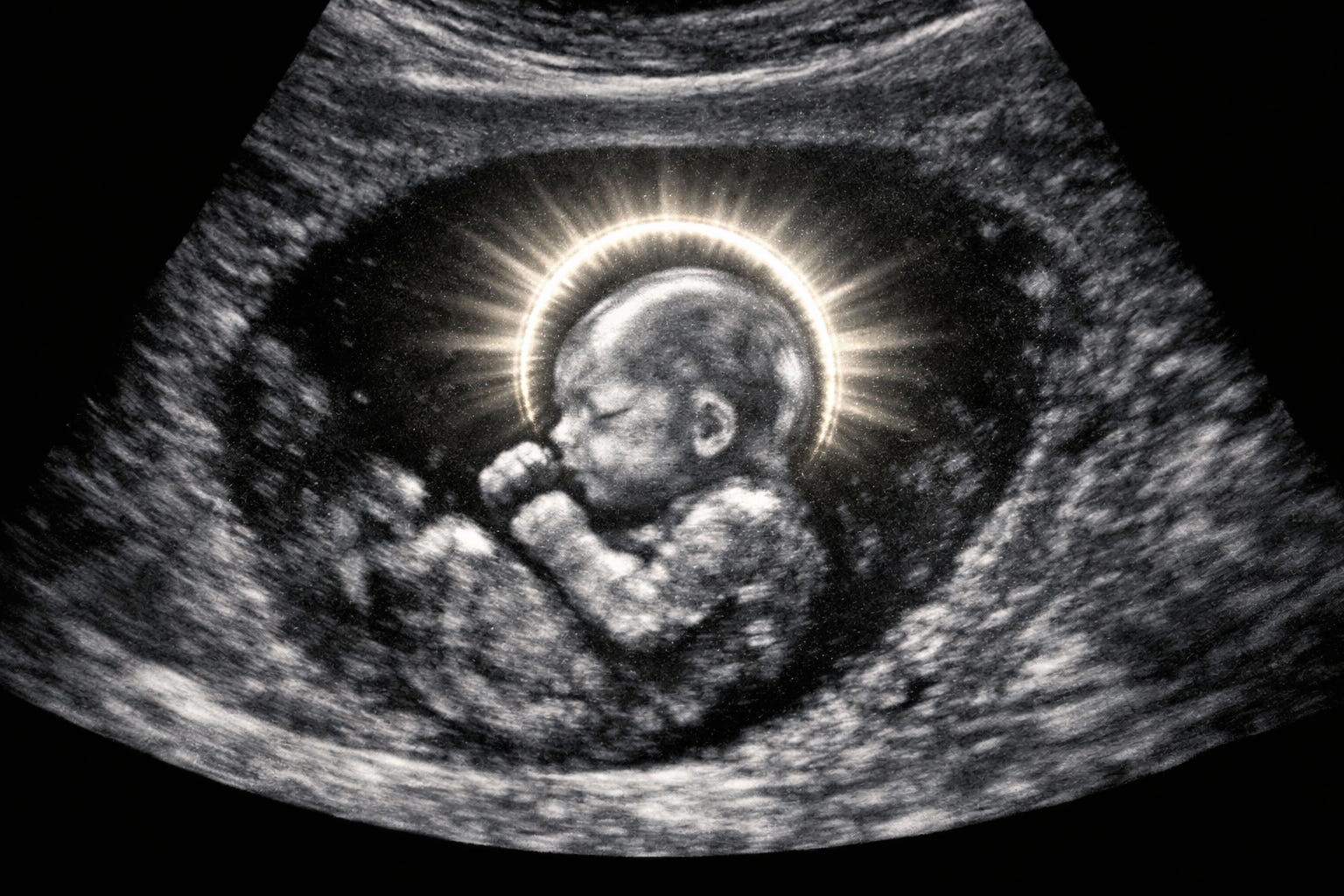
The God Who Once Lived in the Womb

At the heart of the Christian faith stands a mystery so profound that we often rush past it too quickly: the eternal Son of God once lived as an unborn child.
Before Christ preached, healed, suffered, or died—before He ever took His first breath—He first took on our flesh in the hiddenness of Mary’s womb. The eternal Word through whom all things were made entered His creation not with spectacle or power, but in humility, dependence, and vulnerability. God became preborn.
This is not a sentimental detail. It is a theological earthquake.
The incarnation means that God did not merely visit humanity; He fully assumed our humanity from its very beginning. From conception onward, Jesus was truly human—conceived by the Holy Spirit, growing, developing, hidden from the world. The Son of God sanctified every stage of human life by living it Himself. In doing so, He revealed how deeply God cares for the smallest and most unseen among us.
Scripture consistently testifies that God knows and values human life before birth. The psalmist confesses, “You knit me together in my mother’s womb” (Psalm 139:13). The Lord tells Jeremiah, “Before I formed you in the womb I knew you” (Jeremiah 1:5). John the Baptist leaps for joy in Elizabeth’s womb at the presence of the unborn Christ (Luke 1:41). These are not poetic exaggerations but revelations of God’s care.
When God becomes flesh, He confirms what He has always taught: human life is not accidental, disposable, or expendable. Life is gift. Life is vocation. Life is something God delights to create and sustain.
And yet, our culture increasingly treats children as burdens rather than blessings—interruptions to plans, threats to autonomy, or problems to be solved. This way of thinking did not begin in our time. It echoes the ancient lie that life is only valuable when it is strong, wanted, or useful.
Scripture tells a different story.
From the beginning, God blessed man and woman and said, “Be fruitful and multiply” (Genesis 1:28). In marriage, God invites husband and wife to participate in His creative work. Through ordinary human means, He brings forth new life, and in His mercy He gives each child a soul. Life is never merely biological; it is always personal, always a gift entrusted by God.
This is why Scripture also reveals that the enemy so often targets children. Where God gives life, the devil seeks to destroy it. Where God blesses fruitfulness, Satan sows fear, shame, and death. This conflict appears starkly in the Gospel reading appointed for the Feast of the Holy Innocents (Matthew 2:13–18).
When Herod learns of the birth of the true King, he responds with violence. In his rage and fear, he orders the slaughter of the children of Bethlehem. Matthew tells us that Rachel weeps for her children and refuses to be comforted, because they are no more. This is not abstract evil; it is heartbreak, grief, and bloodshed.
Yet even here, God is not absent. He preserves His Son. He fulfills His promises. And He records the tears.
Herod becomes an instrument of the devil’s hatred toward Christ and toward children. The same hatred still echoes wherever life is treated as disposable and where the family and the church are attacked. God created marriage and family as places where life is welcomed, nurtured, and taught the faith. He commanded His people to be fruitful and to make disciples of all nations. Because God loves life, the devil opposes it.
But the story does not end with Herod. It does not end with grief.
The Child who escaped Bethlehem grew up to carry our sins, to suffer, to die, and to rise again. He entered death itself in order to destroy it from the inside. Christ came not only to redeem adults who can speak or choose or understand, but to redeem humanity in its entirety—from conception to the grave.
This truth gives deep comfort, especially to those who have known the quiet, aching sorrow of miscarriage, stillbirth, or the death of a child. These losses are often carried silently. Parents grieve not only a death, but the life that might have been—the laughter, the milestones, the years never lived.
The Christian faith does not dismiss that grief. Nor does it offer shallow explanations. Instead, it directs us to Christ, who Himself became a child, who welcomed children, and who declared that the kingdom of God belongs to such as these. The One who took flesh in the womb knows these little ones more intimately than any parent ever could.
And Scripture dares to give us hope beyond the grave.
Through the prophet Zechariah, the Lord paints a picture of restoration and joy:
“Old men and old women shall again sit in the streets of Jerusalem… and the streets of the city shall be full of boys and girls playing in its streets” (Zechariah 8:4–5).
This vision was first spoken to a people who had known devastation and exile. Yet God promises to dwell again with His people, to restore what was broken, and to fill His city with life. It is a picture of peace, wholeness, and joy—of life restored under God’s faithful care.
For Christians, this vision finds its fulfillment in Christ and in the resurrection of the dead. It gives us a glimpse of what God intends to bring about through His saving work: a renewed creation where death no longer steals, grief no longer lingers, and life flourishes without fear.
For parents who have lost children before birth or in early years, this promise speaks tenderly. Many grieve not only the loss itself, but all the moments that never came—the running, the playing, the growing. Zechariah’s vision allows us to imagine, with reverent hope, that what was denied in this broken world will not be denied forever.
We do not cling to speculation, but to promise. The God who became a child, who fled violence, who died and rose again, is faithful. He gathers His people. He restores what sin and death have broken. He makes all things new.
Thus we entrust our little ones to the mercy of Christ, confident that they are not forgotten, wasted, or lost. The Lord who says, “Let the little children come to me,” is the same Lord who promises, “They shall be my people, and I will be their God, in truth and righteousness” (Zechariah 8:8).
Because Christ lives, life has meaning. Because He rose, death does not have the final word. And because He once lived in the womb, every human life—from its earliest beginning to its final breath—matters deeply to God.
The incarnation teaches us that no stage of life is beneath God’s dignity. The cross teaches us that no death is beyond His redemption. And the resurrection assures us that life, not death, will have the final word.