
Responding to Rev. Matt Popovits on Pastoral Formation
In a recent interview with Rev. Zach Zehnder, Popovits misconstrued or misrepresented several statements about pastoral formation and the SMP program.

Introduction
Rev. Zach Zehnder recently interviewed Pr. Matt Popovits on the Red Letter Disciple podcast. A key topic was the Specific Ministry Pastor (SMP) program. Throughout the interview, a prior Red Letter Disciple interview with Tim Wood was referenced as a point of comparison and contention.
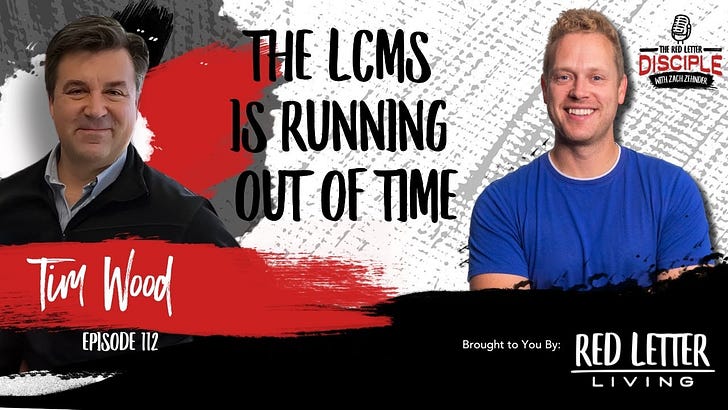
Unfortunately, several of Wood’s positions were misstated, overstated, or reframed in ways that materially altered their meaning, and it is necessary to correct the record.
If continued dialogue between the LCMS poles is to be meaningful, arguments must be engaged as they are actually made, rather than what is convenient to build a political plank.
Wood Does Not “Represent the Synod”
A recurring suggestion in the Popovits interview is that Tim Wood’s views hold institutional authority; that they represent “Synod leadership,” “the establishment,” or a coordinated synodical stance on pastoral formation.
That claim is false.
Wood holds a single board-elected position within the LCMS: he serves as a Regent of Concordia Seminary, St. Louis (CSL). He does not sit on multiple boards. He does not serve in synodical administration. He does not set policy for the Synod, districts, or seminaries. He does not speak for the Council of Presidents, the Praesidium, or any commission.
A regent has no ability to exercise unilateral authority because they are fiduciaries, not executives. They do not directly determine admissions policy, degree pathways, or synod-wide pastoral formation standards. Individual Regents speak only for themselves unless explicitly authorized and designated as spokesmen.
Wood has repeatedly stated, publicly and unambiguously, that his views are his own and do not represent Concordia Seminary, nor the LCMS, and that they cannot be authoritative in any executive or policy sense.
Suggesting otherwise is not just a different interpretation. Unless a board member explicitly states that he or she is an authorized spokesman for an institution, there is no reason to infer that he or she is setting forth an official position. Indeed, it’s a fundamental misunderstanding of how the LCMS polity actually functions.
More pointedly, the idea that Wood is a mouthpiece of “the establishment” falls apart with minimal scrutiny. Across the synodical Venn diagram, Wood is often seen as too pugnacious and an institutional inconvenience, which is hardly the profile of a managed mouthpiece.
Using Wood’s board membership to inflate his authority while ignoring the actual limits of that role serves a rhetorical or political purpose rather than a factual one, which is the root cause of several misleading statements by Popovits.
“Fewer Pastors”
Closely related to the executive inflation problem is a second misrepresentation: the claim that Wood advocates reducing the number of pastors as a policy preference or ideological aim.
That is also false.
Wood’s statements about reducing the size of the pastorate arise entirely within a diagnostic reality, not a programmatic one. The argument for a pastor surplus rather than the claimed pastor shortage is straightforward and evidence-based, but is understandably very uncomfortable for insiders.
LCMS average weekly attendance has declined by more than half in a quarter century.
The number of rostered pastors has remained essentially unchanged over the same period.
Therefore, the pastor-to-parishioner ratio has radically degraded, reducing the workload per pastor and generating a substantial surplus of pastors, but a variety of means heavily camouflages this surplus.
The number of active pastors per congregation has increased 10% in 20 years!
It is undeniable that the LCMS is in a severe and persistent structural crisis.
From this, we can conclude what many would prefer not to face: the current size of the pastorate is unsustainable relative to the number of active parishioners. That is not a demand; it is a statistical reality.
Wood does not argue that pastors are unnecessary, unwanted, or expendable. Nor does he advocate arbitrary cuts. However, structural denial, pretending that the Synod can sustain or even increase late-20th-century staffing levels with early-21st-century attendance, is a refusal to face reality.
When Wood speaks of “shrinking” the pastorate, he does so in the context of:
Congregation closures and consolidations.
Vacant calls caused by economic infeasibility, not a manpower shortage.
Retired pastors propping up nonviable congregations.
Pastors functionally serve many fewer people than in prior generations. The nature of the work is unchanged, so how is the lost parish productivity being accounted for? Much reduced inflation-adjusted wages? Bivocational side hustles? Asset sales/stripping (e.g., selling parsonages)?
This is why Wood repeatedly emphasizes that “we do not have a pastor shortage; we have a parishioner shortage.” That statement is simply descriptive, not accusatory or punitive.
Extracting the phrase “reduce the number of pastors” from this context and presenting it as an independent goal, especially one supposedly supported by “Synod leadership”, is a clear misrepresentation.
Critiques of the SMP Program Are Structural, Not Personal or Moral
Tim Wood’s critique of the SMP program does not question the faith, calling, or legitimacy of those who choose this path to ministry. He acknowledges that SMP can address real needs in rare cases and agrees that mission contexts matter.
What he argues, clearly and repeatedly, is that the program has been structurally abused and misused, particularly in settings for which it was never intended:
Large, well-funded congregations.
Wealthy churches in urban areas.
Senior or sole pastor roles.
Churches that could easily hire pastors with traditional training.
Wood is less concerned about whether the program has produced good results and more about whether its design and incentives are causing problems. These include uneven training, a group of pastors seen as second-class (with gaps in Greek and Hebrew, unable to serve in Synodical roles, and so on), inconsistent practices, and unfair job dynamics that hurt pastors who finished full residential training and want ministry as their main career, not a side job.
Popovits does not say what the limits should be for alternate track pastors. Because of the ongoing structural crisis in the LCMS, this likely means that within twenty-five years, most pastors will have alternate track qualifications.
“Circular Logic”
Wood is described as claiming that many LCMS pastors have not led their congregations well, blaming this on seminary training. He is also said to suggest that the answer is to remove alternative programs like SMP and rely more on residential seminaries. This framing makes the argument seem inconsistent, since seminaries are blamed for problems but also offered as the solution.
However, this is not an accurate summary of Wood’s actual position.
Wood did not say that “most pastors are inept” or criticize seminaries for turning out ineffective pastors. Instead, his concerns focus on institutions, not individuals. He points to a lack of real accountability, a gap between training and the needs of today’s congregations, and a weakening of shared church culture, especially in worship and practice. His doubts about SMP come from these issues, not from thinking that seminaries have failed and need more power.
So, the disagreement is not about whether pastors are faithful or able. Instead, it is a practical debate about how the church should seek unity, training, and renewal. Wood wants more uniformity and centralized training as safeguards, while Popovitz prefers flexibility and different paths based on local needs.
Turning this disagreement into a claim that one side thinks “most pastors are failures” misses the real point and makes the debate more divisive. The real issue is not about the value of pastors, but about church structures, incentives, and whether making current systems less strict can realistically improve results.
“Inept”
Perhaps the most serious distortion in the Popovits interview is the implication that Tim Wood regards LCMS pastors as inept and that his criticisms amount to a sweeping condemnation of the clergy.
That suggestion is also false.
Wood has never said that pastors are usually ineffective, unqualified, or incapable. He does not claim that pastors lack intelligence, training, sincerity, or a true calling. He also does not blame the Synod’s decline on laziness or personal failure by individual pastors.
Wood’s main point is about the system, not individuals. He argues that the LCMS has seen a major drop in attendance, teaching, and confidence in the Bible, even as it keeps or grows its number of pastors and church staff. Because of this, he believes something in the way pastors are trained, assigned, supported, and reviewed is not working. There is also a clear spiritual side to this problem, which has led many people to leave the LCMS for other churches or to stop attending altogether.
In other fields like education, medicine, engineering, or business, this kind of poor performance would lead to tough questions about training, motivation, accountability, leadership, and why people are leaving.
Raising questions about what we can see happening is not an insult to those involved. It is a call to act and respond urgently instead of giving in to apathy or hopelessness.
Wood’s criticism is not about incompetence. He believes pastors are important, but the quality of those serving needs to improve to address the drop in membership and attendance, aside from demographic changes within the Synod.
Pastors can do a lot of good or harm. This shows respect for the role, not a lack of care. The position is too important to accept mediocrity, complacency, or just protecting the institution.
Failure does not always mean someone is inept, though sometimes it does. Both can be true: a faithful pastor can work hard in a broken system and still see decline. The Bible shows this with the prophets, judges, and apostles. Still, when the number of pastors grows while fewer people attend, it clearly signals a serious problem.
When Wood says pastors must take responsibility for the decline, he is not insulting them. He is calling for professional responsibility. Taking ownership shows respect, not contempt.
Wood’s position, clearly and repeatedly stated, is as follows:
The LCMS is experiencing a historic collapse.
The collapse cannot be explained away by demographics alone.
Pastors and institutions must reckon honestly with that reality.
Formation, discipline, deployment, and accountability are all implicated.
Without such reckoning, no pathway, SMP or otherwise, will reverse the decline.
We cannot pretend that the LCMS is not in the vice grip of a spiritual crisis that has caused hundreds of thousands of souls to exit the Synod. We are entirely dishonest with ourselves if we pretend that the Synod’s fall into propositional Lutheranism is not a central problem.
Conditional Objections vs Absolute Rejections
In the Popovits interview, Wood’s position is often described as if he is completely opposed to SMPs, church planting, or contextual ministry.
This is not true.
Wood clearly supports SMPs in situations that are truly uncallable or remote, where it is not possible to send a traditionally trained pastor. His concern is that there are no clear limits when ‘local context’ is used as a reason for everything. If pastors trained for one local context often end up serving in very different places, the reasoning does not hold up. Also, the idea that most pastors should be highly specialized for a local context was never really discussed. Instead, the conversation shifted to defending against arguments Wood did not actually make.
The main problem is that supporters of the alternate track have not explained what the limits are for non-residential training. Alternate track training is not ruled out, but we need to understand how far it will extend in their design.
Power and Elections
Wood does not claim that ‘missional’ or large churches are being silenced by an institutional conspiracy or a political power play. He clearly rejects that idea.
His explanation is simpler and less comfortable: synodical priorities have changed in response to election results. Influence in a representative church body shifts as voting patterns change. Losing control of the institution is not the same as being persecuted. In the Popovits interview, this difference was not clear. Frustration over having less influence was seen as exclusion, instead of as a result of elections. Wood’s real point, that this change was a reaction and not an act of malice, was ignored.
Conclusion: Charity Begins With Accuracy
The issue isn't whether SMP should exist, expand, shrink, or be restructured. Honest debate and faithful representation of other positions is the real question.
Tim Wood’s arguments may be judged right or wrong. But they should at least be judged as they are, not as they are rhetorically convenient to portray. If the LCMS is to maintain dialog, navigate hard questions about formation, mission, fidelity, and spiritual drift, it will not do so by setting up straw men to burn for a baying crowd.
Careful listening and understanding are important, even when the diagnosis is difficult. The truth warrants that much kindness.
Good summary in the spirit of “concord.” Defining the issues in terms of language and clearly articulating the various positions without resorting to ad hominem is the Formula’s pathway to concord. Misrepresentations and caricaturizations are the unfortunate hallmark of the ordo politicus and have no place in the ordo ecclesiasticus.
I worked in Walmart management for two decades. The similarities between pastors/congregations data and store managers/stores data is downright weird to me (as well as other similarities).
The good store managers wanted the bigger stores that have better pay and bonuses. Troubled stores got new managers, that ate them up and spit them out. Then in the 2000s corporate realized they had to highly incentivize the urban troubled stores to bring the right manager over to it. It was only then troubles were fixed.
The problem is the stark difference I see between the corporate world and denominational church governance structures. Corporate change is much faster when it was needed to “save” a dying store. You did it, or you didn’t have a job.
I understand the need to patient with God’s growth in the church, but many times I feel like we are claiming “patience” but sometimes it’s combined with pastoral laziness. Yeah I said it. Get off your butts, men.
I guess I should write an article of my own.
Good article, AC.