
Masculine vs Feminine Coding in LCMS Regions and Districts
A data-driven look at why “keeping the conversation going” cannot bridge the Synod's linguistic divide that manifests in doctrine and praxis.

The Lutheran Church—Missouri Synod (LCMS) is a single church body with a well-defined theology, but the linguistic cultures of its districts vary radically. How a district discusses its work (what it emphasizes, how it describes ministry, and the tone it sets when defining its identity) reveals its instincts and priorities. These linguistic habits are not accidental, and they influence how districts approach doctrine, mission, conflict, and institutional life.
This attempt to map a linguistic analysis of masculine and feminine coding to the districts relies on the narrative and descriptive sections of every district’s (except New England - nothing at all online) convention reports, workbooks, overtures, and presidential reports. It uses a fixed rubric to identify two contrasting families of linguistic patterns. One is more declarative, doctrinal, and boundary-conscious; the other is more therapeutic, relational, narrative, and emotionally expressive. These categories are descriptive, not moral or theological. They cannot evaluate doctrine itself, but they do generally reveal the posture with which doctrine is handled and transmitted.
The average LCMS pastor and Synodocrat would probably guess the results for each district without needing any analysis. The only surprises are the Minnesota North District and the Atlantic District, which are more masculine than their reputations.
The linguistic divides in the LCMS are not just aesthetic, but structural barriers to authentic institutional fellowship. Individuals can sometimes bridge such differences in personal conversation, where love, goodwill, and patience make up for where language fails. However, institutions cannot do that. Synodical fellowship requires not only formal doctrinal agreement but a shared rhetorical scaffolding. There has to be a common way of speaking about doctrine, guarding it, correcting error, and transmitting it. When districts operate in fundamentally different linguistic registers, one boundary-conscious and declarative, the other relational and narrative-driven, the gap cannot be reconciled simply by “continuing the conversation” because the conversation itself proceeds in incompatible modes, like trying to plug a USB-B cable into a USB-C port. In a church body where doctrinal fidelity is essential to its essence and existence, linguistic divergence is a massive impediment to fellowship.
Methodology
This analysis does not evaluate doctrine itself, but examines the language districts use when describing their work. Every district workbook, president’s report, overture set, and set of adopted resolutions was reviewed, and only the narrative and descriptive portions of the text were analyzed. All procedural material, such as orders of business, parliamentary language, voting procedures, bylaws citations, statistical tables, and so on, was excluded. The goal was to evaluate tone, not mechanics and procedure.
Each district’s narrative content was evaluated, using OpenAI, with the fixed rubric below, which measures the relative presence of two families of linguistic features. “Masculine-coded” language refers to declarative, doctrinal, propositional, and boundary-maintaining speech. “Feminine-coded” language refers to relational, narrative, emotionally expressive, and collaboratively framed speech. They are categories on a normal distribution, not an either/or divide. They simply describe two recognizable rhetorical postures that appear consistently in the district documents.
The rubric was applied uniformly across all districts using the same criteria. The analysis did not treat doctrinal content as “masculine” nor relational content as “feminine.” Instead, it measured how districts speak, such as whether they front-load doctrinal clarity or relational narrative, whether they frame ministry in terms of oversight or accompaniment, and whether their default tone tends toward formal authority or emotional connection. Because institutional posture is most clearly revealed in linguistic habits, these patterns do serve as a helpful proxy for understanding each district’s orientation toward doctrinal steadfastness or doctrinal softening, without ever claiming to measure doctrinal adherence itself.
To reflect the real size and influence of each district, congregation counts were incorporated to produce a weighted national average. This allows the linguistic culture of large districts, especially in Texas, the Pacific Southwest, and Florida-Georgia, to be adequately represented in the national picture. The weighted analysis confirms that linguistic tone is not randomly distributed but clusters regionally, revealing meaningful differences in how districts articulate their identity and work.
Evaluation Rubric
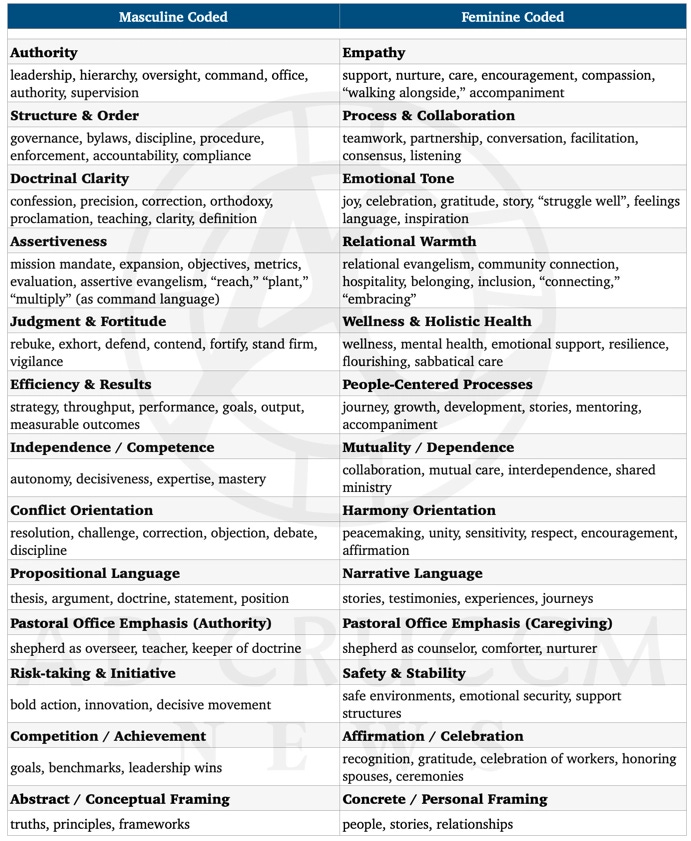
Regional Results
The congregation-weighted national masculine/feminine score is 4.4, but the LCMS Inc.’s “national tone” is 3.9 (based on the proceedings of the 2023 National Convention, 1 = very masculine; 10 = very feminine). Consequently, the LCMS center of doctrine is firmer than the linguistic proxy of many of its largest districts. That division illustrates most clearly the tension in the Synod between ‘missionals’ and ‘confessionals’, and why it is going to get worse rather than better.
District Results
The district distribution is bimodal with two clusters emerging: a soft, narrative-driven linguistic culture in the East–Southeast and West–Southwest, and a firm, doctrinally defined linguistic culture in the Great Plains and Great Lakes. The LCMS ‘National Voice’ aligns more with the latter, not the former. That is not surprising given the tilt of the Synod as reflected in successive National Convention election outcomes.
Conclusion
The results confirm what many know anecdotally: the LCMS does not speak with a common register. Its districts inhabit markedly different linguistic cultures, and these cultures reflect deep fractures in their posture toward doctrine, conflict, authority, and ministry. Masculine-coded districts articulate their work in a declarative, doctrinal, and boundary-conscious register. Feminine-coded districts speak primarily in narrative, relational, and emotionally expressive terms. Those are not superficial stylistic preferences, but tokens of fundamentally different instincts about what the church is, how it should speak, and how doctrine should function and be expressed in its life together.
Such differences can be managed in personal relationships, where shared trust allows two people to navigate divergent linguistic frameworks that are ultimately quite hard coded to our biology (on a normal distribution). Institutions, however, cannot operate on relational elasticity. They require a common rhetorical frame for defining doctrine, adjudicating error, establishing oversight, and pursuing the Great Commission. When that shared frame is truncated or diluted, formal fellowship corrodes in fact and reality even if the formal symbols of the institution persists. Consequently, the LCMS is more a federation of districts that do not process theological or ecclesial questions in the same linguistic and cultural universe. To “keep talking” presumes a mutual vocabulary and a compatible instinct toward doctrinal reasoning, but the data demonstrates that that assumption is flawed.
Consequently, the aspiration to function as a fully unified church body in unambiguous fellowship is structurally inhibited by its internal diversity. When districts do not share a common way of speaking about doctrine and praxis, they do not share a common way of safeguarding and advancing it. In many ways, the linguistic gulf is a real measure of how fragile institutional fellowship really is.
The FL/GA is my district……and I didn’t need a report to know the FL/GA is the most effeminate district 😂😂😭
This is brilliant…everyone ignores types, even though they are universal and literally the most obvious thing in the world.
It sheds light on the problem, but also the solution. And what body is better equipped to properly unite these two inevitable priorities in a proper marriage than the church? Faith defines and devotes itself to love. Love receives everything from faith and supports it always.
Surely no institution is better equipped to understand the hierarchy and mutual respect necessary to a union between the masculine and feminine.
(…though some of these comments suggest otherwise.)