
Book Review: Ashes to Ashes by Rev. Dr. Christopher Thoma

Rev. Thoma’s book is well-written and enjoyable. I found myself eager to return to the story whenever I had to put it down, always a sign an author has struck the right note between content and escapism. The characters were believable and sympathetic, as was the story, unfortunately.
There are two things, however, I feel it is important to discuss concerning this book.
First, there is a particular political zeitgeist currently surrounding justice and punishment. Rev. Thoma’s book plays heavily into that climate.
*Read no further if you do not want the plot spoiled.*
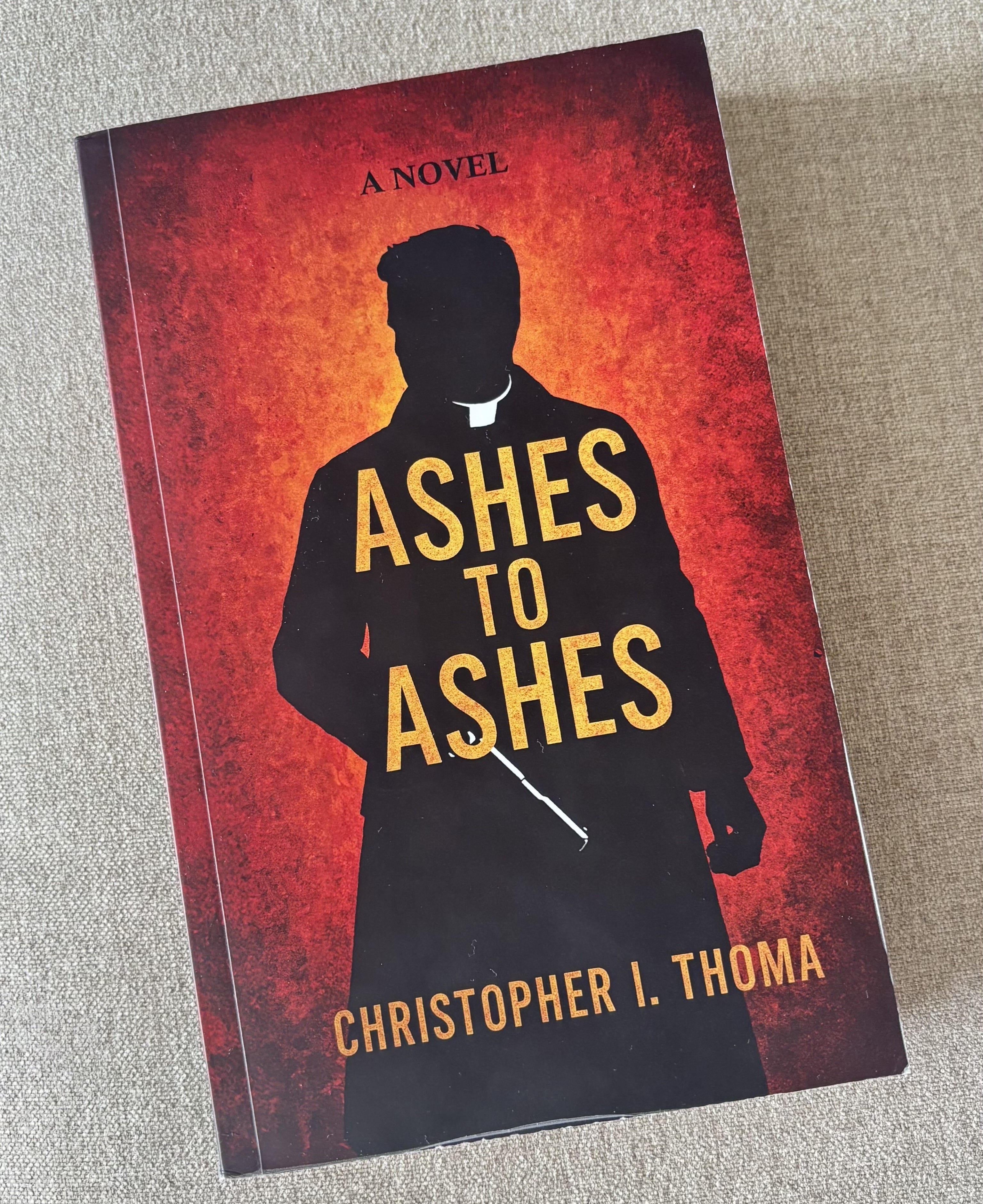
His story, which pits a small-town pastor against big-time underground sex-traffickers and rapists, reflects our times and, in an exaggerated way, our desires for a more just society. The main character, Reverend Daniel Michaels, takes the place of an avenger and a literal executor of justice when he discovers this ring of sex-traffickers and rapists operating in and around his small town. He has clear and substantial evidence of their misdeeds, so there is no doubt the perpetrators are guilty, but the reverend does not go to the authorities. He takes up the sword (in this case a gun he steals from one of his parishioners) and dispenses his idea of justice by killing each sex-trafficker and rapist he knows of or finds. After his first killing I was shocked. By the eighth, I expected it, all the while hoping he would stop, even though I was glad the evil criminals were dead. It was a confusing time for me.
Part of me appreciated that this story would not be some long legal drama where the criminals figure out a way to cheat the system while the good guy furiously but futilely fights against them (that would be a more accurate picture, it seems to me). Instead, evil is simply destroyed. That’s the zeitgeist working its magic. We have had so many examples recently of criminality not only going unpunished by our justice system but, in some cases, lauded. In that way, this book was somewhat cathartic to read.
However, the other part of me was disappointed the authorities never even had the chance to do what was right because the main character took over for them. To me, Reverend Michaels was somewhat of an anti-hero, a character I wanted to like and hoped would win, but who was not himself moral. Was what he did right? There is not a lot of discussion of the morality of his actions within the story, but he gets away in the end, and all the bad guys are dead, which would seem to indicate the reader ought to feel that good won the day.
So, as a tale of ‘evil gets destroyed,’ I enjoyed it. As an example of how right or wrong the actions of a vigilante are, especially a Christian vigilante who is commanded to obey authorities and not to murder, it left something to be desired.
The second thing I want to discuss, and a point in Rev. Thoma’s favor, is that this is not a typical Christian book. Sadly, I have tried to read Christian fiction in the past and been not at all impressed. To put it succinctly, I must have a big glass of ‘whine’ to go with all the ‘cheese’ in Christian fiction.
Unlike that cheesy genre, Rev. Thoma’s characters are not one-hundred percent evil nor one-hundred percent good. His plot, as I complained above, does not shove a moral or Biblical lesson down your throat with all the grace of competitors shoveling food into their mouths at a hot-dog eating contest. They say you should write what you know, and obviously, Rev. Thoma wrote from that perspective. It served him well, because he did not have to shove his characters into Christian costumes or make their dialogue overtly Christian or make sure the story painted Christians in the best possible light. As I said above, his story was somewhat morally ambiguous, but the author is a Christian and because of this, you can tell the story is Christian without the added cheese.
Furthermore, his story is distinctly Lutheran. Not just because he and his characters are, but because he overtly discusses the forgiveness of sins and the role of a pastor, something most Christian authors of other denominations seem to be ignorant of. Rev. Thoma portrays the people as just normal, as sinners, both the bad and good guys, which is refreshing.
So, despite my moral qualms concerning his book, I would happily recommend it to my friends and family. It’s sure to start a lively discussion.
(Deaconess Camille Cox has joined our Ad Crucem team, she is helping us with the editing of our books, and is truly a Godsend!)
 | A guest post by
|
The implicit suggestion there is deeply troubling: that we should reject the Lutheran (and Scriptural) Two Kingdoms view. We know that in this world, sometimes evil needs to be opposed by force by those who hold the vocations to do that. Luther writes that it's for good reason that civil authorities bear a sword, not a bouquet of roses, to do their job. But that is not the vocation of a pastor!
Some of the best fiction is the most provocative and ambiguous. A violently transgressive pastor that then wrestles with his sin, with grace, and ultimately comes to repentance could be pretty powerful. A pastoral version of Crime and Punishment, if you will. But if his vigilantism and violence are celebrated, rather than repented, that is highly problematic and a very anti-Scriptural picture of what pastoral ministry means.
I do think the sequel actually is supposed to get into more of the main character’s own moral dilemma as Thoma pointed to this in a Facebook post. I loved it as a quality form of entertainment that was thought-provoking. It is, of course, just that and I’d caution people against creating meaning that isn’t necessarily in the text itself. It is just worth noting that the “something to be desired” may soon be addressed as I’m fairly certain he is working on a sequel. And a movie I cannot wait to see. The story reminded me a lot of Lee Child Reacher stories.