
A Simple Way to Understand the CMPL Issue
Pastoral formation is about more than achieving academic competence.

The Center for Missional & Pastoral Leadership (CMPL) aims to divert prospective M.Div. students away from the Synod’s seminaries. It insists that a virtually trained pastor is not only a cheaper production unit, but will compete pound-for-pound with a residentially formed man.
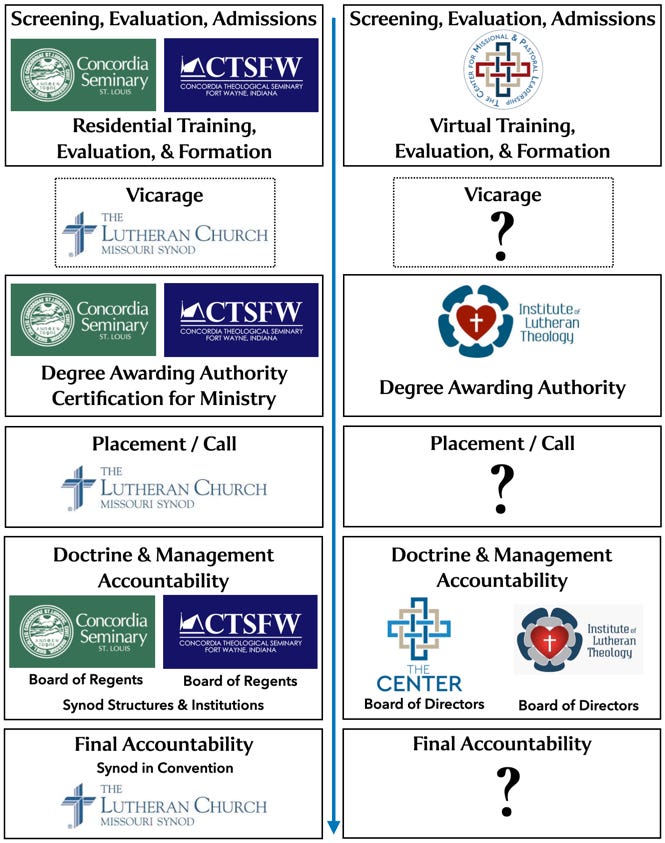
That’s an eyebrow-raising notion, but the issue is deeper than mere academic competence. Before we discuss academic catalogs and faculty qualifications, let’s consider governance structures and lines of accountability. As imperfect as the LCMS is, it has unambiguous mechanisms and procedures to address problems and advance what is best. It has scaffolded governance that overlaps in a dozen places.
However, the CMPL has no comparable safety nets that are ultimately needed to protect the sheep more than the shepherds. The CMPL is accountable to the Center's Board of Directors, which has no external election mechanism. The board’s profile exclusively represents the LCMS’s “Missional” faction.
The CMPL’s degrees will be awarded through the Institute of Lutheran Theology (ILT), whose board of directors is heavily skewed in representation from the Lutheran Church in Mission for Christ (LCMC), which is not in altar and pulpit fellowship with the LCMS.
It’s not a trivial paradox for the CMPL to rely on ILT to award its degrees, and with the stated desire to place graduates in LCMS congregations. We couldn't care less if CMPL graduates go to LCMC or ELCA congregations, but straightforward discussions about LCMS members' affiliations with The Center and CMPL would be required if that were the case. It will be intolerable for Synod members to deliberately enable men (and women?) to be called to heterodox assemblies.
Where does the CMPL's final accountability lie? Apparently, in some melange of incongruous fellowship between The Center and ILT, but it is entirely opaque.
See also:
☩TW☩
Who would go to a heart surgeon with good “ book learning” who had no supervised residential training ??
"As imperfect as the LCMS is, it has unambiguous mechanisms and procedures to address problems and advance what is best. It has scaffolded governance that overlaps in a dozen places."
I eagerly await these addresses and advancements.